Showing posts with label USV. Show all posts

01 July 2017

News Story: Singapore's armed forces to reorganize for terror threat

SINGAPORE, June 30 (Xinhua) -- Singapore Armed Forces (SAF) has to reorganize to respond to terrorism threat, said Defense Minister Ng Eng Hen at the SAF Day Interview.

"Now the reorganization occurs at a backdrop of changing assumptions, in which attacks that could occur in Singapore may increase in scale, frequency and impact," the minister told media earlier this week.

He said the SAF will train more National Servicemen to deal with homeland security and will open a dedicated training institution called the Island Defense Training Institute (IDTI) in July, which has a mission to train National Servicemen to conduct joint operations with the Home Team.

Each year, about 18,000 full-time and operationally ready National Servicemen will be trained for capabilities for homeland security, he added.

Read the full story at Xinhua

04 April 2017

Think Tank: Sea, air, land and space updates (4-Apr-2017)

Zoe Glasson, Sophie Qin, Madeleine Nyst and Patrick Kennedy

Sea State

Indonesia is continuing with its program of literally blowing up illegal fishing boats in its waters. On Saturday, authorities simultaneously destroyed 81 foreign vessels at 12 different locations, in what Maritime and Fisheries Minister Susi Pudjiastuti called ‘a victory for Indonesia’s war against illegal fishing’. Since ramping up its anti-poaching efforts in 2014, Indonesia’s special maritime task force Satgas 115 has captured 317 illegal boats, primarily from Vietnam, the Philippines and Malaysia; all have been confiscated and destroyed. The Indonesian government has linked the crackdown with its plan to revive its fisheries industry and re-establish itself as a maritime power.

Israeli defence electronics firm Elbit Systems has completed operational testing of its Seagull Unmanned Surface Vessel. The Seagull can carry out underwater mine hunting and clearing, as well as anti-diver and anti-submarine missions, enabling navies to use a single platform (with interchangeable modules) for different purposes. Its strategic value isn’t bad either—according to the brochure, Seagull’s ASW capability ‘returns the asymmetric advantage’ to those seeking to counter threats from terrorists, who are increasingly using midget submarines to target bigger and more powerful forces.

Ever heard of Project Combo? If not, you can read all about the US Navy’s Cold War plan to develop a secret communication system by mimicking sea mammal noises here.

21 February 2017

Think Tank: Sea, air, land and space updates (21-Feb-2017)

Zoe Glasson, Sophie Qin, Madeleine Nyst and Patrick Kennedy

Sea State

There’s been an alarming update on 30 January’s Saudi frigate attack by Houthi rebels. Initially believed to be a suicide boat attack, the US Navy declared on 18 February that it was in fact carried out by ‘an unmanned, remote-controlled boat of some kind’—what DefenseNews is calling a ‘drone boat’. This raises serious concerns about the source of the Houthi’s foreign assistance—the US is pointing the finger at Iran—and is further indication that Yemen’s conflict is spreading offshore, something that hasn’t previously occurred in 15 years of fighting in the Middle East.

Reports suggest that Japan is intending to speed up its warship construction, from one 5,000-ton class destroyer to two 3,000-ton class ships per year. Commentators are attributing this upscale to Japan’s need to patrol the East China Sea around the disputed Senkaku/Diaoyu islands in order to curb China’s aggression in what Japan perceives to be its sovereign territory—and put an end, for instance, to incidents like this. An 8-strong fleet of the new ships at a lower cost will allow Japan to increase its naval reach; it’s also expected to boost the JMSDF’s mine-sweeping and anti-submarine capabilities.

Finally, read about the incredible science behind launching an underwater missile and why submarines sometimes use the stars to navigate (bonus: sweet video of a pin-wheeling missile).

14 February 2017

News Story: Alternative Navy Study Bets Big On Robot PT Boats & LCS

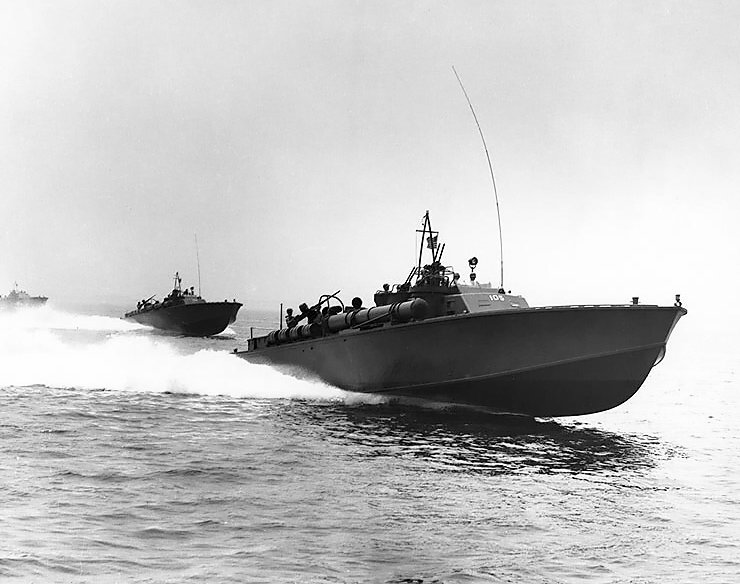
US Navy WWII PT boats underway (Image: Wiki Commons)
By SYDNEY J. FREEDBERG JR.

WASHINGTON: Light carriers. Robot PT boats. Unmanned subs. A congressionally chartered study, the Alternative Future Fleet Platform Architecture Study, “does not represent any official Navy position,” but offers a surprisingly bold vision for the future of the US Navy.

The study, by a “Navy Project Team” of officers, civil servants, and contractors free to brainstorm without being “constrained” by the service’s official plans, calls for a future “battle force” of 321 manned ships. That’s 10 percent smaller than the official Navy program for 355, let alone the parallel studies Congress commissioned from thinktanks CSBA, which calls for 340 manned ships, and MITRE for 414. But while the official 30-year shipbuilding plan submitted to Congress in 2017 only includes 10 large, seagoing unmanned vessels, and CSBA proposes 80, the Alternative Future Fleet would include 138.

That would be a mix of 48 unmanned underwater vessels — designed to supplement traditional nuclear-powered attack submarines — and a whopping 88 unmanned fast attack boats, derived from the Mark V Special Operations vessel or the Mark VI patrol craft. (A Coast Guard patrol boat is a third option). Instead of developing a new purpose-built unmanned boat, like DARPA’s Sea Hunter, this approach would build on ongoing Navy experiments with converting standard small craft for unmanned operations. They’d be launched from shore bases or from the well decks of amphibious assault ships normally used to transport Marines. The Alternative Future Fleet vessels would be about the 80-foot length of World War II Patrol Torpedo boats (remember PT-109?), and like the PT boats, they’d be armed to attack much larger vessels, with “anti-ship cruise missiles, mines or torpedoes with an operating range in the hundreds of nautical miles.”

The PT boats suffered heavy casualties in World War II, and the modern Navy has eschewed such well-armed but fragile small craft. Countries more callous about casualties, such as Iran, have embraced them. Making the expendable attack boats unmanned might make them palatable to the Navy.

Read the full story at BreakingDefense

11 February 2017

News Story: Big Wars, Small Ships - CSBA’s Alternative Navy

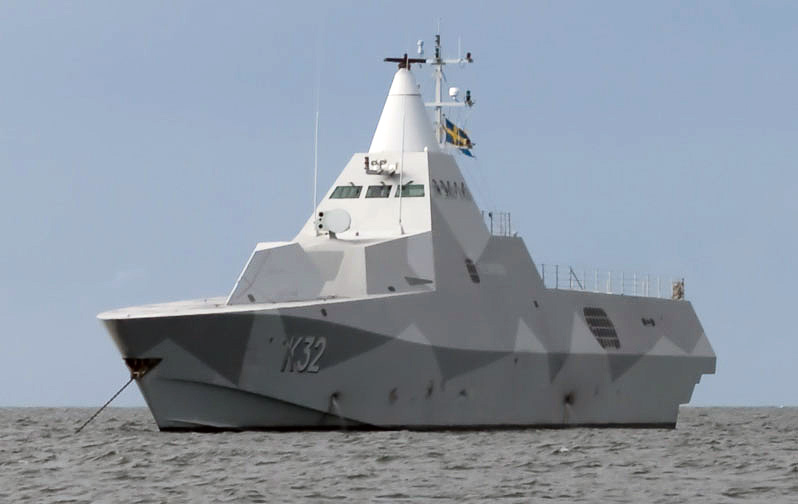
Visby class Corvette (Image: Wiki Commons)
UPDATED with McCain praise WASHINGTON: The Navy needs a bigger fleet of smaller ships than envisioned in its official Force Structure Assessment, says a congressionally-chartered study from the Center for Strategic & Budgetary Assessments.

CSBA emphatically agrees with the Navy that the focus needs to shift from day-to-day counter-terrorism and presence operations to deterring (and if need be, fighting) major wars. Both plans call for a steep increase in attack submarines from 55 today to 66, along 12 nuclear-missile submarines. But CSBA recommends distinctly different surface fleet — one with many similarities to proposals from Senate Armed Services chairman John McCain.

[UPDATE: “I am particularly impressed with the comprehensiveness of the CSBA study, which should serve as the starting point for the new administration’s review of naval forces,” McCain said Friday, praising CSBA’s work out above two other “impressive” congressional chartered studies, one from thinktank MITRE and the other from a Navy team.

“It proposes necessary new strategic, operational, basing, and force structure recommendations that deserve immediate consideration by Navy leaders,” McCain said of the CSBA paper. “My recent white paper ‘Restoring American Power’ has much in common with these studies and recommendations. The question now is what tangible steps Navy leaders will take to turn these recommendations into reality.”

Read the full story at Breaking Defense

19 January 2017

News Story: Gangs of US Navy "Killer" Boats Will Roam the Seas

Protector USV
by Scott N. Romaniuk

What have been appositely referred to as the "military's smartest toys," robot boats have just become a lot smarter, and so has the US Navy.

It has taken the US government some time, but its team of researchers and developers have begun to discover the effectiveness of swarming by means of autonomous boats - Unmanned Surface Vehicles (USVs) or Autonomous Surface Craft (ASCs). The Office of Naval Research (ONR) is committed to the idea of robot boats and the impact they can have in both defensive and offensive contexts at home and abroad.

A swarm of robot made debuted in Virginia's James River approximately two years ago, and in the final weeks of 2016, the ONR put on another show with its small boats in the Chesapeake Bay estuary, near Washington, DC.

The second demonstration showcased better thinking by the ONR and its autonomous systems, which not only performed well individually, they also demonstrated their capacity to swarm as a coherent unit against a potential enemy while maintaining an intricate information relay system.

Using sophisticated software called, Control Architecture for Robotic Agent Command and Sensing (CARACaS), the USN's Rigid Hull Inflatable Boats (RHIBs) processed data about the potential threat in US waters and responded as if they had a life of their own. The USN's advanced robot boats deftly demonstrated the essence of swarming, much like a flock of hyenas in the presence of a gazelle or lion.

Read the full story at SpaceWar

24 October 2016

News Story: (US) Marines want new technologies to take enemy beaches

By: Jeff Schogol

Modern weapons can destroy ships and landing craft many miles from shore, forcing the Marine Corps to turn to new technologies to ensure Marines can land in force on enemy coasts.  

That's why a new task force is looking at everything from drone boats to electronic deception to get Marine raiders and landing teams safely ashore. 

The task force’s goal is to find existing systems to exploit gaps in enemy defenses, allowing Marine amphibious vehicles to get from ship to shore, said Maj. Jim Foley, of the Marine Corps’ Ellis Group, an internal think tank that explores future warfighting scenarios. 

“We’re going to have potentially different vehicles, but we’re going to enable them to get to the shore because we’re going to have more effective en route fire support,” Foley told Marine Corps Times. “We’re going to allow commanders to make better decisions because we’re looking at technologies that will support their command and control ability during those operations — and information warfare capabilities that will support that.” 

Industry, academia and government think tanks will show what technologies they have that meet the Marine Corps’ needs next April at Camp Pendleton, California, Foley said. The task force then hopes to allow Marines to drive those technologies in an amphibious exercise that fall. 

Read the full story at Marine Corps Times

29 September 2016

News Story: Singapore arranges more patrol ships to fight terrorism

An existing patrol boat of the Police Coast Guard
(Image: Wiki Commons)
Singapore (VNA) – Singapore’s Police Coast Guard have been equipped with two new patrol boats that will aid the force’s fight against maritime crime and counter-terrorism capabilities.

According to the Singapore Police Force (SPF), the ships will support the police's overall security operations when major events are staged at the Marina Reservoir in the Marina Bay.

The Police Coast Guard will also use the ships to carry out security operations along the Singapore River, the Kallang Basin at the Marina Reservoir during Parliament sittings, said SPF. 

Read the full story at VietnamPlus

07 April 2016

News Story: U.S. Navy's new unmanned sub-hunter to hit the seas this month

by Carlo Munoz

The U.S. Navy's newest sub-hunting maritime drone successfully completed preliminary speed and maneuverability testing in preparation for its christening into the fleet this month.

A technology demonstration version of the Anti-Submarine Warfare (ASW) Continuous Trail Unmanned Vessel, or ACTUV, completed the open water drills near Portland, Ore., according to a Defense Department fact sheet.

Program officials from the Defense Advanced Research Projects Agency and defense technology firm Leidos are spearheading development of the ACTUV. During the Portland tests, the ship was able to reach a top speed of 27 knots, or 31 miles per hour.

"The ACTUV doesn't just answer one of the biggest challenges the Navy faces today. It launches an entirely new class of unmanned vessel with vast possibilities for the future," according to a company statement.

Read the full story at SpaceWar

16 March 2016

Think Tank: DWP 2016 - unmanned systems and the future ADF

MQ-9 Reaper
James Mugg

The 2016 Defence White Paper mentions ‘unmanned’ systems 15 times. The accompanying Integrated Investment Plan (IIP) [pdf] has 39 references. The government has clear ambitions to purchase UAVs for maritime surveillance and airborne strike, with unmanned systems for other roles evidently under consideration.

Starting with the most assured acquisition, the Triton maritime surveillance UAV has been under consideration for at least three years. The unarmed Triton will provide a high-altitude, high-endurance maritime surveillance capability in concert with the incoming (manned) P-8 Poseidon fleet and other assets. The RAAF is expected to acquire the Tritons from the early 2020s.

As has been flagged previously, the government will also seek to acquire a number of armed reconnaissance UAVs for the Army by the early 2020s. The IIP outlines a plan to acquire ‘armed intelligence, surveillance and reconnaissance unmanned aircraft’ between 2018 and 2038 in Table 8. Until now, Australia has only operated unarmed UAVs like the RQ-7B Shadow, although ADF personnel have been training on US Air Force MQ-9B Reaper armed UAVs for at least a year. A purchase of something like the Reaper is a likely outcome.

12 February 2016

Editorial: World’s Largest Anti-Submarine Robot Ship Ready for Sea-Trials in April

By Franz-Stefan Gady

The U.S. Navy’s largest unmanned surface vehicle designed to track Chinese and Russian subs will be christened in April.

The Pentagon’s Advanced Research Projects Agency (DARPA), an agency responsible for developing and testing cutting-edge military technologies, will test-launch the prototype of its 140-ton Anti-Submarine Warfare Continuous Trail Unmanned Vessel (ACTUV), named Sea Hunter, in April this year, the deputy director of DARPA, Steve Walker, said, according to National Defense Magazine.

The 132-feet (40 meters) long Sea Hunter, an unmanned autonomous trimaran, will be christened in April 2016 at the Vigor Shipyards in Oregon and immediately afterwards commence sea-trials for 18 months to test its long-range tracking capabilities, among a host of other things. During the testing DARPA will closely cooperate with the Office of Naval Research and the Space and Naval Systems Warfare Command.

The ship’s primary mission will be tracking enemy subs in shallow waters, I noted in June 2015 (See: “US Navy to Deploy Robot Ships to Track Chinese and Russian Subs”). Furthermore, I explained that the ACTUV “is designed to operate autonomously for 60 to 90 days straight, surveil large stretches of ocean territory and — should an enemy sub be spotted — guide other U.S. naval assets to the vessel’s location to destroy it (the ACTUV itself is unarmed).”

“Imagine an unmanned surface vessel following all the laws of the sea on its own and operating with manned surface and unmanned underwater vehicles,” Walker told reporters during a briefing at DARPA headquarters in Arlington, Virginia on February 10. “We think the real cost savings will be in operating this vessel at sea compared to how we operate vessels today.”

Read the full story at The Diplomat

10 February 2016

News Story: (New Zealand) Drones an option to replace Orions

Nicholas Jone

Replacement alternatives are being considered for ageing aircraft due to be retired in mid-2020s.

The military is considering using unmanned drones to patrol waters surrounding New Zealand.

At present, six Orion aircraft provide airborne surveillance, support for customs and police operations, search and rescue missions and disaster relief.

Illegal fishing and drug smuggling need to be watched for in New Zealand's Exclusive Economic Zone (EEZ), which is the fourth largest in the world and 20 times the country's land mass.

The Defence Force's P-3K2 Orions, which normally have a crew of 12 and also provide surveillance in the Pacific and Southern Ocean, are due to be retired from service in the mid-2020s.

A Defence spokesman told the Herald that a project examining replacement options was under way.

"It is still in the early capability definition phase. Remotely piloted vehicles will be considered as part of the project, along with piloted and space-based systems."

Australia will supplement the replacement of its own Orions with up to seven MQ-4C Triton unmanned aerial vehicles (UAVs), which have been under development by the United States Navy.

The drones, made by American firm Northrop Grumman, have the wingspan of a small airliner, weigh nearly 15,000kg and and are able to fly for more than 24 hours at a time.

State-of-the-art sensors provide a 360-degree view of surrounds, for more than 2000 nautical miles.

Read the full story at New Zealand Herald

24 November 2015

Editorial: US Navy’s Prototype Robot Ship Gets New Sonar

By Franz-Stefan Gady

An autonomous vessel designed to track Chinese and Russian subs in shallow waters gets new sonar.

The prototype of a U.S. Navy robot ship was recently equipped with a new hull-mounted sonar system, IHS Defense Weekly reports.

The Anti-Submarine Warfare Continuous Trail Unmanned Vessel (ACTUV), received Raytheon’s Modular Scalable Sonar System (MS 3), which “will be integrated as the ACTUV’s primary search-and-detection sonar,” according to the article. The sonar system will produce an “acoustic image” of targets in order to identify and classify vessels in close proximity to the robot ship.

“Designed to autonomously conduct active and passive searches, detect torpedoes, filter passive threats, localize and track submarines, and avoid small objects, the MS 3 is Raytheon’s first fifth-generation medium-frequency hull-mounted sonar system,” IHS Defense Weekly explains.

The ACTUV is an unmanned autonomous trimaran designed by the U.S. Defense Advanced Research Projects Agency (DARPA), an agency responsible for developing emerging technologies for the military’s use. DARPA was tasked with developing an anti-submarine drone — a robot ship capable of tracking enemy subs in shallow waters in 2010.

Read the full story at The Diplomat

14 September 2015

AUS: Government invests $14 million in Defence technology

Seven Australian organisations will receive Australian Government funding of $14.2 million to develop and demonstrate innovative technologies that can enhance defence capability.

The funding is made available under the Capability and Demonstrator Program managed by the Defence Science and Technology Group.

Seven technology proposals from Australian companies, universities and science organisations have been selected this year to demonstrate possible defence application.

These proposals have the potential to advance Defence capability, produce innovative products for Defence and civilian use, and stimulate Australian industry growth.

08 October 2014

Industry: BAE SYSTEMS OFFERS A LOW-RISK SOLUTION TO ROYAL AUSTRALIAN NAVY MARITIME OPERATIONS

Atlas Elektronik SeaFox

Adelaide, Australia: BAE Systems has offered a low-risk solution to provide the Royal Australian Navy (RAN) with deployable mine counter measures.

The company has offered a mission system for the SEA 1778 request for tender, which incorporates products with proven overseas use that will be locally delivered and supported in Sydney.

Under the proposed solution, BAE Systems will maximise the use of off-the-shelf products for undertaking mine and obstacle detection, classification, identification, avoidance and neutralisation (where necessary).

BAE Systems Australia’s Director Land & Integrated Systems, Graeme Bent said, “Our solution will safeguard vessels and crew supporting the Australian Defence Force’s amphibious capabilities, headlined by the two new Landing Helicopter Docks currently being fitted out by BAE Systems in Williamstown, Victoria.