Showing posts with label SAAB. Show all posts

20 September 2017

News Report: Russia Pitches Aggresively For MiG-29K $12 Bn Indian Deal

A MiG-29K on the deck of INS Vikramaditya
Indian Navy had issued a detailed request for information in January this year for 57 multi-role fighter aircraft to which Russian, French, Swedish and American companies had replied with their intent.

New Delhi (Sputnik) — With an eye on a big ticket deal involving supply of 57 naval multi-role fighter jet for Indian Navy's aircraft carriers, Russian manufacturer MiG has offered to jointly develop the MiG 29 K fighter jets with an Indian counterpart under the 'Make in India' program with complete transfer of technology. MiG is planning to submit a detailed proposal to the Indian government in this regard soon.

The procurement plan currently is in request for information stage. MiG CEO Ilya Tarasenko has claimed MiG-29K aircraft have serious tactical and technical advantages compared to Boeing’s F/A-18.

“We are considering various options for long-term and perspective cooperation, including those within the framework of the Make in India program. The Indian side has sent an RFI to companies that produce aircraft, which is one of the procedures preceding the official tender. MiG corp. has received such a request, now we are preparing our proposal,” Ilya Tarasenko, MiG CEO told to PTI in a written interview.
09 September 2017

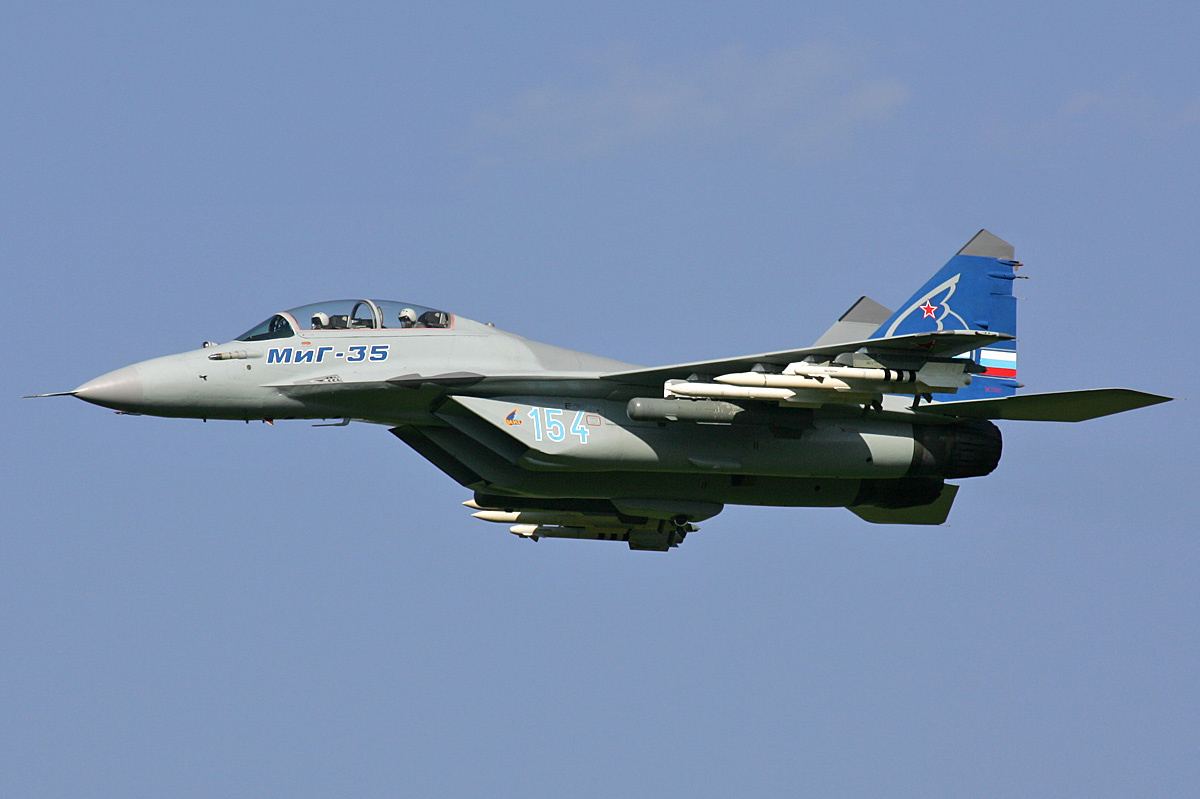
News Story: Russia Pitches MiG-35 to India as FGFA Project Falters

MiG-35 (Image: Wiki Commons)
by Neelam Mathews

As the contest to supply a new fighter aircraft to the Indian Air Force (IAF) heats up, the MiG-35 has emerged as a viable candidate. India is supposedly seeking about 220 single-engine fighters to replace 11 squadrons of MiG-21/27s that entered service in the 1990s.

Rosoboronexport is believed to have offered a licensed production deal for the twin-engine MiG-35 that would compensate for the IAF’s reluctance to proceed with the Indo-Russian Fifth Generation Fighter Aircraft (FGFA) project.

At the MAKS 2017 airshow in July, Ilya Tarasenko, director general of Russian Aircraft Corporation MiG, said: “We are actively working with the IAF in order to win the tender.” Russia has committed to a 40-year maintenance and upgrade contract to preclude the support issues that have arisen in the past with Russian aircraft in service with the IAF. Meanwhile, also at MAKS, Sergei Chemezov, CEO of the Rostec State Corporation, told reporters that a decision on the design and development of the FGFA would be made in the “nearest future.” He did not provide a timeline for the project, a version of Russia’s Sukhoi T-50, which has been under discussion between the two countries for the past decade.

According to an Indian defense official, “The MiG-35 is 25 percent cheaper [than rival candidates for the IAF requirement]; has an AESA radar; has commonality with the fleet; and being in the light to medium category enables it to land in the same airfields that the [indigenous] Light Combat Aircraft does. If the FGFA does not go through, Russia will have to be compensated, and this is the only contract left at the moment.” 

Read the full story at AINonline

02 September 2017

News Story: Saab, Adani Group forge partnership for India’s single-engine fighter

JAS-39 Gripen (Image: Wiki Commons)
By: Vivek Raghuvanshi 

NEW DELHI — Saab of Sweden and Indian infrastructure conglomerate Adani Group have forged a partnership to build Gripen E aircraft and work on other aerospace programs in the Asian country.

The Sept. 1 announcement means India’s single-engine fighter aircraft competition worth $12 billion is now shortlisted between the Saab-Adani partnership and Lockheed Martin of the U.S. in a tie-up with India’s Tata Advanced Systems Limited.

”The intended collaboration would encompass design, development and production of Gripen for India and other high-tech products of national importance for India and also the creation of joint ventures in India in line with and in support of the Make In India policy,” according to a Saab news release.

Lockheed Martin is pitching its F-16 Block 70 aircraft, whereas Saab is fielding the upgraded Gripen E in response to the expression of interest sent to select aerospace companies through foreign Indian embassies in November 2016.

“Our plans in India are to create a new defense eco-system that would involve many partners, vendors and suppliers. To achieve this, we need a strong Indian partner who can help create the framework for the infrastructure and eco-system to come into place,” said HÃ¥kan Buskhe, CEO and president of Saab.

The president of Adani group, Gautam Adani, said: “We are proud of our enduring relationship with Saab and look forward to partnering in major projects such as Gripen. Our various collaborations in aerospace and defence sectors will help establish new production lines in India, generate employment and build sustainable skills.”

Read the full story at DefenseNews

31 August 2017

News Story: Indian Navy to buy underwater systems for its submarines

By: Vivek Raghuvanshi

NEW DELHI — The Indian Navy on Wednesday floated a global request for information to buy 12 anti-torpedo defense systems and associated equipment for its submarines.

“The ATDS is an important program, and it will acquired on a fast-track basis,“ a senior Indian Navy official said.

Global defense companies from Germany, Russia and the U.S. are likely to respond to this request for information, or RFI, and the service wants to induct them within the next two years, he added.

The foreign defense companies have also been asked to furnish details of transfer of production and transfer of technology of ATDS.

Currently, no Indian defense company manufactures submarine-launched ATDS.

Read the full story at DefenseNews

29 August 2017

News Story: India to announce road map for single-engine fighter program

Artists impression of an Indian F-16 Fighting Falcon
By: Vivek Raghuvanshi

NEW DELHI — To accelerate the Make in India initiative under the strategic partnership model, the ruling National Democratic Alliance will formally issue a request for information next month to Lockheed Martin of the U.S. and Saab of Sweden to manufacture single-engine fighters in collaboration with a private company in the India.

The Ministry of Defence will float a request for information, or RFI, to Lockheed Martin for its F-16 Block 70 and Saab for its Gripen E next month, a senior MoD official said.

Under the new strategic partnership, or SP, model the two companies will be asked to submit offers of the single-engine fighters’ air power capabilities, the offer for India-specific technology transfer, indigenous solutions for the program and the offer for building an ecosystem for the program in the country, said a senior Indian Air force official.

“We have chosen both F-16 Block 70 and Gripen E because both single-engine fighters are fully upgraded, fully tested and are in full use,” the IAF official added.

Both Lockheed Martin and Saab will be given three months to respond to the RFI, which will then be evaluated by an IAF expert committee and the final selection will be made early next year, the IAF official added.

Read the full story at DefenseNews

25 August 2017

News Story: How 'Make in India' could impede India’s global hunt for anti-ship missiles

By: Vivek Raghuvanshi

NEW DELHI — India has launched first-ever global hunt for anti-ship missiles with a budget of $1 billion. But a requirement for those missiles, to be built by domestic companies, could be difficult to meet.

The medium-range anti-ship missiles must be capable of engaging fast-maneuvering targets within India’s exclusive economic zone in all weather conditions, and have land-attack capability.

A formal tender will be issued by mid-2018, and India hopes to negotiate a quick delivery of the product.

India’s Ministry of Defence wants the production license rights after it receives a transfer of technology for the medium-range anti-ship missiles.

Although no domestic company in India has ever manufactured an anti-ship missile, the MoD will award the contract to a local business as part of the Make in India policy; a foreign vendor will then have to tie up with the domestic company and bid for the tender, an MoD official explained.

Read the full story at DefenseNews

23 August 2017

News Story: Defence firms eye billion-dollar chance for 'made in India'

By Megha BAHREE

India has drawn up a shopping list for tens of billions of dollars of foreign fighter jets, armoured vehicles, submarines and helicopters but it will only sign the cheques if they are made in India.

The world's largest defence importer has announced a new policy inviting foreign defence manufacturers to set up shop as minority partners in India. It initiated the bidding process for submarines in July.

Such deals would boost job creation and bring key defence technologies into India.

Foreign companies say the opportunity is too good to miss.

Europe's Airbus Group, angling to sell its Panther helicopters, has said that if it wins a contract worth several billion dollars and expected to span at least a decade, it would make India its global hub for the multi-purpose choppers.

The company currently builds them at Marignane in France.

Lockheed Martin says if its F-16 fighter jets are selected -- it will likely compete with Saab for that order of close to $15 billion -- it will "support the advancement of Indian manufacturing expertise."

Germany's ThyssenKrupp Marine Systems and France's Naval Group are eager to compete for a contract of up to $10 billion to build submarines in the South Asian country.

Luring foreign defence companies to build in India would be a major and much-needed boost to the economy.

Prime Minister Narendra Modi, with less than two years to national elections, is under intense pressure to create more jobs for the hundreds of thousands of people joining the workforce every month.

Growth in the first three months of 2017 slowed to 6.1 percent. Experts expect further disruption as businesses adjust to a new nationwide goods and services tax launched in July.

Read the full story at SpaceDaily

01 August 2017

News Report: Indian Navy Gets Cracking on Jet Trials for $15 Billion Fighter Deal

Artists impression of the future IAC-1 Aircraft Carrier
The Indian Navy has rushed into the trial of four jets that had responded to its request for information (RFI) as part of a $15 billion deal. The decision to start trial indicates the urgency of the Navy to procure a fighter jet for its aircraft carrier.

New Delhi (Sputnik) – In the first phase of trials, the French Rafale of Dassault Aviation and American F/A-18 from Boeing had taken part in trials on the western coast of Karwar on the Russian-made aircraft carrier Vikramaditya, formerly Admiral Gorshkov.

SAAB and Rosoboronexport will also show their capabilities during the trial to the Indian Navy which has detailed its requirement for the naval fighter in a 55-page RFI, sources said. The four manufacturers had responded to the global RFI issued by the Indian Navy in January this year.

27 July 2017

News Story: Indian Navy formally launches submarine acquisition program

By: Vivek Raghuvanshi

NEW DELHI — The Indian Navy has issued a request for information for six air-independent propulsion-enabled submarines under Project 75I, a program worth more than $12 billion. However, analysts say the process will take time since the purchase would take place under the new Strategic Parters policy.

The RFI was issued to six foreign shipyards, including Rubin Design Bureau of Russia, Naval Group (formerly DCNS) of France, Navantia of Spain, Saab of Sweden, Mitsubishi Heavy Industries of Japan and ThyssenKrupp of Germany, eliciting a response on AIP-enabled submarine capabilities.

Mitsubishi Heavy Industries is a surprise addition, according to an Indian Ministry of Defence official, because Japanese submarines can be expensive.

Once the overseas shipyards respond to the RFI, a formal request for proposal will be issued. Based on the RFP responses, the MoD will shortlist the shipyards, which could take a minimum of two years, the MoD official said.

A strategic partner will be selected from domestic shipyards, and the companies will join to compete for the project under the Strategic Partners policy

“As per the policy document, the overseas shipyards would be shortlisted based on range, depth and scope of technology transfer offered in identified areas, extent of indigenous content proposed [and] extent of ecosystem of Indian vendors/manufacturers,” said Jayant Damodar Patil, the head of Larsen & Toubro’s defense and aerospace division.

”MoD would short list three to four overseas shipyards from amongst the six based on the above criterion,” Patil added.

Read the full story at DefenseNews

25 July 2017

News Report: Russia, Germany in Race for Indian Navy's $7.8 Billion Submarine Tender

INS Kalvari first of the P-75 Submarines built by MDL
India’s Ministry of Defense has asked six foreign shipbuilders to respond to the Indian Navy’s long-delayed Project 75 India (P-75I) program, which is worth over $7.8 billion.

New Delhi (Sputnik) — The request for information (RFI) has been sent to six selected overseas naval shipbuilders asking for details about locally building six diesel-electric submarines under newly-formulated strategic partnership model under which India’s private defense shipbuilder will collaborate with a foreign manufacturer.

Official sources told Sputnik that Indian Navy had issued RFI on July 19 to Russia’s Rosoboronexport Rubin Design Bureau, France’s Naval Group, Germany’s ThyssenKrupp Marine Systems, Japan’s Mitsubishi Heavy Industries and Kawasaki Heavy Industries, Spain’s Navantia, and Sweden’s Saab.

Companies will have to respond to the Indian Navy’s request by September 15 this year with operational details of their respective submarines with air-independent propulsion (AIP) systems and anti-surface, anti-submarine and land-attack capabilities.

20 July 2017

News Story: India won't ink a single-engine fighter deal before 2019

By: Vivek Raghuvanshi

NEW DELHI — India's single-engine fighter program, worth $12 billion, is unlikely to be "decided before 2019," analysts and officials say, even as the Indian Air Force has decided to hold flight tests of Lockheed's F-16 Block 70 and Sweden's Gripen-E, the two aircraft competing in the program. 

Restricted expressions of interests were sent through Indian embassies to "some overseas participants" to take part in the program in October last year to elicit responses to produce single-engine fighter aircraft in India. Lockheed Martin offered to shift the assembly line of its F-16 Block 70, and Sweden offered to build the Gripen-E aircraft in India with technology transfer. 

The F-16 fighter aircraft did not come up for discussion during last month's summit talks on June 26 between Indian Prime Minister Narendra Modi and U.S. President Donald Trump in Washington, said a Ministry of Defence official without commenting on the outcome of the talks. 

However, analysts and officials are skeptical whether the program would come to an early decision. Some analysts even say the F-16 will never be bought by the Indian Air Force, or IAF. 

"There isn't now even the slightest IAF interest in the F-16 Block 70 or any other variant," said Bharat Karnad, professor of national security studies at Centre for Policy Research. 

Read the full story at DefenseNews

24 June 2017

News Story: MQ-9B drone sale for India to be OK'd

MQ-9B Guardian (Image: Wiki Commons)
By: Aaron Mehta

WASHINGTON — The U.S. State Department is in the final stages of clearing the sale of 22 MQ-9 drones to India, with an expectation that U.S. President Donald Trump will announce the sale during the upcoming visit of Indian Prime Minister Narendra Modi. 

Modi, who will meet with Trump for the first time on June 26, is expected to discuss a wide range of topics, including terrorism and visas, but is poised to walk away with an offer to purchase the unarmed MQ-9B Guardian design produced by General Atomics. 

The Guardian design is a variant of the Predator B drone, equipped with several radar systems specifically useful for maritime searches.  

“We are pleased that the U.S. government has cleared the way for the sale of the MQ-9B Guardian to the Indian Government,” said Linden Blue, CEO of General Atomics Aeronautical Systems, in a statement to Defense News. “Guardian provides the endurance and capability required to significantly enhance India’s sovereign maritime domain awareness in the Indo-Pacific. General Atomics Aeronautical Systems is standing by to support the US and Indian Governments throughout this process” 

It is unclear how much the sale will be worth, nor what offsets were being offered to India. Modi’s Make in India initiative has emphasized production on the ground in India be part of weapon procurement from foreign suppliers. However, GA estimates the sale will create around 5,000 jobs in the U.S. through its supply chain. 

An industry source confirmed that General Atomics has been told the sale is being approved. A spokesman for the U.S. State Department declined to comment. 

But offering sales to New Delhi and getting them concluded are two very different things, with the Indian government notorious among defense circles for dragging out negotiations before cancelling them outright. 

Read the full story at DefenseNews

22 June 2017

News Story: Lockheed - Trump's 'Buy American' emphasis unlikely to thwart potential F-16 production in India

CGI of the F-16IN developed for the Indian MMRCA contest
By: Valerie Insinna

LE BOURGET, France — Lockheed Martin is still waiting for India to make a decision on its fighter jet competition. However, in the event of a win, the company feels assured its proposal to move the F-16 line to India won’t raise eyebrows with the Trump administration, despite the president’s focus on keeping jobs in the United States. 

Earlier this year, Orlando Carvalho, executive vice president of Lockheed Martin's aeronautics business area, said the company was keeping a close eye on what U.S. President Donald Trump’s comments would ultimately mean for the proposed move, which is seen as a key incentive for getting India on board. 

But during a June 20 interview at the Paris Air Show, Carvalho said Lockheed’s engagements with officials have bestowed some level of confidence that the administration will ultimately be supportive. 

“We’ve briefed various members of the administration on the program, on what that program would mean for the United States and what it means for India, and throughout all of the briefings and discussions that we’ve done, we haven’t seen any resistance to the program by the administration,” he told Defense News. 

“Given that, 'yes,' for a short answer, we are feeling more comfortable with the administration. It doesn’t see this program as an issue.” 

Read the full story at DefenseNews

20 May 2017

News Report: Indian Navy Looks to Buy Subsurface Vessels to Detect Undersea Threat

In the absence of the required number of minesweepers, the Indian Navy has started the process to procure remote-controlled portable underwater vessels to conduct explosive ordnance disposal operations in harbors and sea water up to 75 meters depth.

New Delhi (Sputnik) – Indian Navy wants three variants of the underwater vessel namely for detection/inspection, combat and training role. In fact, the Navy will purchase five underwater vehicles which may go up later. The purchase order is expected to be approximately $95 million: half of the total deal amount has to be invested in India under an offset clause of India’s Defense Procurement Policy 2016.

The GPS and inertial navigation system-enabled, 360-degrees maneuverable portable automatic underwater vehicles (PAUV) would be self-propelled using horizontal and vertical thrusters and onboard chargeable battery pack. The Navy wants PAUV to be deployable in rigid-hulled inflatable boats, inflatable crafts, and helicopters. An Indian Navy document demands two hours endurance capacity of the PAUV which can be controllable at a speed of five knots.

18 May 2017

News Story: Business jet customization could be key as Singapore firms up maritime patrol requirement

CGI 0f the SAAB Swordfish MPA
By: Mike Yeo

SINGAPORE — Maritime Patrol Aircraft, or MPA, based on business jet platforms have taken prominence at the IMDEX Asia maritime and defense exhibition in Singapore, with manufacturers touting capability at lower cost, along with willingness to customize their solutions to customer requirements as their main selling points. 

Saab and IAI devoted significant amounts of floor space at their IMDEX Asia booths to their products, the Swordfish and EL/I-3360, respectively, with both emphasizing their willingness to customize and fine-tune their aircraft according to customer requirements. 

Saab recently announced a significant increase in the stores carrying capacity of the Swordfish, with the Bombardier Global Express 6000 business jet it is based on now being cleared to carry up to four RBS-15 anti-ship missiles or six lightweight torpedoes on four external hard points. 

It also says that the high level of commonality between the Swordfish and the Globaleye airborne early warning and control aircraft it is currently building for the United Arab Emirates means that development work on the Swordfish is already 70 percent complete. 

Read the full story at DefenseNews

01 April 2017

News Story: Malaysia Again Says It Will Boost Maritime Surveillance

ATR-72MP
by Chen Chuanren

The Royal Malaysian Air Force (RMAF) has made the acquisition of maritime patrol aircraft (MPA) its “number one priority,” according to Maj. Gen. Kamalruzaman bin Othman, assistant chief of staff, operations and strategy division. Responding to the requirement, Leonardo brought one of the ATR-72MP aircraft that it recently delivered to the Italian air force to last week’s Langkawi International Maritime and Aerospace (LIMA) show. However, a previous Malaysian defense minister made the same declaration four years ago, with no action taken since.

“With the current situation in Sabah and Sarawak, it requires a lot of maritime surveillance,” said Kamalruzaman. He was referring to the repeated pirate attacks on shipping in Sulu Sea, including the kidnapping of sailors and tourists. But the RMAF currently operates just three MPAs. These are Beechcraft B200T Super King Airs, two of which are fitted with the Thales Airborne Maritime Situation and Control System (AMASCOS). A fourth B200T was written off last December, adding to the RMAF’s urgent need for an MPA.

Industry sources said that the RMAF is looking for an MPA focused on surveillance capabilities, rather than an armed platform. The Malaysian Maritime Enforcement Agency (MMEA), which is responsible for policing duties in the country’s exclusive economic zone (EEZ), is also scouting for a light maritime surveillance aircraft. It currently flies just two CL-415 amphibians in this role.

Read the full story at AINonline

News Story: LIMA Show Reveals Malaysian Indecision Over Military Needs

Malaysian Air Force F/A-18D Hornet (Image: Wiki Commons)
by Chen Chuanren and Vladimir Karnozov

The 2017 Langkawi International Marine and Aerospace Exhibition (LIMA) attracted 555 exhibiting companies and more than 40,000 trade visitors and witnessed deal signings worth a reported RM3.8 billion ($860 million). This enabled Malaysian defense minister Hishammudin Hussein to declare the show “a big success.” But there was no disguising the fact that most of the signing ceremonies duringLIMA were small-scale, and that none of Malaysia’s supposed requirements for new military aircraft were firmed up.

The main reason has been the national economy slowdown, lowering GDP growth to 4.2 percent in 2016, much below earlier expectations. Speaking at the show opening, Prime Minister Najib Razak repeated that a total of RM26 billion ($5.9 billion) had been allocated under the 11th national economic development plan to bolster defense, public order and enforcement. Most of that money, however, is already spent, leaving little room for follow-on acquisitions, such as the long-discussed maritime patrol aircraft (MPA), multi-role combat aircraft (MRCA) and medium-altitude, long-endurance (MALE) unmanned air vehicle.

However, Malaysia might soon seek surplus jets and helicopters from Saudi Arabia according to Hishammuddin, who spoke following a visit by the Saudi monarch King Salman Bin Abdul Aziz al-Saud and his entourage to Kuala Lumpur in late February.

The MRCA debate continues, with no apparent progress since 2015. Marketing teams from BAESystems, Dassault and Saab again came to LIMA to press the respective merits of the Eurofighter Typhoon, Rafale and Gripen, with the latter two also present in the form of actual hardware. Senior RMAF officers gave mixed signals about the air arm’s future fighter plans. Although the RMAFcommander Gen. Affendi told AIN that the dwindling operational fleet of MiG-29s might be upgraded, his assistant chief of staff, Maj. Gen. Kamalruzaman, told AIN that the type will be decommissioned.

Kamalruzaman further told AIN that the RMAF could streamline its future inventory as a new strategy to increase fighter availability and reduce costs.

Read the full story at AINonline

30 March 2017

News Story: Poland eyes frigates from Australia, submarines

Adelaide class Frigate (Image: Wiki Commons)
By: Jaroslaw Adamowski

WARSAW, Poland — Poland may purchase two Adelaide-class frigates, based on the Oliver Hazard Perry-class vessel, from Australia for its Navy, said Michal Jach, the chairman of the Polish parliament’s National Defence Committee.

“The acquisition of used Adelaide frigates from Australia would represent a major upgrade for Poland, it would raise the combat capability of our Navy,” Jach said at the Safety Forum 2017 conference in Szczecin, Poland, as reported by local news agency PAP. “These units were modernized and equipped with modern weapons and systems several years ago. After a good negotiation, we will have to pay several hundred million zloty for this. A fully equipped frigate is worth about U.S. $700 million.”

The chairman said that the Polish Ministry of National Defence is also expected to decide this year on the supplier of three new submarines for the country’s Navy. Three companies have applied to take part in the procurement procedure: France’s DCNS, Sweden's Saab and Germany’s ThyssenKrupp Marine Systems. 

Read the full story at DefenseNews


NOTE: The “Wikipedia: Adelaide class Frigate” Link in the above was added by PacificSentinel for clarity & context.

28 March 2017

News Story: Senators press Mattis, Tillerson on India defense deals

CGI of the F-16IN developed for India's MMRCA Competition
By: Joe Gould

WASHINGTON — A bipartisan pair of key senators are pressing the Trump administration to approve two defense deals between the U.S. and India, arguing that U.S. jobs hang in the balance. 

Sens. John Cornyn, R-Texas, and Mark Warner, D-Va., jointly sent letters to Defense Secretary Jim Mattis and Secretary of State Rex Tillerson. The lawmakers pressed, in one letter, to approve co-production of Lockheed Martin’s F-16 in India and, in the other letter, to approve the export of General Atomics’ Guardian, a nonlethal maritime version of the MQ-9 Reaper. 

The two lawmakers co-chair the U.S.-India caucus, while Cornyn is the No. 2 Republican in the Senate and Warner is vice chairman on the Senate Intelligence Committee. For the defense industrial base, the F-16 deal would help sustain the existing fleet, they argue, while the potential Guardian sale is worth $2 billion. 

Read the full story at DefenseNews

24 March 2017

News Story: Could 'America First' policy upend Lockheed’s F-16 plans in India?

CGI of the Lockheed Martin F-16IN offering for the MMRCA
By: Aaron Mehta

WASHINGTON – As the Trump administration focuses on a pro-American industrial policy, Lockheed Martin is keeping a close eye on what that might mean for plans to build F-16 fighters in India.  

For now, company officials are staying positive about the chances that they will be allowed to go through with a plan to open a production line for the F-16 in India. But they acknowledge that the change in administration may require a shift in plans. 

“We’re working closely with the administration to understand what is [their] policy towards a program like the Indian fighter recapitalization program,” Orlando Carvalho, executive vice president of the company's aeronautics division, said in an interview Tuesday.  

“The indications we have heard have been positive. From the Defense Department, from the State Department, the indications are that they are supportive of what the Indian government wants to do. But we’re working with the administration to understand that,” Carvalho added.  

John Rood, Lockheed’s international senior vice president, added that the company has briefed the new administration on the potential F-16 plan, but noted that any timeline for a final decision rests with the Indian government more than the U.S. administration.

Read the full story at DefenseNews