Showing posts with label USA. Show all posts

29 September 2017

USA: P-8 aircraft arrive in Hawaii for rotational deployment

From Navy Region Hawaii Public Affairs

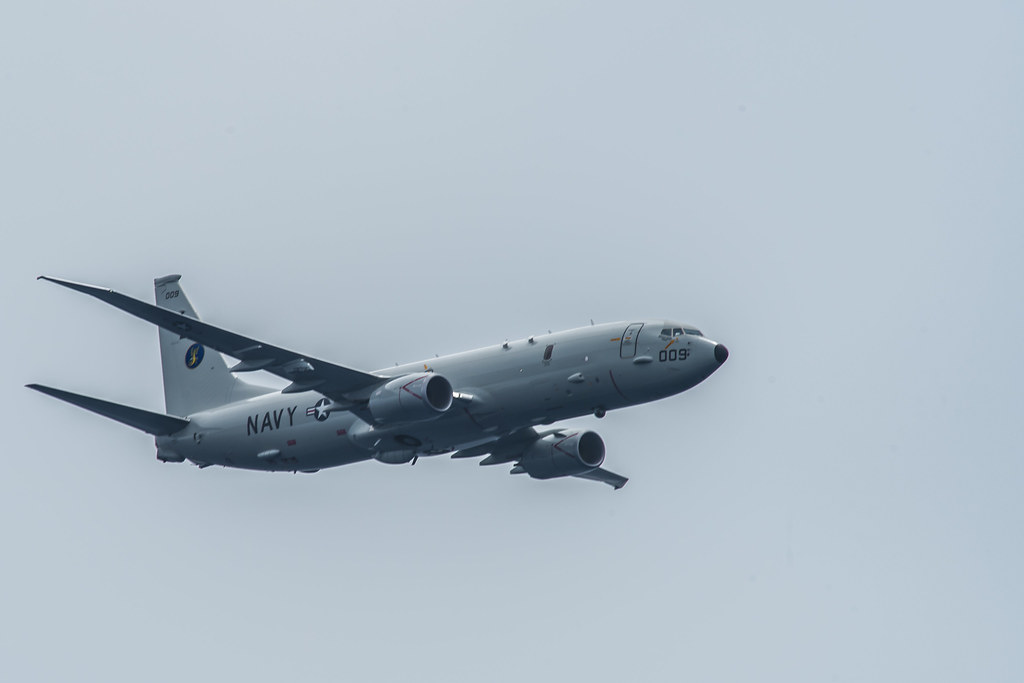
In this file photo, a P-8A Poseidon from Patrol Squadron (VP) 4 flies over USS Theodore Roosevelt (CVN 71) during training in the Pacific, Aug. 29. (U.S. Navy/MC2 Alex Perlman) >>

PEARL HARBOR, Hawaii - Two P-8A Poseidon maritime patrol aircraft assigned to the Skinny Dragons of Patrol Squadron (VP) 4 will operate from Marine Corps Base Hawaii and Joint Base Pearl Harbor-Hickam in support of maritime security initiatives beginning Sept. 28.

This is a part of a rotational deployment of forces, and the first time a P-8 detachment will be deployed to Oahu. Previously, these maritime security missions were flown by P-3C Orion aircraft.

This is VP-4's first deployment flying the P-8A Poseidon. The P-8A, a militarized version of the Boeing 737, is the most advanced long-range maritime patrol aircraft in the world. It is a capable of broad-area, maritime and littoral anti-submarine and anti-surface warfare, and ISR operations. The aircraft brings the latest avionics and onboard systems to the maritime patrol and intelligence, surveillance and reconnaissance (ISR) mission, making it the most advanced anti-submarine and anti-surface warfare aircraft in the world.

VP-4, which is based at Whidbey Island in Washington, has a long history in Hawaii, dating back to 1928 when it was first established in Hawaii. The squadron operated here during the Vietnam War and the Cold War. In recent years, VP-4 deployed to the U.S. 5th Fleet area of operations in Iraq and Afghanistan and U.S. 6th Fleet area of operations including Italy, Greece and Spain, to name a few.

VP-4 departed Oahu for the last time as a Hawaii squadron in March 2016. While on deployment, VP-4 executed a permanent duty station change to Whidbey Island.

Maritime patrol squadrons now temporarily deploy to Hawaii on a rotational basis.

News Report: ‘Tame' Trump - 4.7 Million North Koreans Reportedly Ready to Volunteer for War


Turns out Kim Jong-un wasn't joking around when he said the DPRK would "tame [US President Donald Trump] with fire" last week.

According to Rodong Sinmun, a North Korean outlet, an estimated 4.7 million students and workers indicated they would volunteer to join or re-enlist in the Korean People's Army in the hopes of countering US forces.

Included in the estimates are some 1.22 million women, the outlet reported Thursday.

Kim's latest move backs up a statement he issued last week vowing to take the "highest-level" of actions in response to Trump's United Nations speech, Yonhap News reported.

News Report: UN Chief Urges 'Swift Action' to Alleviate Suffering of Myanmar Muslims

Margaret Besheer

UNITED NATIONS — U.N. Secretary-General Antonio Guterres called Thursday for "swift action" to halt the deteriorating situation in Myanmar's northern Rakhine State, where a half million mostly Rohingya Muslims have fled to neighboring Bangladesh in the past month.

"The situation has spiraled into the world’s fastest developing refugee emergency; a humanitarian and human rights nightmare," Guterres told an open meeting of the U.N. Security Council.

The council has privately discussed the situation three times in the past month, but Thursday’s session was the first time since 2009 that it has publicly discussed Myanmar.

Guterres called for an end to the military’s operations; unhindered aid access; and the safe and voluntary return of refugees to their areas of origin.

"There seems to be a deeply disturbing pattern to the violence and ensuing large movements of an ethnic group from their homes," Guterres said.

Guterres and his human rights commissioner have both expressed concerns that what is happening in Rakhine State is ethnic cleansing.

The secretary-general said the core problem is the prolonged statelessness of the Rohingya and its associated discrimination. "The Muslims of Rakhine State should be granted nationality," Guterres said.

The Rohingya are one of many ethnic minorities in the Buddhist-majority nation. They are considered to be economic migrants from Bangladesh and have been denied citizenship, even though most can show that their families have been in the country for generations.

News Story: Can North Korea shoot down a US military aircraft?

North Korean KN-06 Surface-to-Air Missile System
By: Mike Yeo

MELBOURNE, Australia — At a news conference in New York on Monday, North Korea’s foreign minister accused U.S. President Donald Trump of declaring war via Twitter, and the minister threatened to shoot down U.S. Air Force bombers conducting flights near the Korean Peninsula.

Ri Yong Ho told reporters that his country “reserves the right to shoot down United States strategic bombers even when they’re not yet inside the airspace border of our country.” His comments come in the wake of a war of words between both countries over North Korea’s ballistic missile and nuclear weapons program.

The conference came after a Sept. 23 flight over international waters “east of North Korea” by U.S. Air Force B-1B Lancer bombers, escorted by F-15C jets, that U.S. Pacific Command said was the “farthest north of the Demilitarized Zone (DMZ) any U.S. fighter or bomber aircraft have flown off North Korea’s coast in the 21st century.”

According to South Korean media citing sources from the country’s intelligence services, the route of the B-1Bs took them approximately 90 miles from the North Korean port city of Sinpo and the Punggye-ri nuclear test site at its closest point but beyond the range of known long-range, ground-based air defense systems. The bombers’ flight path was also well beyond the North’s self-declared, 50-mile military boundary zone, which is not recognized by the United States.

At these distances, it would be a significant challenge for the North to effectively target any U.S. overflights. Like much of its conventional forces, North Korea’s air defense network is large in quantity but of questionable quality due to obsolescence, as the country is barred from importing military capabilities due to a United Nations arms embargo.

Read the full story at DefenseNews

News Story: S. Korea closely consults with U.S. on rotational deployment of strategic military assets

SEOUL, Sept. 28 (Xinhua) -- South Korea's defense ministry said on Thursday that the country was closely consulting with the United States on a rotational deployment of U.S. strategic military assets near the Korean Peninsula.

Lee Jin-woo, deputy spokesman of the defense ministry, told a regular press briefing that the two allies agreed to expand the rotational deployment of U.S. strategic assets in and near South Korea during a meeting last week in New York between South Korean President Moon Jae-in and U.S. President Donald Trump.

Read the full story at Xinhua

News Story: S.Korean presidents stresses need for early transfer of wartime operational control from U.S.

South Korean President Moon Jae-in
SEOUL, Sept. 28 (Xinhua) -- South Korean President Moon Jae-in on Thursday stressed a need for early transfer of wartime operational control of its forces from the United States to better tackle the Democratic People's Republic of Korea (DPRK)'s nuclear and missile threats.

Moon said in a speech to celebrate the 69th anniversary of Armed Forces Day that the government aimed to regain the wartime command of South Korean forces early from Washington, and that the transfer will make the military's capability leap forward.

The president said the DPRK will be scared of the South Korean military when it has the wartime control of its own troops.

South Korea handed over its operational command to the U.S. forces after the three-year Korean War broke out in 1950. The country won back its peacetime operational control in 1994.

Read the full story at Xinhua

News Story: ASEAN-Plus defense ministers to discuss terrorism, drug trafficking in Philippines

MANILA, Sept. 28 (Xinhua) -- The defense ministers of the Association of Southeast Asian Nations (ASEAN) and eight dialogue partners will convene in the Philippines next month to discuss fighting terrorism, drug trafficking and maritime conflicts, the Philippine defense chief said on Thursday.

Philippine Defense Secretary Delfin Lorenzana said that ministers will also discuss ways to mitigate climate change and cushion its impact on the region.

"We are going to have some statements with ASEAN countries but we are also having dialogues with our eight other dialogue partners," Lorenzana told reporters.

He described the forthcoming high-level security meeting, dubbed the ASEAN Defense Ministers' Meeting Plus (ADMM-Plus), as "a huge conference" that is hoped to address issues that threaten peace and security of the region.

Read the full story at Xinhua

News Story: Philippines tells U.S. it does not allow extrajudicial killings in anti-drug war

MANILA, Sept. 28 (Xinhua) -- Philippine Foreign Affairs Secretary Alan Peter Cayetano and U.S. Secretary of State Rex Tillerson have met in Washington to discuss Manila's anti-drug war, a statement issued by the Department of Foreign Affairs (DFA) said here Thursday.

During the meeting at the State Department in Washington D.C. on Wednesday, the statement said the Philippines does not allow extrajudicial killings.

"Contrary to media reports, Cayetano also clarified to Tillerson that the Philippines does not have a state policy allowing extrajudicial killings, especially of illegal drug suspects," the statement read.

It said Cayetano informed Tillerson that Manila would welcome further cooperation with Washington, especially on initiatives that would address the illegal drugs problem in the country.

Read the full story at Xinhua

News Story: Pakistan Can’t Be Held Responsibility For Peace - FM

Pakistan’s Foreign Minister Khawaja Asif said Islamabad cannot take responsibility for peace and security in Afghanistan, India’s Economic Times reported on Thursday.

Asif said effective border management with Kabul was imperative to stop the infiltration of terrorists. 

Speaking at the Asia Society seminar in New York, Asif also said the US cannot succeed in Afghanistan by waging war, reported the Economic Times. 

Read the full story at TOLOnews

News Story: U.S. senator suggests having China as part of peacekeeping force in Korea

US Sen. Rand Paul (Image: Wiki Commons)
WASHINGTON, Sept. 27 (Yonhap) -- A U.S. senator proposed Wednesday that China be allowed to keep a peacekeeping force on the inter-Korean border as part of a solution to the North Korean nuclear standoff.

In an interview on MSNBC, Sen. Rand Paul (R-KY) said the arrangement could satisfy both North Korea and China, which he claimed wants to be treated with more respect.

"Have them be part of a peacekeeping force in exchange for North Korea giving up their weapons," Paul said. "But I'm not talking about initially doing this. I'm talking about doing this in exchange for North Korea dismantling their program. They would be simultaneous sort of things."

China is North Korea's main ally and trading partner. It is responsible for 90 percent of the reclusive nation's external trade.

Read the full story at YonhapNews

News Story: Moon, party leaders condemn N.K. nuke, missile provocations

SEOUL, Sept. 27 (Yonhap) -- President Moon Jae-in and the leaders of major parties issued a joint statement Wednesday condemning North Korea's provocations and calling for a peaceful resolution of the nuclear standoff.

In a show of bipartisanship, they announced a five-point agreement after their meeting at Cheong Wa Dae, also reaffirming they would not let another armed conflict occur on the Korean Peninsula.

The talks, the third of their kind, came amid heightened tensions caused by Pyongyang's sixth and most powerful nuke test on Sept. 3 and a series of ballistic missile launches.

"(We) strongly condemn North Korea's nuclear and missile provocations that threaten peace and stability," reads the joint statement adopted after the dinner gathering that lasted two hours and 15 minutes.

"We urge the North to immediately halt provocations and come forward onto a path towards peace and denuclearization," it added. The statement was announced by their spokespersons.

The meeting was attended by Choo Mi-ae, Ahn Cheol-soo, Joo Ho-young and Lee Jung-mi, who represented the ruling Democratic Party, People's Party, Bareun Party and Justice Party, respectively. The leader of the main opposition Liberty Korea Party refused to attend, saying he does not want to serve as "background for a political show."

During the talks, the leaders also agreed to work together to faithfully implement U.N. Security Council sanctions against the North, strengthen the South Korea-U.S. alliance and bolster deterrence capabilities by enhancing the credibility of America's extended deterrence.

Extended deterrence refers to the stated U.S. commitment to defend its ally by mobilizing all military capabilities, nuclear and conventional, against the North's aggression and provocations.

Such a commitment was called into question amid Pyongyang's beefed-up push to develop a nuclear-tipped missile capable of hitting the U.S. mainland. Some argue Washington may dither on defending its Asian ally under attack as its military action could put its own territory at risk.

Read the full story at YonhapNews

News Story: S. Korea, U.S. open alliance talks

SEOUL, Sept. 27 (Yonhap) -- South Korea and the United States began working-level defense talks in Seoul on Wednesday on North Korea and pending alliance issues.

The two-day Korea-U.S. Integrated Defense Dialogue (KIDD) meeting, the 12th of its kind, got under way amid sharp military tensions on the peninsula over North Korea's provocations.

Agenda items include policy coordination against the North's nuclear and missile programs, Washington's commitment to extended deterrence and the transfer of wartime operational control of South Korean troops, according to the Ministry of National Defense.

Read the full story at YonhapNews

28 September 2017

News Report: Top US General Says China Will Displace Russia as ‘Greatest Threat’ By 2025

General Joseph Dunford (Image: Wiki Commons)
The highest ranking military officer in the United States armed forces told Congress that he expected China to become “the greatest threat to our nation” by the year 2025, and pushed for an expansion in military spending to “maintain a competitive advantage” over Beijing.

General Joseph Dunford, chairman of the Joint Chiefs of Staff, appeared before the Senate Armed Services Committee (SASC) on Tuesday to testify on a variety of subjects related to US national security and the military as part of the confirmation process for his second term.

Among comments on areas of interest the world over, such as Afghanistan and North Korea, Dunford told the SASC that he expected China to "probably" become the US' primary adversary by 2025.

Dunford, a decorated soldier who previously served as commandant of the Marine Corps and the leader of US forces in Afghanistan, said this in response to Sen. Mazie Hirono (D-HI) asking him if he still believed the three biggest military threats to the US were Russia, China and North Korea in that order. "If I look out to 2025, and I look at the demographics and the economic situation, I think China probably poses the greatest threat to our nation by about 2025," he said.

News Report: Latest US Sanctions on North Korea Will Result in Full Trade Embargo

Eunjung Cho, Jenny Lee

WASHINGTON — The latest executive order signed by President Donald Trump would, in effect, amount to a full trade and financial embargo, squeezing all the revenue channels North Korea maintains to finance its weapons programs, a former senior counterterrorism official said.

On Sept. 21, less than two weeks after the U.N. Security Council approved new sanctions, Trump turned up the heat on the Kim Jong Un regime with an executive order that widens U.S. authority to sanction any bank and company that finance or facilitate trade with the communist country or any individual involved in the North Korean industries, ports and trade.

“To prevent sanctions evasion, the order also includes measures designed to disrupt critical North Korean shipping and trade networks,” said Trump, in reference to a 180-day ban on ships that have visited North Korea or have been involved in a ship-to-ship transfer with a vessel that has visited North Korea from entering the United States. “For much too long, North Korea has been allowed to abuse the international financial system to facilitate funding for its nuclear weapons and missile programs.”

News Report: War of Words Impedes Complex North Korea Diplomatic Challenge


Brian Padden

SEOUL — The provocative rhetoric between U.S. President Donald Trump and the North Korean leadership is adding to an already growing sense of pessimism that peaceful denuclearization of the Korean Peninsula is possible.

President Trump said Tuesday the use of military force would be “devastating for North Korea,” though it is not his “preferred option” to stop the Kim Jong Un government’s rapidly advancing nuclear and missile program.

The leaders of the U.S. and North Korea have exchanged not only threats of military retribution, but also derisive personal insults, with Trump calling the North Korean leader “little rocket man” and Kim calling the U.S. president a “dotard,” an archaic English word meaning old and senile.

News Report: Mattis Says US 'Not Quitting Fight' in Afghanistan

U.S. Defense Secretary Jim Mattis
William Gallo

KABUL, AFGHANISTAN — During a visit to Kabul Wednesday, U.S. Defense Secretary Jim Mattis said the U.S., with its new strategy for breaking the deadlock with Taliban insurgents, is not going to give up the fight in Afghanistan.

"With our new conditions-based south Asia strategy we will be better postured to support [Afghanistan] as your forces turn the tide against the terrorists,” Mattis said. “We will not abandon Afghanistan to a merciless enemy trying to kill its way to power.”

NATO Secretary General Jens Stoltenberg, who is also in Kabul, affirmed NATO's commitment as well.

“NATO doesn’t quit when the going gets tough," he said. "We keep our promises.”

President Donald Trump’s Afghanistan plan, announced last month, envisions a greater role for regional players, including India.

Kabul is second stop for Mattis on a South Asia tour that began in New Delhi.

News Story: French FM expresses reservations over escalating rhetoric between U.S., DPRK

PARIS, Sept. 27 (Xinhua) -- French Foreign Minister Jean-Yves Le Drian on Wednesday expressed reservations about escalating rhetoric between the United States and the Democratic People's Republic of Korea (DPRK), urging more diplomatic pressure to end the nuclear crisis.

In an interview with BFMTV news channel, Le Drian warned that the verbal clash between U.S. President Donald Trump and DPRK top leader Kim Jong Un has made "the world living in a dangerous period" of unprecedented tension since the end of the Cold War.

"There could be an incident, we need to avoid incidents...so the necessity to act strongly to make North Korea (DPRK) sit on the table of negotiation," he added.

"We have to be extremely firm. Sanctions have been taken, reinforced," he stressed.

In recent weeks, Trump and Kim exchanged bellicose statements, escalating tension on the Korean Peninsula and raising prospects of military action after Pyongyang conducted its sixth missile test on Sept. 3.

Read the full story at Xinhua

News Story: NATO, U.S. defense chiefs' visit to Afghanistan sign of firm support of Afghan forces

by Abdul Haleem

KABUL, Sept. 28 (Xinhua) -- The joint visit of NATO Secretary General Jens Stoltenberg and U.S. Defense Secretary James Mattis to Afghanistan on Wednesday has demonstrated their support to Afghan security forces in the war against the Taliban and associated groups, observers here said.

Both the military chiefs paid an unannounced visit to Afghanistan's capital city of Kabul to review the situation in the militancy-plagued country, as well as to hold talks with commanders of the NATO-led Resolute Support (RS) mission and President Mohammad Ashraf Ghani.

"Our presence together in Afghanistan reflects our continuing commitment to bringing stability and peace," the NATO chief said at a joint press conference attended by the head of the Pentagon and president Ghani.

"The Taliban must understand that they cannot win on the battlefield and there is much more to gain around the negotiating table," the NATO Secretary General stated.

Welcoming the visit as a sign of close relations between Kabul and Washington, Afghan analyst Mohammad Reza Huwaida said that the surprise tour to Afghanistan amid increasing militancy sends a strong message to the Taliban and their supporters that the militants have no chance to win the war.

"By renewing their commitment to Afghanistan, the military chiefs of the U.S. and NATO have sent a strong message to the Taliban and their supporters to give up support, of any kind, including military, diplomatic and financial, to the militants fighting in Afghanistan," Huwaida told Xinhua.

Read the full story at Xinhua

News Story: U.S. yet to announce exact troop number deployment in Afghanistan

KABUL, Sept. 27 (Xinhua)-- The visiting U.S. Defense Secretary James Mattis said Wednesday that the exact number of additional U.S. troops to be deployed in Afghanistan was not still clear.

"Afghan security forces continue to take the lead but we are going to give them more advantages," Mattis responded to a query when asked to comment on the number of U.S. troops expected to arrive in Afghanistan.

At the moment, according to media reports, there are 11,000 U.S. troops in Afghanistan and Pentagon, reportedly would send some 3,500 additional forces to the militancy-battered country.

Mattis who attended a joint press conference with NATO Secretary General Jens Stoltenberg and Afghan President Ashraf Ghani, told reporters that he would not reveal the "exact number of additional troops to the enemy."

Nevertheless, the Pentagon chief added that the Afghan security forces would take the lead in the fight against Taliban and other insurgents.

Read the full story at Xinhua

News Story: Ghani, Mattis And Stoltenberg Hold Closed Door Talks

President Ashraf Ghani held a joint press conference in Kabul on Wednesday with NATO Secretary General Jens Stoltenberg and US Defense Secretary James Mattis after holding talks behind closed doors with the two leaders.

Both Mattis and Stoltenberg made an unannounced visit to Kabul and arrived early Wednesday morning.

Speaking at the press conference, it appeared that the three leaders had discussed a wide range of issues.

Taking to the podium, Ghani called on India, Russia and other countries in the region to come together to help mobilize against the fight against terrorism.

Ghani also said Afghanistan wants an Afghan-owned peace process and called on insurgents to join the peace process.

In addition he stated government had drawn up a four-year military plan that has been approved by NATO.

In turn Jens Stoltenberg, NATO’s secretary general, said: “We count on Afghan government to make good on its commitments on key reforms and that NATO supports peace.”

He said that “with NATO’s help, Afghan forces have come a very long way and we will continue to train, advise and assist” the Afghan security forces.

Read the full story at TOLOnews

Related Story: