Showing posts with label Shipbuilding. Show all posts

28 September 2017

Industry: Navantia Congratulates (AUS) Navy on the Commissioning of HMAS Hobart

HMAS Hobart (File Photo)
The commissioning of HMAS Hobart (III) into service by the Royal Australian Navy on Saturday, 23 September 2017 marks the achievement of a major milestone for both Navantia Australia and the Australian shipbuilding industry and workforce. The ship was built under the AWD Alliance.

Navantia commenced operating in Australia in 2006 when the AWD Project was just beginning. Since that time and its selection in 2007 as ship designer, Navantia has worked closely with Australia and Australian industry to bring this ship into reality.

“Navantia Australia is very proud of our role as ship designer and shipbuilding management services provider for the AWD Alliance,” said Donato Martínez, Navantia Australia’s managing director. “Through our experience in the AWD program, Navantia Australia has developed strong partnerships with Australian industry and a deep understanding of the Royal Australian Navy and Australian Defence Force requirements.” 

21 September 2017

News Story: S. Korea denies report on agreement with U.S. on nuclear-powered submarines

NEW YORK, Sept. 19 (Yonhap) -- South Korea has no immediate plans to build nuclear-powered submarines nor has it discussed the issue with the United States, an official from Seoul's presidential office Cheong Wa Dae said Tuesday.

A South Korean newspaper reported that the allies have already reached an agreement on the issue and that it will soon be announced.

Read the full story at YonhapNews

19 September 2017

News Report: Is North Korea Building Their First Nuclear Submarine?

Japanese media outlets are reporting that North Korea is clandestinely building a nuclear-powered submarine that they hope to have operational by 2020. The reports come from an anonymous but “informed” source.

Japanese newspaper Sekai Nippo claims that the "informed" source "familiar with the North Korea situation" told them that the DPRK has been clandestinely building the nuclear submarine, which would be a massive leap forward from the current DPRK Navy, which may maintain a fleet of 50 to 60 diesel-electric submarines.

The source went on to claim that Chinese and Russian engineers have been lending their expertise to the DPRK at North Korea's Nampo Naval Shipyard, in North Korea's manufacturing capital.

While nuclear submarines are significantly more difficult and expensive to produce than conventional diesel-electric ones, they are also faster, more powerful, more versatile, and have a wider range since they can stay underwater for much longer without needing to resurface and refuel.

News Report: India’s First Scorpene Submarine to Join Naval Fleet from Next Month

INS Kalvari during sea trials
The 1565-ton Scorpene class submarine is a critical asset in a war like situation with Pakistan as the shallow Arabian Sea does not provide required depth to the larger boats like the Kilo-class, or the six nuclear-powered attack submarines that India plans to build.

New Delhi (Sputnik) – Indian Prime Minister Narendra Modi will be handing over India’s first locally built Submarine – christened INS Kalvari — to the Indian Navy next month. The much-awaited diesel-electric Scorpene class submarine is the first of the six such submarines being built at Indian shipyard with the technical support of French naval shipbuilding firm Naval Group, earlier known as DCNS. The submarine would be sent to the Indian Ocean on operational deployment soon after it is handed over to the Indian Navy. However, it would be some time before the vessel is fitted with torpedoes – its primary weapon.

The boat was scheduled to serve the Indian Navy from 2012; seven years after signing of the deal. However, the Indian firm MDL’s ineptness in absorbing the technology transferred by Naval Group delayed the project by five years, according to sources.

13 September 2017

News Report: India Close to Launching Second Indigenous Nuke Submarine

INS Arinhat Ballistic Missile Submarine
The Indian Navy is preparing to drop its second nuclear-capable submarine into the open seas within the next month close to the first anniversary of India became the first nation outside the five permanent members of the UN Security Council – Russia, US, UK, France, China – to commission its first homemade nuclear attack submarine.

The INS Aridhaman is the second ballistic missile submarine India will have constructed once she begins sea trials, which could take at least a year. She is powered by a pressurized water reactor, a common nuclear energy generator used in the subs of nations as the US, Russia, and France.

09 September 2017

News Story: Aussie warship project to be delayed for two years by local companies - minister

BAE Systems Type 26 Global Combat Ship for SEA 5000
CANBERRA, Sept. 8 (Xinhua) -- A 28-billion-U.S.-dollar Australian warship project could be delayed for two years if local companies are handed the contract, a government minister has warned.

The Future Frigates project will see nine new anti-submarine warfare frigates designed and built to replace Australia's existing Anzac frigate fleet.

The Australian bid to build the ships is being led by South Australia's ASC and Western Australia's Austal but Spain's Navantina, Britain's BAE Systems and Italy's Fincantieri have also been shortlisted for the project.

Despite an initial promise that the ships would be built in Australia, the Defence Department has convinced the government that the Australian-built clause should be "optional" rather than "mandated."

Christopher Pyne, Australia's defence industry minister, said: "Advice from the Department of Defence is that changing the request for tender to mandate a particular shipbuilder would result in a delay of at least two years in the Future Frigates program."

Read the full story at Xinhua


--

PacificSentinel: I think people need to remember three things, first of all the project was moved forward by two or three years in the first place, so a two year delay would put it back on the original time table, the second thing is the reason it was moved forward in the first place, which was to build a local shipbuilding industry, so sending the construction overseas defeats the original purpose anyway, the third thing is that the ANZAC class Frigates have just finished an upgrade that should see them more than capable of lasting for an additional 2 years.

08 September 2017

News Report: ‘Strategic Dagger’ - South Korean Navy Introduces New Attack Submarine

On Thursday, the South Korean Navy launched its ninth KSS-2-class diesel-electric attack submarine made by shipbuilder Hyundai Heavy Industries (HHI).

The Republic of Korea Navy (ROKN) released a statement noting that the new sub, dubbed Sin Dol-Seok, debuted Thursday at a ceremony at the HHI shipyard in Ulsan. The 65-meter-long boat, which features air-independent propulsion systems, will be the last of its class. The ROKN currently operates five of the class’ (of) nine boats.

Sin Dol-Seok is named for a famous 18th century Korean military leader, and is equipped with a domestic 1,000-kilometer-range cruise missile.

Jane’s reports that the 1,800-ton submarine is HHI’s sixth KSS-2 class vessel, with the three other submarines of the class having been manufactured by Daewoo Shipbuilding & Marine Engineering (DSME) instead.

30 August 2017

News Story: S. Korean-made submarine delivered to Indonesia

JAKARTA, Aug. 29 (Yonhap) -- A South Korean-made submarine has arrived at a port of the Indonesian Navy's Eastern Fleet in Surabaya after 16 days of sailing from South Korea, the country's Navy said Tuesday.

The arrival of the new submarine, the KRI Nagapasa 403, on the previous day came after South Korea's Daewoo Shipbuilding and Marine Engineering handed over the 1,400-ton submarine to the Indonesian Navy at the shipbuilder's Okpo shipyard on Aug. 2.

During a ceremony Monday at the Indonesian port to mark the submarine's arrival, Navy chief Adm. Ade Supandi said the introduction of the new submarine will enhance deterrence in the region and the Navy's strategic capabilities, contributing to strengthening of the country's maritime defense system.

It is the first of three submarines Indonesia had ordered from South Korea under a 2011 deal worth US$1.1 billion.

Read the full story at Yonhap

29 August 2017

News Story: How the US Navy's fleet has been on a collision course for years

USS Fitzgerald after collision with a Cargo Ship
By: David B. Larter

WASHINGTON — The second deadly collision in as many months between a U.S. destroyer and a larger, slower commercial ship in Asian waters has shaken the U.S. Navy to its foundations and raised questions about the fleet’s readiness in the most congested and volatile region on earth.

The collision between the McCain and an oil tanker three times its size outside the Strait of Malacca was the most recent of four incidents in the U.S. 7th Fleet, which has included three collisions and a grounding that caused an oil spill in Tokyo Bay. While these accidents have been shocking, with a total of 17 sailors killed, there have been signs that all is not well in the 7th Fleet or the U.S. Navy more broadly for some time.

A series of warnings and alarming incidents have raised red flags about forward-deployed ships, which operate at a much higher tempo than their stateside counterparts but have also seen readiness eaten away by too much time at sea and too little time to train and maintain.

That will be the subject of a review ordered by Adm. John Richardson, chief of Naval Operations, who directed Fleet Forces Command head Adm. Phil Davidson to look at the training and readiness of forward-deployed sailors in Japan.

“There’s the longer-term review that I’ve asked Adm. Davidson, down in fleet forces command, to undertake,” Richardson said.

“This will be a broader effort, looking at a number of things. One being, what is the situation out in Japan with our forward-deployed naval forces out there? How are they executing their business? I just want to understand that more deeply in terms of training, generating that readiness that we’ve asked them to achieve and then certifying that readiness.”

Read the full story at DefenseNews

25 August 2017

News Story: Malaysia launches its first French-designed LCS as Navy moves to modernize

Maharaja Lela LCS/Corvette under-construction
By: Mike Yeo

MELBOURNE, Australia ― Malaysia has launched the first of its new littoral combat ships ordered under a $2 billion contract signed in 2011, as the Southeast Asian country continues its drive to modernize its navy.

The ship, named the Maharaja Lela, was launched Thursday at the facilities of builder Boustead Naval Shipyard in Lumut, Malaysia, in a ceremony attended by Malaysian Defence Minister Hishammuddin Hussein and Chief of the Royal Malaysian Navy Adm. Kamarulzaman Bin Haji Ahmad Badaruddin.

Malaysia’s LCS design is based on the French Gowind 2500 corvette, and the first ship is expected to enter service with the Royal Malaysian Navy in the first half of 2019. All six of the program’s ships are scheduled to be in service by 2023. Boustead had laid the keel of the second ship in February this year.

The 3,100-ton ship incorporates stealth characteristics, and its primary armament consists of a single BAE Systems Mk3 57mm gun in a stealthy turret; a 16-cell Sylver vertical launching system for the MBDA VL MICA surface-to-air missile; and a pair of quadruple launchers for the Kongsberg anti-ship Naval Strike Missile. Additionally, a pair of MSI Seahawk 30mm cannons and two J+S Marine triple torpedo launchers are also fitted.

Read the full story at DefenseNews

24 August 2017

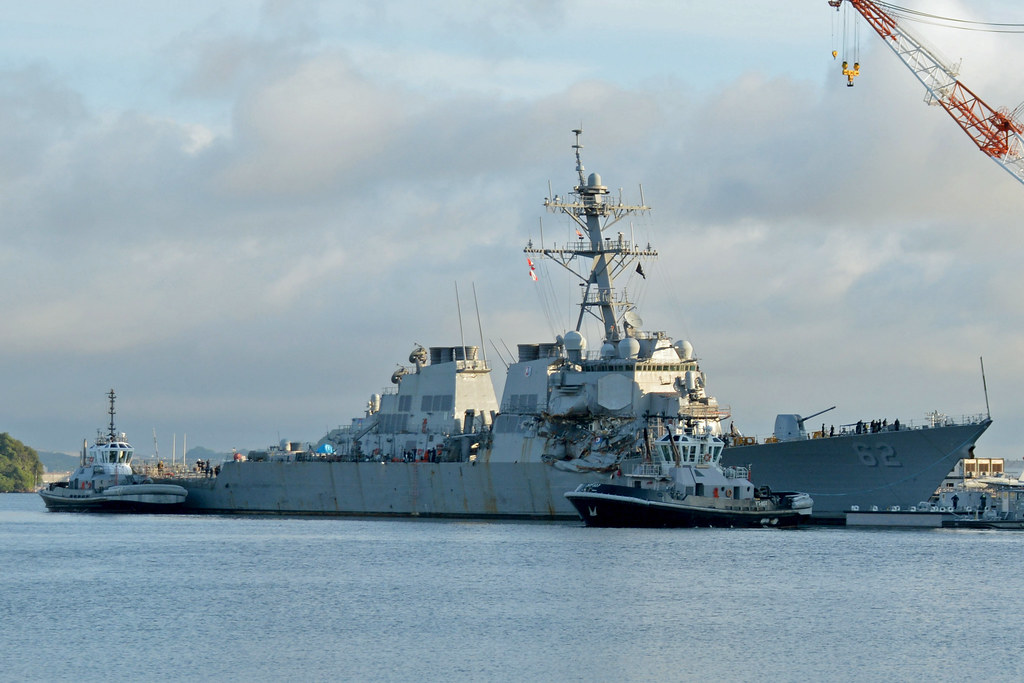
USA: Navy intends to restore USS Fitzgerald at Huntington Ingalls Industries

From Naval Sea Systems Command

In this file photo, USS Fitzgerald (DDG 62) moves to a dry dock at Fleet Activities, Yokosuka, Japan, July 11. (U.S. Navy/MC1 Peter Burghart) >>

WASHINGTON - The Navy intends to award a contract initiating the restoration of USS Fitzgerald (DDG 62) at Huntington Ingalls Industries (HII) in Pascagoula, Mississippi, before the end of the fiscal year.

The start date, scope, cost and the time required to fully restore the ship have not yet been determined.

The Navy chose this course of action following a review of the capabilities and workload of new construction and repair shipyards. Given the complexity of the work and the significant unknowns of the restoration, the Navy determined that only an Arleigh Burke-class shipbuilder could perform the effort.

23 August 2017

News Story: Defence firms eye billion-dollar chance for 'made in India'

By Megha BAHREE

India has drawn up a shopping list for tens of billions of dollars of foreign fighter jets, armoured vehicles, submarines and helicopters but it will only sign the cheques if they are made in India.

The world's largest defence importer has announced a new policy inviting foreign defence manufacturers to set up shop as minority partners in India. It initiated the bidding process for submarines in July.

Such deals would boost job creation and bring key defence technologies into India.

Foreign companies say the opportunity is too good to miss.

Europe's Airbus Group, angling to sell its Panther helicopters, has said that if it wins a contract worth several billion dollars and expected to span at least a decade, it would make India its global hub for the multi-purpose choppers.

The company currently builds them at Marignane in France.

Lockheed Martin says if its F-16 fighter jets are selected -- it will likely compete with Saab for that order of close to $15 billion -- it will "support the advancement of Indian manufacturing expertise."

Germany's ThyssenKrupp Marine Systems and France's Naval Group are eager to compete for a contract of up to $10 billion to build submarines in the South Asian country.

Luring foreign defence companies to build in India would be a major and much-needed boost to the economy.

Prime Minister Narendra Modi, with less than two years to national elections, is under intense pressure to create more jobs for the hundreds of thousands of people joining the workforce every month.

Growth in the first three months of 2017 slowed to 6.1 percent. Experts expect further disruption as businesses adjust to a new nationwide goods and services tax launched in July.

Read the full story at SpaceDaily

22 August 2017

India: Commissioning of Second Ship of Landing Craft Utility MK-IV ‘IN LCU L52’(GRSE Yard 2093) at Port Blair

Launch of LCU L53 after construction (Image: Wiki Commons)
Dr. Jagdish Mukhi, Lieutenant Governor, Andaman and Nicobar Islands, commissioned IN LCU L52 into the Indian Navy today at Port Blair. IN LCU L52 is the second Landing Craft Utility (LCU) Mk-IV class to be inducted into the Indian Navy. The ship has been indigenously designed and built by Garden Reach Shipbuilders and Engineers, Kolkata. The commissioning of L-52 is yet another manifestation of the potential of the country’s indigenous design and ship building capability.

LCU MK-IV ship is an amphibious ship with the primary role to transport and deploy Main Battle Tanks, Armoured Vehicles, troops and equipment from ship to shore. These ships would be based in the Andaman and Nicobar Command and can be deployed for multirole activities like beaching operations, search and rescue, disaster relief operations, supply and replenishment and evacuation from distant islands.

The ship, commanded by Commander Kaushik Chatterjee, has a complement of 05 officers, 46 sailors and is capable of carrying 160 troops in addition. The ship, displacing 830 Tons, is capable of transporting various kinds of combat equipment such as Main Battle Tanks Arjun, T72 and other vehicles. The ship is fitted with state-of-the-art equipment and advanced systems like Integrated Bridge System (IBS) and Integrated Platform Management System (IPMS).

The remaining six ships of the same class are in advanced stages of construction at M/S GRSE, Kolkata and are scheduled to be inducted in the next two years. The induction of these ships will contribute to the nation’s maritime security needs and is in consonance with the Hon’ble Prime Minister’s drive for ‘Make in India’.

21 August 2017

News Story: MHI lands contract to build new Japanese destroyers

By: Mike Yeo

MELBOURNE, Australia – Japan has selected Mitsubishi Heavy Industries, or MHI, to be the lead contractor to build a new class of multipurpose destroyers with construction expected to begin in 2018.

An Aug. 9 release from Japan’s Acquisition, Technology and Logistics Agency, or ATLA, also named Mitsui Engineering and Shipbuilding Company as the subcontractor for the project which seeks to build eight ships to enter service with the Japan Maritime Self Defense Force by the next decade.

MHI’s design and proposal beat out competition from Mitsui and Japan Marine United Corporation for Phase 2 of ATLA’s evaluation, with MHI coming up tops for performance, balance and capability. However, ATLA had previously said in February that the losing bidders will still carry out major portions of the build to avoid shipyard closures and loss of industrial capacity.

According to the specifications released by ATLA, the new destroyers will be 130 meters long and displace 3,900 tons, and will be designed for a variety of missions including anti-submarine warfare and mine countermeasures, with the capability to operate helicopters, unmanned surface and underwater vehicles.

Read the full story at DefenseNews

19 August 2017

News Report: India Begins Major Overhauling of Country’s Coastal Security

With a coastline of more than 7500 kilometers, India aims to equip its coast guards with 175 ships & 110 aircraft in next five years.

New Delhi (Sputnik) – After a delay of more than a decade to fill the gaps in coastal security, India has finally expedited the process to add more ships, aircraft, and high-speed interceptor boats to Indian Coast Guard, the country’s smallest armed force.

On Thursday, private defense firm Larsen & Toubro (L&T) delivered two more high-speed interceptor Ships (C-433 and C-434) to Indian Coast Guard near Chennai, seven months ahead of contractual schedule. The boats are part of a $200 million deal under which the company has to deliver 54 interceptors.

“Made of aluminum alloy hull with waterjet propulsion, these ships have a speed of over 45 knots with excellent maneuverability and are ideally suited for the high interception,” L&T said in a statement.

News Story: India approves deals for Apache helicopters, maritime engines

AH-64 Apache Attack Helicopter
By: Vivek Raghuvanshi

NEW DELHI ― The Indian government this week cleared long-pending deals for six Boeing Apache attack helicopters and two Zorya marine engines from Ukraine.

The two projects were cleared by the Defence Acquisition Council, which is headed by Defence Minister Arun Jaitley. Formal contracts will be awarded in the next four to six months, a Ministry of Defence official said.

Under the deal, the Indian Army will acquire six Apache attack helicopters for about $650 million. They will be equipped with Hellfire and Stinger missiles.

The Army, which currently has no attack helicopters as part of its inventory, requires 39 Apache helicopters, but the Defence Acquisition Council only cleared six, the MoD official noted.

In 2012, Boeing was awarded a $1.3 billion order for 22 Apache AH-64D helicopters for the Indian Air Force. The deliveries will begin mid-2017 and will include 812 AGM-114L-3 Hellfire Longbow missiles, 542 AGM-114R-3 Hellfire II missiles, 245 Stinger Block I-92H missiles and 12 AN/APG-78 fire-control radars.

Read the full story at DefenseNews

18 August 2017

News Story: India mine-sweeper program hits another roadblock

By: Vivek Raghuvanshi

NEW DELHI ― Goa Shipyard Limited’s quest to build 12 high-tech mine countermeasure vessels for $5 billion, which is already delayed, has hit a roadblock over the selection of propulsion engines.

According to a source in India’s Ministry of Defence, the Navy supports a multi-vendor tender process for the engine selection, but Goa Shipyard, citing reservations from Kangnam Corporation of South Korea, prefers a single-vendor nomination of German MTU engines.

Goa Shipyard of India, which is state-owned, was nominated by the MoD to make 12 MCMVs for the Indian Navy. Kangnam was selected to provide the technology needed to build the vessels because India does not possess the required technology.

The Kangam-built MCMVs for the South Korean Navy are fitted with German MTU engines, and the company is offering the same to India. However, the Indian Navy is skeptical about the suitability of German MTU engines for Indian MCMVs because of the differences in geographical location and areas of operation.

India’s coastline is about 7,500 kilometers ― larger than that of South Korea.

Read the full story at DefenseNews

16 August 2017

News Story: Navantia pitches F-5000 design for Future (Aus) Frigates bid

Navantia Australia has submitted its response to the Commonwealth’s Request for Tender for the Sea 5000 Future Frigate program with what it regards as “a comprehensive plan for a leading edge anti-submarine warfare (ASW) vessel and Australia’s continuous shipbuilding industry”.

The F-5000, an evolution of the soon to be commissioned Navantia-designed Hobart Class DDG, will be designed locally to meet specific requirements of the Royal Australian Navy, and built in Adelaide using expertise, experience and equipment from Australia, according to the company.

With capabilities based on the Hobart Class, the F-5000 also incorporates lessons learnt from the operational requirements of the Navantia designed and built Norwegian F-310 ASW frigate. The F-5000 will also provide operational flexibility and force multiplication by incorporating 48 strike length missile cells, a Mk45 5” gun, an advanced above water sensor suite, and integration of the MH-60R combat helicopter and UAV featured in the F-5000’s design.

Navantia says that incorporating the Navantia-SAGE Automation Group’s (NSAG) Integrated Platform Management System (IPMS), which will already be operated by 1,500 men and women of the Navy across seven existing naval platforms, additional training requirements will be reduced and the Adelaide based NSAG will continue to grow as a key input to capability.

“By using an in service Australian ship as our reference to build the F-5000, we will be ensuring that Australia’s future ASW frigate is able to seamlessly integrate into the RAN’s fleet and provide the savings through economies of scale for shipbuilding, training, maintenance and supply support.” Navantia Australia’s Donato Martínez said.

Read the full story at Australian Defence

09 August 2017

News Story: LCS Lives - They Still Count In Age Of Frigates

Freedom class LCS
By SYDNEY J. FREEDBERG JR.

Yes, the Navy has cut short its Littoral Combat Ship program and started work on a bigger, tougher, better-armed frigate. But the small ships will still be big part of the future fleet, experts we spoke to agreed, and the frigate will carry on much of the LCS legacy.

It’s true the Navy’s needs have changed, because the world has changed, with rising threats from major powers eclipsing Third World pirates – but the Littoral Combat Ship has changed as well. In particular, an LCS design conceived during the days of the “peace dividend” is being upgunned with both short- and long-range missiles that increase its relevance for major war.

The shift to frigates is not just a rejection of LCS, either. While the frigate concept turns away from some aspects of LCS – its high speed, its small crew, its limited combat power – it embraces others, such as extending the ship’s reach with unmanned craft and fleetwide networks. In other crucial respects, especially the frigate’s offensive and defensive firepower, the Navy’s still making up its mind.

Independence class LCS
After studying the Navy’s Request For Information (RFI) on industry’s frigate designs, “I wouldn’t say the RFI repudiates the LCS approach, because the idea of having a smaller, less-expensive, shallow-draft, fast ship makes sense,” said retired commander Bryan Clark, now with the Center for Strategic & Budgetary Assessments. The new frigate isn’t really replacing the 3,400-ton LCS, he argued, but filling a gap between smaller coastal patrol craft like the 380-ton Cyclone class and larger multi-role warships like 9,700-ton Aegis destroyers.

To that end, Clark wants the future frigate to have both the weapons and radar to conduct wide-area air defense of nearby ships in a task force or convoy –a mini-Aegis like Spain’s Navantia frigates – rather than only defend itself – like the current LCS.

Read the full story at Breaking Defense

08 August 2017

News Report: China’s First Home-Grown Aircraft Carrier May Deploy Ahead of Schedule

Chinese military analysts say that advances and progress with the power generators for its Type 001A aircraft carrier place the massive ship ahead of schedule prior to its first deployment.

Type 001A could join the People’s Liberation Army Navy (PLA-N) by the end of 2018 or perhaps 2019, according to the South China Morning Post’s report on Monday. The Washington-based Center for Strategic and International Studies previously estimated the carrier wouldn’t join the rest of the navy until 2020.

Before the Type 001A joins the active duty fleet, "we also need to a do a variety of systematic tests [at sea], including matching tests of carrier-based aircraft, weapons systems, and others," the Type 001A’s project manager told SCMP.

The carrier will rely primarily on steam generators to power it over long distances. Construction on the carrier was finished in April, when it made its first launch into the open sea, and took just five years and three months to complete. Rebuilding the Soviet-made Liaoning (originally the Kuznetsov-class carrier Varyag), PLA-N’s only other carrier, is believed to have given the Chinese important lessons in building the massive ships, which are vital for long-range maritime expeditionary capabilities.