Showing posts with label Sonar. Show all posts

20 July 2017

USA: USS Sterett ‘up guns’ Bonhomme Richard ESG for Talisman Saber exercise

By MC1 Byron C. Linder, USS Sterett Public Affairs

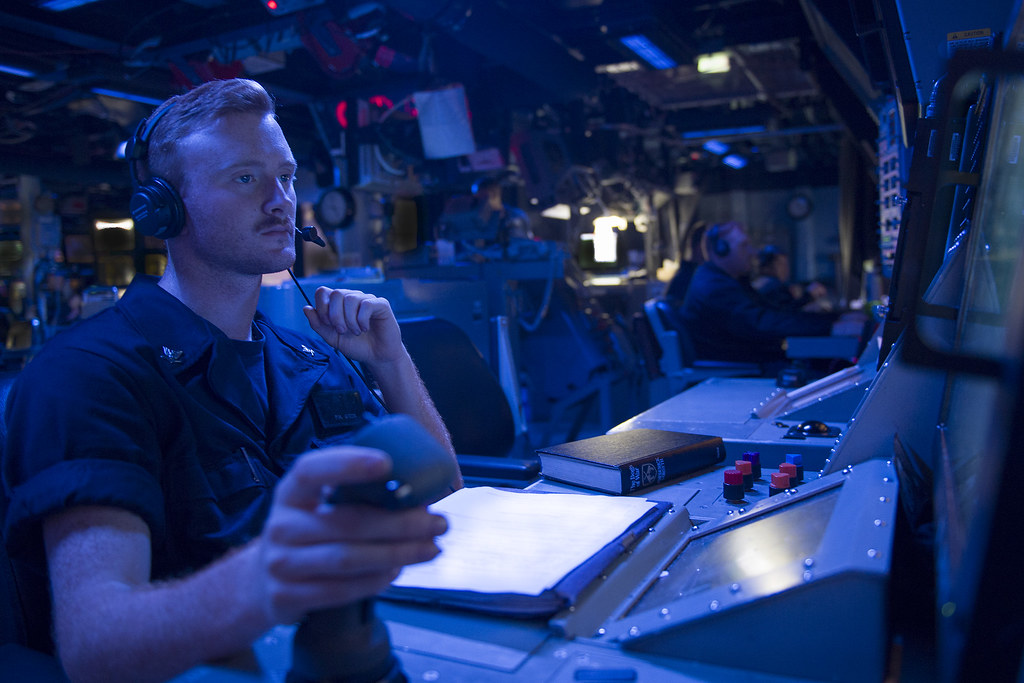
Gunner’s Mate 3rd Class Patrick Green stands watch aboard USS Sterett (DDG 104) during Talisman Saber 17. (U.S. Navy/MC1 Byron C. Linder) >>

CORAL SEA - Watchstanders hover over chart tables, plotting courses as they assess possible tracks of an Australian submarine posing as an opposing force. Sailors at consoles “hook” tracks and report inbound aircraft, signaling to the tactical action officer that queries and other pre-planned responses need to be made.

For the Arleigh Burke-class guided-missile destroyer USS Sterett (DDG 104), the ship’s combat information center is routinely abuzz as the ship often manages a number of missions, often simultaneously.

But here at U.S.-Australian bilateral exercise Talisman Saber 17, Sterett is playing a different role than it normally would. It is taking commands and direction from an amphibious flagship, alongside Australian frigates with similar sensors and defense capabilities.

02 June 2017

News Story: Bharat Electronics forecasts $1.5B in sales as India boosts domestic production

By: Vivek Raghuvanshi

NEW DELHI — India's state-owned defense electronics enterprise Bharat Electronics Ltd., BEL, has increased sales by 17 percent in fiscal year 2017, according to Venkateswara Gowtama Mannava, chairman and managing director. 

“The company has projected the sales to grow from the current level of $1.35 billion to $1.54 billion next year,” Gowtama said. 

He added, “BEL will create new business partnerships with both domestic and overseas defense companies and enforce quick decision making within the company in order to remain competitive in the Indian defense market.”  

The market will become much stronger, he said, because the government has made much quicker decisions and the (procurement) cycle time is shorter. Many of the pending cases have been resolved. 

The list of weapons projects executed for the Indian defense forces include the short-range surface-to-air missile system Akash, a handheld thermal imager with laser range finder systems, a 3-D tactical control radar, a weapon locating radar, upgraded L/70 air defense guns, fire control systems, hull mounted sonars, radio relays systems, major sub-systems of integrated air command and control systems and ship-borne electronic warfare systems. 

Gowtama announced that the company has an order of $6.15 billion. "There is no vertical where we do not have an order at this point of time," he said. 

Read the full story at DefenseNews

19 April 2017

News Story: Components selection ramps up in massive French-Australian submarine deal

By: Pierre Tran

PARIS – Lockheed Martin will report this summer results of studies for potential suppliers of sonar and other critical systems for Australia’s planned fleet of 12 new attack submarines, said Mike Oliver, program director for the future submarine combat system. 

“Lockheed Martin has been conducting trade studies in a number of key areas of the submarine’s design,” he told Defense News. “We are examining all options and will deliver the results of those trade studies in June to the customer.”

Sonar is among the key systems, the company’s program team said. 

Australia this time last year picked DCNS to build the future submarine after a tender which pitted the French company against Germany's ThyssenKrupp Marine Systems, and Mitsubishi Heavy Industries and Kawasaki Heavy Industries, backed by Tokyo. 

“The choice of sonar systems and arrays is in the hands of Lockheed Martin,” Marie-Pierre de Bailliencourt, general manager at DCNS, told Defense News. 

Canberra in September selected Lockheed as combat system integrator, partnering with DCNS, which will design, build and service a fleet of 12 ocean-going diesel-electric boats. The program is worth AUS$50 billion ($38.1 billion) over some 35 years. 

A survey of sonar and other systems marks a first step in a selection process that Thales hopes to win through its Australian subsidiary.
The French electronics company expects to secure more than €1 billion of deals, with €100 million per boat based on sonar systems, electronic warfare and periscopes. A towed sonar array is part of the kit. 

A Thales spokesperson declined comment. 

Read the full story at DefenseNews

21 December 2016

News Report: India, the New Kid in Defense Exports, Ratchets Healthy Growth

Export licenses issued to Indian domestic companies have jumped eight times since Narendra Modi became PM in mid-2014. But in absence of home grown technology, it will have to depend on global manufacturers for further breakthroughs.

New Delhi (Sputnik) – In an indication of the present Government's focus on advancing defense manufacturing, India's global sale of defense equipment has increased to almost double than last year.

The Indian government has provided a major boost to indigenous defense equipment capabilities by granting production licenses to 116 Indian companies. Defense Ministry documents suggest that India has turned its focus towards sale of aviation items to smaller countries after gaining a favorable response in selling naval equipment to countries having differences with an assertive China. Apart from government units, New Delhi has issued 54 industrial licenses to Indian private companies for the manufacture of aviation items such as aircraft, Unmanned Aerial Vehicles (UAVs), lighter-than-air-vehicles, remotely piloted vehicles, parts and accessories for aircraft, air flights, airframes sets, landing gears and related equipment. 

24 November 2016

Industry: Thales to upgrade Collins submarine with latest generation sonar systems

Royal Australian Navy Collins class Submarine
Thales has signed a design and pre-production contract to upgrade Australia’s Collins class submarine sonar systems, enhancing their capability to outperform the most advanced underwater threats in an increasingly complex environment.
  • Maintain Royal Australian Navy’s operational edge in the region and contribute to Australian sovereignty
  • Better detection of evolving underwater threats and upgrades to cylindrical and flank arrays, as well as on-board processing
  • Benefits of multi-decade investment in Australian innovation

As Australia’s leading provider of sonar technologies, Thales will build on its local and international expertise to prepare for upgrades to the submarines’ cylindrical array, flank array, and on-board processing to maintain Royal Australian Navy superiority in the region.

Benefitting from a multi-decade investment in Australian innovation, Thales will utilise some of the latest developments in underwater sensing to replace the Collins arrays, which have not been upgraded since first entering service in the mid-1990s.

23 November 2016

AUS: Thales Australia Awarded Collins Sonar Upgrade Design

The Minister for Defence Industry, the Hon Christopher Pyne MP, today announced that Thales Australia has been awarded a $100 million contract  to design a major sonar system upgrade for Collins class submarines.

Minister Pyne said Thales Australia will engage other Australian-based companies including Sonartech Atlas and L3 Oceania, as well as suppliers from the United Kingdom (UK) and France to design the Collins sonar system upgrade.

“The sonar system upgrade will install improved sonar sensor arrays aboard each of the Collins submarines, as well as improved signal processing systems,” Minister Pyne said.

“Under the contract Australian industry will play a key role in delivering leading edge sonar capability for Australian submarines.”

“The Australian industry component of the contract to be led by Thales Australia is worth in the order of $50 million and will support around 50 Australian jobs in Sydney and Perth.

“This is a clear example of our commitment to building and harnessing the innovation potential of Australia’s defence industry, as outlined in the 2016 Defence Industry Policy Statement,” he said.

18 November 2016

India: Induction of DRDO developed Naval Systems into Indian Navy – A Curtain Raiser

Four Naval Systems developed by DRDO will be handed over to the Indian Navy by the Defence Minister Shri Manohar Parrikar at a function, here tomorrow. Chief of the Naval Staff Admiral Sunil Lanba will formally take over the systems from the Defence Minister which include ABHAY – Compact Hull Mounted SONAR for Shallow Water Crafts, HUMSA UG – Upgrade for the HUMSA SONAR System, NACS – Near-field Acoustic Characterisation System, and AIDSS – Advanced Indigenous Distress SONAR System for submarines. Secretary, Department of Defence R&D and Chairman DRDO Dr S Christopher will be present on the occasion.

The systems have been designed and developed by NPOL, a Kochi based premier laboratory of DRDO which has outstanding contributions and achievements in the design of SONAR systems for the Indian Navy to its credit. ABHAY is an advanced Active-cum-Passive integrated SONAR system designed and developed for the smaller platforms such as shallow water crafts and coastal surveillance/patrol vessels. Designed using the latest technology in hardware architecture and advanced signal processing algorithms, the SONAR is capable of detecting, localizing, classifying and tracking sub-surface and surface targets in both its active and passive modes of operation.

11 November 2016

AUS: Sonar and Acoustics expert wins science award

A Defence scientist who has exploited the science of sound to pinpoint military threats underwater and over land has won the 2016 Minister’s Award for Achievement in Defence Science.

Minister for Defence, Senator the Hon Marise Payne, congratulated Dr Brian Ferguson from the Defence Science and Technology Group for his world-leading research in acoustics and signal processing which has contributed significantly to Defence capability by detecting, classifying and tracking targets of military interest.

“Dr Ferguson has broken new ground with his innovative research into advanced acoustic technologies which are being used in Australian and US operational systems for improved situational awareness and surveillance,” Minister Payne said.

Dr Ferguson’s extensive studies established a direct connection between acoustic signals and the course, speed and identity of ships, submarines, aircraft and even speeding bullets.

31 October 2016

News Story: PH, US forces conclude mine search, underwater search-and-retrieval training

Philippine Navy (PN) special operations operatives and their US counterparts recently concluded another exercise called the “Humanitarian Mine Action Assistance Training” which was held last Oct. 17 to 26 in Palawan. This was confirmed by Armed Forces of the Philippines (AFP) public affairs office chief Col. Edgard Arevalo Thursday.

The nine-day training activity took place at the Western Command’s Tide Pool Pier at Naval Station Apolinario Jalandoon, in Puerto Princesa, Palawan.

“It was a small unit subject matter expert engagement that has long been prior scheduled and participated in by only eight PN Special Operations personnel and four US counterparts,” Arevalo said.

Read the full story at Update.PH

05 October 2016

AUS: Sydney Royal Australian Navy mine hunter vessels destroy WWII bombs in Solomon Islands

Her Majesty’s Australian Ships (HMAS) Diamantina and Huon have spent two weeks finding and destroying unexploded World War II munitions in the waters around the Solomon Islands during Operation Render Safe.

The Sydney-based mine hunter vessels found over eight tonnes of projectiles and bombs during their searches around the Russell Islands, Florida Group and Honiara.

Commanding Officer of HMAS Diamantina, Lieutenant Commander Mark Northcote said the seas contain a variety of explosive remnants of war.

“We’ve had reports of torpedoes which unfortunately are too deep for us to find, but anything from air dropped weapons to projectiles from the ships and guns that were here in the Second World War,” he said.

Clearance Diver Able Seaman Luke Woodcroft was in the Solomon Islands three years ago for Operation Render Safe and said the numbers are improving.

“I’ve seen some bombs, projectiles, mortars, various types of rounds. There’s definitely quite a bit still remaining, however there’s not as much as last time I was here in 2013, so we’re definitely making an impact,” he said.

13 August 2016

News Story: Tata Power SED Emerges as Lowest Bidder To Build Sonar Systems

Vivek Raghuvanshi

NEW DELHI — Private defense company Tata Power's Strategic Engineering Division (SED) has emerged as the lowest bidder to build 78 portable diver detection sonar (PDDS) systems.

Tata Power SED, whose parent company is Tata Group, quoted $20 million for the Buy and Make (India) category tender, against its rivals Elcome Integrated Systems at $26 million and Larsen & Toubro at $30 million.

This will be for the first time an Indian defense company will build PDDS systems for the Indian Navy. The service was previously sourcing the technology from Sonardyne in the United Kingdom.

A senior Indian Navy official confirmed that no domestic defense company has yet built PDDS systems, and that any domestic companies that do so will likely have to team up with foreign defense companies.

"A formal contact will be awarded to Tata Power SED within the next two months," he added.

Read the full story at DefenseNews

20 July 2016

Industry: ECA Group awarded a contract for the supply of a sonar laboratory to the Indonesian Navy

ECA Group has been awarded a contract to a supply a sonar laboratory to the Indonesian Navy. The sonar laboratory is a PC based solution for the training of sonar operators using ECA Group sonar simulation system.

ECA Group sonar simulator has already been validated in the past year by customer Navy operators, who have expressed their appreciation for the extreme reliability and realism of the solution. ECA Group sonar simulation system is based on the principle of the internationally approved sonar theories.

Sonar operators can be trained in underwater and surface vessel detection, classification and identification in a virtualized environment with the same characteristics of the real operational area, such as: background noise, the bottom surface reverberation, the climatic and meteorological conditions and all the conditions that effect the sound propagation in a specific geographic area, chosen by the customer.

Navy instructors, using the user-friendly interface of our instructor software can configure realistic scenarios with increasing difficulties in order to train sonar operator from the basic to advanced level.

19 July 2016

Think Tank: Sea, air and land updates (19-Jul-2016)

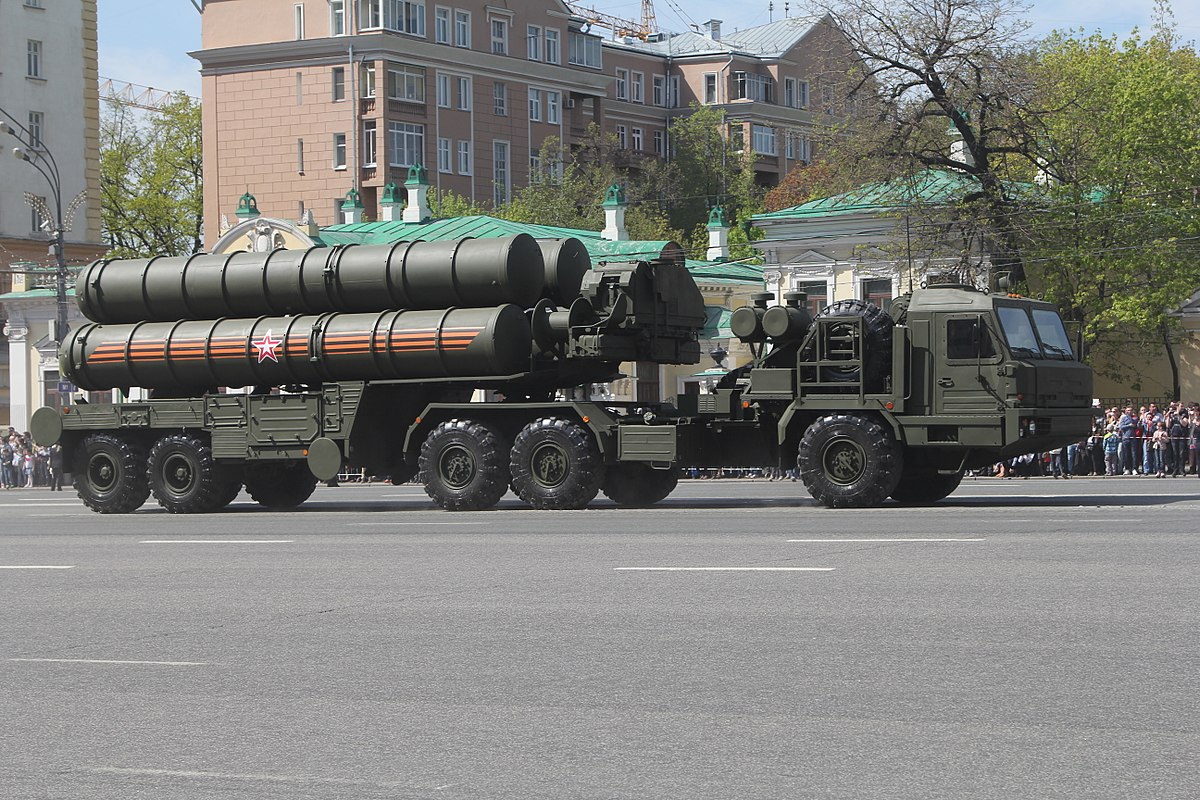
S-400 Triumf launch vehicle (Image: Wiki Commons)
Dione Hodgson, Ashleigh Sharp and Lachlan Wilson

Sea State

The USN has been restricted from using low-frequency active sonar in some ocean areas because it can injure whales and other marine life. A federal appeals court found on 15 July that the USN had been wrongly permitted to use low-frequency sonar during training, testing and routine operations, overturning a previous lower court decision. The lower court decision had upheld approval granted by the National Marine Fisheries Service in 2012 which allowed the USN to use sonar during peacetime operations in the Pacific, Atlantic and Indian oceans and the Mediterranean Sea. The decision means the USN won’t be able to use the sonar to detect submarines in certain marine habitats. Ecowatch has taken a look at the effect sonar—and other industrial noise—has on marine life.

Blast from the past: The National Oceanic and Atmospheric Administration—with help from the USN and Boeing—captured the first clear images of the radioactivity-polluted USS Independence on the ocean floor last Thursday. Using a robotic underwater vehicle, scientists were able to map the wreck of the WWII aircraft carrier, which was deliberately sunk off the coast of Half Moon Bay by the USN in 1951. The ship faced its fair share of damage during its 10 years of service—it was heavily damaged during nuclear weapons testing at Bikini Atoll in 1946, turned into a floating nuclear decontamination site while stationed in a shipyard in San Francisco, and was then scuttled by two torpedo warheads while laden with barrels of radioactive waste.

04 May 2016

News Story: India Crafts Naval Technology Plan

Indian Navy Kolkata class Destroyer
Vivek Raghuvanshi

NEW DELHI — The Indian Navy has finalized a plan to acquire 100 cutting-edge technologies in the next 15 years to build its war-fighting capabilities, but how realistic that will be is a million-dollar question.

The 15-year prospective plan unveiled last month calls for acquiring a range of futuristic technologies. These include naval missiles and guns, propulsion and power generation, surveillance and detection systems, torpedoes and directed energy weapons, submarines and anti-submarine warfare systems, naval aviation, network-centric warfare and combat management systems.

"By 2027, we want 200 warships and around 600 aerial assets, hypersonic and loitering missiles, and laser weapons," said Rear Adm. Dinesh Tripathi, the Indian Navy's assistant chief of naval staff for policy and plans.

The navy has 138 warships and submarines and about 230 aerial assets, he said.

"In addition, we need to reduce import content for our sensors and weapons and need a high-range of hypersonic and loitering missiles and laser and directed energy weapons," Tripathi added.

Future naval technologies will be built domestically under the "Make in India" a(nd) "Indigenization" categories.

Read the full story at DefenseNews

27 April 2016

Industry: Thales is delighted that DCNS has been selected by Australia for the renewal of its submarine fleet

  • Thales is a trusted partner of the Australian Defence Force.
  • Thales in Australia is also present in civil sectors ranging from air traffic management and ground transport systems to security systems and services.
  • Employing around 3,200 people at over 35 sites across the country, Thales in Australia recorded €726 million in revenues in  2015 (Australia and New Zealand).


As a major player in the defence sector in both France and Australia, Thales is delighted that DCNS has been selected, after an international competitive evaluation process, as the international partner of the Australian Ministry of Defence for the renewal of its submarine fleet (SEA 1000 programme). 

Thales is DCNS's main shareholder (35%) alongside the French state and is a major defence contractor in Australia, with a local workforce of more than 3,200 employees. Thales already provides acoustic sensors (sonars) to both DCNS and the Royal Australian Navy.

The SEA 1000 programme is the largest acquisition project in the history of Australian defence, representing an investment of around 34 billion euros.

"This is a great day for the Australian and French defence industries. Thales congratulates DCNS for a success that reflects the level of trust between the French and Australian defence sectors and the extent of technology transfers between the two countries. All of us in France are proud to contribute to Australia's defence capability by providing the very best naval technologies available."
Patrice Caine, Chairman & Chief Executive Officer of Thales.

12 February 2016

Editorial: World’s Largest Anti-Submarine Robot Ship Ready for Sea-Trials in April

By Franz-Stefan Gady

The U.S. Navy’s largest unmanned surface vehicle designed to track Chinese and Russian subs will be christened in April.

The Pentagon’s Advanced Research Projects Agency (DARPA), an agency responsible for developing and testing cutting-edge military technologies, will test-launch the prototype of its 140-ton Anti-Submarine Warfare Continuous Trail Unmanned Vessel (ACTUV), named Sea Hunter, in April this year, the deputy director of DARPA, Steve Walker, said, according to National Defense Magazine.

The 132-feet (40 meters) long Sea Hunter, an unmanned autonomous trimaran, will be christened in April 2016 at the Vigor Shipyards in Oregon and immediately afterwards commence sea-trials for 18 months to test its long-range tracking capabilities, among a host of other things. During the testing DARPA will closely cooperate with the Office of Naval Research and the Space and Naval Systems Warfare Command.

The ship’s primary mission will be tracking enemy subs in shallow waters, I noted in June 2015 (See: “US Navy to Deploy Robot Ships to Track Chinese and Russian Subs”). Furthermore, I explained that the ACTUV “is designed to operate autonomously for 60 to 90 days straight, surveil large stretches of ocean territory and — should an enemy sub be spotted — guide other U.S. naval assets to the vessel’s location to destroy it (the ACTUV itself is unarmed).”

“Imagine an unmanned surface vessel following all the laws of the sea on its own and operating with manned surface and unmanned underwater vehicles,” Walker told reporters during a briefing at DARPA headquarters in Arlington, Virginia on February 10. “We think the real cost savings will be in operating this vessel at sea compared to how we operate vessels today.”

Read the full story at The Diplomat

10 February 2016

Think Tank: SEA 1000 - A Franco–Australian solution

Sean Costello

Where Australia selects France, it selects enduring geopolitical alignment and surety of supply, a program of technical transfer to deliver sovereignty, a regionally superior capability and interoperability with our allies.

I can make those statements with respect to France because France is a complete submarine power and has national polices to remain so. A complete submarine power is one that can safely design, build, operate and sustain any class of submarine on an enduring basis.

Objective evidence of being a complete submarine power is the ability to re-apply technology from multiple designs, both nuclear and conventional, to optimize for any one design. In a strategic framework this is critical. Whatever the future holds, cooperation with a complete power provides Australia with the greatest latitude in developing a solution.

Planned in detail to beyond the year 2080, France’s mature galaxy of submarine capabilities stems from France’s own commitment to, and maintenance of, a strategic nuclear deterrent. Stemming from this national undertaking France autonomously designs, builds and sustains large ocean going nuclear powered submarines, conventional submarines and of course has proven and established methods for technology transfer.

24 November 2015

Editorial: US Navy’s Prototype Robot Ship Gets New Sonar

By Franz-Stefan Gady

An autonomous vessel designed to track Chinese and Russian subs in shallow waters gets new sonar.

The prototype of a U.S. Navy robot ship was recently equipped with a new hull-mounted sonar system, IHS Defense Weekly reports.

The Anti-Submarine Warfare Continuous Trail Unmanned Vessel (ACTUV), received Raytheon’s Modular Scalable Sonar System (MS 3), which “will be integrated as the ACTUV’s primary search-and-detection sonar,” according to the article. The sonar system will produce an “acoustic image” of targets in order to identify and classify vessels in close proximity to the robot ship.

“Designed to autonomously conduct active and passive searches, detect torpedoes, filter passive threats, localize and track submarines, and avoid small objects, the MS 3 is Raytheon’s first fifth-generation medium-frequency hull-mounted sonar system,” IHS Defense Weekly explains.

The ACTUV is an unmanned autonomous trimaran designed by the U.S. Defense Advanced Research Projects Agency (DARPA), an agency responsible for developing emerging technologies for the military’s use. DARPA was tasked with developing an anti-submarine drone — a robot ship capable of tracking enemy subs in shallow waters in 2010.

Read the full story at The Diplomat

11 September 2015

News Story: US, Japan to operate undersea system to monitor PLA subs

Ryukyu islands, Japan
To monitor the activities of Chinese submarines in the Western Pacific, the United States Navy and Japan Maritime Self-Defense Force have begun the joint operation of an undersea submarine detection system on the floor of the Pacific side of the Ryukyu islands, according to the Tokyo-based Kyodo News.

Known as the SOSUS, this latest model sound surveillance system is being deployed by the US and Japanese navies to detect submarines of the People's Liberation Army Navy traveling from the East China Sea to the Yellow Sea, an unnamed source from the JMSDF told Kyodo News. He said that this is the first time the US has established a listening system solely targeting China. Because the system is still top secret in the US-Japan security system, the JMSDF only revealed its details to key figures in the government.

Read the full story at Want China Times

27 July 2015

News Story: PLA's underwater listening network is baloney - Taiwan colonel

Concept art of the PLA's purported underwater listening
network shown on a Chinese website. (Internet photo)
The claim made recently in Chinese media outlets that the People's Liberation Army can monitor the movement of US submarines as far away as Guam is unrealistic, says Colonel Wang Chih-peng, a reserve officer in Taiwan's navy.

China began the development of its underwater listening network in 1996 under the codename Program 863, according to the Beijing-based Sina Military Network. The article made the claims that various underwater listening devices connected by undersea cables enable the PLA Navy to monitor the activities of submarines at distances of more than 15,000 kilometers. Monitoring operations can be enhanced in the future with the use of unmanned underwater vehicles, warships and the Y-8 GX8 Electronic Intelligence aircraft, the report claimed.

Read the full story at Want China Times