Showing posts with label Tanker Aircraft. Show all posts

21 September 2017

News Story: US Increases Number of F-16s To 18 In Afghanistan

The United States Air Force has increased the number of F-16 multi task Fighting Falcons to 18 from 12, two generals, quoted by Military.com said Tuesday at the Air Force Association's Air, Space and Cyber Conference.

In addition air refueling tankers are in Afghanistan for the first time in about five years, they said.

The Air Force now has 18 multi-role F-16 fighters in country, Lt. Gen. Jeffrey L. Harrigian, commander of US Air Forces Central Command, told reporters at the conference.

"We just plussed up our number of fighters. We had 12 F-16s; we now have 18," said Harrigian, who oversees missions at the Combined Air Operations Center at Al Udeid Air Base, Qatar.

According to Military.com, Harrigian said: "Our close-air support role continues and, as you look at the strategy coming forward, we're actually right now working with [Commander of US forces in Afghanistan] Gen. John Nicholson's staff on how to best synchronize his advice-and-assist strategy going forward to optimize the placement of the air assets."

Read the full story at TOLOnews

20 September 2017

News Story: Sixth RAAF KC-30A arrives at Amberley

The sixth Airbus Defence and Space KC-30A MRTT for the RAAF arrived at Amberley, south-east Queensland on September 1.

The former A330-203 airliner saw service with Qantas and Jetstar as VH-EBH and first flew in 2007. It was converted to MRTT configuration by Airbus Defence and Space at Getafe near Madrid and arrived at Amberley, where it will enter service with 33 Squadron, wearing its Spanish test registration MRTT039.

The aircraft requires the completion of airworthiness directive (AD) and service bulletin (SB) work, Australian Defence Business Review understands, as well as hardware and software configuration upgrades to bring it up to a common standard with the RAAF’s five existing KC-30As before being accepted into service.

Read the full story at ADBR

01 September 2017

News Story: U.S. military sends bombers, fighter jets to S. Korea for joint bomb-dropping drill

USAF F-35 Lightning Fighter
SEOUL, Aug. 31 (Xinhua) -- The U.S. military on Thursday sent strategic bombers and stealth fighter jets over South Korea for the joint bomb-dropping drill with the South Korean jetfighters in the country's northeastern region, local media citing the South Korean air force.

Two U.S. B-1B strategic bombers and four U.S. F-35B stealth combat planes were dispatched Thursday afternoon over the Korean Peninsula from the U.S. island of Guam and the U.S. military base in Japan respectively.

The U.S. combat aircraft conducted a joint flight drill with four South Korean F-15K fighter jets over the peninsula, before dropping MK-84, MK-82 and GBU-32 bombs on a target at the Pilseung firing range in Gangwon province, the northeastern region of South Korea.

The U.S. KC-135 aerial refueling plane was also dispatched to South Korea for the joint air drill, according to local media reports.

Read the full story at Xinhua

25 August 2017

News Report: Russia's Tu-95MS Bombers Perform Routine Flight Over Int'l Waters in Asia

Russian Tu-95MS Bomber (Image: Wiki Commons)
Russia's Tu-95MS strategic bombers have carried out routine flights over international waters of the Sea of Japan, Yellow and East China seas, the Russian Defense Ministry's press service said Thursday.

MOSCOW (Sputnik) — The long-range planes were accompanied by a Su-35S fighter of the Eastern Military District and A-50 Airborne Early Warning and Control Aircraft of military-transport aviation.

During the flight, Tu-95MS crews performed aerial refueling, according to the ministry.

The ministry noted that at certain stages of the route, the Russian strategic bombers were accompanied by aircraft of the Korean Air Force and the Japan Air Self-Defense Force.

Russian Tu-95MS strategic bombers have taken part in Russia's air campaign in Syria successfuly launching strikes against the terrorist group Daesh operating in the Middle East.

Russia’s military jets regularly carry out patrol flights over the neutral waters of the Arctic region, Atlantic Ocean, Black Sea and Pacific Ocean, the ministry said. All such flights are carried out in strict accordance with the international law regarding the use of neutral waters airspace, without violating borders of other states.

This story first appeared on Sputnik & is reposted here with permission.

03 August 2017

News Report: India’s IL-78 Fleet Rusting Away Hangar-Less Since 2003, Says Auditor

Indian Il-78 refueling Mirage 2000 Fighters
(Image: Wiki Commons)
India’s top auditor, the Comptroller and Auditor General, has revealed that the Indian Air Force’s (IAF) fleet of six IL-78 refueling aircraft has been rusting in the open because of a lack of hangars. There is only one hangar for the six planes, the CAG noted.

New Delhi (Sputnik) – The CAG report tabled in Parliament said the IAF is missing pivotal infrastructure and dedicated refueling corridor for its air-to-air refueling IL-78s. CAG also points out the aircraft require 11480 feet to 15022 feet-long runway for the carrying of optimum quantity of fuel but of the 10 airfields, only one is 10500 feet long.

"Six IL-78 aircraft were procured during 2003-04, but only one hangar is available. Due to non-availability of hangers, the costly air assets remained in the open which adversely affected their serviceability and life," CAG report tabled in the Parliament reads.

03 July 2017

News Story: Iwakuni base expansion accelerates as local heads OK transfer of US carrier-borne jets

US Navy F/A-18E Super Hornet Fighter Aircraft (File Photo)
The Yamaguchi Prefecture city of Iwakuni is on track to host one of the largest U.S. air stations in the Far East following an announcement from local heads that they will accept the relocation of U.S. carrier-based aircraft units from Kanagawa Prefecture to a base in the coastal city.

"After careful consideration and much thought, I have decided to accept (the relocation plan)," Iwakuni Mayor Yoshihiko Fukuda said during a municipal assembly meeting on June 23. He was the first among the heads of local municipalities hosting the Iwakuni base to announce the approval of the plan to host U.S. carrier-based jets from the U.S. Naval Air Facility Atsugi in Kanagawa Prefecture. Assembly members opposed to the plan presented a no-confidence motion against Fukuda, but it was voted down. Meanwhile on June 30, Yamaguchi Gov. Tsugumasa Muraoka told a prefectural assembly plenary session that he too accepts the relocation plan.

While concerns remain strong among Iwakuni residents about noise pollution and accidents of U.S. aircraft, as well as possible crimes and incidents involving American soldiers, moves against the relocation plan have not been prominent on the local level. Behind their relatively quiet stance towards the base issue is the city's history, in which residents have been twisted around by the central government's use of a carrot-and-stick approach.

The plan to move U.S. carrier-based jets from the Atsugi base to U.S. Marine Corps Air Station Iwakuni surfaced in October 2005. Local residents expressed their opposition to the plan in a March 2006 referendum and in the mayoral election called in April that year following Iwakuni's merger with surrounding municipalities -- in which anti-relocation incumbent Katsusuke Ihara was elected.

The state subsequently froze a 3.5 billion yen subsidy for the construction of a new city hall, which was already under construction at the time. Then mayor Ihara resigned at the end of 2007 seeking a mandate from residents, and lost to Fukuda, who was endorsed by the pro-relocation camp, in a subsequent mayoral election.

Read the full story at The Mainichi

15 April 2017

News Report: North Korea Says Next Nuke Test Will Come When Leadership is Good and Ready

On Friday, North Korea’s vice foreign minister said the country’s rumored next nuclear test would take place any time the leadership decides. Han Song-ryol said there was a “vicious cycle” happening on the Korean Peninsula, and that Pyongyang wouldn’t countenance a preemptive strike from Washington.

"If the U.S. comes with reckless military maneuvers then we will confront it with a pre-emptive strike," Han said. "We've got a powerful nuclear deterrent already in our hands, and we certainly will not keep our arms crossed in the face of a US pre-emptive strike." 

NBC reported Thursday that US intelligence officials had told them the US was prepared to launch a pre-emptive strike with conventional weapons if a nuclear test appeared imminent. A few days before, a US carrier strike group led by the USS Carl Vinson was ordered to the Korean Peninsula.

This comes as the Japan-based 18th Wing of the US Air Force conducted a surprise military exercise at Okinawa’s Kadena Air Force base as a clear warning to the North. The show of force included a group of E-3 Sentries, F-15 Eagles, KC-135 Stratotankers and HH-60 Pave Hawks.

23 March 2017

USA: 7th Fleet commander, USS Coronado highlight US participation at LIMA Exhibition

From U.S. 7th Fleet Public Affairs

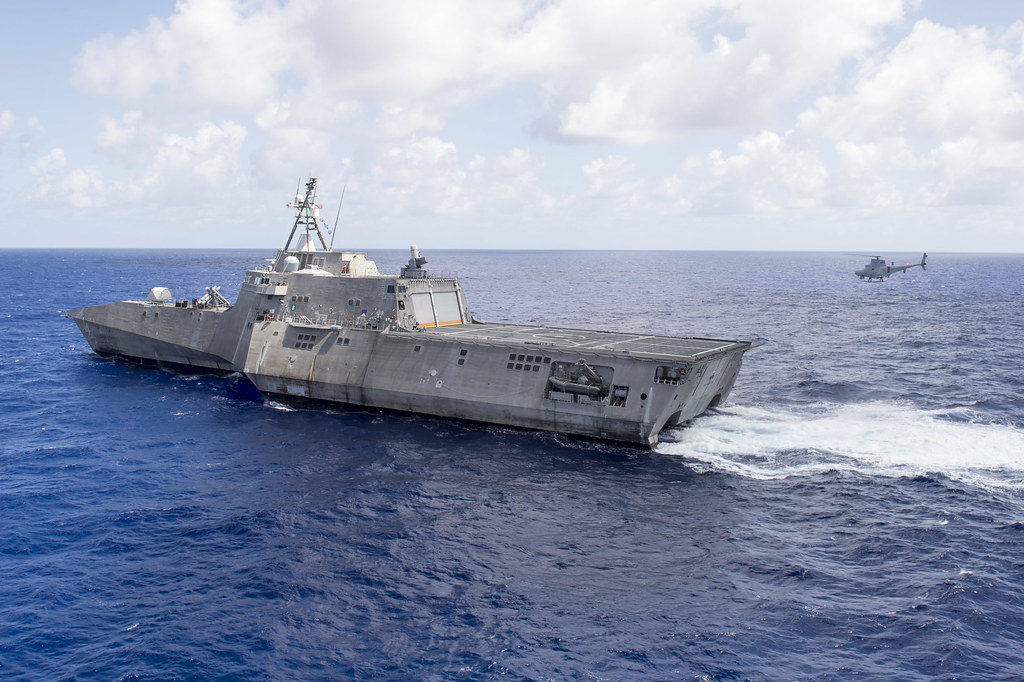
In this file photo, an MQ-8B Fire Scout approaches USS Coronado (LCS 4) during operations in the Pacific. (U.S. Navy/MC2 Michaela Garrison) >>

LANGKAWI, Malaysia - Assets from the U.S. Navy and Air Force are on display at the Langkawi International Maritime and Aerospace (LIMA) Exhibition 2017, March 21-25.

Founded in 1991, LIMA is a biennial event which has become a premier destination for aerospace and maritime manufacturers. The U.S. last participated in LIMA in 2015.

"LIMA is a tremendous opportunity for the United States military to engage with counterparts in southeast Asia and to showcase our capabilities and assets," said U.S Ambassador to Malaysia, Kamala Shirin Lakhdir. "It is also an opportunity for U.S. companies to expand their markets in southeast Asia. The strong U.S. presence at LIMA this year demonstrates our increased engagement with Malaysia and our commitment to the region."

U.S. Navy assets featured at LIMA include littoral combat ship USS Coronado (LCS 4) and embarked MH-60S Sea Hawk helicopter and two MQ-8B Fire Scout unmanned helicopters.

Additionally, two F/A 18F Super Hornets from Strike Fighter Squadron (VFA) 102, and one P-8A Poseidon from Patrol Squadron (VP) 10 will be on display throughout the exhibition.

14 March 2017

USA: Exercise Cope North Concludes in Guam

Exercise Cope North 2015 participants and aircraft
By Air Force Senior Airman John Linzmeier 18th Wing

KADENA AIR BASE, Japan, March 13, 2017 — Airmen and aircraft from the 67th Fighter Squadron, 909th Air Refueling Squadron, 961st Airborne Air Control Squadron, and 18th Aeromedical Evacuation Squadron returned here after participating in Exercise Cope North.

The exercise was held at Andersen Air Force Base, Guam.

Exercise Cope North Guam aims to cultivate regional ties and seeks to enhance the Air Force's interoperability with allied forces in the Pacific region. The bilateral exercise is designed to enhance joint operational capability alongside 22 flying units from the Japan Air Self-Defense Force, Royal Australian Air Force, and the U.S. Air Force, Navy, and Marine Corps.

04 March 2017

Industry: Royal Australian Air Force and Airbus partner on KC-30A future capability roadmap

A RAAF KC-30A in-flight refueling an F-35 via the Boom
Melbourne, 2 March 2016: The Royal Australian Air Force (RAAF) and Airbus today signed a research agreement to further develop the RAAF KC-30A’s capabilities.

The agreement strengthens the industrial partnership between Airbus and Australia’s defence force, and will help to define the evolution of the KC-30A fleet as it reaches operational maturity and expand its capabilities.

This will result in the KC-30A’s core transport and refuelling capabilities supporting the RAAF’s transformation into a fully integrated force, capable of tackling complex contemporary defence and security challenges.

The agreement’s first milestone is the joint development of the automatic air-to-air refuelling (A3R) concept, which represents a major step forward in in-flight refuelling.

03 March 2017

News Story: Australian tankers to get automatic midair refueling capability

A RAAF KC-30A MRTT mid-air refuels a F-35 via it's Boom
By: Nigel Pittaway

AVALON, Australia — The Royal Australian Air Force (RAAF) signed a research agreement with Airbus Defence and Space to develop an automatic air-to-air refueling capability for its KC-30A multirole tanker transport aircraft.

Chief of Air Force Air Marshal Leo Davies signed the agreement with Airbus DS boss Fernando Alonso at the 2017 Australian International Airshow at Avalon on Thursday.

The agreement will see an RAAF aircraft involved in the testing of the system, which has been under development by Airbus DS for some time.

Davies also used the opportunity to announce that the Australian government had signed off on final operational capability for the KC-30A.

“A lot of hard work has gone into the development of this capability, and we are now able to go into the next phase,” he said. 

Read the full story at DefenseNews

02 March 2017

AUS: Final operational capability for KC-30A MRTT

A RAAF KC-30A MRTT refueling a RAAF E-7 Wedgetail
The Minister for Defence, Senator the Hon Marise Payne, today congratulated Royal Australian Air Force on the achievement of Final Operational Capability (FOC) for the KC-30A Multi-Role Tanker Transport aircraft fleet.

Minister Payne said the KC-30A was a significant capability multiplier for our Air Force, which has proven itself over Iraq as part of Operation OKRA.

“This is a significant milestone for the fleet, which is now able to refuel a range of aircraft from our Air Force and our international partners,” Minister Payne said.

“The KC-30A has been an outstanding asset over Iraq on Operation OKRA, having offloaded over 74 million pounds of fuel to coalition aircraft, including Australia’s F/A-18A Hornet and E-7A Wedgetail aircraft. It is on the front line, making sure the Hornets can take the fight to Daesh effectively.

“Just one KC-30A can support the deployment of four fighter aircraft over 5000km, with 50 personnel and 12 tonnes of equipment. It is an extremely versatile aircraft that is suited to the long ranges of the Australian continent.”

The Chief of Air Force, Air Marshal Leo Davies said FOC for our KC-30A MRTT is a critical component of our aviation capability.

17 February 2017

AUS: F-22 Raptors and F/A-18A/B Hornets commence combined training

Image: © Commonwealth of Australia
This week the United States Air Force F-22 Raptors commenced training with the Royal Australian Air Force’s (RAAF) F/A 18 Hornets for the first enhanced air cooperation activity in Australia.

Enhanced air cooperation is part of the United States Force posture initiatives and builds on a range of air exercises and training activities already undertaken by the United States and Australia.

Wing Commander Andrew Tatnell, Commanding Officer 17 Squadron, said the F-22 Raptors from the 90th Fighter Squadron, 3rd Wing were visiting RAAF Base Tindal to conduct integrated training opportunities with the RAAF’s 75 Squadron F/A-18A/B Hornets along with ground assets and personnel.

“The F-22 is one of the world’s most advanced fifth generation fighter aircraft,” Wing Commander Tatnell said

“Combined training activity will vastly enhance the Royal Australian Air Force’s ability to integrate with the United States Air Force’s fifth generation aircraft while introducing fifth generation operations to RAAF Base Tindal.

20 January 2017

Industry: Northrop Grumman Partners with Air France Industries KLM Engineering & Maintenance on Australian KC-30A Through-Life Support Program

A RAAF KC-30A refuels an F-35 during an operational test
SYDNEY, Australia – Jan. 18, 2017 – Northrop Grumman Integrated Defence Services (IDS), a fully-owned Australian subsidiary of Northrop Grumman Corporation (NYSE: NOC), has signed an agreement with Air France Industries KLM Engineering & Maintenance (AFI KLM E&M) for the provision of services in support of the Royal Australian Air Force’s (RAAF) fleet of KC-30A Multi-Role Tanker Transport (MRTT) aircraft. Northrop Grumman IDS is the prime contractor for MRTT Through-Life Support (TLS).

“We are excited to have reached this agreement with AFI KLM E&M,” said Ian Irving, chief executive, Northrop Grumman Australia. “Partnerships such as this are an important way for Northrop Grumman to support the Australian Department of Defence’s ‘smart buyer’ philosophy. By leveraging huge commercial supply chains and expertise in order to provide competitive pricing for MRTT maintenance, this agreement will increase the program’s value and effectiveness.”

The agreement will provide the Australian MRTT program with improved access to an experienced, world-class aftermarket organisation. As a result, Northrop Grumman will also have increased access to a worldwide network and a more streamlined process of materiel management solutions leveraging AFI KLM E&M’s global expertise and footprint.

Industry: Northrop Grumman Partners with Lufthansa Technik on Australian KC-30A Through-Life Support Program

A RAAF KC-30A MRTT refuels a RAAF E-7 Wedgetail
SYDNEY, Australia – Jan. 18, 2017 – Northrop Grumman Integrated Defence Services (IDS), a fully-owned Australian subsidiary of Northrop Grumman Corporation (NYSE: NOC), has signed an agreement with Lufthansa Technik AG for the provision of services in support of the Royal Australian Air Force’s (RAAF) fleet of KC-30A Multi-Role Tanker Transport (MRTT) aircraft. Northrop Grumman IDS is the prime contractor for MRTT Through-Life Support (TLS).

“This agreement between Northrop Grumman and Lufthansa Technik provides the potential for significant savings for the Australian government,” said Ian Irving, chief executive, Northrop Grumman Australia. “This access to parts and expertise through this agreement is an important part of our vision to build Northrop Grumman as a regional support hub for a range of aircraft types for Australian and regional air forces.”

The agreement will provide the Australian MRTT program with improved access to a global inventory network, landing gear services and a reduction in component repair times through Lufthansa Technik’s commercial expertise. It also allows for future extension for support of parts and general maintenance to other aircraft types.

10 January 2017

News Story: China Receives First Advanced Su-35 Flankers From Russia

An Su-35 Flanker-E of the Russian Air Force
By: Mike Yeo

MELBOURNE, Australia — China has taken delivery of the Sukhoi Su-35 “Flanker-E” fighter jet from Russia, according to Chinese state media. 

The Chinese military confirmed that it took delivery of four Su-35s in late December, the English-language China Daily newspaper reported without providing further details.  

However, an Ilyushin Il-76 transport aircraft belonging to Russian charter company Volga-Dnepr was noted on the live flight-tracking website Flightradar24. The aircraft was flying from Komsomolsk-on-Amur, where the Su-35 is built by the Komsomolsk-on-Amur Aircraft Production Association (KnAAPO), to Cangzhou-Cangxian Airbase in China’s Hebei Province before carrying on to Suixi Airbase in Guangdong Province on December 25. 

Cangzhou-Cangxian is the home of the Flight Test and Training Centre (FTTC), the People’s Liberation Army Air Force (PLAAF) unit responsible for developing flying procedures, combat tactics and training programs for new aircraft types. Suixi is the nearest PLAAF base to the disputed islands of the South China Sea. 

It is not known if the Il-76 was accompanying the Su-35s, or operated as a separate flight carrying support equipment and spares for the newly-delivered fighters. China has also not released any official photos of its Su-35s, although grainy images purporting to be the PLAAF Su-35s have been published on Chinese social media.

Read the full story at DefenseNews

News Story: U.S. military to resume contentious Osprey aircraft refueling exercises in Japan's Okinawa

V-22 Osprey Tilt-Rotor Aircraft
TOKYO, Jan. 5 (Xinhua) -- Japan's Defense Ministry announced Thursday that the U.S. military will resume from Friday aerial refueling training for the contentious Osprey aircraft in Japan's Okinawa Prefecture.

The announcement came less than a month after one of the MV-22 Osprey aircraft deployed at the U.S. Futenma base in the city of Ginowan made a water crash-landing off Okinawa on Dec. 13, 2016, injuring two of the five crew members aboard.

The incident, according to the U.S. military, was caused by a damage to the aircraft's propeller in the process of aerial refueling training by a refueling plane.

Following the accident, Japan had asked the U.S. military to suspend its Osprey flights in Okinawa until the cause of the accident is known and safety is ensured.

The U.S. Military, however, resumed Osprey flights in Okinawa less than a week later, saying the accident was not caused by any problem with the aircraft itself, despite safety concerns and protests of the local people.

Read the full story at Xinhua

05 November 2016

News Report: US, S. Korea, UK Invincible Shield Drills to Take Place in Korea on Nov. 4-10

Eurofighter Typhoon
Trilateral military exercises with participation of servicemen from the United Kingdom, the United States and South Korea are expected to start at the Korean Peninsula on Friday and to last until November 10.

MOSCOW (Sputnik) — The first drills with participation of the three countries dubbed Invincible Shield were announced in September and were aimed at training in countering Pyongyang in the event of a war on the Korean peninsula.

According to the South Korean Air Force, the servicemen from the three countries will hold the drills at the Osan Air Base in Pyeongtaek located south of the country's capital. 

South Korean media reported that the United Kingdom would send Eurofighter Typhoon combat jets, Voyager tanker aircraft and C-17 Globemaster transport aircraft to participate in the drills, the United States would be represented by F-16 fighter jets, while the host nation would participate in the drills using the F-15K and KF-16 fighters.

This story first appeared on Sputnik & is reposted here with permission.

11 October 2016

News Story: Australia Gets Its Air Force One

A KC-30A MRTT Tanker Aircraft
Amy Remeikis

Australia is getting its own Air Force One – albeit a budget version.

After years of deliberations and political hesitancy, the Defence Department has been given the go-ahead to convert a KC-30A air-to-air refuelling aircraft, essentially an Airbus A330, into the VIP jet, replacing the ageing leased fleet.

First floated in a white paper, Defence has admitted, five months after it was first asked, it is moving ahead with modifications of one of its $204 million refuellers to give the Prime Minister an office in the air.

The new VIP jet is to be kept "modest" with only the minimum required modifications, remain capable of acting as an air-to-air refueller, but will also allow for "the continuance of Government business whilst in transit", meaning the Prime Minister will remain in contact at all times.

The government has chosen the cheapest of the options available to it, following former British prime minister David Cameron's lead. Defence confirmed it was "managing the modification",  with the cost to come from $190 million already set aside to alter planes according to the air force's needs. Britain managed it for £10 million, which equates to about $16.5 million.

Read the full story at Sydney Morning Herald

29 September 2016

News Story: Mixed Prospects for Boeing Military Aircraft

by Chris Pocock

The future sales prospects for Boeing’s military aircraft are mixed at present. The F-15 and F-18 production lines now seem more likely to extend into the next decade with more sales to the Middle East, now that political objections in Tel Aviv and Washington appear to be subsiding. A sale of fourKC-46 tankers to Japan has now been formally notified, but some U.S. Air Force (USAF) leadership has suggested that the service will buy no more than the 179 aircraft to which it is already committed. Meanwhile, Boeing faces stiff competition for the USAF JSTARS replacement, while arguing that the 737-800 airframe that it has proposed for that near-term requirement is also suitable as an AWACS and Rivet Joint SIGINT platform further in the next decade. All three missions are currently flown by Boeing 707 derivatives.

Kuwait is reportedly seeking 28 F-18s and Qatar 36 F-15s, with options for 36 more. The potential sales are yet to be formally approved and notified by the U.S. government. But the recent U..S 10-year, $38billion arms supply agreement with Israel might help clear the way. That agreement might even result in Boeing supplying more F-15I Strike Eagles to Israel, which received 25 of them in the mid-1990s. Boeing is still offering various avionics upgrades to the F-15, some of which are found on the 84 F-15SAs for Saudi Arabia that are now in production. But the company has dropped the full set of “Silent Eagle” stealth airframe modifications that it first proposed in 2009. As for the F/A-18, Boeing is still proposing the Advanced Super Hornet upgrades, some of which flew in mid-2013.

Read the full story at AINonline