Showing posts with label Samoa. Show all posts

01 September 2017

USA: Acting Assistant Secretary of State Susan Thornton to Lead U.S. Delegation to the Pacific Islands Forum

Acting Assistant Secretary of State for East Asian and Pacific Affairs Susan Thornton will lead a high-level U.S. government delegation to the 29th Pacific Islands Forum Leaders Session with Forum Dialogue Partners (PIF FDP) on September 7, 2017 in Apia, Samoa. Her visit will demonstrate U.S. commitment to our continuing close partnership with the Pacific Islands in promoting sustainable growth and prosperity, ensuring regional stability, and addressing environmental concerns.

The U.S. delegation will include senior officials from the U.S. Department of State, Department of Defense, U.S. Coast Guard, and the U.S. Agency for International Development. The PIF FDP will provide a forum for U.S. and Pacific Islands leaders to discuss issues of regional and global importance including security, climate change, marine conservation, sustainable development, and health. Acting Assistant Secretary Thornton will conduct bilateral consultations with heads of state of Pacific Islands Forum members and other senior foreign officials.

Acting Assistant Secretary Thornton will host a roundtable with Pacific Islands leaders. While in Samoa, she will also tour a U.S. Department of Defense’s Overseas Humanitarian, Disaster, and Civic Aid (OHDACA) funded school renovation project at Safata College and speak at a reception honoring recipients of U.S. Embassy Apia’s public diplomacy grant funding.

19 February 2016

USA: Assistant Secretary Russel Travel to Samoa, Tonga, and Palau

Assistant Secretary of State for East Asian and Pacific Affairs Daniel Russel will travel to Apia, Samoa; Nuku'alofa, Tonga; and Koror, Palau, February 20-25, for bilateral meetings and regional consultations. Commander of the U.S. Pacific Fleet Admiral Scott Swift will accompany Assistant Secretary Russel.

This high-level trip demonstrates the United States’ enduring commitment to the Pacific Islands region and the whole-of-government approach to enhancing our bilateral political, economic, and security relations in the Pacific. The trip also underscores continued U.S. support to the issues that are of utmost importance to the Pacific Islands, including climate change, the ocean, maritime security, women’s empowerment, sustainable development, and health.

In Apia, Samoa, Assistant Secretary Russel will meet with Samoan government officials and visit U.S. Government-supported projects that bolster security, women’s empowerment, and environmental protection.

In Tonga, Assistant Secretary Russel will meet with Tongan government officials in Nuku'alofa and visit a USAID coastal community adaptation project site in Popua.

In Koror, Palau, Assistant Secretary Russel will meet with the president of Palau and senior officials, make a televised address to a joint session of the Palauan legislature, and have bilateral meetings with the presidents of the Republic of the Marshall Islands and the Federated States of Micronesia who will be in Palau for the Micronesian Chief Executives’ Summit.

02 May 2015

AUS: Papua New Guinea joins Pacific Maritime Security Program

Users of the Pacific class Patrol Boat supplied by Australia

Papua New Guinea today advised it would join the Pacific Maritime Security Program.

Papua New Guinea is now the twelfth regional partner to join the Pacific Maritime Security Program.

This Program provides a regional solution to regional security issues. Papua New Guinea’s participation further strengthens the benefits of the cooperative program, expanding the region’s capacity to secure maritime resources and provide humanitarian assistance.

The Pacific Maritime Security Program will replace the current Pacific Patrol Boat Program as the centrepiece of Australia’s security engagement in the South Pacific.

The initiative includes delivery of replacement Australian-built Pacific Patrol Boats, integrated aerial surveillance activities, and enhancement to regional coordination.

Australia will build up to 21 new patrol boats, creating $594 million worth of Australian defence industry opportunities, plus a further $1.38 billion to support 30 years of through-life sustainment and personnel costs.

Other Pacific Maritime Security Program partners include Solomon Islands, Palau, the Federated States of Micronesia, Kiribati, Samoa, Vanuatu, Fiji, Tuvalu, Tonga, Cook Islands and the Republic of the Marshall Islands.

07 March 2015

Editorial: New Zealand's Mass Surveillance of Pacific States Exposed


By Ankit Panda

New Zealand’s Government Communications Security Bureau conducts mass surveillance of several Pacific states.

Reports citing classified documents leaked by U.S. National Security Agency whistleblower Edward Snowden state that New Zealand is carrying out mass surveillance over several Pacific island states, including  Fiji, Papua New Guinea, the Solomon Islands, Nauru, Samoa, Vanuatu, Kiribati, New Caledonia, Tonga and French Polynesia. The New Zealand Herald notes that the data gathered was shared with the other members of the “Five Eyes” intelligence-sharing network, a grouping encompassing the United States, Australia, the United Kingdom, and Canada. New Zealand’s Green Party has lodged a complaint with the country’s Inspector General of Intelligence and Security claiming that the Government Communications Security Bureau (New Zealand’s intelligence agency) broke the law by spying on, among other target, New Zealand citizens’ activities in the aforementioned states.
Diplomatically, the revelations will likely cause a problematic backlash for Prime Minister John Key’s government. The nations included in the Snowden documents as targets of New Zealand’s mass surveillance are all friendly with New Zealand. The Intercept, which hosted the leaked documents, notes that the surveillance “is being carried out by GCSB from an intelligence base in New Zealand’s Waihopai Valley.” The report adds:
Intercepted data collected at the Waihopai site is being shared through an NSA surveillance system called XKEYSCORE, which is used to analyze vast amounts of emails, internet browsing sessions and online chats that are intercepted from some 150 different locations worldwide. 
Read the full story at The Diplomat

05 March 2015

AUS: Tender announced for Pacific Patrol Boat Replacement Project

Pacific class Patrol Boat HMPNGS Drege

Today, the Government announces the Request for Tender (RFT) for the replacement – Australian-made – Pacific Patrol Boats under the Pacific Maritime Security Program, Project SEA3036 Phase 1.

This project represents a significant investment in Australian defence industry with the Australian-made patrol boats worth $594 million in addition to through life sustainment and personnel costs estimated at $1.38 billion over 30 years.

Building towards the release of the Defence White Paper, in December last year, the Government announced a plan that will allow for a sustainable naval shipbuilding industry that supports shipbuilding jobs. The Government recognises the significant value to our nation of a skilled naval shipbuilding workforce. 

The current Pacific Patrol Boat Program is the centrepiece of the Australian Government’s engagement in the South Pacific.

10 October 2014

Editorial: Peacekeeping - Australia The Persistent

Map of Existing Pacific class Patrol Boat users

October 9, 2014: Australia is spending nearly $2 billion to replace the 22 Pacific Forum class patrol boats they built and gave to twelve Pacific Island nations in the 1980s and 90s. This is part of the Pacific Patrol Boat Program, which was started in the 1980s. The twenty new patrol boats will go to the original twelve (Papua New Guinea, Tonga, Solomon Islands, Fiji, Tuvalu, Kiribati, Samoa, Vanuatu, Federated States of Micronesia, Palau, Republic of Marshall Islands and Cook Islands) members plus East Timor. The patrol boats are used for things like fisheries protection, search & rescue and dealing with smuggling. The original boats were 31.5-meters (101 feet) long and designed to last at least 15 years. As those original boats reached their service limit it was noted that they had held up better than expected. So Australia refurbished them but now these original boats are definitely in need of replacement. About a third of the money will go for building the new patrol boats while the rest will be spent over the next 30 years to help maintain and operate the boats.

PNG Pacific class Patrol Boat HMPNGS Dreger
The Pacific Patrol Boat Program is one of many efforts by the more affluent (like Australia and New Zealand) Pacific nations to assist the many poor Polynesian and Melanesian states that were formed since the 1950s. While the Polynesian nations of the south and central Pacific mainly need economic and technical assistance, the Melanesian nations (Papua, the Solomons, East Timor and a few others) are not only closer but more often in need of peacekeepers (occasionally) and help (more frequently) with internal security. As a result of those needs Australia has found itself, often against its will, deputized as the policeman of Melanesia. It's a thankless task that has sent Australian peacekeepers to several different island trouble spots since the 1990s.

Read the full story at Strategy Page

02 July 2014

Editorial: Australia Launches New Pacific Patrol Boat Program

Pacific class Patrol Boat (File Photo)

By Shahryar Pasandideh

Providing patrol boats to its island neighbors gives Australia influence and stability in its emerging periphery.

In an attempt to bolster its influence and help improve regional security, Australia has announced a new Pacific Patrol Boat Program that will provide new patrol boats to twelve Pacific nations. The $1.88 billion program was announced on  June 17 by Australia’s foreign and defense ministers. The new vessels will replace those previously donated by Australia that are approaching the end of their service life. The announcement signals Australia’s intention to keep its role as a regional leader through security assistance to its less wealthy island neighbors.
The new all-steel patrol boats will replace the twenty-two 162-ton Pacific-class patrol boats that Australia donated to its neighbors between 1987 and 1997 in the first Pacific Patrol Boat Program. The original impetus was the passage of the 1982 United Nations Convention on the Law of the Sea (UNCLOS). UNCLOS divided formerly international waters mainly through the establishment of Exclusive Economic Zones (EEZ) that extend 200 nautical miles (370 kilometers, or 230 miles) from the shores of each country. This had a particular impact on the small Pacific island states as they suddenly acquired the responsibility to police and regulate activities across vast stretches of water. For example, Kiribati alone has 3,441,810 square kilometers of EEZ, the 13th largest in the world, larger than the total land area of India. The new program will deliver patrol boats to Tonga, the Solomon Islands, Palau, Papua New Guinea, Fiji, Tuvalu, Kiribati, Samoa, Vanuatu, the Federated States of Micronesia, the Republic of the Marshall Islands, and the Cook Islands – the original recipients of the program. In addition, Timor-Leste may become a beneficiary of this new program, raising the total number of recipients to thirteen. 

Read the full story at The Diplomat

18 June 2014

AUS: Maritime security strengthened through Pacific Patrol Boat Program

Existing Pacific class Patrol Boat (Wiki Info - Image: Wiki Commons)

A new $2 billion Pacific Patrol Boat (PPB) Program unveiled today by Foreign Minister Julie Bishop and Defence Minister David Johnston aims to significantly strengthen security in our region.

“The Pacific Patrol Boat Program is an important pillar of the Australian Government’s commitment to working with our regional partners to enable cohesive security cooperation on maritime surveillance, including in fisheries protection and transnational crime,” Minister Bishop said. 

“Defence will replace the current fleet of patrol boats for all current PPB members with the addition of  a new member, Timor-Leste (East Timor), which has been invited to join the program, evidence of Australia’s growing defence cooperation program with that country,” said Senator Johnston.

15 August 2013

USA: Pacific Partnership 2013 Comes to a Close


By Mass Communication Specialist 2nd Class Tim D. Godbee

<< U.S. Navy Capt. Wallace Lovely, Pacific Partnership mission commander, and Royal New Zealand Navy Cmdr. David Turner, HMNZS Canterbury’s commanding officer, salute the Pacific Partnership 2013 pennant as it’s lowered from the ship’s mast Aug. 13 in Honiara, Solomon Islands, to conclude this year’s mission. (U.S. Navy photo by MC2 Tim D. Godbee)

HONIARA, Solomon Islands - The sixth phase of Pacific Partnership concluded Aug. 13 in the Solomon Islands, bringing the 2013 edition of the multinational mission to a close.

U.S. Navy forces were joined by several non-governmental organizations (NGOs) and regional partners that included Australia, Canada, Colombia, France, Japan, Malaysia, Singapore, South Korea, and New Zealand with the goal of improving maritime security, conducting humanitarian assistance and strengthening disaster-response preparedness throughout the Indo-Asia-Pacific region.

24 July 2013

NZ: PREPARING IN CALM TO RESPOND IN CRISIS

HMNZS Canterbury MRV (Wiki Info - File Photo)

By LT CDR Vicki Rendall RNZN

Developing relationships, enhancing capability, and making lives better for Pacific nations—these are the aspirations of the Pacific Partnership team in 2013. This year’s NZDF contribution is larger than previously.  New Zealand has provided two deputy mission commanders over the duration of the mission: GPCAPT Darryn Webb and  CAPT Tony Millar.  There are three ships participating, operational divers and EOD teams, over 120 NZDF personnel involved in ground operations and supporting RNZAF flights throughout the Pacific.

“Pacific Partnership 13 is a four-month operation spanning six Pacific nations,” says Deputy Mission Commander, CAPT Tony Millar, RNZN.  “It is a large-scale regional operation designed to provide real world help to local people whilst simultaneously building relationships and cooperation between regional partners in order to be ready deal with a natural disaster or other emergency.

Pacific Partnership originated as a means of improving regional cooperation  after the December 2004 Banda Aceh earthquake and tsunami. “We are all Pacific peoples who live along and within the infamous ring of fire. We have needed to deal with natural disasters in the past and we will have to do it again,” says CAPT Millar.

19 July 2013

USA: Multilateral Pacific Mission Boosts Disaster Response Capacity


By Donna Miles
American Forces Press Service

<< WEWAK, Papua New Guinea (June 15, 2013) Lt. Luke Wolf speaks to residents during a Pacific Partnership 2013 health fair. Working at the invitation of each host nation, Pacific Partnership is joined by partner nations that include Australia, Canada, Colombia, France, Japan, Malaysia Singapore, South Korea and New Zealand to strengthen disaster response preparedness around the Indo-Asia-Pacific region. (U.S. Navy photo by Lt. j.g. Paul Newell/Released) 

WASHINGTON, July 18, 2013 – Two months into the largest disaster response preparedness operation in the Indo-Asia-Pacific region, participants in Pacific Partnership 2013 are taking the mission to the next level in ways the mission commander says will help to ensure its long-term viability despite budgetary constraints.

USS Pearl Harbor, an amphibious dock landing ship serving as the mission’s primary command-and-control platform, arrived earlier this week for an 11-day visit to Kiribati, Navy Capt. Wallace Lovely said during a telephone interview shortly after arriving at the Pacific island nation.

Kiribati is one of six host nations participating in this year’s mission, which kicked off in May, and has paid 10- to 12-day visits to Samoa, Tonga and Papua New Guinea, Lovely reported. Later this month, the participants will continue on to the Marshall Islands before wrapping up the mission in the Solomon Islands.

04 July 2013

USA: Pacific Partnership 2013 Arrives in Marshall Islands


By Mass Communication Specialist 2nd Class Tim D. Godbee

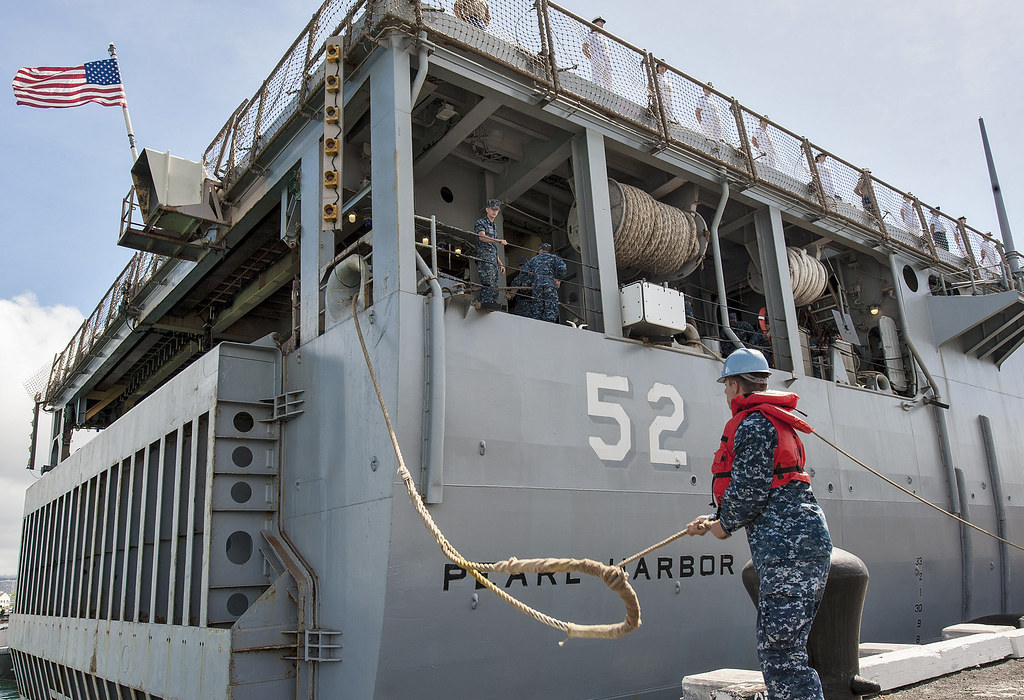
<< MAJURO, Marshall Islands (July 3, 2013) U.S., partner nation service members and non-governmental organization volunteers watch as the amphibious dock landing ship USS Pearl Harbor (LSD 52) anchors off the Republic of the Marshall Islands. (U.S. Navy photo by Mass Communication Specialist 2nd Class Carlos M. Vazquez II/Released)

MAJURO, Marshall Islands - Pacific Partnership 2013 arrived at its third mission port, the Republic of the Marshall Islands, July 3.

U.S., partner nation military members and non-governmental organization volunteers are scheduled to take part in a variety of projects while ashore in the Marshall Islands such as the installation of rain water catchment and filtration, health fairs, engineering projects, disaster response seminars and training with the goal of improving the Marshall Islands' overall disaster preparedness.

"As we've learned previously, no nation can successfully conduct operations in response to major disasters, such as earthquakes or tsunamis, by themselves," said Royal New Zealand Navy Acting Capt. Anthony Millar, Pacific Partnership 2013 deputy mission commander. "It is necessary for nations to be able to work together to achieve a timely response to emergencies. Pacific Partnership provides a great opportunity for nations to practice being able to coordinate and collaborate in host nations."

02 July 2013

AUS: Strong partnerships help improve conditions in Island nations


Australian Defence Force (ADF) personnel are playing a vital role as key contributors to Pacific Partnership, a United States-sponsored humanitarian and civic assistance mission to help improve the lives of people in the Pacific Region.

This year, Pacific Partnership will deliver medical, dental, veterinary, explosive remnants of war disposal and engineering aid to Papua New Guinea, Samoa, Tonga, the Marshall Islands, Kiribati and Solomon Islands. The contributing nations include the US, Japan, New Zealand, Canada, France and Malaysia.

Around one hundred medical and engineering personnel from the US, Japan and the ADF are embarked in landing ship HMAS Tobruk for the mission in Papua New Guinea to administer medical, dental, veterinary and engineering aid.

Rear Admiral Steve Gilmore, Deputy Chief of Joint Operations, said that as well as embarked specialist medical and engineering personnel, Tobruk’s ship’s company was assisting the townships in Vanimo and Wewak which have a combined population of about 40,000.

25 June 2013

USA: Pacific Partnership Arrives in New Caledonia, Bids Farewell to French Engineers


Mass Communication Specialist 2nd Class Carlos M. Vazquez II

<< Partner nation military members watch as U.S. Navy Sailors pull the amphibious dock landing ship USS Pearl Harbor into port in Noumea, New Caledonia, June 25. (U.S. Navy Photo by Mass Communication Specialist 3rd Class Samantha J. Webb)

NOUMEA, New Caledonia - The amphibious dock landing ship USS Pearl Harbor (LSD 52) along with embarked Pacific Partnership 2013 personnel arrived in Noumea, New Caledonia, June 25.

While in port, U.S. and partner nation service members along with non-governmental organization volunteers will get a chance to experience liberty in the city, and continue to foster a relationship with the capitol that dates back to World War II, when Noumea operated as a U.S. Military hub. Also, an engineering element from the Battalion of French Armed Forces Marine Infantry will be departing. The element, stationed in New Caledonia, participated in Pacific Partnership, helping on the islands of Samoa and Tonga with multiple engineering and construction projects.

20 June 2013

AUS: ADF personnel participate in humanitarian mission

HMAS Tobruk (Wiki Info - Image: Wiki Commons)

A large joint contingent of Australian and American personnel are onboard HMAS Tobruk to participate in Pacific Partnership, an annual US-sponsored humanitarian and civic assistance mission aimed at strengthening international relationships with partner and host nations in the Asia-Pacific.

One hundred military medical and engineering personnel are embarked in HMAS Tobruk as part of the seven-week deployment to Papua New Guinea.

The personnel will travel to the townships of Wewak and Vanimo to administer medical, dental, veterinary and engineering aid. Tobruk’s Army detachment also loaded with approximately 100 tonnes of medical and engineering cargo for the mission.

Commanding Officer, Commander Leif Maxfield, said the deployment was a superb opportunity to use Tobruk’s strengths as a heavy lift ship to deliver significant aid to our regional neighbour.

“This sort of mission delivers enormous benefit to some of our closest regional neighbours and completing this kind of deployment with Japan, New Zealand and the United States, adds confidence to our ability to respond to disasters in the Pacific region”, he said.

17 June 2013

AUS: Australian Defence Force participates in Pacific Partnership


Defence medical practitioners and engineers have today (13 June 2013) deployed on Pacific Partnership 2013. Australia’s largest contingent, onboard HMAS Tobruk, will deliver medical, dental, veterinary and engineering aid to Vanimo and Wewak, in Papua New Guinea from 13 June to 6 July 2013.

The annual US-sponsored Pacific Partnership mission aims to strengthen international relationships and improve the interoperability of regional forces in response to natural disaster and humanitarian emergencies. The mission provides humanitarian and civic assistance across the Pacific from 25 May to 19 August 2013.

Defence specialists and command staff will also be onboard the USS Pearl Harbour to deliver assistance to Samoa, Tonga and the Marshall Islands, as well as to Kiribati.

Parliamentary Secretary for Defence Senator David Feeney says the mission is a good opportunity to work with our regional partners.

11 June 2013

USA: Pacific Partnership Departs Samoa for Tonga


By Mass Communication Specialist 3rd Class Samantha Webb

<< Pacific Partnership 2013 non-governmental organization volunteers, U.S. and partner nation service members man the rails as USS Pearl Harbor (LSD 52) departs Samoa, June 10. (U.S. Navy photo by Mass Communication Specialist 2nd Class Tim D. Godbee)

APIA, Samoa - The amphibious dock landing ship USS Pearl Harbor (LSD 52) departed Samoa, the first mission port of Pacific Partnership 2013, June 10.

Mission personnel consisting of U.S. service members, partner nation service members and non-governmental organizations conducted various projects throughout Samoa over the past seven days including multiple community service projects totaling more than 1,600 man-hours.

"For the people in pain we could see that we were helping them," said Royal Australian Air Force Leading Aircraft Woman Kymberley Monck, a dental assistant who conducted exams and tooth extractions throughout the past week.

Monck said the patients she saw couldn't always communicate because of language barriers, but they seemed to be appreciative.

01 June 2013

USA: USS Pearl Harbor Arrives in Samoa for First Mission Port of Pacific Partnership


By Mass Communication Specialist Seaman Samantha J. Webb

<< In this file photo, World Vets volunteers man the rails alongside Sailors as USS Pearl Harbor (LSD 52) arrives in Pearl Harbor May 21 in preparation for Pacific Partnership 2013. (U.S. Navy photo by Mass Communication Specialist 3rd Class Laurie Dexter)

APIA, Samoa - The amphibious dock landing ship USS Pearl Harbor (LSD 52) arrived in Apia, the first mission port of Pacific Partnership 2013, June 1.

A multinational, multiagency team of U.S. service members, partner nation military and non-governmental organization volunteers are scheduled to work at the invitation of the Samoan people, on a variety of projects to include school renovations, health fairs and water catchment construction.

U. S. Navy Hospital Corpsman 3rd Class Jessica Craig will be participating as an optician's assistant helping assess patients' suitability for corrective eyewear.

"I'm a little nervous," said Craig of the mission, "But I'm glad I'm here."

Craig isn't alone when it comes to being excited to begin the mission.

29 May 2013

USA: USS Pearl Harbor Underway for First Pacific Partnership Mission Port


By Mass Communication Specialist Seaman Samantha J. Webb

<< A Sailor handles lines as USS Pearl Harbor (LSD-52) prepares to depart from Joint Base Pearl Harbor-Hickam, May 25. (U.S. Navy photo by Mass Communication Specialist Seaman Johans Chavarro)

PEARL HARBOR, Hawaii - The amphibious dock landing ship USS Pearl Harbor (LSD 52) departed its namesake May 25 for Samoa, the first mission port of Pacific Partnership 2013.

Conducted annually since 2006, Pacific Partnership is the largest disaster preparedness response mission in the Indo-Asia-Pacific Region. The mission was born after U.S. military responded to the needs of people in Southeast Asia following the devastating tsunami in 2004.

Samoa is scheduled to be the first of many mission ports including Tonga, Republic of the Marshall Islands, Papua New Guinea, Kiribati, and the Solomon Islands.

After a visit to the ship on Friday, Adm. Cecil D. Haney, commander, U.S. Pacific Fleet, said he was impressed by the enthusiasm displayed for Pacific Partnership 2013, an important deployment that both builds relationships and improves the multilateral approach needed to successfully respond in the eventuality of a regional crisis or disaster.

"It builds trust, enhances cooperation and opens dialogues between leaders," Haney said of the mission's multilateral approach, "That benefits all Pacific nations including the United States."

This year's mission will partner the U.S. Navy with non-governmental organizations and regional partners including Australia, Canada, France, Japan, Malaysia and New Zealand to improve maritime security, conduct humanitarian assistance and strengthen regional disaster response preparedness. Partner nations will lead individual phases for the first time in the history of the mission.

23 May 2013

Editorial: China in the Pacific Islands - Competition Not Dominance

By Jenny Hayward-Jones

China is a better friend to Pacific Island countries than the United States, says Samoan Prime Minister Tuilaepa. Certainly, the emerging giant’s growing presence in the region has captured the public imagination. But politicians and officials in Australia and the United States are not quite as enthusiastic about that as the Samoan prime minister appears to be.
Indeed, in 2011, then Secretary of State Hillary Clinton described the United States as being in competition with China in the Pacific Islands, and led a resurgence of US commitments to the region. Clinton adopted more conciliatory language when she attended the Pacific Islands Forum Leaders’ meeting in the Cook Islands in 2012, but she also reminded Island states of the history, values and goals the United States shared with them. The Australian government has long called for more transparency around Chinese aid to the Pacific Islands and sought unsuccessfully to persuade China to join the Cairns Compact for Strengthening Development Cooperation in the region. The Australian Defence White Paper 2013 described the growing reach and influence of “Asian nations” (read China) in the Pacific Islands as a challenge and cautioned that Australia’s contributions may be balanced by support and assistance given by “others” (again, read China) in the future.
Although its presence in the Pacific Islands is not new, it is China’s interests in the region in the last five years that have provoked most unease in the capitals of the region’s established international partners. It is tempting for these partners to adopt the popular threat narrative so frequently invoked in debate about China’s role in the wider Asia-Pacific to interpret its rise in the Pacific Islands but this would be wrong.
To understand China’s ambitions in the Pacific Islands we should look not at what American, Australian, Japanese and Pacific Island officials and analysts think are China’s hidden intentions, but at what China is actually doing.

Read the full story at The Diplomat