Showing posts with label Defence Production. Show all posts

23 September 2017

News Report: India's Defense Sector Prepares for 100% Foreign Direct Investment

FDI proposals for 100% have to be in areas where India lacks either the existing capabilities or is not even developing it.

NEW DELHI (Sputnik) — India is planning to further liberalize its defense sector by allowing 100 percent foreign direct investment (FDI) in projects. The move is mainly aimed at curtailing the striking slowdown in the defense sector which has failed to attract huge investments in recent years despite the introduction of sweeping reforms in defense investment rules.

Disclosing the government's agenda, defense ministry officials said that 100 percent FDI would be allowed in cases where foreign firms would be willing for the complete transfer of technology.

"The government of India would be open to considering 100 percent FDI in defense, should the company be willing to provide full technology transfer," Ashok Kumar Gupta, India's Secretary of Defense Production was quoted as saying during his interaction with representatives of US corporate sector.
22 September 2017

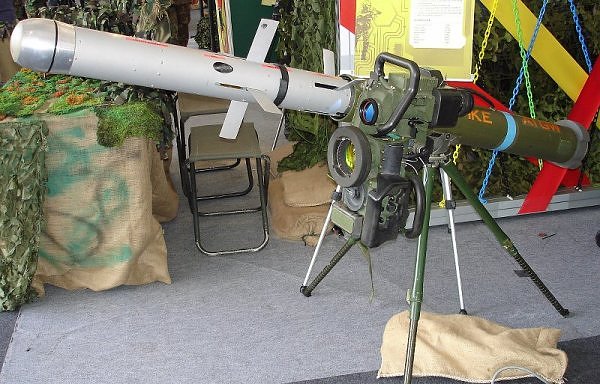
News Story: Varley selected for Australian production of SPIKE LR II missile

Spike anti tank missile (Image: Wiki Commons)
Varley Australia has announced a joint venture with Rafael Advanced Defense Systems for local production and assembly of high-end technologies in support of future Defence contracts.

Varley stated that it has been selected to create a state-of-the-art manufacturing facility in Australia that will provide production and support of the SPIKE LR II missile, after Rafael conducted a comprehensive assessment of Australian manufacturing facilities and operations.

The joint venture would be the first entity to manufacture the SPIKE LR II outside of Israel.

Read the full story at ADBR

13 September 2017

News Story: Indian defense minister to hold daily meetings with chiefs of Army, Navy, Air Force

NEW DELHI, Sept. 12 (Xinhua) -- Indian Defense Minister Nirmala Sitharaman has decided to hold meetings with chiefs of the Army, Navy and Air Force and the defense secretary daily to ensure quick decision-making in her ministry.

"Daily morning meetings with the three services chiefs and a separate daily meeting with the defense secretary have been formatted as a new practice for quick decision-making," the Indian Defense Ministry said in a statement late Monday evening.

With the chiefs of Army, Air Force and Navy and the defense secretary, Sitharaman "will review defence preparedness and allied issues of strategic interests," the statement said.
Previous defense ministers met the chiefs of the three armed forces once a week.

The defense minister will also hold meetings of the Defense Acquisition Council, the highest decision making body on defence procurement, once every two weeks. Earlier the Council met once per month.

Read the full story at Xinhua

08 September 2017

News Story: India's first full-time woman defense minister takes charge

NEW DELHI, Sept. 7 (Xinhua) -- India's first full-time woman Defense Minister Nirmala Sitharaman formally assumed charge of the ministry Thursday.

"I will be the Defense Minister round-the-clock," 58-year-old Sitharaman told the media after taking over from her predecessor, Finance Minister Arun Jaitley, who held the additional charge of the defense portfolio for the past five months.

Spelling out her priorities, the new defense minister said she would ensure armed forces preparedness, speedy implementation of defense deals and defense production with focus on Prime Minister Narendra Modi's "Make in India" initiative.

Read the full story at Xinhua

04 September 2017

News Report: Pyongyang Says It Has Developed a Hydrogen Bomb

North Korea said early Sunday that it had developed a hydrogen bomb that could be loaded into the country's new intercontinental ballistic missile.

The claim from Pyongyang came via official state media. The Korean Central News Agency said leader Kim Jong Un had inspected the device at the country's Nuclear Weapons Institute.

KCNA quoted Kim as describing the weapon as a "thermonuclear weapon with super explosive power, made by our own efforts and technology." He also was quoted as saying that all components of the hydrogen bomb were "100 percent domestically made."

The report included a picture of Kim dressed in a black uniform, posing with a metal object.

News Story: DPRK top leader inspects nuclear bomb making institute

North Korean Dictator Kim Jong Un
PYONGYANG, Sept. 3 (Xinhua) -- Kim Jong Un, top leader of the Democratic People's Republic of Korea (DPRK) has inspected a nuclear bomb producing institute where a H-bomb to be loaded into an intercontinental ballistic missile was recently produced, said official media Sunday.

"Respected Supreme Leader Kim Jong Un guided the work for nuclear weaponization on the spot," said the official Korean Central News Agency (KCNA) without giving specified date of the event.

DPRK official media report news about the top leader usually one day after it takes place.

"He was greeted by senior officials of the Department of Munitions Industry of the Central Committee of the Workers' Party of Korea (WPK) and scientists of the Nuclear Weapons Institute before being briefed on the details of nuclear weaponization," said KCNA.

Read the full story at Xinhua

29 August 2017

News Report: India Begins Production of Missile Equipped LCH to be Deployed at Chinese Border

Light Combat Helicopter - LCH (Image: Wiki Commons)
The 5.8 ton helicopter will provide crucial air support to the armed forces deployed along the Chinese border as it has the power to carry out operational roles under extreme weather conditions at altitudes of 20,000 meters in the difficult Himalayan terrain.

New Delhi (Sputnik) — India's state owned Hindustan Aeronautics Ltd (HAL) has begun production of light combat helicopters (LCH) which are equipped with a 20 mm turret gun, 70 mm rocket, air to air missile, electro optical pod and helmet pointing system.

The production formally commenced on Saturday in Bengaluru in the presence of Defense Minister Arun Jaitley. The LCH is entirely locally designed and developed by HAL.

"The LCH has demonstrated the capability to land and take off from Siachen range with considerable load, fuel, and weapons that are beyond the capacity of any other combat helicopter," HAL said in a statement.

17 July 2017

Industry: Rheinmetall selects Queensland for Military Vehicle Centre of Excellence

Rheinmetall Defence Australia today announced it had selected Queensland as its location for its Military Vehicle Centre of Excellence (MILVEHCOE) and the Australian Headquarters that will be established if the company is successful in securing Australia’s Land 400 combat reconnaissance vehicle program.

Currently the largest supplier of military vehicles to the Australian Defence Force, Rheinmetall will establish the MILVEHCOE as a sovereign industrial capability for the continuous design, manufacture, export and support for military vehicles, turrets and tactical systems. The MILVEHCOE will also draw on a supply network across Australia to deliver products and services from local industry into Rheinmetall’s Global Supply Chain.

Rheinmetall is delivering more than 2500 logistics trucks to the Australian Army under the LAND 121 Phase 3B program and is currently bidding for the supply of the armoured combat reconnaissance vehicle under the Commonwealth of Australia’s Land 400 Phase 2 program.

As a centre of excellence, the MILVEHCOE will be the focal point for the LAND 400 combat vehicles, LAND 121 logistics vehicles, and other complex defence projects. Advanced manufacturing jobs will be created in a wide range of technologies including military vehicle design, medium calibre weapons and ammunition, protection systems, fire control and surveillance systems, and systems engineering and integration.

07 July 2017

News Report: Indian Navy to Splurge on Hundreds of Helicopters for Warships

After the cancellation of two major helicopters tenders, the Indian Navy will soon issue a new tender for 251 helicopters including 140 naval multi-role helicopters.

New Delhi (Sputnik) – The plan to buy 111 light utility helicopters is going to be issued in the next few weeks under the newly-prepared strategic partnership model of country’s defense procurement plan 2016, while another scheme is underway for the 140 multi-role helicopters critical for naval forces, sources told Sputnik.

Under the strategic partnership model, a foreign original equipment manufacturer and one domestic private sector company (strategic partner) will complete the manufacturing plan, where the majority stake will lie with the Indian company. The foreign company will be selected directly by the Indian defense ministry and not the strategic partner from the private sector.

Presently, there is a deficiency to the extent of 100 integral helicopters on existing ships. Indian warship such as INS Chennai, INS Kochi, and INS Delhi are moving without new helicopters. To make up for the deficiency, a mid-life upgrade of 28 Kamov helicopters is being undertaken. Helicopters requirement will go up further as 35 ships are under construction at various shipyards and will be part of the Indian Navy soon. Currently, Indian Navy has 121 ships, 15 submarines and 232 aircraft which may go up to 198 ships and submarines by 2027.

30 June 2017

News Story: Privatizing arms manufacturing has India's federal workforce seeing red

By: Vivek Raghuvanshi

NEW DELHI — The Indian government is contemplating major changes in the state-owned Ordnance Factory Board, which administers 42 armament and ammunition factories across the country, but the workforce is opposing the move. 

The government has already opened some noncore areas of weaponry to the private sector, including ammunition production, and now the plan is to identify some factories and tie up these with private-sector defense companies, thus breaking the monopoly of the Ordnance Factory Board, or OFB, a Ministry of Defence official said. 

The move could eventually lead to privatization of the OFB at a later date, say analysts. However, the workforce, numbering 90,000 in these 42 factories, is opposing the move. 

C Srikumar, general secretary of the All India Defence Employees Federation, told Defense New: "The government is trying to create a monopoly through private models. When price cannot be determined, it is better to have public monopoly as per market principles." 

With a turnover of over $2 billion, the 42 factories under the OFB produce arms, ammunition, artillery guns, tanks, combat vehicles and troop comfort items. Nearly 80 percent of the production goes to the Indian Army, six percent each to the Indian Air Force and the Indian Navy and the remaining eight percent for paramilitary forces. 

Besides opening up products to the private sector, the government is also identifying weapon factories of OFB that can be corporatized resulting in a tie up with private sector defense companies, MoD official said.

Read the full story at DefenseNews

28 June 2017

News Report: Questions Arise as US-India F-16 Deal Seeks to Get Airborne

CGI of Lockheed Martin's F-16 for India (File Photo)
A lucrative aviation deal between US-India firms to manufacture F-16 fighter jets in the south Asian nation has attracted criticism that old technology is being "dumped."

US defense contractor Lockheed Martin has taken further steps to secure a deal which would relocate the manufacture of F-16 fighter jets to India. News of the multi-billion dollar agreement with Indian industry giant Tata Group came as Indian Prime Minister Narendra Modi met with US President Donald Trump in Washington on Monday, June 26.


A press release issued by both firms stated that India will be able to "produce, operate and export the multi(-role) fighter F-16 Block 70 aircraft."

News Story: 22 drones and a summit - The state of India-US defense ties

By: Vivek Raghuvanshi

NEW DELHI — The White House symbolically confirmed its policy to treat India as a major defense partner, following its decision to move ahead with the sale to India of 22 Guardian maritime drones worth about $2 billion prior to a June 26 meeting in Washington between Indian Prime Minister Narendra Modi and U.S. President Donald Trump, say analysts. 

"The fact that the Trump administration made the effort to expeditiously close on the Indian request (for Guardian drones) signals its interest in preserving close relations with India," said Ashley J. Tellis, a senior fellow at the Carnegie Endowment for International Peace. 

India requested to buy the 22 drones in late 2016 under the Obama administration, but the former president left the decision to the new administration. India's request also included the purchase of an unknown numbers of armed drones.

India's wish list still includes that import of armed drones from the U.S., but that sale would require "a major policy change," according to Tellis. 

"The United States has a standing prohibition against export of advanced unmanned aerial vehicles. The only exceptions we've made are to allies involved in combined operations. India's need for armed UAVs is great, but it will take a major policy change for the administration to authorize the sale of armed UAVs to India," Tellis said. 

An Indian Ministry of Defence official said the country will now look to Israel for its acquisition of armed drones, rather than wait for a decision from the U.S. 

Read the full story at DefenseNews

22 June 2017

News Story: Lockheed - Trump's 'Buy American' emphasis unlikely to thwart potential F-16 production in India

CGI of the F-16IN developed for the Indian MMRCA contest
By: Valerie Insinna

LE BOURGET, France — Lockheed Martin is still waiting for India to make a decision on its fighter jet competition. However, in the event of a win, the company feels assured its proposal to move the F-16 line to India won’t raise eyebrows with the Trump administration, despite the president’s focus on keeping jobs in the United States. 

Earlier this year, Orlando Carvalho, executive vice president of Lockheed Martin's aeronautics business area, said the company was keeping a close eye on what U.S. President Donald Trump’s comments would ultimately mean for the proposed move, which is seen as a key incentive for getting India on board. 

But during a June 20 interview at the Paris Air Show, Carvalho said Lockheed’s engagements with officials have bestowed some level of confidence that the administration will ultimately be supportive. 

“We’ve briefed various members of the administration on the program, on what that program would mean for the United States and what it means for India, and throughout all of the briefings and discussions that we’ve done, we haven’t seen any resistance to the program by the administration,” he told Defense News. 

“Given that, 'yes,' for a short answer, we are feeling more comfortable with the administration. It doesn’t see this program as an issue.” 

Read the full story at DefenseNews

20 June 2017

News Report: Tata, Lockheed Martin to Produce F-16 Block 70 Fighter Jet Together in India

CGI of the F-16IN for India
The F-16 Block 70 will be produced in India under a partnership with Tata Advanced Systems Limited (TASL), Lockheed Martin said in a press release on Monday.

The F-16 Block 70, the newest version of the fighter jet, will be produced in India under a partnership with Tata Advanced Systems Limited (TASL), Lockheed Martin said in a press release on Monday.

"Lockheed Martin and Tata Advanced Systems Limited signed a landmark agreement affirming the companies’ intent to join hands to produce the F-16 Block 70 in India," the release stated.

The release noted this "unprecedented" partnership will allow India to produce, operate and export the F-16 Block 70.

The agreement builds on a previous agreement between Lockheed Martin and TASL, which successfully build airframe components for the C-130J airlifter and the S-92 helicopter, the release added.

17 June 2017

News Story: India may sue Polish firm over armored recovery vehicle contract

By: Vivek Raghuvanshi

NEW DELHI — The Indian government may file a lawsuit against Polski Holding Obronny of Poland, formerly known as Bumar, for allegedly not honoring a contract to supply full technology transfer for key systems of armored recovery vehicles, or ARV, to be manufactured in India by state-owned Bharat Earth Movers Limited for the Indian Army. 

“Despite an undersigned contract [worth] $275 million signed in January 2012 for supply of 204 ARVs, the Polish company has ... not given critical technology transfer for ARVs to be manufactured by BEML in India. The Polish company also refused to open performance bank guarantee of $100 million for technology transfer of critical systems for ARVs, and despite several reminders, PHO has refused to honor its commitment," according to an Indian Ministry of Defence official, who spoke to Defense News on condition of anonymity. 

“India is now actively pursuing to file a lawsuit again PHO for not honoring [its] commitment, and [the Indian] government will now recover liquidity damages,” the MoD source added. 

BEML bagged an order from the MoD in November 2011 to produce 204 ARVs with full technology transfer from PHO for the Indian Army’s Russian-made T-72 main battle tanks.

Read the full story at DefenseNews

02 June 2017

News Story: Bharat Electronics forecasts $1.5B in sales as India boosts domestic production

By: Vivek Raghuvanshi

NEW DELHI — India's state-owned defense electronics enterprise Bharat Electronics Ltd., BEL, has increased sales by 17 percent in fiscal year 2017, according to Venkateswara Gowtama Mannava, chairman and managing director. 

“The company has projected the sales to grow from the current level of $1.35 billion to $1.54 billion next year,” Gowtama said. 

He added, “BEL will create new business partnerships with both domestic and overseas defense companies and enforce quick decision making within the company in order to remain competitive in the Indian defense market.”  

The market will become much stronger, he said, because the government has made much quicker decisions and the (procurement) cycle time is shorter. Many of the pending cases have been resolved. 

The list of weapons projects executed for the Indian defense forces include the short-range surface-to-air missile system Akash, a handheld thermal imager with laser range finder systems, a 3-D tactical control radar, a weapon locating radar, upgraded L/70 air defense guns, fire control systems, hull mounted sonars, radio relays systems, major sub-systems of integrated air command and control systems and ship-borne electronic warfare systems. 

Gowtama announced that the company has an order of $6.15 billion. "There is no vertical where we do not have an order at this point of time," he said. 

Read the full story at DefenseNews

News Story: S. Korea to mass-produce anti-tank guided missile

SEOUL, June 1 (Yonhap) -- South Korea is set for the mass-production of the Raybolt medium-range anti-tank guided missile, as it has passed a "quality certification" test, the nation's arms procurement agency said Thursday.

The live-fire test of the man-portable rocket system was successful, held at a Pocheon range, northeast of Seoul, according to the Defense Acquisition Program Administration (DAPA).

The Defense Agency for Technology and Quality (DATQ) also participated in the test of an actual product made by LIG Nex1, a local defense firm.

Read the full story at YonhapNews

23 May 2017

News Story: North Korea says it's ready to deploy, mass-produce new missile

Pukguksong-2  ballistic missile test launch
By: Eric Talmadge

TOKYO — North Korea said Monday it is ready to start mass-producing a new medium-range missile after a weekend test launch confirmed its combat readiness. It called the missile, capable of reaching Japan and major U.S. military bases there, an "answer" to U.S. President Donald Trump's policies. 

The solid-fuel Pukguksong-2 missile flew about 310 miles and reached a height of 350 miles on Sunday before plunging into the Pacific Ocean. North Korea's media said more missiles will be launched in the future. 

Trump, traveling in Saudi Arabia and Israel, had no immediate public comment. 

North Korean leader Kim Jong Un ordered the launch and watched from an observation post, state media reported Monday. The Korean Central News Agency said the test verified technical aspects of the weapon system and examined its "adaptability under various battle conditions" before it is deployed to military units. 

Kim reportedly said the launch was a success, "approved the deployment of this weapon system for action" and said that it should "be rapidly mass-produced." 

North Korea has significantly speeded up its missile tests over the past year or so and appears to be making tangible progress toward developing an arsenal that poses a threat to South Korea and Japan — which together host about 80,000 U.S. troops — and developing an intercontinental ballistic missile capable of reaching the mainland United States. 

Read the full story at DefenseNews

22 May 2017

News Report: Kim Jong-un Approves Mass Production of Successfully Launched Ballistic Missile

Pukguksong-2 ballistic missile test launch
North Korean leader Kim Jong-un ordered on Monday to deploy Pukguksong-2 ballistic missile for combat use.

MOSCOW (Sputnik) — Earlier on Monday media reported, that Pyongyang announced the successful launch of the intermediate-range ballistic missile.

"This type of missile should be rapidly mass-produced in a serial way," Kim said as quoted by Yonhap news agency.

The North Korean leader supervised the launch of Pukguksong-2 missile and expressed satisfaction with its accuracy in hitting targets, according to the outlet citing the North Korean state-run Korean Central News Agency (KCNA).

The ground-to-ground missile launched on Sunday reportedly flew some 500 kilometers (310 miles) before falling into the Sea of Japan short of reaching Japan’s exclusive economic zone.

This story first appeared on Sputnik & is reposted here with permission.

19 May 2017

News Story: (Philippines) Government cautioned on China’s $500-M loan offer

By Paolo Romero

MANILA, Philippines -  Senate President Pro Tempore Ralph Recto cautioned the Duterte administration yesterday against its reported plan to take the $500-million loan being offered by the Chinese government to modernize the Armed Forces of the Philippines.

As this developed, the Philippine National Police said the government of China will be donating 23,000 M4 rifles to the agency to boost its operational capabilities in the countryside.

For her part, detained Sen. Leila de Lima sought an inquiry into the $167-billion infrastructure project of the Duterte administration that would be financed through foreign loans, mostly coming from the Chinese government.

“We must stop relying on foreign suppliers to modernize the… equipment of our armed forces,” Recto said, after hearing Defense Secretary Delfin Lorenzana’s statement that the country plans to avail itself of the loan to procure defense equipment from China.

“There is no need to borrow from China. We should tap our domestic industries for the equipment needed by our policemen and soldiers,” he said.

Recto cited the existence of a vibrant local firearms industry, which has been exporting its products for decades.

“Some of them (are) licensees of (the) world’s leading gun makers,” he pointed out.

Read the full story at PhilStar