Showing posts with label Destroyer. Show all posts

28 September 2017

Industry: Navantia Congratulates (AUS) Navy on the Commissioning of HMAS Hobart

HMAS Hobart (File Photo)
The commissioning of HMAS Hobart (III) into service by the Royal Australian Navy on Saturday, 23 September 2017 marks the achievement of a major milestone for both Navantia Australia and the Australian shipbuilding industry and workforce. The ship was built under the AWD Alliance.

Navantia commenced operating in Australia in 2006 when the AWD Project was just beginning. Since that time and its selection in 2007 as ship designer, Navantia has worked closely with Australia and Australian industry to bring this ship into reality.

“Navantia Australia is very proud of our role as ship designer and shipbuilding management services provider for the AWD Alliance,” said Donato Martínez, Navantia Australia’s managing director. “Through our experience in the AWD program, Navantia Australia has developed strong partnerships with Australian industry and a deep understanding of the Royal Australian Navy and Australian Defence Force requirements.” 

27 September 2017

News Report: USS Ronald Reagan Supercarrier to Conduct Exercises Off Korean Peninsula

The US Navy has announced that the nuclear-powered supercarrier USS Ronald Reagan will be deployed to the Korean Peninsula to participate in joint exercises with the South Korean Navy as part of a continued American military buildup in the region as it faces off against North Korea.

The entire USS Ronald Reagan strike group, which includes four destroyers and two submarines, will be participating in exercises alongside South Korean ships in late October. The Pentagon claims that the exercises have been in the works for a long time, and are not a response to current tensions with Pyongyang.

On Friday, the 100,000-ton Reagan conducted drills with Japanese warships south of the Korean Peninsula as a response to the twin North Korean ballistic missile tests in August and September.

Then on Saturday, a pair of US B-1B Lancer strategic bombers flew within miles of the North Korean border. North Korea did not issue an official response to the mission, leading South Korean intelligence to claim that Pyongyang only found out about the bombers when the Pentagon told them.

News Story: Japan evaluating sites for Aegis Ashore missile defense system

CGI of an Aegis Ashore Ballistic Missile Defense (BMD) System
By: Mike Yeo

MELBOURNE, Australia ― Japan is evaluating locations to base the Aegis Ashore land-based ballistic missile defense system of which it has expressed interest in acquiring to better defend against North Korean ballistic missiles.

According to the Asahi Shimbun newspaper, which quoted Japanese Defense Ministry sources, Japan is looking at placing the Aegis Ashore on two sites along the country’s western coast to give complete coverage against North Korean ballistic missiles.

The newspaper reported that the sites under consideration for the northern system are either the Kamo sub-base in Oga, Akita prefecture, and the Sado sub-base in Sado, Niigata prefecture; for the system covering the southern part of Japan, either the Unishima sub-base in Tsushima or the Fukuejima sub-base in Goto, both in Nagasaki prefecture.

These sites are all part of Japan’s current early-warning and ballistic missile-defense radar network operated by the Japan Air Self-Defense Force, operating a mixture of J/FPS-3, J/FPS-5 and other older radars.

The Asahi Shimbun reported that Japan plans to have its Aegis Ashore systems operational by 2023, although this could be pushed forward if the regional security changes. The newspaper quoted Defense Minister Itsunori Onodera as saying that “we want to introduce the system at the earliest possible schedule”.

Read the full story at DefenseNews

26 September 2017

News Story: Chinese naval fleet returns home after drill with Russia & China, Russia conclude joint naval drills

Chinese Navy Warships (File Photo)
Chinese naval fleet returns home after drill with Russia

SANYA, Sept. 25 (Xinhua) -- A Chinese naval flotilla Monday returned to a military port in the city of Sanya in southern China's Hainan Province after a military exercise with the Russian navy in the Baltic Sea.

The formation, comprising missile destroyer "Hefei," missile frigate "Yuncheng" and supply vessel "Luomahu," was the first Chinese fleet to ever sail in the region for a military exercise.

The joint drill, held in July, was the first phase of "Joint Sea 2017," which had similar exercises in the Sea of Japan and Okhotsk this year.

Read the full story at Xinhua

--

China, Russia conclude joint naval drills

MOSCOW, Sept. 25 (Xinhua) -- The last batch of scheduled exercises in the second phase of the 2017 China-Russia Joint Sea Drills was completed in the Okhotsk Sea near Russia's Far East Federal District on Monday.

Starting in the morning, Chinese and Russian commanders simulated joint rescues of ships hijacked by pirates and ships in distress, and later in the afternoon, fleets of the two sides held a farewell ceremony after the completion of both exercises.

During the entire week-long drills, major Chinese and Russian fleets conducted a string of highly challenging joint operations, including air defense, anti-submarine and anti-fleet actions as well as maritime search and rescue.

Read the full story at Xinhua

23 September 2017

News Report: US Supercarrier Starts New Drills With Japanese Navy South of Korean Peninsula

USS Ronald Reagan; A Nimitz class Aircraft Carrier
The 100,000-ton USS Ronald Reagan convened with one Japanese Maritime Self-Defense Force (JMSDF) helicopter carrier and two destroyers off the Korean Peninsula to conduct military exercises, the Japanese military said Friday.

The drills began September 11 in maritime areas to the south and west of the Japanese archipelago, according to a Friday JMSDF statement, and are slated to conclude September 28.

North Korea has carried out a flurry of ballistic missile and nuclear weapons tests in recent weeks in spite of new UN Security Council sanctions. On September 15, Japanese residents were urged to find cover as a North Korean ballistic missile soared by overhead. On September 3, Pyongyang conducted its most powerful nuclear test ever. Shortly before the nuke test, on August 29, a Hwasong-12 ballistic missile was launched from a site near Pyongyang, observed directly by leader Kim Jong-un as he puffed a cigarette and studied a map.

22 September 2017

News Report: India Begins Deployment of Submarine in Indian Ocean Region After Long Gap

The Shishumar class attack submarine is being accompanied by two other naval vessels and two maritime patrol aircraft on a month-long mission to enhance cooperation with the countries of the Arabian Sea rim.

New Delhi (Sputnik) — India is deploying an attack submarine to the Western Arabian Sea in the Indian Ocean after a long gap. The Indian submarine Shishumar entered Duqm in Oman along with naval ship INS Mumbai and two P-8I long-range maritime reconnaissance aircraft on Wednesday. Meanwhile, naval ship INS Kochi is on its way to join the fleet.

"Indian Naval Ship Mumbai and submarine Shishumar entered Duqm, Oman as part of this deployment to the Western Arabian Sea, after conducting a series of exercises en-route. An Indian naval submarine is visiting a foreign port after a long gap," the Indian Navy said in a statement.

20 September 2017

News Report: US Navy Blames Collisions on Operations Pace, Failure to Prioritize Safety

USS Fitzgerald, after colliding with a container ship 
Carla Babb

WASHINGTON — The U.S. Navy is blaming the high pace of operations, budget uncertainty and naval leaders who put their mission before safety for recent deadly incidents at sea.

The destroyer USS John S. McCain collided with an oil tanker last month off the coast of Singapore, leaving 10 U.S. sailors dead and five injured. And the USS Fitzgerald, another destroyer, collided with a container ship in waters off Japan in June, killing seven sailors.

The collisions are still under investigation, but at a Senate Armed Services Committee hearing Tuesday, the chief naval officer, Admiral John Richardson, said a failure of leadership throughout the service was the main contributing factor in the deadly collisions.

"I own this problem," Richardson testified.

He vowed to make safety the most important goal of the Navy in the wake of recent events, acknowledging that commanders of vessels on forward deployments too often put the mission first, at the expense of safety.

"Only with those [safety certifications] done and the maintenance properly done can we expect to deploy effectively and execute the mission," he said.

At the start of Tuesday's committee hearing, U.S. Senator John McCain extended his "deepest condolences" on behalf of all Americans to the family members of those killed, some of whom sat in the hearing room. The USS John S. McCain was named in honor of the Arizona Republican's father and grandfather, both of whom were Navy admirals.

News Story: Japan deploys PAC-3 missile interceptor near North Korea flight path

A Japanese Patriot PAC-3 Missile System
By: Mari Yamaguchi

TOKYO (AP) — Japan on Tuesday moved a mobile missile-defense system on the northern island of Hokkaido to a base near recent North Korean missile flyover routes.

Defense Minister Itsunori Onodera said a Patriot Advanced Capability-3 interceptor unit was deployed at the Hakodate base on southern Hokkaido “as a precaution” as part of government preparations for a possible emergency.

The relocation came after a North Korean missile was test-fired last week and flew over southern Hokkaido and landed in the Pacific off the island’s east coast — the second flyover in less than a month.

The PAC-3 was brought from another base in Yakumo town on Hokkaido, about 80 kilometers (50 miles) northeast of Hakodate. The system has a range of about 20 kilometers.

Read the full story at DefenseNews

19 September 2017

News Story: China, Russia start joint naval drills

VLADIVOSTOK, Russia, Sept. 18 (Xinhua) -- China and Russia started the second stage of their "Joint Sea-2017" military exercises on Monday with the arrival of a Chinese naval fleet in the Russian port city of Vladivostok.

The exercises are scheduled to take place in the Sea of Japan and the Okhotsk Sea, after the first stage was held on July 22-27 in the Baltic Sea.

It is the first time that the venue of the drills has extended to the Okhotsk Sea. Naval forces from both sides will, also for the first time, conduct joint submarine rescue exercises and joint anti-submarine exercises.

Read the full story at Xinhua

News Story: To shoot down or not? NKorea launch highlights intercept issues

CGI of an Aegis Ashore system (Click Image to Enlarge)
By Thomas Watkins with Shingo Ito in Tokyo

North Korea's latest missile launch over Japan set sirens blaring and triggered alerts telling people to seek shelter -- yet neither Tokyo nor Washington tried to shoot the rocket down.

The test follows one in August that saw another rocket soar over Hokkaido. In that case too, much-vaunted Japanese and US missile-intercept capabilities were not used.

Now some in the United States are wondering why all this sophisticated weaponry isn't being used, especially as North Korean leader Kim Jong-Un accelerates toward his goal of building a nuclear missile capable of striking the United States.

"The next time the North Koreans launch a rocket, especially one that will traverse over our ally Japan, I would hope that we shoot it down as a message to the North Koreans and to other people, like in Japan, who are counting on us," Republican Congressman Dana Rohrabacher told lawmakers this week.

"Unless we demonstrate we're willing to use force, there's no reason for them to believe we will."

The US Pacific Command confirmed Friday's rocket was an intermediate-range ballistic missile (IRBM), and Seoul's defense ministry said it probably traveled around 3,700 kilometers (2,300 miles), hurtling to a maximum altitude of 770 kilometers.

The missile, which fell in the Pacific Ocean, represented North Korea's furthest-ever flight.

Evans Revere and Jonathan Pollack of the Brookings Institution wrote in a paper that Washington should declare that any future North Korean missiles toward or over US or allied territory would be deemed a direct threat that would "be addressed with the full range of US and allied defensive capabilities."

Read the full story at SpaceDaily

15 September 2017

News Story: Japan refuels US missile defense ships under new security laws

TOKYO (Kyodo) -- The Maritime Self-Defense Force has refueled U.S. ships patrolling to counter North Korean missile launches under new security laws that took effect last year, a Japanese government source said Thursday.

The refueling missions to U.S. Aegis ships sailing in the Sea of Japan were conducted multiple times since April, making them the second instance in which Japanese Self-Defense Forces were known to have performed their expanded roles under the security legislation.

The legislation has loosened the constraints of Japan's war-renouncing postwar Constitution imposed on the activities of the defense forces, setting the stage for U.S. and Japanese troops to work more closely than ever.

Top government spokesman Yoshihide Suga said the SDF personnel are engaging in activities to provide supplies to the U.S. military based on the legislation, but refrained from acknowledging specific operations.

"I cannot comment on the issue because it will unveil the details of the operations of the SDF and the U.S. military," the chief Cabinet secretary said at a regular press conference.

In May, the MSDF engaged in a mission to protect a U.S. Navy vessel off Japan for the first time under the legislation, although Tokyo has also not officially confirmed that operation to avoid impacting U.S. military activities and bilateral relations.

Read the full story at The Mainichi

14 September 2017

News Story: Chinese naval fleet departs for joint drill in Russia

Chinese Navy Warships (File Photo)
QINGDAO, Sept. 13 (Xinhua) -- A Chinese naval fleet sailed from a port in Qingdao in east China's Shandong Province Wednesday for Russia's Vladivostok to take part in a scheduled joint military exercise with the Russian navy.

The fleet consists of missile destroyer "Shijiazhuang," missile frigate "Daqing," comprehensive supply ship "Dongpinghu," and submarine rescue ship "Changdao." The fleet is carrying ship-borne helicopters and deep submersible rescue vehicles.

The upcoming drill, which will be held in the Sea of Japan and Okhotsk, is the second phase of an annual joint naval drill between the two countries.

The first stage was held from July 22 to 27 in the Baltic Sea.

Read the full story at Xinhua

08 September 2017

News Story: Japan MSDF says human error behind recent helicopter crash

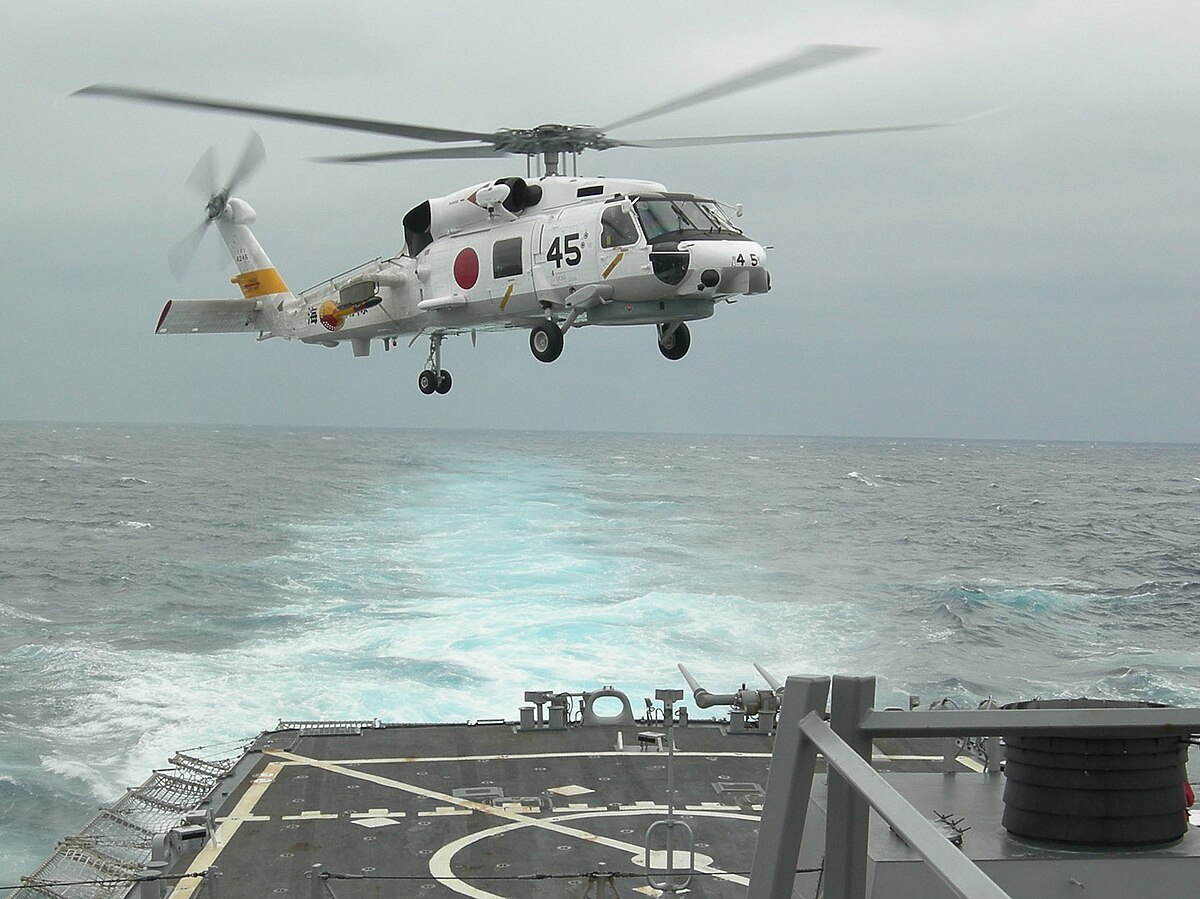
A JMSDF SH-60J Seahawk helicopter (Image: Wiki Commons)
TOKYO, Sept. 7 (Xinhua) -- Japan's Maritime Self-Defense Force (MSDF) said on Thursday that a recent helicopter crash off northeastern Japan was caused by human error, and flights of helicopters of the same type will be resumed.

Three of the four crewmen aboard the helicopter were still missing and the MSDF is continuing searching for them.

A SH-60J patrol helicopter belonging to the MSDF lost contact during a landing and takeoff drill on a destroyer off Aomori Prefecture, northeastern Japan on Aug. 26.

Four people were on board the helicopter. One of them was rescued some 40 minutes after the incident, while the other three remained missing.

Part of the wreckage of the helicopter was found later around the crash area. The water at the crash site is about 2,600 meters deep.

According to the MSDF, based on data from the flight recorder and the account of a rescued crew member, the crash happened when the crew members were focusing on fixing an error with the bearing indicator and failed to notice the chopper was losing balance.

Read the full story at Xinhua

05 September 2017

USA: US, Singapore navies enhance maritime partnership with training in Guam

From Lt. Clyde Shavers, CTF 73-DESRON 7 Public Affairs

USS Benfold (DDG 65) and RSS Endurance (LST 207) steam in formation during exercise Pacific Griffin 2017, Aug. 28. (U.S. Navy/MC1 Benjamin A. Lewis) >>

GUAM - The U.S. Navy and Republic of Singapore navies concluded Exercise Pacific Griffin 2017 at U.S. Naval Base Guam, Sept 2.

Pacific Griffin 17 served as this year’s U.S.-Singapore annual maritime exercise and ran from Aug. 19 through Sept. 2 in waters near Guam. The exercise was coordinated months in advance by planners from both navies.

Pacific Griffin highlights the longstanding maritime partnership between the U.S. and the Republic of Singapore navies through 23 years of annual bilateral exercises.

“The U.S. Navy deeply values our close partnership with the Republic of Singapore Navy,” said Capt. Lex Walker, commander of Destroyer Squadron 7. “Pacific Griffin 2017 provided a unique opportunity for both navies to interact and engage in a broader and more complex range of maritime scenarios and operations.”

04 September 2017

News Report: US to Replace Destroyers Damaged in Accidents at Sea

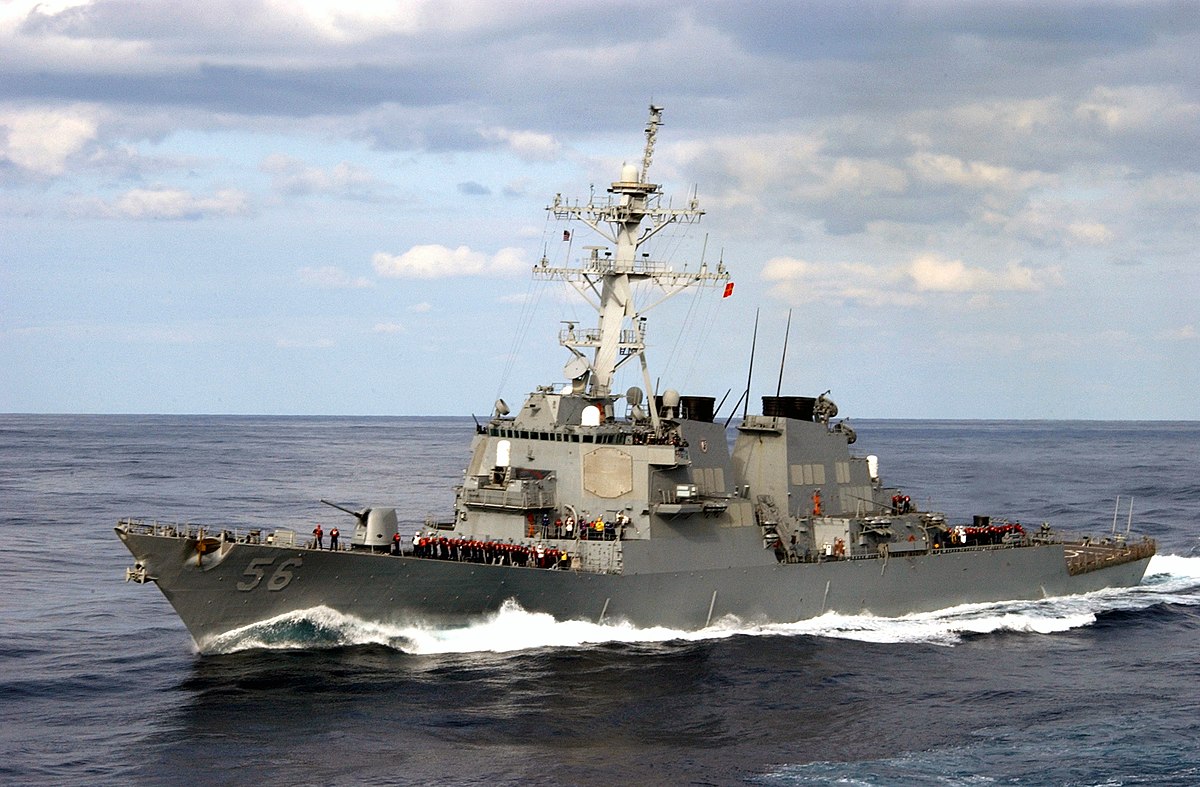
Arleigh Burke class destroyer (Image: Wiki Commons)
The US Navy will replace two Arleigh Burke-class destroyers damaged at sea over the past three months in deadly accidents, according to the US Pacific Command.

The US Navy 7th Fleet will replace two Arleigh Burke-class destroyers, the USS John S. McCain and the USS Fitzgerald, both damaged in deadly collisions with commercial shipping traffic.

The August 21 collision involving the USS McCain saw 10 sailors killed after the US ship struck an oil tanker near Singapore.

The USS Fitzgerald struck a container cargo ship on June 17 near Shizuoka, Japan, about 64 miles south of Tokyo, killing seven sailors.

In both instances the US ships required significant assistance following the accidents, while the ships that they struck were able to continue to their next port under their own power.

01 September 2017

News Story: Japan Defense Ministry seeks missile interceptors in budget

By: Mari Yamaguchi

TOKYO — Japan’s Defense Ministry is seeking a record-high budget to add missile interceptors and other equipment to defend the country from more North Korean weapons launches.

The 5.26 trillion yen (U.S. $47.78 billion) request for the fiscal year beginning next April is a 2.5 percent increase from the current year. A big chunk of the request announced Thursday will cover purchases of upgraded missile interceptors with expanded range, altitude and accuracy.

They include the ship-to-air SM-3 Block IIA jointly developed by the U.S. and Japan and the surface-to-air PAC-3 MSE.

The request comes amid growing fear about North Korea’s missile threat and rising tensions between the U.S. and North Korea. On Tuesday, Pyongyang fired a missile that flew over Japan and landed in the northern Pacific Ocean. It flight tested two intercontinental ballistic missiles in July and has threatened to send missiles near the U.S. territory of Guam, where the U.S. has military bases.

Prime Minister Shinzo Abe called Tuesday’s missile firing an “unprecedented, grave and serious threat.” On Wednesday, Defense Minister Itsunori Onodera, an advocate of bolstering Japan’s missile and strike-back capability, said Tokyo must quickly upgrade its missile arsenal.

China, which is seen by Tokyo as another security concern, questioned Japan’s intentions.

“We think Japan is obliged to explain its real intention to the international community,” Hua Chunying, China’s Foreign Affairs Ministry spokeswoman, told a regular news conference.

Japan has criticized Beijing over its military spending and assertive maritime activity in regional waters.

Read the full story at DefenseNews

News Story: Japan's defense ministry seeks record budget for FY 2018

CGI of an Aegis Ashore System
TOKYO, Aug. 31 (Xinhua) -- Japan's Ministry of Defense announced on Thursday a record-high budget request for the fiscal year 2018, which, if approved, would mark the sixth annual increase since Prime Minister Shinzo Abe retook office in 2012.

The defense ministry's budget request, up by 2.5 percent from this year's initial budget, totals 5.26 trillion yen (47.8 billion U.S. dollars) for the fiscal year starting from April, 2018.

The budget request was compiled by setting the dollar's exchange rate at 110 yen for fiscal 2018, according to the ministry.

Part of the money would be used to introduce a new missile shield system, possibly the land-based Aegis Ashore, but the amount was unspecified as it still needs to be hammered out with the United States, said the ministry.

Japan has so far taken steps to counter any potential launches of ballistic missiles by deploying high-tech Aegis advanced radar-equipped destroyers which are tasked with stopping missiles in the outer atmosphere, and ground-based Patriot Advanced Capability-3 interceptors which will counter the attack at lower altitudes.

The Aegis Ashore system is a land-based version of the Aegis advanced radar system, and with potential to be permanently installed, it is expected to reduce the workload of the Japanese Self-Defense Forces members in missile intercept operations.

Each Aegis Ashore unit costs around 80 billion yen, and Japan would need two units to cover the whole landmass, experts here have said.

Read the full story at Xinhua

31 August 2017

News Report: US Test-Intercepts Medium-Range Ballistic Missile Off Hawaii Coast

USS John Paul Jones (Image: Wiki Commons)
A day after the latest North Korean missile launch, the US military test-intercepted a ballistic missile off the Hawaii coast.

MOSCOW (Sputnik) – The US Missile Defense Agency said it had conducted jointly with the US Navy soldiers missile defense flight test, intercepting a medium-range ballistic missile target off the coast of Hawaii.

"The Missile Defense Agency and U.S. Navy sailors aboard the USS John Paul Jones (DDG 53) successfully conducted a complex missile defense flight test, resulting in the intercept of a medium-range ballistic missile (MRBM) target using Standard Missile-6 (SM-6) guided missiles during a test off the coast of Hawaii today," the statement read.

The vessel detected and tracked the target missile launched from the Pacific Missile Range Facility on Kauai, Hawaii with its onboard AN/SPY-1 radar, the statement read.

30 August 2017

News Story: S. Korean military warns of retaliation against N. Korea

SEOUL, Aug. 29 (Yonhap) -- South Korea's armed forces on Tuesday denounced North Korea's latest ballistic missile launch, warning that it will face "resolute" retaliation if it remains bellicose.

The South's Joint Chiefs of Staff (JCS) noted that it was the North's 13th ballistic missile fired this year. Furthermore, the latest one flew over Japan.

It's a "blatant violation" of the U.N. Security Council resolution against Pyongyang and a grave provocation that threatens the peace and stability of the world, Army Col. Roh Jae-cheon, the JCS spokesman, said in a statement.

The South and the United States will retaliate resolutely against any additional provocations, he added.

Read the full story at Yonhap

29 August 2017

News Report: US Navy - Bodies of All 10 Sailors Recovered from USS McCain

USS John S. McCain in 2003 (Image: Wiki Commons)
The U.S. Navy says divers have recovered the remains of all 10 sailors from the USS John S. McCain, the naval ship that collided with a merchant vessel last week.

Last Monday, the USS McCain became the second U.S. guided-missile destroyer to collide with a commercial vessel in as many months.

U.S. investigators are trying to determine what led to the collision with a Liberian oil tanker near the Strait of Malacca. Navy photos show a gaping hole below the waterline on the destroyer's port (left) side. Some sleeping areas and communications rooms flooded as a result.