Showing posts with label Logistics. Show all posts

23 September 2017

News Story: No Safe Place In Next War - The Army’s Expanded Battlefield

Bradley M2A3 IFVs are unloaded at Busan port RoK (File Photo)
By SYDNEY J. FREEDBERG JR.

What if the next war starts, not with a gunshot, but with a tweet? As tensions rise, US troops discover their families’ names, faces, and home addresses have been posted on social media as they prepare to deploy, along with exhortations to kill the fascists/imperialists/infidels (pick one). Trolls call them late at night with death threats, a mentally ill lone wolf runs over a soldier’s children, fake news claims the military is covering up more deaths, and official social media accounts are hacked to post falsehoods. The whole force is distracted and demoralized.

Meanwhile, defense contractors discover the networks they use to deliver supplies to the military have been penetrated. Vital spare parts go missing without ever leaving the warehouse because the serial number saying which crate they’re in has been scrambled in the database. As railways and seaports prepare to transport heavy equipment, they discover key railroad switches, loading cranes, and other equipment – civilian-owned but vital to the military operation – now malfunction unpredictably, forcing prolonged safety inspections.

US forces finally cut through this cyber thicket and begin to deploy abroad by air and sea – but now the shooting starts. A thousand miles from enemy territory, submarines sink transport ships with torpedoes, cruise missiles and covertly laid mines. A few hundred miles out, long-range anti-aircraft missiles blunt the US air offensive. While stealth fighters can penetrate the defenses, the lumbering fuel tankers that let them cover long distances cannot. Transport planes must unload the troops at airfields well outside the danger zone, while transport ships must unload at distant ports.

US forces face a long road march just to reach the ally they’re supposed to be defending. The whole way, they must fight through attacks by everything from surface-to-surface missiles to local malcontents stirred up by social media. By the time the Americans arrive, their ally’s territory is not only occupied but thoroughly defended by dug-in enemies.

Read the full story at Breaking Defense

15 September 2017

News Story: Japan refuels US missile defense ships under new security laws

TOKYO (Kyodo) -- The Maritime Self-Defense Force has refueled U.S. ships patrolling to counter North Korean missile launches under new security laws that took effect last year, a Japanese government source said Thursday.

The refueling missions to U.S. Aegis ships sailing in the Sea of Japan were conducted multiple times since April, making them the second instance in which Japanese Self-Defense Forces were known to have performed their expanded roles under the security legislation.

The legislation has loosened the constraints of Japan's war-renouncing postwar Constitution imposed on the activities of the defense forces, setting the stage for U.S. and Japanese troops to work more closely than ever.

Top government spokesman Yoshihide Suga said the SDF personnel are engaging in activities to provide supplies to the U.S. military based on the legislation, but refrained from acknowledging specific operations.

"I cannot comment on the issue because it will unveil the details of the operations of the SDF and the U.S. military," the chief Cabinet secretary said at a regular press conference.

In May, the MSDF engaged in a mission to protect a U.S. Navy vessel off Japan for the first time under the legislation, although Tokyo has also not officially confirmed that operation to avoid impacting U.S. military activities and bilateral relations.

Read the full story at The Mainichi

12 September 2017

News Story: Japan, Britain look to sign accord to strengthen joint security drills

Japan and Britain are considering signing a bilateral status-of-forces agreement in a bid to beef up joint drills between Japan's Self-Defense Forces (SDF) and British military, sources familiar with the issue said.

By signing an accord, the Japanese and British governments will aim to clarify legal procedures for dealing with crimes and accidents in which SDF and British forces' personnel are involved while in the other country's territory and facilitate troop operations.

Tokyo and London will go ahead with work toward signing a bilateral status-of-forces pact at an early date at a so-called "two-plus-two" meeting between foreign and defense ministers to be held in Britain as early as this year.

At a joint news conference following a summit meeting between Prime Minister Shinzo Abe and his British counterpart Theresa May on Aug. 31, the two leaders released a joint declaration on security cooperation.

"Britain is an important player in security in the Asia-Pacific region. Our two countries will work more closely in joint drills, defense equipment, technological cooperation and assistance in capacity building efforts," Abe said.

Read the full story at The Mainichi

31 August 2017

News Report: Pakistan - Trump's Afghan Policy 'Hostile and Threatening'

Ayesha Tanzeem

ISLAMABAD — Pakistan’s National Assembly passed a resolution Wednesday strongly denouncing President Donald Trump’s new policy on Afghanistan and calling his and General John Nicholson’s statements on Pakistan “hostile and threatening.”

President Trump had some of the harshest words for Pakistan when he announced his new policy on Afghanistan and South Asia on August 21.

“We have been paying Pakistan billions and billions of dollars at the same time they are housing the very terrorists we are fighting,” he said in a speech.

Soon after, in an interview with an Afghan TV channel, the top U.S. military commander in Kabul, General Nicholson said the U.S. is "aware of the presence" of Taliban leaders in the Pakistani cities of Quetta and Peshawar, and that they should not "sleep in peace."

29 August 2017

News Report: Pakistan Hardens Stance to Trump’s Afghan Strategy

Ayaz Gul

ISLAMABAD — Pakistan appears to have hardened its stance to U.S. President Donald Trump’s recently announced Afghan and South Asia strategy; but, officials dismiss suggestions Islamabad is seeking “confrontation” or a “rupture” in its decades-old relations with Washington.

While announcing his long-awaited policy last week, Trump accused Pakistan of housing “agents of chaos” and “the very terrorists” the U.S. military has been battling in Afghanistan. The policy also attempts to give Pakistan’s archival, India, a major role in security-related regional efforts.

Pakistani leaders responded by saying the U.S. terror charges are an attempt to “scapegoat” their country and accused the American military of failing to defeat the 16-year-old Afghan Taliban insurgency.

Moreover, Pakistan postponed Assistant Secretary of State Alice Wells’ visit to Islamabad, scheduled for Monday, “until a mutually convenient time.”

The development came shortly after Islamabad decided against sending Foreign Minister Khawaja Asif to Washington, where he was scheduled to meet with his U.S. counterpart.

04 August 2017

News Report: Best Birthday Gift - Why China Marks Army Anniversary With Djibouti Base Opening

On Tuesday, China formally opened its first overseas naval logistics center with a flag raising ceremony in Djibouti, the same day as the People's Liberation Army (PLA) marked its 90th anniversary. In an interview with Sputnik some experts said this is a clear sign of China’s determination to uphold its national interests outside the country.

The base in Djibouti is China's first overseas naval base, though Beijing officially describes it as a logistics facility.

According to media reports more than 300 people attended the ceremony, including Chinese deputy naval commander Tian Zhong and Djibouti's defense minister.

The ceremony was held with the participation of Chinese PLA soldiers and the guard of honor of the army of Djibouti. The culmination of the ceremony was the mooring of the ships of the PLA Navy, which headed for Djibouti on July 11.

News Story: Sky's the Limit for Joint Russian-Chinese Eurasian Air Defense Zone

A Russian Air Force Su-35 Flanker Fighter (File Photo)
The commander of the People's Liberation Army Air Force (PLAAF) has signaled China's intention to continue the development of full-fledged cooperation with Russia's Aerospace Defense Forces. Russian military analyst Alexander Khrolenko says the signal of intent is the first step on the road to creating a common air defense in the Eurasian space.

Speaking to reporters at the opening ceremony of the Aviadarts-2017 international army games in Changchun, China, PLAAF commander Maj. Gen. Ma Xiaotian said that Beijing was looking to develop full-fledged cooperation with the Russian air force.

Ma emphasized that China and Russia are "friendly neighbors" which "play an important role in the global arena," adding that "in today's complex and volatile situation in the structure of international relations, both countries have common interests and strategic needs." The Chinese air force is looking to enhance cooperation in a number of areas, from joint tactical flight exercises to cooperation in the fields of missile defense and logistics, according to the officer.

Earlier, Russian Aerospace Forces (VKS) commander Col-Gen Viktor Bondarev praised the state of Russian-Chinese air force cooperation, pointing out that relations between the two countries' air forces were "excellent."

"The Chinese side knows our planes and helicopters, and buys a great deal. I think that in the field of [military] aviation, we have found a balance and continue to work to our mutual benefit in this direction," Bondarev said.

Read the full story at SpaceDaily

20 July 2017

News Report: India Due to Get US Call For Greater Afghanistan Role

India can work closely with the US and Afghanistan in providing security in the war-torn country and supporting wider stability in the region, according to the US Senate Armed Services Committee.

New Delhi (Sputnik)-Indian experts reckon that stakes for New Delhi in Afghanistan are high, but rule out any direct military involvement in the country. More importantly, they say the role of Russia and the expanding Chinese presence cannot be ignored.

The US Senate Armed Services Committee says the US should leverage the capabilities of its allies and partners to more effectively secure regional stability and security. India, as a regional partner to Afghanistan and a major defense partner of the US, is "well-suited" to take part in the role and work on a "trilateral basis with the US and Afghanistan," says a committee report attached to the National Defense Authorization Act (NDAA) 2018.

"The committee also believes that timely actions by the Indian government to fill identified needs in Afghanistan would significantly benefit the short and long-term security and stability of the region. The committee believes that the US needs to recommit to the fight in Afghanistan and that India, as a major defense partner of the US and a contributor to regional security, has a critical role to play in this effort," the Senate Armed Services Committee said, as it passed the NDAA-2018.

17 July 2017

USA: Hawaii gathering focuses on Pacific F-35B deployment

From MC1 Phillip Pavlovich, U.S. Pacific Fleet Public Affairs

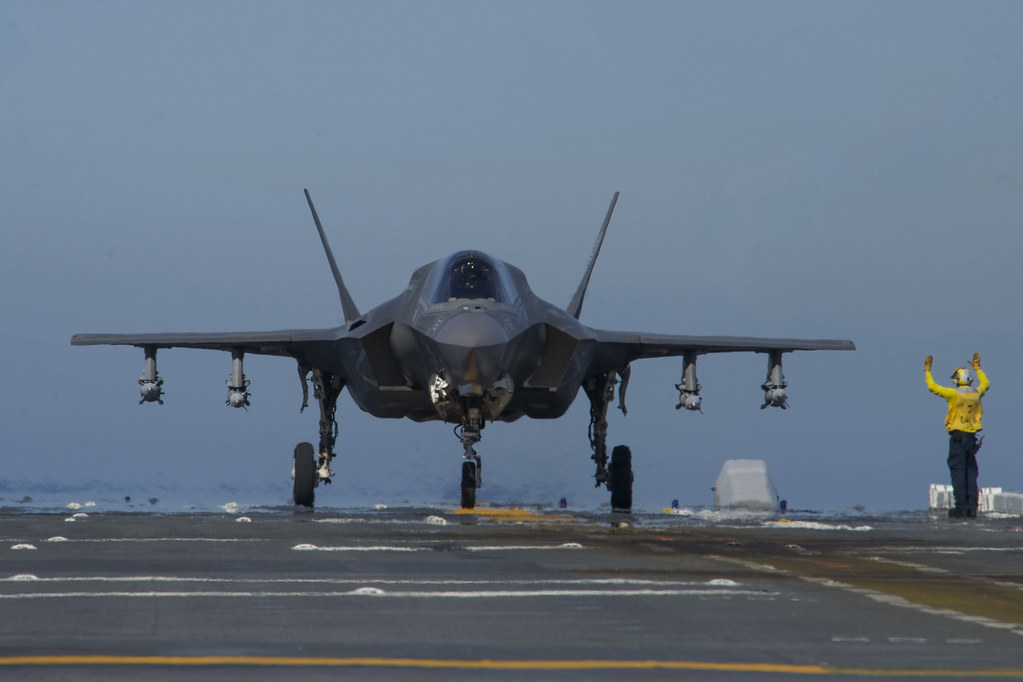
In this file photo, a Sailor directs an F-35B Lightning II aboard USS America (LHA 6) during operational testing in November 2016. (U.S. Navy/MC3 Kyle Goldberg) >>

PEARL HARBOR - Commander, U.S. Pacific Fleet (COMPACFLT) co-hosted a Joint Strike Fighter Sustainment Summit alongside Marine Corps Forces, Pacific at COMPACFLT headquarters, June 27-28.

Attendees focused on planning and preparing the logistical support for the F-35B Lightning II first deployment scheduled to happen within the next year.

"The summit was primarily built to maximize communication, elevate problems, and arrive at solutions. This aircraft has a unique maintenance and support structure, and it is unlike any aviation weapon system presently in the Navy and Marine Corps inventories," said Rear Adm. John Palmer, U.S. Pacific Fleet's director of logistics, fleet supply and ordnance.

A variety of organizations participated, including representatives Lockheed Martin, who built the aircraft, Pratt and Whitney, who built the engine, Marine Corps Headquarters, Defense Logistics Agency, Office of the Chief of Naval Operations, Commander Naval Air Forces Pacific, Commander Naval Air Forces Atlantic, Commander Naval Surface Forces Pacific, and Military Sealift Command.

14 July 2017

News Story: China ships troops to its first overseas base in Africa

China has deployed troops to its first overseas naval base in Djibouti, a major step forward for the country's expansion of its military presence abroad.

Chinese sailors sailed out of a naval base in Zhanjiang in the southern province of Guangdong on Tuesday and towards the Horn of Africa nation, according to a statement posted on the defence ministry's website.

The logistics base is the first of its kind for China, which will use it to support "naval escorts in Africa and southwest Asia, (UN) peacekeeping and for humanitarian support," the statement said.

It will also allow China to evacuate its nationals in a crisis, support anti-piracy activities off Somalia and work with other nations to "jointly defend the security of strategic passages."

The Chinese navy has long assisted in anti-piracy missions in the Gulf of Aden, as well as UN peacekeeping efforts throughout Africa, but the base will be the country's first naval base abroad.

Read the full story at SpaceDaily

12 May 2017

News Story: Locals Upbeat Over Improved Security In Maidan Wardak

Click Image to Enlarge
By Tamim Hamid

Maidan Wardak, which is close to Kabul city and had a reputation of being an insecure province, has made an about turn and is now fairly calm in terms of insurgent activity.

The reopening of Maidan Shahr-Jalrez highway for military conveys is also an indication of improved security in the province, locals said.  

TOLOnews reporter Tamim Hamid, who visited the province, said there were still however roadside mines and the occasional Taliban snipers on the highway.  

Security officials said that the relative calm in security came about after military operations in the past few months.  

“The area has lots of green areas (with many trees) which is in favor of the enemy and we had only problems in two points,” said Mohammad Farooq Hashimi security officer for the Maidan Shahr-Jalrez highway.

“One or two points were vulnerable and challenging for us so we created checkpoints,” said Ghafoor Aziz, Maidan Wardak’s highway security officer.

In recent years, this highway was considered one of the most dangerous in the country but now, after three years, it is once again open to traffic – including supply trucks and military vehicles.  

A few months ago, it had been impossible for security forces to use the highway, however, it is now passable despite the risk of roadside mines. 

Read the full story at TOLOnews

21 April 2017

News Story: Japan, Australia discuss regional security issues, agree to enhance ties

TOKYO, April 20 (Xinhua) -- Japan and Australia on Thursday agreed to strengthen their cooperative efforts to respond to current tensions on the Korean Peninsular as well as boost logistic cooperation between their defense forces.

The so-called "two-plus-two" talks were held in Tokyo between Japanese Foreign Minister Fumio Kishida, Defense Minister Tomomi Inada and their Australian counterparts, Julie Bishop and Marise Payne.

Japanese officials said that security concerns pertaining to the Democratic People's Republic of Korea (DPRK) and its nuclear and missile programs were discussed by both sides, who agreed that they would cooperate with the United States on the issue.

The ministers were also set to discuss the idea of revising a bilateral pact inked in January to extend logistic cooperation between the defense forces of both countries, officials said.

Also chaired for discussion was a possible agreement that would allow for the facilitation of joint exercises by both countries' defense forces on overseas visits to each other.

The reciprocal access agreement is set to be concluded this year, informed sources said.

Read the full story at Xinhua

11 April 2017

News Story: China-Myanmar crude oil pipeline put into operation

MADE ISLAND, Myanmar, April 10 (Xinhua) -- A 140,000-ton crude oil tanker "Suezmax" began offloading crude oil at Made Island oil port in Myanmar's western Rakhine state on Monday after the signing of a China-Myanmar crude oil pipeline transmission agreement in Beijing earlier in the day.

Made Island oil port is the starting point of the China-Myanmar crude oil pipeline which is part of the China-Myanmar oil and gas pipeline project.

Read the full story at Xinhua


--

PacificSentinel: This may sound like a minor event on the global stage, however, it helps to eliminate China's Malacca Strait Dilemma.

01 April 2017

News Story: China's army to put forward medical assistance worldwide

BEIJING, March 31 (Xinhua) -- The Chinese military will continue to participate in global medical assistance, especially in African countries, according to an article run by the People's Liberation Army (PLA) Daily Friday.

Assistance will include medical cooperation with Africa after the Ebola breakout, and sending experts to the African Union to support the development of a disease control system, said PLA Daily.

In recent years, China's military has sent out more than 170 medical team groups to over 50 countries and regions, according to the article, which quoted an official from the Central Military Commission's Logistical Support Department.

Read the full story at Xinhua

29 March 2017

News Story: New Zealand military aircraft to be deployed to Middle East

An RNZAF C-130 (Image: Wiki Commons)
WELLINGTON, March 28 (Xinhua) -- The military is to deploy a C-130 Hercules transport aircraft to the Middle East to help in operations in Afghanistan, Iraq and other countries, Defence Minister Gerry Brownlee said Tuesday.

The aircraft was deploying in response to a request from the Australian Defence Force to provide additional capacity during a period of high operational tempo, Brownlee said in a statement.

"I am pleased the New Zealand Defence Force can provide this assistance, considering the significant support we receive from the Australian Defence Force in Iraq and New Zealand's other deployments in the region," Brownlee said.

Read the full story at Xinhua

22 March 2017

News Report: Daesh, Logistics Deal Top Indian NSA’s To-Do List For US Visit

National Security Advisor Ajit Doval is set to leave on a four-day US visit from Tuesday to discuss the Indo-US logistics exchange agreement, the increasing Daesh influence in Afghanistan, Chinese assertiveness in the seas and cross-border terrorism among other topics.

New Delhi (Sputnik) — During his visit, Indian National Security Advisor Ajit Doval will meet US Defense Secretary James Mattis and his counterpart HR McMaster.

Home Ministry sources said Doval and McMaster are likely to discuss the situations in Afghanistan-Pakistan and the rise of Daesh in Afghanistan. India will also raise the issue of cross-border terrorism. Apart from that, Doval is expected to appraise his US counterpart McMaster about the recent terror attacks in Pakistan and how Pakistan-based terror groups could pose a grave danger to Islamabad's nuclear installations.

08 March 2017

News Story: Vietnam, Myanmar boost military ties & Vietnam, Myanmar enhance defence collaboration

Vietnam, Myanmar boost military ties

Hanoi (VNA) – The Vietnamese State and Government will create the best conditions for the country’s army to enhance coordination with the Myanmar counterpart to deepen the bilateral friendship and cooperation.

President Tran Dai Quang made the statement at a reception for Myanmar’s Commander-in-Chief of the Defence Services Senior General Min Aung Hlaing in Hanoi on March 6.

He said the ongoing visit by Senior General Min Aung Hlaing is a vivid demonstration of the sound traditional friendship between the two armies, which will help increase bilateral amity, mutual trust and understanding.

Myanmar has always been an important partner in Vietnam’s external policy, he said, adding that the bilateral political relationship has seen significant outcomes thanks to regular high-level delegation exchanges.

He highly valued the outcomes of the talks between Senior General Min Aung Hlaing and General Ngo Xuan Lich, saying the two countries’ armies have implemented effectively agreements in defense partnership.

Read the full story at VietnamPlus

--

Vietnam, Myanmar enhance defence collaboration

Hanoi (VNA) – Senior defence officials of Vietnam and Myanmar have agreed to continue bolstering defence cooperation between the two countries and making it deeper, more effective and practical in the future.

The agreement was reached during talks in Hanoi on March 6 between Defence Minister Ngo Xuan Lich and Commander-in-Chief of the Myanmar Armed Forces Min Aung Hlaign, who is on a four-day visit to Vietnam from March 5 at the invitation of the Vietnamese Defence Minister.

At the talks, the two sides briefed each other on political, socio-economic and defence-security situation in each country, and shared experience in building the armed forces.

Noting that defence cooperation between the two countries over the past years has become one of key pillars in partnership between Vietnam and Myanmar, the officials discussed the orientations and contents for cooperation in 2017 and beyond.

Read the full story at VietnamPlus

04 March 2017

Brunei: ASEAN Defence Senior Officials' meeting working group and ADSOM-PLUS working group meetings held in Manila

MANILA, PHILIPPINES, Thursday 2 March 2017 – The 1st of the ASEAN Defence Senior Officials’ Meeting Working Group (ADSOM WG) and ADSOM-Plus Working Group (ADSOM-Plus WG) meetings of 2017 concluded today in Manila, Philippines.

The meetings were chaired by the Assistant Secretary for Assessments and International Affairs, Department of National Defense, Philippines, Professor Raymund Jose G. Quilop. Present as the Head of Delegation and ADSOM WG Leader of Brunei Darussalam was the Acting Director of Defence Policy, Haji Adi Ihram bin Dato Paduka Haji Mahmud.

ADSOM WG discussed agendas relating to the progress and streamlining of ASEAN defence cooperation including in areas such as Humanitarian Assistance and Disaster Relief (HADR); Direct Communications Link (DCL); Peace Keeping Operations; Defence Industry Collaboration; Military Medicine; as well as Logistics Support Framework.

Meanwhile the ADSOM-Plus WG discussed the tentative work plans and concept papers of all the ADMM-Plus Experts’ Working Groups in seven key areas which include HADR; Maritime Security; Counter-Terrorism; Peace Keeping Operations; Military Medicine; Humanitarian Mine Action; and Cyber Security.

The meetings also discussed the necessary preparations for the upcoming ADSOM and ADSOM-Plus meetings which will be held in Cebu, Philippines on 5 to 7 April 2017.

17 February 2017

USA: Navy Command Prepares for Pacific Partnership Mission

By Navy Petty Officer 2nd Class Joshua Fulton, USS Coronado

Singapore, Feb. 16, 2017 — Staff from Navy Supply Systems Command, Fleet Logistics Center Site Singapore, are providing logistical support for the joint high speed vessel USNS Fall River here today, initiating the final preparation phase for the 12th annual Pacific Partnership mission that will run from March through June.

The Fall River is the mission platform for Pacific Partnership 17, a multilateral mission that helps regional nations to improve their disaster response preparedness and capacities while enhancing partnerships throughout the Indo-Asia-Pacific region.

News Report: Panel to Senate: Moving U.S. Forces Forward Key to Deterring Russia, China

US Marines disembark an MV-22 Osprey in Australia during a
Military Exercise (File Photo)
By: John Grady

Stationing more U.S. forces forward is key to reshaping the American military to deter future Russian and Chinese ambitions in Europe and the Pacific and it can be done now, four defense experts told the Senate Armed Services Committee on Thursday.

Bryan Clark, a senior fellow at the Center for Strategic and Budgetary Assessments said — using the seizure of Crimea as an example — sending forces in later “would look like we’re trying to change the facts on the ground.” This makes the response look like an act of aggression.

“We’re going to have to prevent those things [from happening] in the first place,” he said.

Thomas Donnelly, resident fellow at the American Enterprise Institute, said the United States needs to think about China, a continental power, in broader terms than its maritime influence. Now, “a continental power is going to sea,” but historically it has been at odds with Vietnam and India and challenged on land.