Showing posts with label Amphibious Operations. Show all posts

20 September 2017

USA: Bonhomme Richard ESG completes deployment with 31st MEU

By MC2 Sarah Villegas, ESG 7 Public Affairs

In this file photo, ships of the Bonhomme Richard Expeditionary Strike Group form up with ships from the Royal Australian Navy and Royal New Zealand Navy during exercise Talisman Saber in July. (Royal Australian Navy/LSIS Helen Frank) >>

OKINAWA, Japan - The amphibious assault ship USS Bonhomme Richard (LHD 6) and dock landing ship USS Ashland (LSD 48) arrived in Okinawa, Japan, to offload the 31st Marine Expeditionary Unit (MEU), Sept. 19, capping a multi-month deployment in the Indo-Asia-Pacific region.

The Bonhomme Richard Expeditionary Strike Group and 31st Marine Expeditionary Unit, deployed together since early June, successfully completed multiple certifications, participated in Talisman Saber 17, and conducted port visits throughout Australia.

The Blue-Green Team participated in the biennial exercise Talisman Saber off the coast of Australia to achieve interoperability and strengthen the U.S.-Australia alliance. The bilateral training tested watchstanders in nearly every domain—surface, air, undersea—and increased proficiencies in the ESG’s primary mission of landing forces ashore.

14 September 2017

News Story: 5 years after nationalizing Senkakus, Japan still looking for solutions with China

As the Japanese and Chinese governments both show signs of working to repair relations, the territorial dispute over the Senkaku Islands remains a delicate issue as Japan marked the fifth year since its nationalization of the islets in Okinawa Prefecture.

"There is no doubt both historically and under international law that the Senkaku Islands are a part of Japan's territory," said Chief Cabinet Secretary Yoshihide Suga at a press conference held on the fifth anniversary of the nationalization of the islands on Sept. 11. Of the Chinese government ships that repeatedly sail into Japanese waters around the islands in protest, Suga said, "The repeated incursion into our territorial waters is truly regrettable. We would like to handle the situation firmly and calmly."

After Japan nationalized the Senkakus, incursions into the waters around the Senkaku Islands by China Coast Guard ships became regular, and in November 2013, the Chinese government designated an air defense identification zone as guidelines for scrambling fighter jets in the East China Sea that included the airspace above the islands. Since then, Chinese government ships -- remodeled naval vessels -- also began appearing in the waters nearby, and in June 2016, the Chinese military sailed a naval ship into the contiguous zone near the Senkaku Islands for the first time.

Read the full story at The Mainichi

06 September 2017

News Story: China poised to achieve air supremacy over 'first island chain'

Click Image to Enlarge
MANILA, Philippines — China has demonstrated its ability to gain air supremacy over areas of the "first island chain" as it continues its military buildup in the region, according to a report from Taiwan's Ministry of National Defense (MND).

The "first island chain" covers major archipelagos on the East Asian continental coast including the northern Philippines, the Kuril Islands, the Japanese archipelago, the Ryukyu Islands, Taiwan and Borneo.

Focus Taiwan News Channel reported that Chinese bombers and fighter jets have been crossing the "first island chain" regularly, challenging US military presence in the Asia Pacific region.

Beijing has been conducting far-sea training and using its operational aircraft carrier to gradually increase its ability to take over the Taiwan Strait, the Taiwanese MND reported.

To strengthen its preparedness against Taiwan, the Chinese People's Liberation Army had been holding land drills to seize Taiwan's offshore islands, the report said.

Read the full story at PhilStar

25 August 2017

USA: Pearl Harbor Arrives in Goa, India

USS Pearl Harbor (Image: Wiki Commons)
From USS Pearl Harbor (LSD 52) Public Affairs

GOA, India (NNS) -- The amphibious dock landing ship USS Pearl Harbor (LSD 52), with embarked 15th Marine Expeditionary Unit (MEU), arrived in Goa for a scheduled port visit and subject matter expert exchange, Aug. 24. 

USS Pearl Harbor is a Whidbey Island-class (cargo variant) amphibious dock landing ship with a crew of more than 700 Sailors and embarked Marines. 

While in Goa the ship's Sailors and Marines will conduct exchanges with the Indian Navy and Indian Navy Marine Commandos relating to amphibious warfare.

22 August 2017

India: Commissioning of Second Ship of Landing Craft Utility MK-IV ‘IN LCU L52’(GRSE Yard 2093) at Port Blair

Launch of LCU L53 after construction (Image: Wiki Commons)
Dr. Jagdish Mukhi, Lieutenant Governor, Andaman and Nicobar Islands, commissioned IN LCU L52 into the Indian Navy today at Port Blair. IN LCU L52 is the second Landing Craft Utility (LCU) Mk-IV class to be inducted into the Indian Navy. The ship has been indigenously designed and built by Garden Reach Shipbuilders and Engineers, Kolkata. The commissioning of L-52 is yet another manifestation of the potential of the country’s indigenous design and ship building capability.

LCU MK-IV ship is an amphibious ship with the primary role to transport and deploy Main Battle Tanks, Armoured Vehicles, troops and equipment from ship to shore. These ships would be based in the Andaman and Nicobar Command and can be deployed for multirole activities like beaching operations, search and rescue, disaster relief operations, supply and replenishment and evacuation from distant islands.

The ship, commanded by Commander Kaushik Chatterjee, has a complement of 05 officers, 46 sailors and is capable of carrying 160 troops in addition. The ship, displacing 830 Tons, is capable of transporting various kinds of combat equipment such as Main Battle Tanks Arjun, T72 and other vehicles. The ship is fitted with state-of-the-art equipment and advanced systems like Integrated Bridge System (IBS) and Integrated Platform Management System (IPMS).

The remaining six ships of the same class are in advanced stages of construction at M/S GRSE, Kolkata and are scheduled to be inducted in the next two years. The induction of these ships will contribute to the nation’s maritime security needs and is in consonance with the Hon’ble Prime Minister’s drive for ‘Make in India’.

09 August 2017

News Story: Boost to SDF services' operational integration eyed amid altered security environment

The government will set a new medium-term plan to integrate the operations of Japan's Air, Ground and Maritime Self-Defense forces as early as next year, a government-related source told the Mainichi Shimbun on Aug. 6.

At the core of the plan will be strengthening Japan's ability to defend its far-flung island territories, and ballistic missile defense. The move to better integrate the Self-Defense Forces (SDF) will coincide with the coming revamp of the National Defense Program Guidelines and formulation of the Medium Term Defense Program.

The Joint Staff, which has overall control of SDF operations, draws up an operational program every fiscal year with the aim of unifying command of the forces. However, there has never been a medium-term plan to integrate the services.

With China flexing its muscles on the seas and North Korea continuing its ballistic missile development pace, and the administration of U.S. President Donald Trump demanding its allies pick up more of the defense burden, the security environment around Japan has changed significantly. This had spurred calls to create a services integration plan with a longer-term view to coincide with the regular medium-term equipment procurement and force structure revisions.

01 August 2017

News Story: (South Korea) Navy to receive new landing ship this week

Lead ship of the Cheonwangbong class LST
SEOUL, July 31 (Yonhap) -- A next-generation landing ship capable of transporting more troops and military hardware than existing vessels will be delivered to the Navy this week, the state arms procurement agency said Monday.

The Cheonjabong, which will be delivered Tuesday, is the Navy's second LST-II ship acquired under the next generation landing ship project that calls for building a total of four such ships by 2018. The first ship, the Cheonwangbong, was delivered to the Navy in November 2014.

The 4,500-ton Cheonjabong can transport more troops and hardware further away at a faster speed than the existing Gobongjun-class (LST-I) ship. It can travel at a maximum speed of 23 knots per hour with a total of 130 crew members, according to the Defense Acquisition Program Administration.

Read the full story at YonhapNews

---

PacificSentinel: For those that don't know LST stands for "Landing Ship - Tank", thought from the look of the design it would better fit the LPD (Landing Platform - Dock) designation.

27 July 2017

USA: ‘Up-Gunned ESG’ concept moves forward in Talisman Saber exercise

From Expeditionary Strike Group 7 Public Affairs

Ships of the Bonhomme Richard ESG form up with Royal Australian Navy and Royal New Zealand Navy ships during Talisman Saber, July 22. (Royal Australian Navy/LSIS Helen Frank) >>

CORAL SEA - Flanked by a U.S. destroyer and four Australian frigates, the Bonhomme Richard Expeditionary Strike Group successfully executed elements of the ‘Up-Gunned ESG’ concept while participating in more than two weeks of live action training as part of Talisman Saber 2017.

The field training exercise (FTX) component of TS17 tested a combined and joint forces’ ability to respond to a crisis situation. Amphibious forces played a critical role in seizing objectives ashore that allowed a land force led by Australian Army’s 3rd Brigade to further deliver stability.

Throughout the exercise, the combined U.S.-Australia-New Zealand amphibious force defended against opposing exercise forces in the air, surface, and undersea domains while delivering combat power against both those forces and opposing forces ashore. The scenarios allowed the ESG to flex its sensors, weapons, and maneuver capability to attain sea control and project power ashore.

26 July 2017

USA: Talisman Saber a success, 31st MEU re-embarks Bonhomme Richard ARG

By Staff Sgt. T. T. Parish, 31st Marine Expeditionary Unit

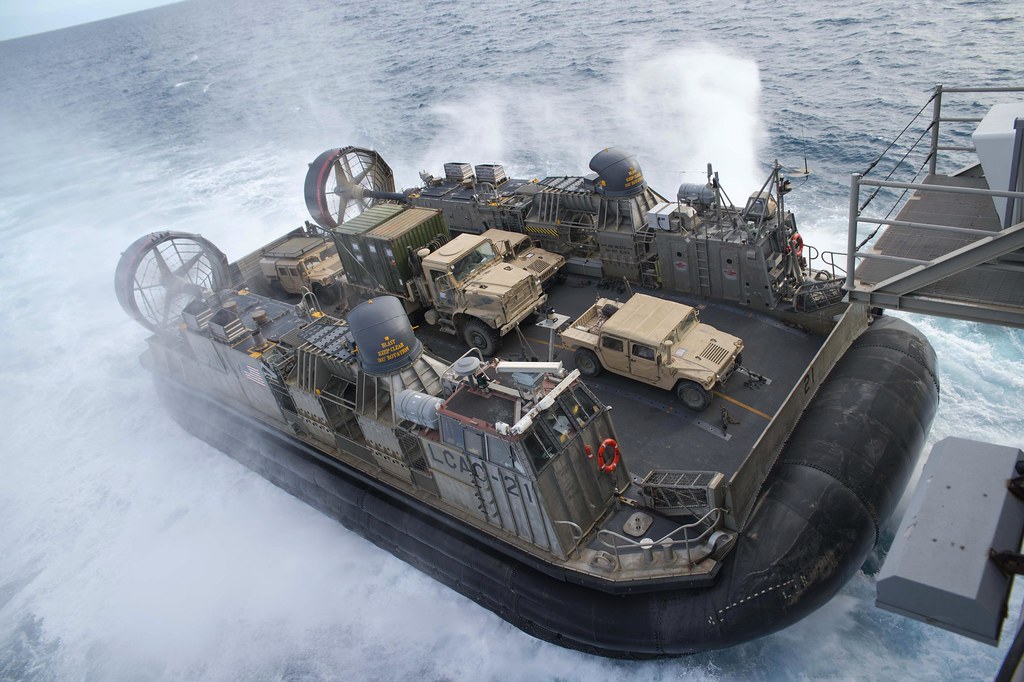
A landing craft air cushion from Naval Beach Unit 7 approaches USS Bonhomme Richard (LHD 6), July 23, as Marines return from training during Talisman Saber. (U.S. Navy/MC3 William Sykes) >>

BRISBANE, Australia - Marines and Sailors with the 31st Marine Expeditionary Unit completed the biennial Exercise Talisman Saber, re-embarking aboard the U.S. Navy ships of the USS Bonhomme Richard Expeditionary Strike Group off the coast of Queensland, Australia, July 23-25.

The Marines and Sailors, along with their counterparts in the Australian Defence Forces, spent several weeks building bilateral capabilities and strengthening the U.S.-Australian defense posture while honing a long-lasting relationship between the two nations.

The exercise was a resounding success for the 31st MEU and the members of the Australian military, according to Col. Tye R. Wallace, commanding officer of the 31st MEU.

"Working with our allies and partners has been extremely rewarding. Talisman Saber offers a unique opportunity to increase our interoperability with the Australians," said U.S. Marine Corps Col. Tye R. Wallace, commanding officer of the 31st MEU.

USA: USNS Montford Point concludes skin-to-skin operations in Saipan

By MC1 Micah Blechner, CTF 73 Public Affairs

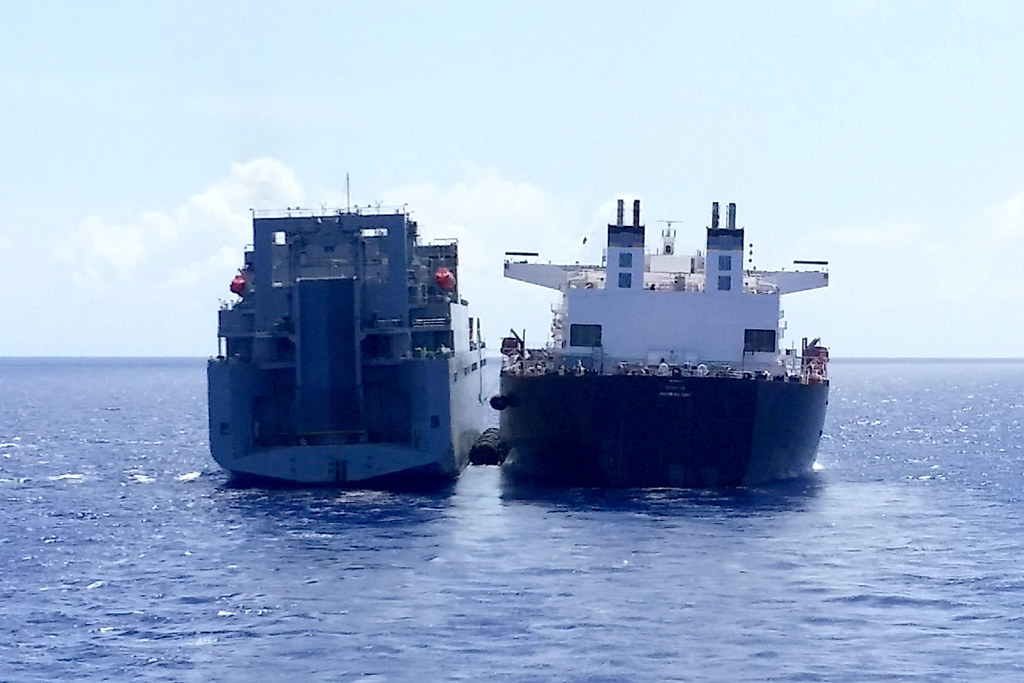
USNS Red Cloud (T-AKR 313), left, and USNS Montford Point (ESD 1) conduct “skin-to-skin” operations, July 11. (U.S. Navy photo) >>

SAIPAN - The expeditionary transfer dock USNS Montford Point (T-ESD 1) wrapped up a series of “skin-to-skin” operations in the vicinity of Saipan, July 22.

The operations took place over the course of 17 days and included complex maneuvering and positioning drills with ships from Maritime Prepositioning Squadron (MPSRON) 3.

“Skin-to-skin operations are game-changers when it comes to supporting the Marine Corps and other expeditionary forces with greater flexibility at sea,” said Mr. Paul Grgas, deputy director of operations for the Military Sealift Command Far East. “Expeditionary transfer docks like Montford Point can operate off shore and augment ship to shore movements during amphibious operations.”

25 July 2017

News Story: Chinese intel-gathering ship spotted near US-Australia exercise

By: Mike Yeo

ROCKHAMPTON, Australia — The high-end warfare being practiced by U.S. and Australian forces at a major exercise in Australia has attracted an unwanted visitor in the form of a Chinese intelligence-gathering ship.

The Australian Broadcasting Corporation has reported that a People’s Liberation Army Navy, or PLAN, Type 815 (Dongdiao-class electronic surveillance ship) was sighted in waters off the Australian state of Queensland where Exercise Talisman Saber is being held. Australia’s Department of Defence subsequently confirmed that the ship, which it calls an auxiliary general intelligence vessel, “has remained outside Australia’s territorial waters but inside the Australian Exclusive Economic Zone in the Coral Sea.”

The agency added that “the vessel’s presence has not detracted from the Exercise objectives,” with senior officers at the exercise remaining equally sanguine about the vessel’s presence. The maritime component commander at the exercise, Royal Australian Navy Commodore Mal Wise, observed that “we subscribe as the U.S. does to the freedom of the global commons and rules-based global order, and as long as they’re operating within that construct,” Australia has no objections.

Talisman Saber is a biennial U.S. and Australian exercise designed to improve combat readiness and interoperability between both forces in planning and conducting combined task force operations. This year’s exercise saw 33,000 personnel participate, and included smaller contingents from New Zealand, Japan and Canada, with the bulk of activity taking place on and in the vicinity of the Shoalwater Bay Training Area in central Queensland.

Read the full story at DefenseNews

News Story: US Navy tests amphibious concept at Talisman Saber exercise

By: Mike Yeo

ROCKHAMPTON, Australia — The U.S. Navy has put its up-gunned expeditionary strike group concept into practice within a realistic war-fighting scenario, with allied surface combatants joining an amphibious ready group, or ARG, and its embarked Marines for a major exercise off the coast of Australia.

The Bonhomme Richard ARG was joined by a surface action group, or SAG, made up of the U.S. destroyer Sterett and four Australian frigates at Exercise Talisman Saber 2017, which saw American and Australian forces carry out two major amphibious landings at Australia’s Shoalwater Bay Training Area.

According to Royal Australian Navy Capt. Guy Holthouse, sea combat commander for the Talisman Saber 2017 Combined Amphibious Force, the up-gunned ESG was pitted against a very active and capable adversary that presented a mix of surface, air and subsurface threats using real submarines, aircraft and ships throughout the exercise, which added training value to both U.S. and Australian forces.

Rear Adm. Marc Dalton, commander of the U.S. Navy’s Amphibious Force 7th Fleet, added that Talisman Saber was used “to work on concept development (of the up-gunned ESG), especially for the cruiser/destroyer/frigate integration into the force as we build towards adding the F-35B.”

Dalton noted that the amphibious assault ship Wasp, which will replace the Bonhomme Richard as the Navy’s forward-deployed big-deck amphibious ship in Japan this fall, will start deploying the F-35B at sea in the region in early 2018 and will represent “the first opportunity to operate with the complete package of the up-gunned ESG.”

Read the full story at DefenseNews

22 July 2017

AUS: Allied Forces Defeat Adversary In Major United States-Australia Military Exercise—Talisman Saber 2017

The United States (US) and Australian Defence Forces have proven their interoperability in a major land warfare scenario in the Shoalwater Bay Training Area last night with an intense final assault on the ‘enemy’.

More than 33,000 soldiers, sailors, airmen and marines from Australia,  the US, New Zealand, Japan and Canada have spent the past three weeks involved in the realistic, scenario-based military exercise TALISMAN SABER 2017 (TS17). The exercise took place in Central Queensland, with elements also supporting the mission in Brisbane, Townsville and Hawaii.

Following several weeks of lead in training TS17 ramped up last week when a 33-strong fleet of multi-national warships and submarines, including HMAS Canberra—an expeditionary strike group led by the USS Bonhomme Richard, and a carrier strike group led by the USS Ronald Reagan, moved into position off the coast of Rockhampton.

The Australian Defence Force’s Deputy Chief of Joint Operations, Major General Greg Bilton, said the participating nations demonstrated the ability to expertly land thousands of troops ashore by sea and air to support a complex ground warfare mission.

USA: Combined amphibious force launches Marines ashore for Talisman Saber

From Expeditionary Strike Group 7 Public Affairs

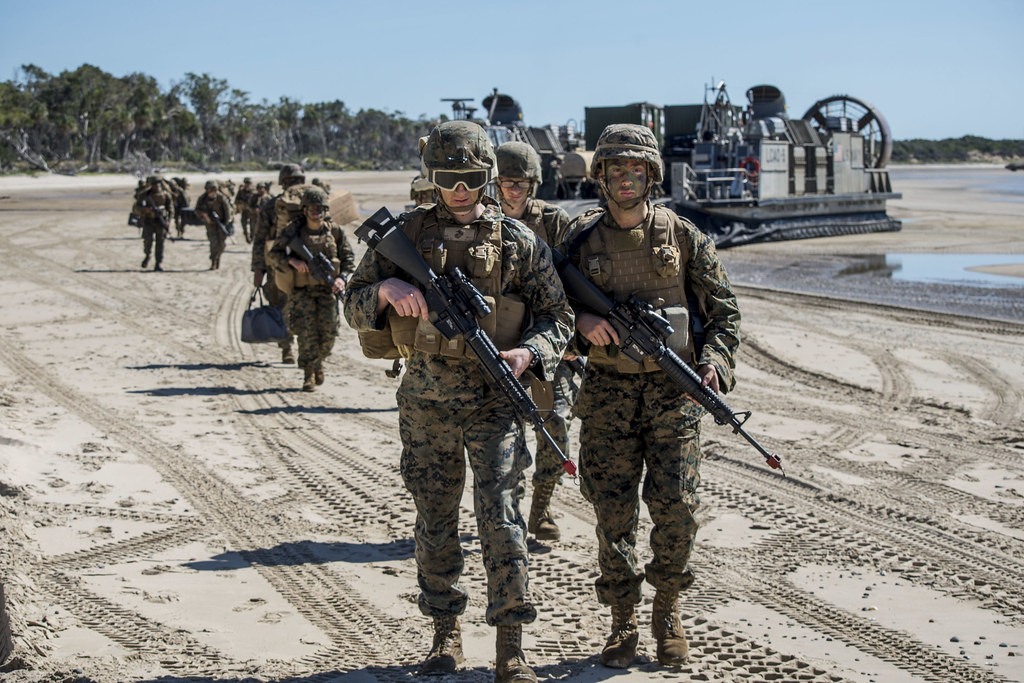
Marines offload gear from a landing craft air cushion (LCAC) during a Talisman Saber combined amphibious assault, July 19.(U.S. Navy/MC2 Sarah Villegas) >>

SHOALWATER BAY, Australia - “ATTENTION LANDING FORCE, stand by for call away!” The 1MC, the ship’s announcing system, booms through the hangar bay and berthing areas aboard USS Bonhomme Richard (LHD 6) to muster up Marines for departure to insertion points ashore.

Bonhomme Richard, landing craft from Naval Beach Unit (NBU 7), and ships of the combined amphibious force launched Australian soldiers and U.S. Marines of the 31st Marine Expeditionary Unit (MEU) ashore to the Shoalwater Bay Training Area and Townshend Island in several waves of landings, followed by support and resupply runs from July 12-20.

The landing craft air cushions (LCAC) splashed up on the beach, kicking up sand and a cloud of dust as the hovercraft drifted into the landing zone. Landing craft utility (LCU) coasted into the shoreline shortly after MV-22 B Ospreys chopped in overhead near the ridges of mountains lining the beach. CH-53E Super Stallions pumped in past the tree lines to a landing zone, shoving up dirt and debris. One after another, aircraft and landing craft alike continued to surface on the beach and station on the landing zones to ensure the Marines had the supplies, mobility, and artillery to complete objectives ashore.

18 July 2017

Think Tank: Sea, air, land and space updates (18-Jul-2017)

Jack Viola, Eliza Chapman, Jacqueline Westermann and Harley Comrie
Sea state
The US Navy released a request for information (RFI) last week seeking proposals for a new guided missile frigate. Its previous plans for a new frigate were based on modifying the current littoral combat ships. But the RFI for the new replacement program, designated FFG(X), calls for a bigger crew and more guns, which the current hulls may not be able to deliver. That could mean a whole new design and a new ship in the seas.
The Chinese Navy has conducted a live-fire drill in the Mediterranean Sea. The Chinese flotilla was on its way to join in exercises with the Russian Navy in the Baltic. According to the China Daily, the flotilla ‘fired several rounds’ during a drill that ‘was aimed at honing crew members’ skills in attacking small targets’. The second phase of the exercises, planned for September in the Sea of Japan, will include ‘an amphibious assault component’.
If you’ve ever wondered what happens when you try to kill a submarine with a nuclear depth charge, War is Boring and Operation Wigwam have some answers.

30 June 2017

AUS: Talisman Saber 2017 officially opened in Sydney

Australia's largest military exercise, Talisman Saber, was officially opened today aboard the United States Landing Helicopter Dock the USS Bonhomme Richard (BHR) off the Sydney coast.

Minister for Urban Development, the Honourable Paul Fletcher MP, representing the Minister for Defence, and the US Charge d'Affaires, Mr James Carouso, officially announced the start of the combined military exercise taking place from late June through to late July. Field training will occur in Shoalwater Bay Training Area, near Rockhampton and Mount Bundy Training Area, south of Darwin.

The Minister was joined by the US Pacific Forces Commander, Admiral ADM Harry B. Harris, Jr and Officer Conducting the Exercise, Australia's Chief of Joint Operations Vice Admiral David Johnston along with other senior Australian Defence Force.

Vice Admiral Johnston said the exercise is important to highlight and certify the interoperability between the forces.

“Talisman Saber is the premier Australia‑United States bilateral exercise,” Vice Admiral Johnston said.

USA: Exercise Talisman Saber 17 Commences in Australia

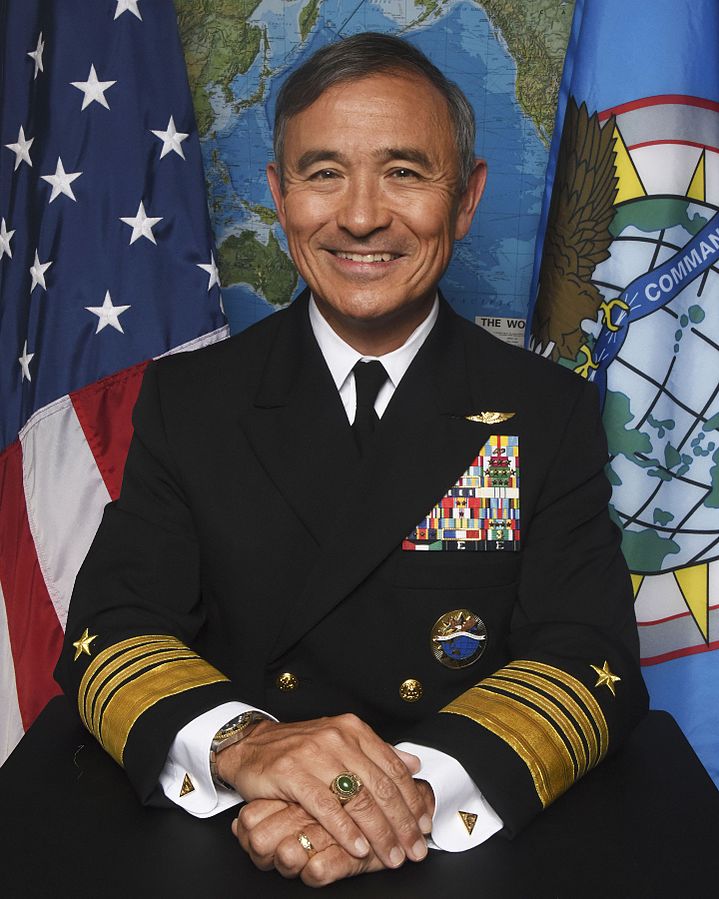
Adm. Harry B. Harris Jr (Image: Wiki Commons)
By Terri Moon Cronk 
DoD News, Defense Media Activity

WASHINGTON, June 29, 2017 — Talisman Saber is a realistic and challenging exercise that provides opportunities for the United States and Australia to innovatively prepare for regional and global security challenges, Navy Adm. Harry B. Harris Jr., commander of U.S. Pacific Command, said today.

Speaking at the opening ceremony aboard the U.S. Navy amphibious assault ship USS Bonhomme Richard at sea off the coast of eastern Australia, the admiral said Pacom is partnering in the biennial exercise with Australian allies for high-end warfighting scenarios for the seventh time. About 33,000 American and Australian service members are taking part.

“Exercises like Talisman Saber are precisely where we really learn how to take advantage of cutting-edge technology to outpace our adversaries,” Harris said. “It’s also a perfect place for our forces to operationalize a very important concept.”

The Pacom commander said he has challenged the Army, Navy, Air Force and Marine Corps to execute multi-domain battle, “to find new ways to enable our joint and multinational combined forces to be faster, more precise, more cost-effective, and most importantly, more lethal.

05 June 2017

USA: Green Bay sets sail to join Bonhomme Richard ARG

From Expeditionary Strike Group 7 Public Affairs

USS Green Bay (LPD 20) departs Fleet Activities Sasebo, June 2. (U.S. Navy/MC2 Jordan Crouch) >>

SASEBO, Japan - USS Green Bay (LPD 20) departed its forward-deployed base of Sasebo, Japan, June 2, becoming the final ship in the Bonhomme Richard Amphibious Ready Group to set sail on a routine deployment in the Indo-Asia-Pacific.

The amphibious ships, together with the 31st Marine Expeditionary Unit, are scheduled to train alongside Australian counterparts in the biennial exercise Talisman Saber and serve as a ready-force for any type of contingency while on the multi-month deployment.

Talisman Saber, jointly sponsored by the U.S. Pacific Command and Australian Defence Force Headquarters Joint Operations Command, will incorporate U.S. Army, Navy, Marine Corps and Air Force and the Australian Defence Force as well as other government agencies from each country.

01 June 2017

USA: U.S.-Japan forces set milestones for enhancing amphibious, mine warfare

By Lt. Adam Cole, Amphibious Force 7th Fleet Public Affairs

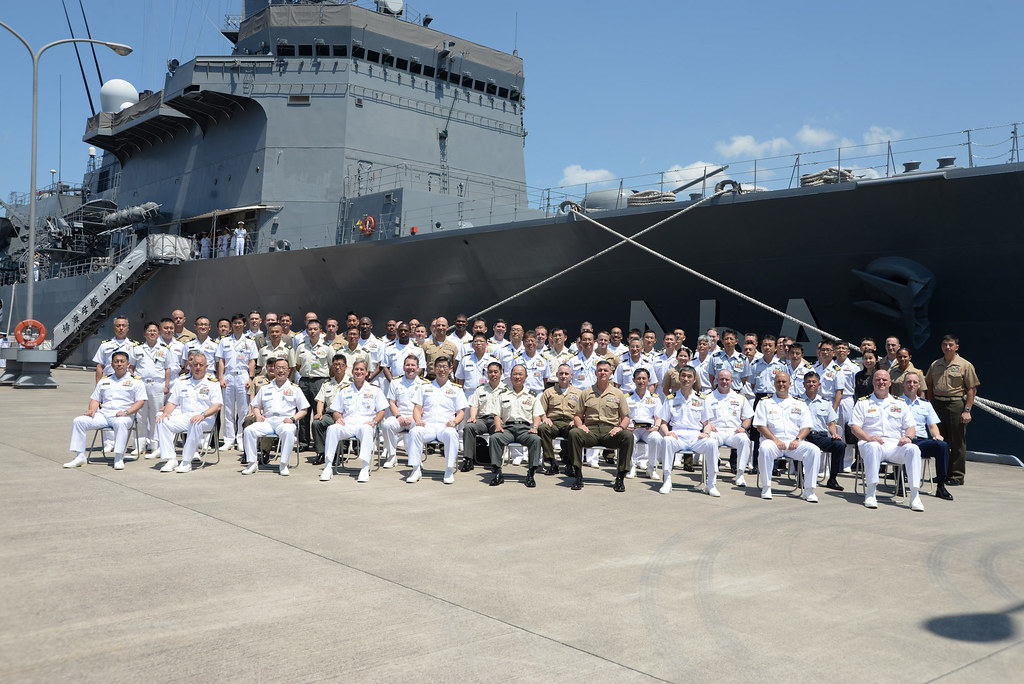
Participants of the U.S.-Japan bilateral amphibious and mine warfare staff talks pose for a group photo in front of JS Bungo (MST 464). (U.S. Navy/LT Adam Cole) >>

KURE, Japan - U.S. military and Japan Self Defense Force personnel comprising 34 different commands across ground, maritime, and air services met for bilateral amphibious and mine warfare discussions, May 22-24.

The staff talks were hosted by Japan Maritime Self Defense Force’s Mine Warfare Command, Japan’s counterpart to the U.S. Navy’s Amphibious Force 7th Fleet.

This year marked the 14th time these two staffs have met to maintain and enhance the bilateral partnership as well as dialogue on increasing integration for training and operations. Beginning last year, the talks were opened up to include landing force counterparts from U.S. Marine Corps and Japan Ground Self Defense force units. This year, the participation was extended even further to include Air Force and Japan Air Self Defense Force personnel.

News Story: DPRK blasts U.S. for extending joint drills with S. Korea

PYONGYANG, May 31 (Xinhua) -- The Democratic People's Republic of Korea (DPRK) Wednesday blasted the United States and South Korea for planning to extend their joint naval exercises in the East Sea of Korea to the end of June.

According to the Korean Central News Agency (KCNA), the United States plans to deploy the task force of the Ronald Reagan nuclear carrier from the Yokosuka base to join the strike group of nuclear aircraft carrier USS Carl Vinson, which is already in the drill, to stage the largest-ever joint exercises of its kind from next month.

Read the full story at Xinhua