Showing posts with label F-16. Show all posts

27 September 2017

News Story: US Vows Solid Support to Afghan Air Force

Afghan Air Force A-29 Super Tucano Ground Attack Aircraft
By Sayed Sharif Amiri

Lt. Gen. Jeffrey L. Harrigian, the Commander of US Air Forces Central Command, on Monday said the Afghan Air Force (AAF) will play an increasingly important role in future missions. 

Recently the Pentagon signed a contract worth $1 billion USD to purchase 150 C-130 aircraft for the Afghan army, a move which was warmly welcomed by the Afghan ministry of defense. 

The AAF is considered one of the key pillars of the Afghan National Army (ANA) and it is expected that within the next four years, there will be a significant change in the structure of the air force. 

Although the US has provided $4 billion USD in assistance to the Afghan air force, the AAF still needs more time and help to stand on its own. 

“We increased our number of F-16s in Bagram from 12 to 18. So that's a first step as we do our initial analysis, but we're gonna take a longer term look at this. Importantly though, I think the other piece I'd highlight to you, is that the Afghan Air Force is gonna play a particularly important role here, and that air force is gonna triple its size over the next several years, and I'd highlight that what the Afghans have done with their A-29 and their ability to quickly get themselves into the fight and support their teams on the ground has also been an important part that we're gonna leverage going forward as part of this plan,” said Harrigian. 

Read the full story at TOLOnews

26 September 2017

News Story: Drones, Fighter jets on table as Mattis visits key ally India

By Abhaya SRIVASTAVA

Fighter jets, drone deals and shared concerns over Afghanistan's security look set to dominate the agenda when US Defense Secretary James Mattis visits India this week.

Mattis is scheduled to arrive late Monday and is set to meet Prime Minister Narendra Modi and his new defence minister, in the first visit by a top US official since Donald Trump became president in January.

"The United States views India as a valued and influential partner, with broad mutual interests extending well beyond South Asia," a Pentagon statement said.

Trump and Modi met in June in Washington and the visit by Mattis is a sign "the political leadership in both countries place defence cooperation as a top priority", Mukesh Aghi, president of the US India Strategic Partnership Forum, told AFP.

Delhi and Washington share concerns about Afghanistan, with Trump announcing a new strategy for the war-torn country last month which cleared the way for the deployment of thousands more US troops.

The president has urged India to increase assistance to Afghanistan's economy, and has lambasted Delhi's arch-rival Pakistan for offering safe haven to "agents of chaos".

Read the full story at SpaceDaily

21 September 2017

News Story: US Increases Number of F-16s To 18 In Afghanistan

The United States Air Force has increased the number of F-16 multi task Fighting Falcons to 18 from 12, two generals, quoted by Military.com said Tuesday at the Air Force Association's Air, Space and Cyber Conference.

In addition air refueling tankers are in Afghanistan for the first time in about five years, they said.

The Air Force now has 18 multi-role F-16 fighters in country, Lt. Gen. Jeffrey L. Harrigian, commander of US Air Forces Central Command, told reporters at the conference.

"We just plussed up our number of fighters. We had 12 F-16s; we now have 18," said Harrigian, who oversees missions at the Combined Air Operations Center at Al Udeid Air Base, Qatar.

According to Military.com, Harrigian said: "Our close-air support role continues and, as you look at the strategy coming forward, we're actually right now working with [Commander of US forces in Afghanistan] Gen. John Nicholson's staff on how to best synchronize his advice-and-assist strategy going forward to optimize the placement of the air assets."

Read the full story at TOLOnews

14 September 2017

News Report: US Bombing Campaign in Afghanistan Intensifies, Hitting New High

Ayaz Gul

ISLAMABAD — The U.S. military dropped 555 bombs in Afghanistan against Taliban and Islamic State targets in August, the highest number in a single month since 2012.

Overall, the U.S. has conducted about 2,400 airstrikes since the beginning of the year in support of Afghan partners battling the Taliban and IS terrorists, said U.S. Navy Captain Bill Salvin, spokesman for NATO’s Resolute Support mission in the country.

About 1,700 of them were “strategic effects” strikes, Salvin told VOA, explaining "those are strikes that have an impact on the battlefield. They help the forces on the ground, essentially helping the ANDSF (Afghan National Defense Security Forces) take ground, hold ground and take the fight to the enemy."

Salvin said the spike in airstrikes conducted both by F-16 fighter planes and drones was facilitated by increased authority that the former U.S. administration under then-President Barack Obama gave last year to General John Nicholson, commander of international forces. The aim is to deny IS sanctuaries on Afghan soil and enable friendly ground forces to reverse Taliban battlefield gains.

13 September 2017

News Story: Pakistani PM warns U.S. against cutting military assistance

ISLAMABAD, Sept. 12 (Xinhua) -- Pakistani Prime Minister Shahid Khaqan Abbasi said that U.S. sanctions against Pakistani officials, or further cutting of military assistance will be counter-productive, local media reported Tuesday.

Abbasi said any such move would harm war against militancy, which both countries are fighting for the last 16 years, Urdu newspaper Roznama Express said.

He warned that Washington will not achieve its counter-terrorism aims by starving Pakistan of funds, adding that both countries need to make cooperative efforts to win over militancy in the region.

The PM's remarks came after Washington asked Islamabad to do more against militant group Haqqani Network, which it believes has close ties with Pakistan.

Read the full story at Xinhua

09 September 2017

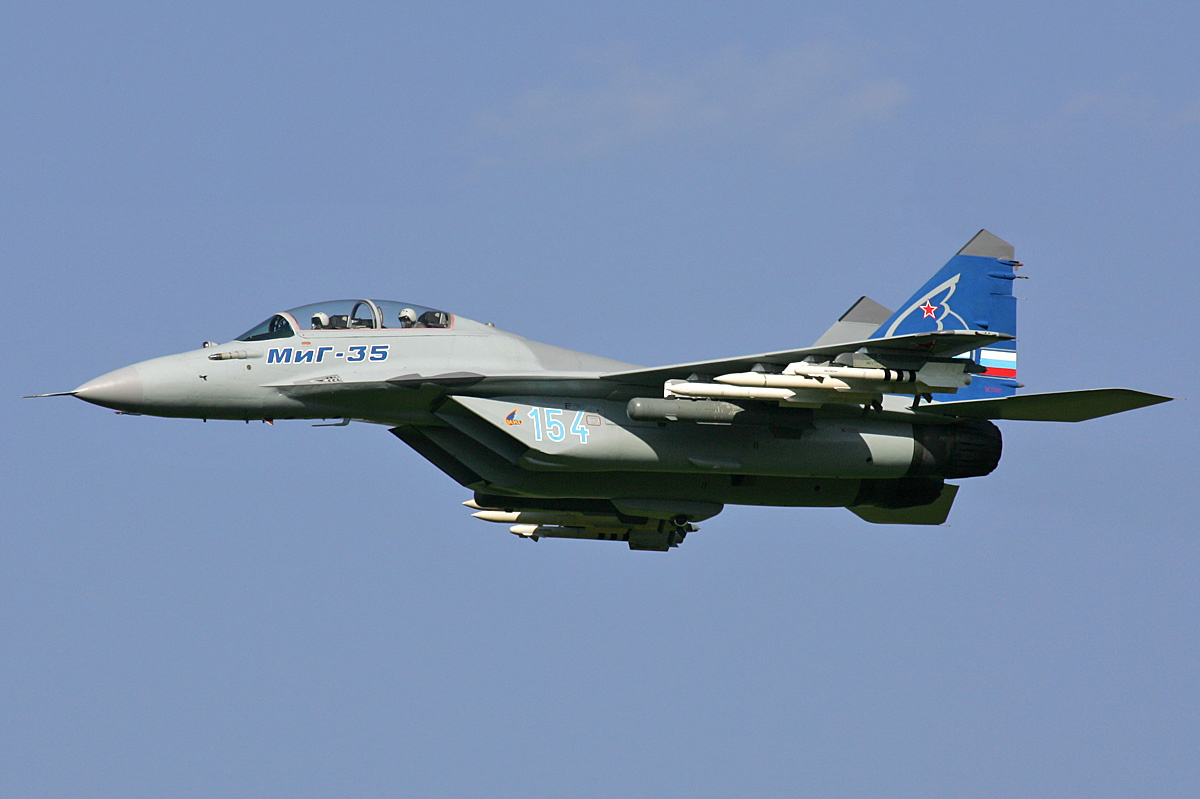
News Story: Russia Pitches MiG-35 to India as FGFA Project Falters

MiG-35 (Image: Wiki Commons)
by Neelam Mathews

As the contest to supply a new fighter aircraft to the Indian Air Force (IAF) heats up, the MiG-35 has emerged as a viable candidate. India is supposedly seeking about 220 single-engine fighters to replace 11 squadrons of MiG-21/27s that entered service in the 1990s.

Rosoboronexport is believed to have offered a licensed production deal for the twin-engine MiG-35 that would compensate for the IAF’s reluctance to proceed with the Indo-Russian Fifth Generation Fighter Aircraft (FGFA) project.

At the MAKS 2017 airshow in July, Ilya Tarasenko, director general of Russian Aircraft Corporation MiG, said: “We are actively working with the IAF in order to win the tender.” Russia has committed to a 40-year maintenance and upgrade contract to preclude the support issues that have arisen in the past with Russian aircraft in service with the IAF. Meanwhile, also at MAKS, Sergei Chemezov, CEO of the Rostec State Corporation, told reporters that a decision on the design and development of the FGFA would be made in the “nearest future.” He did not provide a timeline for the project, a version of Russia’s Sukhoi T-50, which has been under discussion between the two countries for the past decade.

According to an Indian defense official, “The MiG-35 is 25 percent cheaper [than rival candidates for the IAF requirement]; has an AESA radar; has commonality with the fleet; and being in the light to medium category enables it to land in the same airfields that the [indigenous] Light Combat Aircraft does. If the FGFA does not go through, Russia will have to be compensated, and this is the only contract left at the moment.” 

Read the full story at AINonline

04 September 2017

News Story: Defense Ministry Preparing For US Troop Surge

By Massoud Ansar

The Afghan Ministry of Defense (MoD) on Saturday said it has starting preparing for the deployment of extra US troops to the country.

“Training centers exist in Kabul, Jalalabad, Helmand, Mazar-e-Sharif and Kandahar and Gardez where we have training centers and they (the additional troops) will help us in our training centers,” said MoD spokesman Dawlat Waziri.

On August 21, US President Donald Trump outlined a revised vision for the US war against terrorism in Afghanistan, pledging to end a strategy of nation building and instead increase attacks on militants.

Trump also said that within the framework of the new strategy, the United States will deploy thousands of additional forces to Afghanistan to deal with the threats that emanate from the region.

The Pentagon in turn has announced that the new batch of US forces will be deployed to military and security training centers of the Afghan National and Defense Forces (ANDSF) around the country.

The US is however also expected to ramp up airstrikes against militant bases in the country and earlier this week, reports indicated that they could use both F-16s and B-52s.

Footage released on Saturday by the Pentagon shows a US B-52 bomber patrolling Afghanistan air space on August 29 (on Tuesday) and of it being refueled.

Read the full story at TOLOnews

02 September 2017

News Story: Saab, Adani Group forge partnership for India’s single-engine fighter

JAS-39 Gripen (Image: Wiki Commons)
By: Vivek Raghuvanshi 

NEW DELHI — Saab of Sweden and Indian infrastructure conglomerate Adani Group have forged a partnership to build Gripen E aircraft and work on other aerospace programs in the Asian country.

The Sept. 1 announcement means India’s single-engine fighter aircraft competition worth $12 billion is now shortlisted between the Saab-Adani partnership and Lockheed Martin of the U.S. in a tie-up with India’s Tata Advanced Systems Limited.

”The intended collaboration would encompass design, development and production of Gripen for India and other high-tech products of national importance for India and also the creation of joint ventures in India in line with and in support of the Make In India policy,” according to a Saab news release.

Lockheed Martin is pitching its F-16 Block 70 aircraft, whereas Saab is fielding the upgraded Gripen E in response to the expression of interest sent to select aerospace companies through foreign Indian embassies in November 2016.

“Our plans in India are to create a new defense eco-system that would involve many partners, vendors and suppliers. To achieve this, we need a strong Indian partner who can help create the framework for the infrastructure and eco-system to come into place,” said HÃ¥kan Buskhe, CEO and president of Saab.

The president of Adani group, Gautam Adani, said: “We are proud of our enduring relationship with Saab and look forward to partnering in major projects such as Gripen. Our various collaborations in aerospace and defence sectors will help establish new production lines in India, generate employment and build sustainable skills.”

Read the full story at DefenseNews

23 August 2017

News Story: Defence firms eye billion-dollar chance for 'made in India'

By Megha BAHREE

India has drawn up a shopping list for tens of billions of dollars of foreign fighter jets, armoured vehicles, submarines and helicopters but it will only sign the cheques if they are made in India.

The world's largest defence importer has announced a new policy inviting foreign defence manufacturers to set up shop as minority partners in India. It initiated the bidding process for submarines in July.

Such deals would boost job creation and bring key defence technologies into India.

Foreign companies say the opportunity is too good to miss.

Europe's Airbus Group, angling to sell its Panther helicopters, has said that if it wins a contract worth several billion dollars and expected to span at least a decade, it would make India its global hub for the multi-purpose choppers.

The company currently builds them at Marignane in France.

Lockheed Martin says if its F-16 fighter jets are selected -- it will likely compete with Saab for that order of close to $15 billion -- it will "support the advancement of Indian manufacturing expertise."

Germany's ThyssenKrupp Marine Systems and France's Naval Group are eager to compete for a contract of up to $10 billion to build submarines in the South Asian country.

Luring foreign defence companies to build in India would be a major and much-needed boost to the economy.

Prime Minister Narendra Modi, with less than two years to national elections, is under intense pressure to create more jobs for the hundreds of thousands of people joining the workforce every month.

Growth in the first three months of 2017 slowed to 6.1 percent. Experts expect further disruption as businesses adjust to a new nationwide goods and services tax launched in July.

Read the full story at SpaceDaily

11 August 2017

News Report: Super Tigers - New Upgrades to Keep Aging Thai F-5s Flying Into the 2030s

Royal Thai Air Force F-5E Tiger (Image: Wiki Commons)
The Royal Thai Air Force (RTAF) is enhancing the readiness of its fleet via an upgrade package that will transform four F-5E Tigers into bonafide F-5T Super Tigers.

The warplanes will receive Python-4 and I Derby beyond-visual-range air-to-air weapons, new radar systems, electronic warfare capabilities and "network-centric capabilities for disaster preparedness," the Air Force said in an August 2 announcement. 

Converting F-5Es into F-5Ts began in 2014 when the government authorized funds to upgrade 10 of the fighter-bombers, the Diplomat reported on August 8.

Thai "F-5E fighter aircraft have been in service since 1978 and [are] considered a third-generation plane with limited capabilities," the service said. "With outdated technology, you cannot face current threats," the announcement noted.

Renovations will transform the jets into 4/4.5-generation aircraft, the service claimed, placing the jets on par with RTAF’s Lockheed F-16A/B Fighting Falcons and Saab JAS-39C/D Gripen warplanes. 

The aim of the $96 million project is to extend the planes’ useful life by 15 years, RTAF added.

This story first appeared on Sputnik & is reposted here with permission.

20 July 2017

News Story: India won't ink a single-engine fighter deal before 2019

By: Vivek Raghuvanshi

NEW DELHI — India's single-engine fighter program, worth $12 billion, is unlikely to be "decided before 2019," analysts and officials say, even as the Indian Air Force has decided to hold flight tests of Lockheed's F-16 Block 70 and Sweden's Gripen-E, the two aircraft competing in the program. 

Restricted expressions of interests were sent through Indian embassies to "some overseas participants" to take part in the program in October last year to elicit responses to produce single-engine fighter aircraft in India. Lockheed Martin offered to shift the assembly line of its F-16 Block 70, and Sweden offered to build the Gripen-E aircraft in India with technology transfer. 

The F-16 fighter aircraft did not come up for discussion during last month's summit talks on June 26 between Indian Prime Minister Narendra Modi and U.S. President Donald Trump in Washington, said a Ministry of Defence official without commenting on the outcome of the talks. 

However, analysts and officials are skeptical whether the program would come to an early decision. Some analysts even say the F-16 will never be bought by the Indian Air Force, or IAF. 

"There isn't now even the slightest IAF interest in the F-16 Block 70 or any other variant," said Bharat Karnad, professor of national security studies at Centre for Policy Research. 

Read the full story at DefenseNews

19 July 2017

News Report: Singapore to Dig Up More Than 80,000 Graves to Expand Military Base

In its quest to expand regional military influence and create new space for a rapidly increasing population, Singapore will dig up some 80,000 graves to make way for a new military airstrip.

A graveyard estimated to contain some 80,000 corpses will be dug up to make room for the expansion of Singapore's Tengah Air Base. The base is the tiny island city-state and global financial center's primary location for its fleet of US-built F16s and unmanned aerial vehicles (UAV).

Additionally, the Republic of Singapore Air Force (RSAF) will acquire land belonging to fish farms and a nursery. The total expansion amounts to around half a square mile of territory in the 278-square-mile nation.

By 2030 the expansion is slated to accommodate the assets and facilities from the country's Paya Lebar Air Base, according to a joint Tuesday statement from Singapore's Ministry of National Development, National Environment Agency and Singapore Land Authority.

12 July 2017

News Story: DPRK accuses U.S., South Korea of intensifying war preparations

PYONGYANG, July 11 (Xinhua) -- The Democratic People's Republic of Korea (DPRK) Tuesday accused the United States and South Korea of intensifying war preparations after it launched an intercontinental ballistic missile (ICBM) earlier this month.

"It was reported that the U.S. Department of Defense, much scared by the DPRK's success of test-launch of ICBM Hwasong-14 at one go, had a military attack scenario in the making such as hurling fighters and warships into the waters off the Korean peninsula," said the official daily newspaper Minju Joson (Democratic Korea).

The DPRK declared on July 4 that it successfully launched an ICBM on the same day, hailing it as the "final gate to rounding off the state nuclear force."

The launch has aroused grave concern from Russia and China, and drawn strong condemnation from the United Nations, South Korea and Japan, as it seriously violated relevant UN Security Council resolutions.

Minju Joson also accused South Korea of holding joint ballistic missile drills with U.S. forces to "deliberately escalate tensions" after the missile launch.

Meanwhile, Rodong Sinmun, the official daily of the ruling Workers' Party of Korea, charged that South Korean military forces recently took part in the U.S.-led air defense exercises in Alaska.

Read the full story at Xinhua

10 July 2017

News Story: US bombers join jets from Japan, S. Korea for training mission

B-1B Lancer (Image: Wiki Commons)
WASHINGTON (AP) -- Two U.S. bombers flew to the Korean Peninsula to join fighter jets from South Korea and Japan for a practice bombing run as part of a training mission in response to North Korea's ballistic missile and nuclear programs, officials said Friday.

U.S. military officials described the mission as a defensive show of force and unity from the three allied nations and said it demonstrated "the ironclad U.S. commitment to our allies."

"North Korea's actions are a threat to our allies, partners and homeland," Gen. Terrence O' Shaughnessy, U.S. Pacific Air Forces commander, said in a statement from Pacific Air Forces. "Let me be clear: If called upon we are trained, equipped and ready to unleash the full lethal capability of our allied air forces."

The U.S. Air Force B-1B Lancer bombers from Andersen Air Force Base at the island of Guam conducted a 10-hour sequenced bilateral mission with South Korean and Japanese fighter jets, the statement said.

"U.S. bombers and Republic of Korea fighters are just two of many lethal military options at our disposal," said Lt. Gen. Thomas Bergeson, U.S. Forces Korea deputy commander. "This mission clearly demonstrates the U.S.-ROK alliance remains prepared to use the full range of capabilities to defend and to preserve the security of the Korean Peninsula and region."

Read the full story at The Mainichi

28 June 2017

News Report: Questions Arise as US-India F-16 Deal Seeks to Get Airborne

CGI of Lockheed Martin's F-16 for India (File Photo)
A lucrative aviation deal between US-India firms to manufacture F-16 fighter jets in the south Asian nation has attracted criticism that old technology is being "dumped."

US defense contractor Lockheed Martin has taken further steps to secure a deal which would relocate the manufacture of F-16 fighter jets to India. News of the multi-billion dollar agreement with Indian industry giant Tata Group came as Indian Prime Minister Narendra Modi met with US President Donald Trump in Washington on Monday, June 26.


A press release issued by both firms stated that India will be able to "produce, operate and export the multi(-role) fighter F-16 Block 70 aircraft."

News Story: 22 drones and a summit - The state of India-US defense ties

By: Vivek Raghuvanshi

NEW DELHI — The White House symbolically confirmed its policy to treat India as a major defense partner, following its decision to move ahead with the sale to India of 22 Guardian maritime drones worth about $2 billion prior to a June 26 meeting in Washington between Indian Prime Minister Narendra Modi and U.S. President Donald Trump, say analysts. 

"The fact that the Trump administration made the effort to expeditiously close on the Indian request (for Guardian drones) signals its interest in preserving close relations with India," said Ashley J. Tellis, a senior fellow at the Carnegie Endowment for International Peace. 

India requested to buy the 22 drones in late 2016 under the Obama administration, but the former president left the decision to the new administration. India's request also included the purchase of an unknown numbers of armed drones.

India's wish list still includes that import of armed drones from the U.S., but that sale would require "a major policy change," according to Tellis. 

"The United States has a standing prohibition against export of advanced unmanned aerial vehicles. The only exceptions we've made are to allies involved in combined operations. India's need for armed UAVs is great, but it will take a major policy change for the administration to authorize the sale of armed UAVs to India," Tellis said. 

An Indian Ministry of Defence official said the country will now look to Israel for its acquisition of armed drones, rather than wait for a decision from the U.S. 

Read the full story at DefenseNews

27 June 2017

Think Tank: Sea, air, land and space updates (27-Jun-2017)

An unpainted Chinese Y-8Q/GX-6 ASW Aircraft during testing
Zoe Glasson, Sophie Qin, Madeleine Nyst and Patrick Kennedy
Sea State
Just in time for President Modi’s visit to Washington, the Trump administration has agreed to sell 22 Guardian drones to India, in a deal that’s been described as a ‘game changer’ for US–India relations. The drones would be a ‘force multiplier’ for the Indian Navy, improving its maritime surveillance and reconnaissance capabilities. Though yet to be approved in India, New Delhi reportedly sees the deal as ‘a key test of defence ties’. Defense News speculates that the sale of the unarmed Guardians could be a precursor to the purchase of armed drones—something India has sought previously but which is currently prohibited by US export laws. Finalising the deal is likely to require a fine balance between Trump’s “America First” platform and Modi’s “Make in India” policy.
Israel Aerospace Industries (IAI) successfully test-fired its Long-Range Artillery system (LORA) on 20 June. LORA’s strength is its portability: it launches from a container that can be trucked onto the deck of a cargo ship. According to The Drive, LORA’s relative low-cost and plug-and-play nature means that a range of auxiliary ships ‘could suddenly become impromptu combatants’. IAI says ‘several deals’ for LORA are underway, but it remains to be seen who’s in the market for the platform.
And for the final Sea State reads this week, here are two great pieces: one about how noisy herrings are creating (submarine) confusion; and another about marauding orcas fleecing fisherman.

News Report: Modi Confident in 'Convergence' of US, Indian Interests

Indian Prime Minister Narendra Modi said he is "confident in the growing convergence" between India and the U.S. as he prepares to meet with President Donald Trump at the White House.

In an op-ed published in the Wall Street Journal, Modi stated his optimism for economic growth and increased bilateral trade between the two countries.

"In an uncertain global economic landscape, our two nations stand as mutually reinforcing engines of growth and innovation," he wrote.

On Sunday, Modi met with top American business executives and members of the Indian diaspora on his first visit to the U.S. since Trump was elected president.

Meeting with tech leaders 

At a hotel meeting in Washington with leaders of some of the top American technology companies, the prime minister extolled the virtues of doing business in India where he said there was "minimum government," making it easy to do business in the South Asian nation.

Among those attending the meeting were Google's Sundar Pichai, Satya Nadella of Microsoft and Shantanu Narayen of Adobe Systems, who are all Indian Americans. Amazon chief Jeff Bezos and Apple's Tim Cook also attended the meeting.

26 June 2017

News Report: Defense Deals on the Agenda for First Trump-Modi Talks

Steve Herman

WHITE HOUSE — The bearers of two potentially clashing slogans, “Made in India” and “America First,” will finally meet Monday at the White House.

“It’s going to be a robust discussion,” White House Press Secretary Sean Spicer said of what will be the first face-to-face talks between India's Prime Minister Narendra Modi and U.S. President Donald Trump.

“We’re really seeking to roll out the red carpet,” a senior U.S. official said of the visit, which will feature the first dinner Trump will host at the White House for a foreign dignitary.

“It’ll be a long interaction and lots of time for the two leaders to get to know each other,” the senior official told White House reporters Friday.

“These are two very populist leaders,” with aspirations for transformation, notes Satu Limaye. He is director of the Washington office of the East-West Center, an American nonprofit group dedicated to promoting public diplomacy in the Asia-Pacific region.

24 June 2017

News Story: MQ-9B drone sale for India to be OK'd

MQ-9B Guardian (Image: Wiki Commons)
By: Aaron Mehta

WASHINGTON — The U.S. State Department is in the final stages of clearing the sale of 22 MQ-9 drones to India, with an expectation that U.S. President Donald Trump will announce the sale during the upcoming visit of Indian Prime Minister Narendra Modi. 

Modi, who will meet with Trump for the first time on June 26, is expected to discuss a wide range of topics, including terrorism and visas, but is poised to walk away with an offer to purchase the unarmed MQ-9B Guardian design produced by General Atomics. 

The Guardian design is a variant of the Predator B drone, equipped with several radar systems specifically useful for maritime searches.  

“We are pleased that the U.S. government has cleared the way for the sale of the MQ-9B Guardian to the Indian Government,” said Linden Blue, CEO of General Atomics Aeronautical Systems, in a statement to Defense News. “Guardian provides the endurance and capability required to significantly enhance India’s sovereign maritime domain awareness in the Indo-Pacific. General Atomics Aeronautical Systems is standing by to support the US and Indian Governments throughout this process” 

It is unclear how much the sale will be worth, nor what offsets were being offered to India. Modi’s Make in India initiative has emphasized production on the ground in India be part of weapon procurement from foreign suppliers. However, GA estimates the sale will create around 5,000 jobs in the U.S. through its supply chain. 

An industry source confirmed that General Atomics has been told the sale is being approved. A spokesman for the U.S. State Department declined to comment. 

But offering sales to New Delhi and getting them concluded are two very different things, with the Indian government notorious among defense circles for dragging out negotiations before cancelling them outright. 

Read the full story at DefenseNews