Showing posts with label LHD. Show all posts

26 September 2017

USA: USS Bonhomme Richard returns to Sasebo after 4-month patrol

By MC2 Diana Quinlan, USS Bonhomme Richard Public Affairs

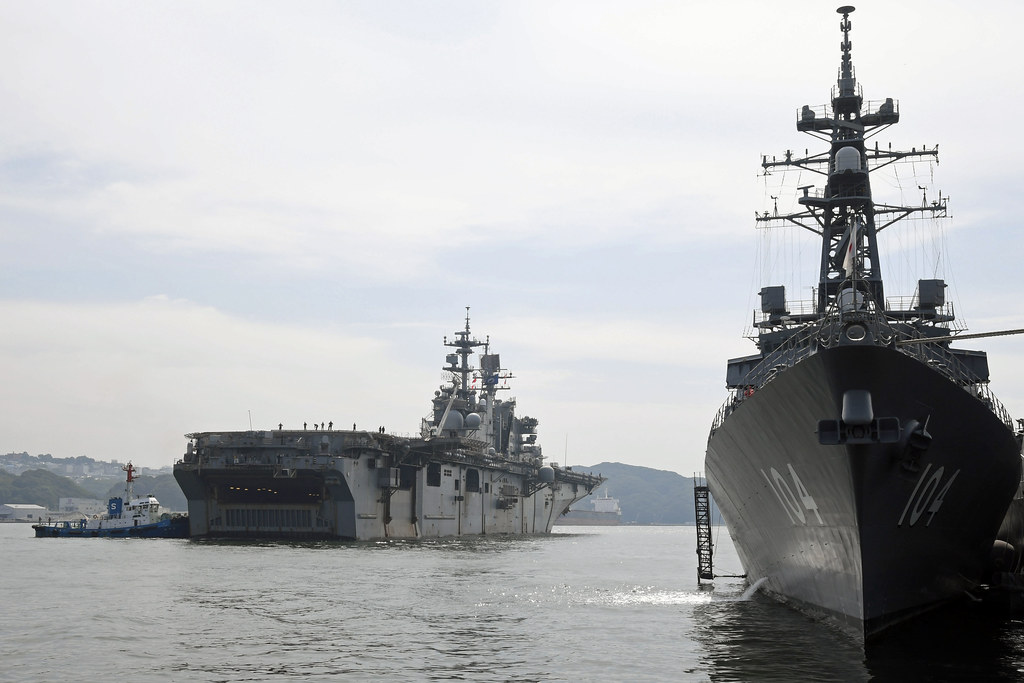
USS Bonhomme Richard (LHD 6) passes Japan Maritime Self-Defense Force destroyer JS Kirisame (DD 104) upon its return to Sasebo, Sept. 25. (U.S. Navy/MC1 David R. Krigbaum) >>

SASEBO, Japan - The amphibious assault ship USS Bonhomme Richard (LHD 6) returned to Sasebo, Japan, after completing a four-month deployment in the 7th Fleet area of operations, Sept. 25.

While deployed to the South Pacific, Bonhomme Richard, with the embarked 31st Marine Expeditionary Unit (MEU), participated in the bilateral, biennial U.S.-Australia exercise Talisman Saber 2017, completed amphibious integration training (AIT), successfully certified during the 31st MEU's certification exercise (CERTEX) and completed an amphibious maritime warfare (AMW) evaluation.

Additionally, Bonhomme Richard conducted port visits to Australia's cities of Sydney, Brisbane and Melbourne, during which many Sailors and Marines participated in community service projects, including visits to children's hospitals and care centers for underprivileged and disabled members of the local communities. Alongside the multiple COMREL events, the crew also hosted several ship tours to allow Australian allies a look into life aboard a U.S. naval amphibious vessel.

20 September 2017

USA: Bonhomme Richard ESG completes deployment with 31st MEU

By MC2 Sarah Villegas, ESG 7 Public Affairs

In this file photo, ships of the Bonhomme Richard Expeditionary Strike Group form up with ships from the Royal Australian Navy and Royal New Zealand Navy during exercise Talisman Saber in July. (Royal Australian Navy/LSIS Helen Frank) >>

OKINAWA, Japan - The amphibious assault ship USS Bonhomme Richard (LHD 6) and dock landing ship USS Ashland (LSD 48) arrived in Okinawa, Japan, to offload the 31st Marine Expeditionary Unit (MEU), Sept. 19, capping a multi-month deployment in the Indo-Asia-Pacific region.

The Bonhomme Richard Expeditionary Strike Group and 31st Marine Expeditionary Unit, deployed together since early June, successfully completed multiple certifications, participated in Talisman Saber 17, and conducted port visits throughout Australia.

The Blue-Green Team participated in the biennial exercise Talisman Saber off the coast of Australia to achieve interoperability and strengthen the U.S.-Australia alliance. The bilateral training tested watchstanders in nearly every domain—surface, air, undersea—and increased proficiencies in the ESG’s primary mission of landing forces ashore.

09 September 2017

News Report: US Assault Ship Loaded with Joint Strike Fighters Heads to North Korea

Lockheed Martin F-35 Lightning
The USS Wasp is sailing from its homeport in Virginia to Sasebo, Japan, to join the US Navy’s 7th Fleet and bring Washington’s most advanced fighter jets to North Korea’s backyard.

The Wasp, an Amphibious Assault Ship and lead ship of her class, doesn’t have quite as much surface area for jets to take off and land as the larger Nimitz-class aircraft carriers, but the ship will still bring a new squadron of carrier-compatible F-35B aircraft to the 7th Fleet’s area of operations. 

The F-35B jets have the AV-8B Harrier’s capability of taking off vertically, as a helicopter does, while also being able to operate in the air like fighter jets. 

06 September 2017

News Story: U.S. to send more strategic assets to Korea - Pacific Fleet chief

Adm. Scott Swift (Image: Wiki Commons)
By Lee Chi-dong

SEOUL, Sept. 5 (Yonhap) -- A top U.S. naval commander said Tuesday his country will keep sending formidable defense assets to the Korean Peninsula in combined deterrence and response to North Korea's "self-destructive" actions.

Adm. Scott Swift, who commands the U.S. Pacific Fleet, stressed that although South Koreans stand closest to the North's threats, they "do not face this aggressor alone."

He cited the North's continued provocations, including "ill-advised" ballistic missile launches and inflammatory warnings of nuclear war, highlighted by its sixth nuclear test Sunday.

Speaking at the International Seapower Symposium here, the admiral described the Kim Jong-un regime's choice as "irrationally self-destructive actions and behaviors that defy logic and explanation."

"We will continue to deploy carrier strike groups, expeditionary strike groups, AEGIS ships, the world's most capable submarine force and advanced aircraft like the F-35, P-8 and MH-60R to be prepared to respond decisively when called," he stressed. "Today, our platforms have longer reach, are more interconnected and possess greater lethality than what has ever been fielded before."

Read the full story at YonhapNews

    05 September 2017

    News Story: Task Group deployment to strengthen regional military cooperation

    An Australian Defence Force (ADF) Joint Task Group, Indo-Pacific Endeavour 2017, departed Sydney today to participate in a series of key military exercises throughout the Indo-Pacific region.

    Running from 4 September to 26 November, Indo-Pacific Endeavour will focus on enhancing military cooperation with some of Australia’s key regional partners including Brunei, Cambodia, the Federated States of Micronesia, India, Indonesia, Japan, Malaysia, the Philippines, the Republic of Korea, Singapore, Thailand, and Timor-Leste.

    More than 1200 ADF personnel will participate in the deployment, which is being led by Canberra-class amphibious assault ship HMAS Adelaide.

    HMAS Adelaide will be accompanied at various stages of the deployment by HMAS Melbourne, HMAS Darwin, HMAS Toowoomba, HMAS Parramatta, and HMAS Sirius, making this the biggest coordinated task group deployment since the early 1980s.

    Minister Payne said the Indo-Pacific Endeavour deployment, which has been in planning for over 12 months, was part of ongoing efforts to enhance and develop strong positive relations with regional militaries through both dialogue and practical activities.

    USA: Bonhomme Richard Departs Melbourne, Australia

    USS Bonhomme Richard (Image: Wiki Commons)
    By Mass Communication Specialist 2nd Class Cameron McCulloch, USS Bonhomme Richard (LHD 6) Public Affairs

    MELBOURNE, Australia (NNS) -- The amphibious assault ship USS Bonhomme Richard (LHD 6) departed Melbourne, Australia, Sept. 3, concluding a scheduled six-day port visit. 

    Melbourne is Bonhomme Richard's third Australian port visit during the current routine deployment as part of the U.S. - Australian biennial, bilateral exercise Talisman Saber 2017 (TS17), following visits to Sydney and Brisbane.

    "The people of Australia, military and civilian, have made us feel welcome throughout the entirety of this deployment in every port we entered", said Capt. Larry McCullen, commanding officer of Bonhomme Richard. "We will always cherish the relationships that we have established and the bonds that have been strengthened during our time here in Australia. It has been a truly positive experience working with one of our greatest and long-standing allies."

    31 August 2017

    USA: USS Wasp departs to join 7th Fleet forces in Japan

    From USS Wasp Public Affairs

    USS Wasp (LHD 1) file photo. (U.S. Marine Corps/Cpl. Ryan G. Coleman) >>

    NORFOLK, Va. - Amphibious assault ship USS Wasp (LHD 1) departed for Sasebo, Japan, Aug. 30, where it will assume duties as the forward-deployed flagship of the amphibious force of the U.S. 7th Fleet.

    The shift will introduce an F-35B Joint Strike Fighter-capable amphibious assault ship to the Indo-Asia-Pacific region, pairing it with the F-35Bs of Marine Fighter Attack Squadron (VMFA) 121.

    "This move ensures that our most technologically-advanced air warfare platforms are forward deployed," said Wasp Commanding Officer Capt. Andrew Smith. "Our capabilities, paired with the F-35B Joint Strike Fighter, increases our Navy's precision strike capabilities within the 7th Fleet region. Wasp will help America's commitment to the maritime security and stability in the Indo-Asia-Pacific."

    29 August 2017

    USA: Bonhomme Richard arrives in Melbourne for port visit

    From USS Bonhomme Richard Public Affairs

    USS Bonhomme Richard (LHD 6) sits along the pier in Melbourne after arriving for a port visit, Aug. 28. (U.S. Navy photo) >>

    MELBOURNE, Australia - The amphibious assault ship USS Bonhomme Richard (LHD 6) arrived in Melbourne for a scheduled port visit, Aug. 28.

    Bonhomme Richard and the embarked 31st Marine Expeditionary Unit (MEU) recently completed amphibious integration training (AIT) and a certification exercise (CERTEX), which tested the MEU’s ability to conduct all of its core missions such as stability operations, non-combatant evacuation and disaster relief.

    “Over the past month, BHR’s crew has been doing remarkable work,” said Capt. Larry McCullen, Bonhomme Richard’s commanding officer. “Our blue-green team came together to execute AIT and earn certification as true professionals. As we arrive in Melbourne for some well-earned liberty, we look forward to experiencing the sights and sounds of the city.”

    While in port, Sailors and Marines will have the opportunity to interact with the local community through community relations (COMREL) events and Morale, Welfare and Recreation (MWR) tours. Bonhomme Richard’s MWR office has coordinated a wide variety of events and tours to help Sailors and Marines enjoy the sights, wildlife, food and culture of the Melbourne area, including a trip to a wildlife sanctuary and a local rugby match.

    08 August 2017

    USA: Australian Defence Force assists in MV-22 Osprey recovery

    MARINE CORPS BASE CAMP BUTLER, Okinawa, Japan -- The Royal Australian Navy Clearance Diving team completed embark today aboard HMAS Melville to commence recovery operations near the site where an MV-22 Osprey entered the water on Aug. 5. Dive team members finalized planning in conjunction with the U.S. Marine Corps and U.S. Navy aboard USS Bonhomme Richard (LHD 6). The dive team plans to commence recovery operations using a remote operating vehicle this evening. The location of the MV-22 was detected on Aug. 6 by Melville using its hydrographic capabilities.

    "I want to thank the Australian Defence Force, and the crew of the HMAS Melville in particular, for their assistance in the search and recovery effort of our MV-22 that went down off the coast of Australia," said Lt. Gen. Lawrence Nicholson, Commanding General, III Marine Expeditionary Force‎. They volunteered their help before we could even ask, demonstrating their friendship and value as international partners. The crew of the Melville and its assets have been invaluable in the recovery effort. On behalf of the Marines, sailors, and families of III MEF, I thank you for your support.

    News Report: Australia Finds Missing US Aircraft

    The Australian navy says it has found the missing U.S. aircraft that crashed into the sea Saturday off Australia's east coast.

    Australian Defense Minister Marise Payne said in a statement the submerged aircraft was located "shortly after" Royal Australian Navy survey ship HMAS Melville arrived in Shoalwater Bay.

    The Sydney Morning Herald reports that Navy divers are working with the crew of the Melville at the crash site and are using remotely operated underwater vehicles.

    The aircraft had been launched from the USS Bonhomme Richard assault ship and was involved in routine operations when it crashed.

    Twenty-three people aboard the MV-22 Osprey were rescued, but three Marines remained missing.

    07 August 2017

    News Report: Search Suspended for 3 Marines Missing After MV-22 Crash

    An MV-22 Osprey aircraft lands abord amphibious assault ship
    USS America (Image: Wiki Commons)
    By: Sam LaGrone

    The search for three Marines missing after an MV-22 crash off of Australia has been suspended, according to a late Saturday statement from III Marine Expeditionary Force.

    “On Aug. 6 at around 3:00 a.m. local time, the U.S. Navy and Marine Corps suspended search and rescue operations for three Marines involved in the Aug. 5 MV-22 Osprey mishap off the east coast of Australia. Operations have now shifted to recovery efforts,” read the statement.

    “The transition comes after teams led continuous sustained search efforts supported by aircraft and ships. As the sea state permits, recovery efforts will be conducted to further search, assess and survey the area, in coordination and with assistance from the Australian Defence Force. Recovery and salvage operations can take several months to complete, but can be extended based on several environmental factors.”

    Families of the missing Marines, now presumed lost at sea, have been notified.

    03 August 2017

    News Story: Bonhomme Richard Departs Brisbane

    USS Bonhomme Richard (Image: Wiki Commons)
    From USS Bonhomme Richard Public Affairs

    CORAL SEA (NNS) -- The amphibious assault ship USS Bonhomme Richard (LHD 6) departed Brisbane, Australia, Aug. 1, following a scheduled four-day port visit.

    During the visit, Bonhomme Richard Sailors and Marines of the 31st Marine Expeditionary Unit (MEU) hosted shipboard tours, participated in community relations (COMREL) projects, and took advantage of tours offered through Bonhomme Richards' Morale, Welfare and Recreation (MWR) office.

    As part of the COMREL events, Sailors from Bonhomme Richard volunteered at the Brisbane Lone Pine Koala Sanctuary and visited the Lady Cilento Children's Hospital.

    "For me it's always good to be a part of something bigger," said Senior Chief Logistics Specialist Sheryl Gutierrez, a COMREL volunteer at the Lady Cilento Children's Hospital. "This is most likely the only time we'll meet these kids, but that exchange for just a minute or two, and being able to make these kids feel a little better about everything, makes it all worth it." 

    02 August 2017

    News Story: Osprey tiltrotor proves its worth in the Asia-Pacific

    By: Mike Yeo

    ROCKHAMPTON, Australia — Five years after its arrival in the Indo-Asia-Pacific, the Boeing MV-22B Osprey tiltrotor is proving to be an integral part of operations for forward-deployed U.S. Marines in the region.

    Defense News went on board the U.S. Navy helicopter assault ship Bonhomme Richard during the recently concluded exercise Talisman Saber in Australia, where the Osprey played a major role in supporting the 31st Marine Expeditionary Unit and other elements taking part in the exercise.

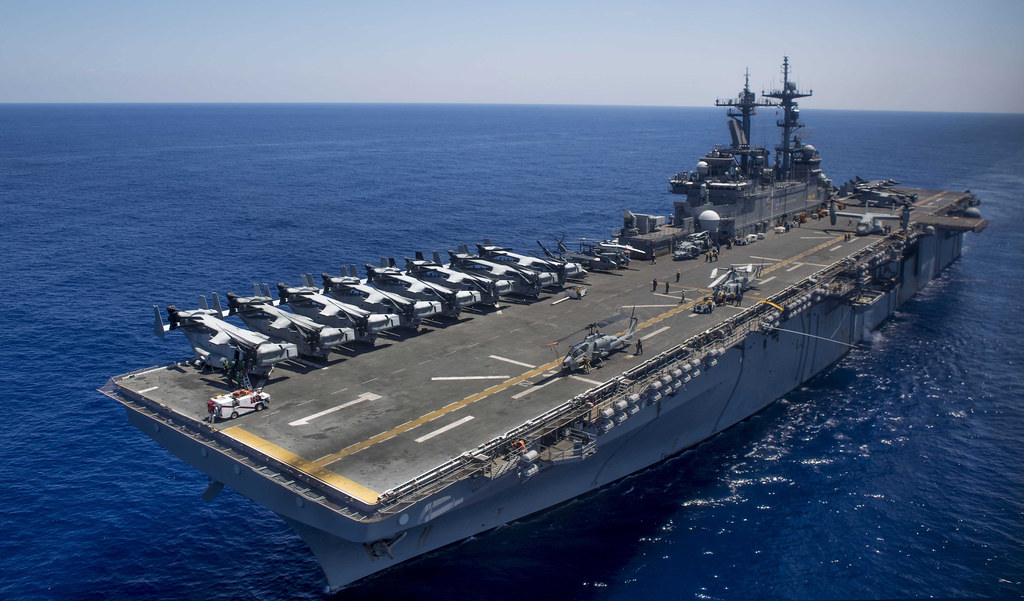
    The Bonhomme Richard carried 12 Ospreys from the “Dragons” of Marine Medium Tiltrotor Squadron (VMM) 265 at the exercise, while the Marines of the 31st MEU were spread among the three ships of the Bonhomme Richard Amphibious Ready Group, made up of the amphibious dock landing ship Ashland and amphibious transport dock ship Green Bay.

    According to VMM-265 pilot Capt. Charles Randolph, the Osprey’s main role at Talisman Saber was troop transport for ground assaults, operating either from the ships or as part of shore-based detachments. This included combined air assaults with U.S. Army and Australian helicopter assets also at the exercise, with the Osprey’s speed used to good effect to move troops around when conducting rapid flanking maneuvers on the ground.

    Randolph praised the Australian forces with whom the Marines exercised, telling Defense News that “everything that we‘ve been doing with the Australians — extremely professional, they’re highly knowledgeable and very good at what they do.” The pilot also reveled in the vastness of the training areas available where the Ospreys “have lots of room to maneuver, and it lets us use the aircraft to maximize its capabilities” compared to the smaller and more restrictive training areas in Japan.

    Read the full story at DefenseNews

    31 July 2017

    USA: USS Bonhomme Richard makes Brisbane port call

    From USS Bonhomme Richard Public Affairs

    USS Bonhomme Richard (LHD 6) operates in the Coral Sea, July 12, during exercise during Talisman Saber. (U.S. Navy/MC2 Cameron McCulloch) >>

    BRISBANE, Australia - The amphibious assault ship USS Bonhomme Richard (LHD 6) arrived in Brisbane, Australia, for a scheduled port visit, July 29.

    Bonhomme Richard, along with the 31st Marine Expeditionary Unit (MEU), successfully completed the biennial, bilateral exercise Talisman Saber 2017 (TS17). While in Brisbane, the Sailors and Marines will have the opportunity to enjoy the sights and rich culture of the city.

    “Our blue-green team operated at the highest levels of proficiency and professionalism alongside our Australian allies during Talisman Saber, and I couldn’t be more proud of everyone who made an impact during that mission,” said Capt. Larry McCullen, Bonhomme Richard’s commanding officer. “It’s great to now be in Brisbane, where those same Sailors and Marines can enjoy some well-deserved liberty and experience all that the city has to offer.”

    29 July 2017

    USA: McCampbell visits Sydney following Talisman Saber

    From USS McCampbell Public Affairs

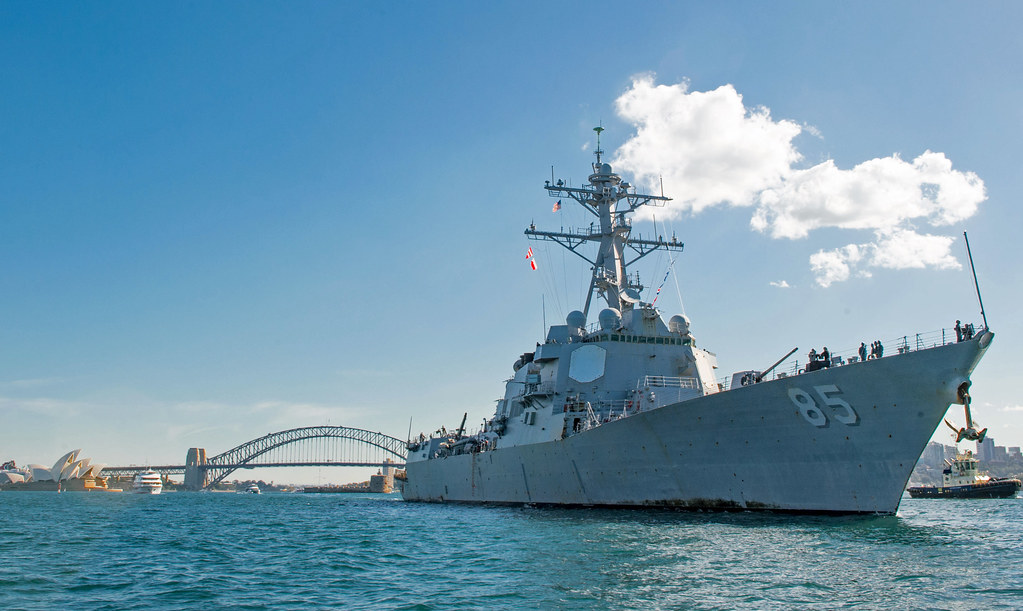
    USS McCampbell (DDG 85) departs Sydney, July 27. (U.S. Navy/MC2 Jeremy Graham) >>

    SYDNEY, Australia - The forward-deployed Arleigh Burke-class guided-missile destroyer USS McCampbell (DDG 85) departed Sydney, July 27 following a four-day port visit.

    The visit marked the end of McCampbell's participation in the biennial, U.S.-Australia, multi-domain exercise Talisman Saber 2017 (TS 17). This was an exercise that focused on joint training among U.S. forces to conduct a range of missions in the air, sea, land, and cyberspace.

    US Navy participants included USS Ronald Reagan (CVN 76), Carrier Air Wing 5, USS Shiloh (CG 62), USS Barry (DDG 52), USS McCampbell (DDG 85), USS Bonhomme Richard (LHD 6), USS Green Bay (LPD 20), USS Ashland (LSD 48) and USS Sterett (DDG 104).

    More than 33,000 forces from the U.S. and Australia have participated in TS 17. Although TS 17 remained a bilateral exercise, members of the New Zealand Defense Forces participated under the command of Australia, and members of the Japan Self-Defense Force participated under U.S. command.

    27 July 2017

    USA: ‘Up-Gunned ESG’ concept moves forward in Talisman Saber exercise

    From Expeditionary Strike Group 7 Public Affairs

    Ships of the Bonhomme Richard ESG form up with Royal Australian Navy and Royal New Zealand Navy ships during Talisman Saber, July 22. (Royal Australian Navy/LSIS Helen Frank) >>

    CORAL SEA - Flanked by a U.S. destroyer and four Australian frigates, the Bonhomme Richard Expeditionary Strike Group successfully executed elements of the ‘Up-Gunned ESG’ concept while participating in more than two weeks of live action training as part of Talisman Saber 2017.

    The field training exercise (FTX) component of TS17 tested a combined and joint forces’ ability to respond to a crisis situation. Amphibious forces played a critical role in seizing objectives ashore that allowed a land force led by Australian Army’s 3rd Brigade to further deliver stability.

    Throughout the exercise, the combined U.S.-Australia-New Zealand amphibious force defended against opposing exercise forces in the air, surface, and undersea domains while delivering combat power against both those forces and opposing forces ashore. The scenarios allowed the ESG to flex its sensors, weapons, and maneuver capability to attain sea control and project power ashore.

    USA: U.S.-Australia team up for TS17 command and control from Bonhomme Richard

    By MC2 Cameron McCulloch, USS Bonhomme Richard Public Affairs

    Royal Australian Navy Sailor Able Seaman Combat Systems Operator Samuel Perkins communicates with ships of the U.S.-Australia expeditionary strike group from the combat information center aboard the USS Bonhomme Richard (LHD 6) during Talisman Saber 17, July 7. (U.S. Navy/MC2 Cameron McCulloch) >>

    CORAL SEA - Through a locked door painted with a mural depicting the amphibious assault ship USS Bonhomme Richard (LHD 6), various aircraft, and the words “In God we trust, all others we track,” is one of the Bonhomme Richard Expeditionary Strike Group (ESG) nerve centers. Here, information on allied and adversarial surface and air contacts is gathered and disseminated throughout the ESG. The space, thus, is suitably named the Combat Information Center (CIC).

    Locked with a cipher lock and only accessed by those outside of the “need-to-know” via buzzer and a secret clearance, this dark room with little headroom contains the equipment and communications systems to be the eyes, ears and voice of the ship. Consoles made up of monitors in a variety of shapes and sizes display information using the ship’s radar and tracking software. The information displayed glows from the screens in tones of green and orange. These glowing screens illuminate the faces of their operators; Sailors using such precise finger-to-keyboard movements and disciplined voice communications that an interruption of their work feels like it could be considered an act of sabotage, like a wrench thrown into gears.

    26 July 2017

    USA: Talisman Saber a success, 31st MEU re-embarks Bonhomme Richard ARG

    By Staff Sgt. T. T. Parish, 31st Marine Expeditionary Unit

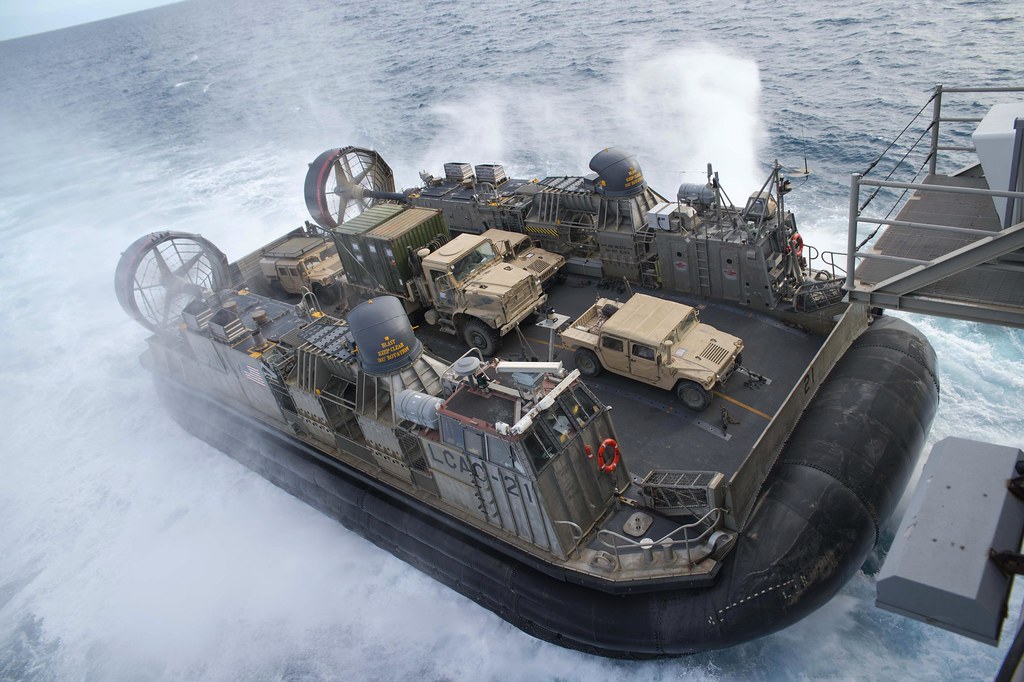
    A landing craft air cushion from Naval Beach Unit 7 approaches USS Bonhomme Richard (LHD 6), July 23, as Marines return from training during Talisman Saber. (U.S. Navy/MC3 William Sykes) >>

    BRISBANE, Australia - Marines and Sailors with the 31st Marine Expeditionary Unit completed the biennial Exercise Talisman Saber, re-embarking aboard the U.S. Navy ships of the USS Bonhomme Richard Expeditionary Strike Group off the coast of Queensland, Australia, July 23-25.

    The Marines and Sailors, along with their counterparts in the Australian Defence Forces, spent several weeks building bilateral capabilities and strengthening the U.S.-Australian defense posture while honing a long-lasting relationship between the two nations.

    The exercise was a resounding success for the 31st MEU and the members of the Australian military, according to Col. Tye R. Wallace, commanding officer of the 31st MEU.

    "Working with our allies and partners has been extremely rewarding. Talisman Saber offers a unique opportunity to increase our interoperability with the Australians," said U.S. Marine Corps Col. Tye R. Wallace, commanding officer of the 31st MEU.

    25 July 2017

    News Story: US Navy tests amphibious concept at Talisman Saber exercise

    By: Mike Yeo

    ROCKHAMPTON, Australia — The U.S. Navy has put its up-gunned expeditionary strike group concept into practice within a realistic war-fighting scenario, with allied surface combatants joining an amphibious ready group, or ARG, and its embarked Marines for a major exercise off the coast of Australia.

    The Bonhomme Richard ARG was joined by a surface action group, or SAG, made up of the U.S. destroyer Sterett and four Australian frigates at Exercise Talisman Saber 2017, which saw American and Australian forces carry out two major amphibious landings at Australia’s Shoalwater Bay Training Area.

    According to Royal Australian Navy Capt. Guy Holthouse, sea combat commander for the Talisman Saber 2017 Combined Amphibious Force, the up-gunned ESG was pitted against a very active and capable adversary that presented a mix of surface, air and subsurface threats using real submarines, aircraft and ships throughout the exercise, which added training value to both U.S. and Australian forces.

    Rear Adm. Marc Dalton, commander of the U.S. Navy’s Amphibious Force 7th Fleet, added that Talisman Saber was used “to work on concept development (of the up-gunned ESG), especially for the cruiser/destroyer/frigate integration into the force as we build towards adding the F-35B.”

    Dalton noted that the amphibious assault ship Wasp, which will replace the Bonhomme Richard as the Navy’s forward-deployed big-deck amphibious ship in Japan this fall, will start deploying the F-35B at sea in the region in early 2018 and will represent “the first opportunity to operate with the complete package of the up-gunned ESG.”

    Read the full story at DefenseNews

    22 July 2017

    AUS: Allied Forces Defeat Adversary In Major United States-Australia Military Exercise—Talisman Saber 2017

    The United States (US) and Australian Defence Forces have proven their interoperability in a major land warfare scenario in the Shoalwater Bay Training Area last night with an intense final assault on the ‘enemy’.

    More than 33,000 soldiers, sailors, airmen and marines from Australia,  the US, New Zealand, Japan and Canada have spent the past three weeks involved in the realistic, scenario-based military exercise TALISMAN SABER 2017 (TS17). The exercise took place in Central Queensland, with elements also supporting the mission in Brisbane, Townsville and Hawaii.

    Following several weeks of lead in training TS17 ramped up last week when a 33-strong fleet of multi-national warships and submarines, including HMAS Canberra—an expeditionary strike group led by the USS Bonhomme Richard, and a carrier strike group led by the USS Ronald Reagan, moved into position off the coast of Rockhampton.

    The Australian Defence Force’s Deputy Chief of Joint Operations, Major General Greg Bilton, said the participating nations demonstrated the ability to expertly land thousands of troops ashore by sea and air to support a complex ground warfare mission.