Showing posts with label UUV. Show all posts

14 August 2017

AUS: Deployable Mine Countermeasure Capabilities For Navy

The Royal Australian Navy is forging ahead with new technologies to counter the threat of sea mines to military and commercial vessels.

The Head of Navy Capability, Rear Admiral Jonathan Mead, said the prevalence and increasing sophistication of sea mines means the Royal Australian Navy must continue to improve the way it finds and disposes of these mines.

“New autonomous and remote-controlled technologies deployed from within the maritime task force provides the opportunity to find and dispose of sea mines more safely and efficiently,” Rear Admiral Mead said.

“In the 2030s, Defence will seek to replace its specialised mine hunting and environmental survey vessels with a single fleet of multi-role vessels embarking advanced autonomous and uninhabited systems.”

Rear Admiral Mead said these newly introduced systems are the first step in realising a future capability which would allow the Royal Australian Navy to clear sea mines with minimal risk to its people and assets.

“Thales Australia Ltd will deliver and support the new equipment over the next 15 years,” Rear Admiral Mead said.

The new capability will primarily be based and sustained at HMAS Waterhen in Sydney, New South Wales.

08 August 2017

USA: Australian Defence Force assists in MV-22 Osprey recovery

MARINE CORPS BASE CAMP BUTLER, Okinawa, Japan -- The Royal Australian Navy Clearance Diving team completed embark today aboard HMAS Melville to commence recovery operations near the site where an MV-22 Osprey entered the water on Aug. 5. Dive team members finalized planning in conjunction with the U.S. Marine Corps and U.S. Navy aboard USS Bonhomme Richard (LHD 6). The dive team plans to commence recovery operations using a remote operating vehicle this evening. The location of the MV-22 was detected on Aug. 6 by Melville using its hydrographic capabilities.

"I want to thank the Australian Defence Force, and the crew of the HMAS Melville in particular, for their assistance in the search and recovery effort of our MV-22 that went down off the coast of Australia," said Lt. Gen. Lawrence Nicholson, Commanding General, III Marine Expeditionary Force‎. They volunteered their help before we could even ask, demonstrating their friendship and value as international partners. The crew of the Melville and its assets have been invaluable in the recovery effort. On behalf of the Marines, sailors, and families of III MEF, I thank you for your support.

News Report: Australia Finds Missing US Aircraft

The Australian navy says it has found the missing U.S. aircraft that crashed into the sea Saturday off Australia's east coast.

Australian Defense Minister Marise Payne said in a statement the submerged aircraft was located "shortly after" Royal Australian Navy survey ship HMAS Melville arrived in Shoalwater Bay.

The Sydney Morning Herald reports that Navy divers are working with the crew of the Melville at the crash site and are using remotely operated underwater vehicles.

The aircraft had been launched from the USS Bonhomme Richard assault ship and was involved in routine operations when it crashed.

Twenty-three people aboard the MV-22 Osprey were rescued, but three Marines remained missing.

27 July 2017

News Report: Chinese Navy Expands Submarine Detection Testing in the South China Sea

The Chinese navy will conduct a massive experiment with underwater drones equipped with "real-time data transmission technology," in hopes of building up Beijing’s capacity to detect hostile submarines in the South China Sea.

Beijing wants to accelerate the development of underwater monitoring technology, the South China Morning Post report said, in response to US President Donald Trump’s sanctioning the US Navy to conduct more freedom-of-navigation operations.

Twelve undersea "gliders" positioned in undisclosed locations in the South China Sea will transmit data back to control centers, SCMP noted. The unmanned sea drones will cruise around for a month to gather data on water temperature, salinity, cleanliness, oxygen levels and sea current velocity, a Chinese Academy of Sciences official told the Post.

25 July 2017

News Story: Japan's R&D misfire for defense reform

Kawasaki C-2 Cargo Aircraft (File Photo)
By: Paul Kallender-Umezu 

TOKYO — Since the October 2015 establishment of the 1,800-strong Acquisition, Technology and Logistics Agency, Japan’s Ministry of Defense has been attempting to streamline its acquisition process and facilitate private-sector research and development. Results have been mixed.

In doing so, the MoD launched a new program to funnel more spending to Japanese scientists. The same year, ¥300 million (U.S. $2.7 million) was budgeted for the program. That doubled to ¥600 million (U.S. $5.4 million) in fiscal year 2016 and is set to rise to ¥11 billion (U.S. $98 million) in fiscal year 2017 as the MoD tries to build a research cadre in Japan’s academic sector that will benefit defense procurement later.

The establishment of the Acquisition, Technology and Logistics Agency, or ATLA, came on top of an April 2014 relaxation of defense export rules allowing cases that will contribute to global peace and serve Japan’s security interests, leading to the July 2014 sale of Patriot Advanced Capability-2 missile interceptors to the United States. ATLA’s new job is to try to better connect disparate R&D efforts to produce new outputs.

“We understand that China is very active, and we always want to stay ahead and secure technological superiority, and we are using this fund more actively to stimulate research in industry and academia,” said Takahiro Yoshida, director of ATLA’s Aircraft Project Management division.

Backers of the new strategy are banking ability or likelihood of success based on leveraging a series of Japanese civil technologies such as robotics, AI and machine learning and advanced materials, said Steven Ganyard, president of Avascent Global Advisors.

“The rise of a belligerent China and [North Korea] means that Japan can no longer afford a defense procurement process divorced from reality. Japan builds … products like C-2, P-1 and F-2 when they could be buying the best in the world for a fraction of the price. No other country in the world operates like this,” he said.

Read the full story at DefenseNews

20 June 2017

Think Tank: Sea, air, land and space updates (20-Jun-2017)

Boeing's Echo Voyager UUV (Click Image to Enlarge)
Zoe Glasson, Sophie Qin, Madeleine Nyst and Patrick Kennedy
Sea State
An Iranian ship came within 730m of three US Navy vessels (an amphibious assault ship, a guided-missile destroyer and a dry cargo ship) in the Strait of Hormuz last week. The Iranian vessel shined a spotlight on the destroyer before training a laser on a CH-53E helicopter flying alongside it, prompting the USN to label the incident as an ‘unsafe and unprofessional’ encounter. While this encounter isn’t the first instance of harassment by Iran in this strategic waterway, what was unusual was that the ship involved formed part of the Iranian Navy, rather than the Revolutionary Guards’ Navy which normally carries out acts of that nature.
Last Sunday Iran and China completed a joint naval exercise in the Strait involving 700 Iranian personnel. For an analytical deep-dive into the Strait of Hormuz’s strategic significance and the viability of Iran’s asymmetric warfare, check out a two-part series from the Center for International Maritime Security (here and here).
The USN, Boeing and Huntington Ingalls have joined forces in an underwater endeavour to build the Echo Voyager, a would-be ‘massive unmanned, autonomous submarine’ able to fire missiles, drop mines and stay submerged for months. Boeing is currently testing the drone off the coast of California.

06 June 2017

Think Tank: Sea, air, land and space updates (6-Jun-2017)

Zoe Glasson, Sophie Qin, Madeleine Nyst and Patrick Kennedy
Sea State
DARPA is looking for a way to improve US Navy capability by making it possible for unmanned underwater vehicles (UUVs) to communicate underwater. DARPA thinks the answer might be AMEBA (A Mechanically Based Antenna) which could enable wireless communication and data transfer, with antennae  small enough to be installed on UUVs or carried in troops’ packs.
While US Navy UUVs are used for intelligence operations and minesweeping, others have a somewhat different purpose—such as BIKI, the ‘world’s first bionic robot fish’. Though marketed as an underwater camera or monitoring device, BIKI is the real deal, carrying advanced bionics tech of the kind built for artic research.
In an interview with a Chinese State TV channel, a top Chinese naval engineer has revealed that PLAN’s newest nuclear attack submarines (the Type 095 SSN) will be fitted with a ‘revolutionary and silent propulsion system’—a ‘shaftless rim-driven pumpjet’. Analysis of the announcement is just beginning to roll in, but one commentator views the development as ‘an attempt to leap beyond current submarine technology’, which if successful could see the PLAN outpace the US and Britain, whose SSBNs carrying the option for rim-drive pumpjets won’t enter service until 2030.

20 May 2017

News Report: Indian Navy Looks to Buy Subsurface Vessels to Detect Undersea Threat

In the absence of the required number of minesweepers, the Indian Navy has started the process to procure remote-controlled portable underwater vessels to conduct explosive ordnance disposal operations in harbors and sea water up to 75 meters depth.

New Delhi (Sputnik) – Indian Navy wants three variants of the underwater vessel namely for detection/inspection, combat and training role. In fact, the Navy will purchase five underwater vehicles which may go up later. The purchase order is expected to be approximately $95 million: half of the total deal amount has to be invested in India under an offset clause of India’s Defense Procurement Policy 2016.

The GPS and inertial navigation system-enabled, 360-degrees maneuverable portable automatic underwater vehicles (PAUV) would be self-propelled using horizontal and vertical thrusters and onboard chargeable battery pack. The Navy wants PAUV to be deployable in rigid-hulled inflatable boats, inflatable crafts, and helicopters. An Indian Navy document demands two hours endurance capacity of the PAUV which can be controllable at a speed of five knots.

22 March 2017

News Story: Major aerospace, maritime exhibition kicks off in Malaysia's Langkawi

LANGKAWI, Malaysia, March 21 (Xinhua) -- The 14th Langkawi International Maritime and Aerospace Exhibition (LIMA) kicked off on Tuesday, as major defense companies are striving to take a bigger share of the increasing Asian defense market.

Malaysia's Ministry of Defense said 555 exhibitors from 36 countries and regions took part in the five-day exhibition, covering an area of 119,209 square meters, the biggest scale so far. The ministry hopes to attract 40,000 trade visitors and more than 140,000 public visitors.

In total, 101 aircrafts will take part in static display and aerial display, in which aerobatic teams from Russia and South Korea will also put on fabulous airshows. Sixty-one maritime assets, including guided-missile frigates and submarines, also joined the exhibition.

Major defense companies such as Boeing, Lockheed Martin from the United States, Saab from Sweden and Dassault from France, came to the show with the intention of taking the first mover advantage if Malaysia replaces the MiG-29 fighter jets in its air force with a new model, a plan announced two years ago but is yet to be materialized.

Read the full story at Xinhua

14 February 2017

News Story: Alternative Navy Study Bets Big On Robot PT Boats & LCS

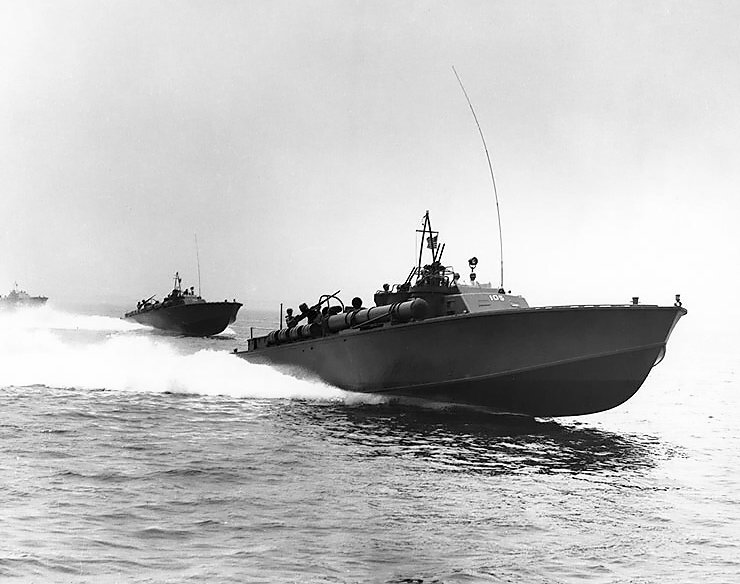
US Navy WWII PT boats underway (Image: Wiki Commons)
By SYDNEY J. FREEDBERG JR.

WASHINGTON: Light carriers. Robot PT boats. Unmanned subs. A congressionally chartered study, the Alternative Future Fleet Platform Architecture Study, “does not represent any official Navy position,” but offers a surprisingly bold vision for the future of the US Navy.

The study, by a “Navy Project Team” of officers, civil servants, and contractors free to brainstorm without being “constrained” by the service’s official plans, calls for a future “battle force” of 321 manned ships. That’s 10 percent smaller than the official Navy program for 355, let alone the parallel studies Congress commissioned from thinktanks CSBA, which calls for 340 manned ships, and MITRE for 414. But while the official 30-year shipbuilding plan submitted to Congress in 2017 only includes 10 large, seagoing unmanned vessels, and CSBA proposes 80, the Alternative Future Fleet would include 138.

That would be a mix of 48 unmanned underwater vessels — designed to supplement traditional nuclear-powered attack submarines — and a whopping 88 unmanned fast attack boats, derived from the Mark V Special Operations vessel or the Mark VI patrol craft. (A Coast Guard patrol boat is a third option). Instead of developing a new purpose-built unmanned boat, like DARPA’s Sea Hunter, this approach would build on ongoing Navy experiments with converting standard small craft for unmanned operations. They’d be launched from shore bases or from the well decks of amphibious assault ships normally used to transport Marines. The Alternative Future Fleet vessels would be about the 80-foot length of World War II Patrol Torpedo boats (remember PT-109?), and like the PT boats, they’d be armed to attack much larger vessels, with “anti-ship cruise missiles, mines or torpedoes with an operating range in the hundreds of nautical miles.”

The PT boats suffered heavy casualties in World War II, and the modern Navy has eschewed such well-armed but fragile small craft. Countries more callous about casualties, such as Iran, have embraced them. Making the expendable attack boats unmanned might make them palatable to the Navy.

Read the full story at BreakingDefense

11 February 2017

News Story: Big Wars, Small Ships - CSBA’s Alternative Navy

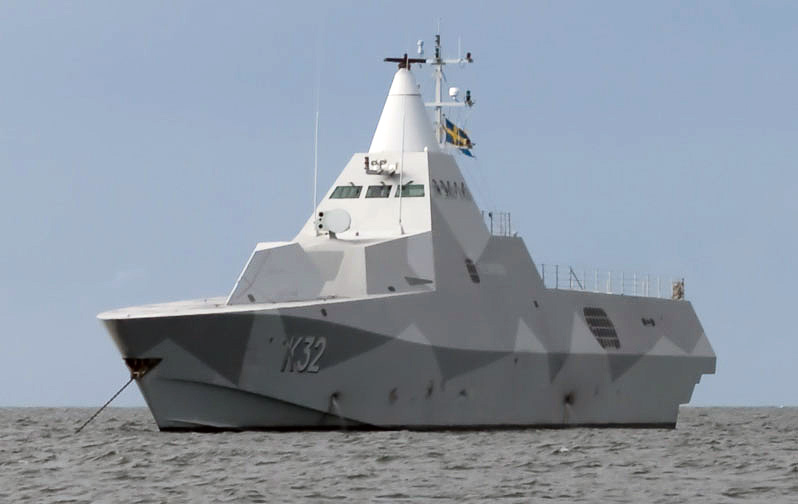
Visby class Corvette (Image: Wiki Commons)
UPDATED with McCain praise WASHINGTON: The Navy needs a bigger fleet of smaller ships than envisioned in its official Force Structure Assessment, says a congressionally-chartered study from the Center for Strategic & Budgetary Assessments.

CSBA emphatically agrees with the Navy that the focus needs to shift from day-to-day counter-terrorism and presence operations to deterring (and if need be, fighting) major wars. Both plans call for a steep increase in attack submarines from 55 today to 66, along 12 nuclear-missile submarines. But CSBA recommends distinctly different surface fleet — one with many similarities to proposals from Senate Armed Services chairman John McCain.

[UPDATE: “I am particularly impressed with the comprehensiveness of the CSBA study, which should serve as the starting point for the new administration’s review of naval forces,” McCain said Friday, praising CSBA’s work out above two other “impressive” congressional chartered studies, one from thinktank MITRE and the other from a Navy team.

“It proposes necessary new strategic, operational, basing, and force structure recommendations that deserve immediate consideration by Navy leaders,” McCain said of the CSBA paper. “My recent white paper ‘Restoring American Power’ has much in common with these studies and recommendations. The question now is what tangible steps Navy leaders will take to turn these recommendations into reality.”

Read the full story at Breaking Defense

02 February 2017

News Report: China Eyes Breakthrough R&D Defense Plan to Take on US Technological Dominance

Recently, China established a new central commission for joint military and civilian development. The new institution will be chaired by Chinese President Xi Jinping.

"The commission will be the central agency tasked with decision-making, deliberation and coordination of major issues regarding integrated military and civilian development," read an official statement issued by Xinhua news agency.

According to military expert Vasily Kashin, the fact that the commission is overseen by the Chinese leader proves that it is expected to play an important role in China’s far-reaching defense modernization plans.

The conception of integrated military and civilian development was first presented in China back in the 1980s, at the early stage of China’s economic reforms.

19 January 2017

News Story: Gangs of US Navy "Killer" Boats Will Roam the Seas

Protector USV
by Scott N. Romaniuk

What have been appositely referred to as the "military's smartest toys," robot boats have just become a lot smarter, and so has the US Navy.

It has taken the US government some time, but its team of researchers and developers have begun to discover the effectiveness of swarming by means of autonomous boats - Unmanned Surface Vehicles (USVs) or Autonomous Surface Craft (ASCs). The Office of Naval Research (ONR) is committed to the idea of robot boats and the impact they can have in both defensive and offensive contexts at home and abroad.

A swarm of robot made debuted in Virginia's James River approximately two years ago, and in the final weeks of 2016, the ONR put on another show with its small boats in the Chesapeake Bay estuary, near Washington, DC.

The second demonstration showcased better thinking by the ONR and its autonomous systems, which not only performed well individually, they also demonstrated their capacity to swarm as a coherent unit against a potential enemy while maintaining an intricate information relay system.

Using sophisticated software called, Control Architecture for Robotic Agent Command and Sensing (CARACaS), the USN's Rigid Hull Inflatable Boats (RHIBs) processed data about the potential threat in US waters and responded as if they had a life of their own. The USN's advanced robot boats deftly demonstrated the essence of swarming, much like a flock of hyenas in the presence of a gazelle or lion.

Read the full story at SpaceWar

10 January 2017

News Story: Beijing building up underwater defense in South China Sea?

A Chinese Unmanned Underwater Vehicle (UUV) - Drone
Military analysts says Beijing has to ‘respond strongly’ by catching up in the underwater drone race between the US and China following seizure of Washington’s sea drone in the South China Sea.

“For example, we could develop a technology for our drones to capture their drones or cut off their underwater communications,” said Li Jie, a Beijing-based military analyst as quoted by South China Morning Post.

Military commentator Yue Gang, a retired People’s Liberation Army (PLA) colonel, said the US drone had been “conducting espionage activities” in the South China Sea, collecting underwater information that could “be provided to its submarines, allowing them to freely roam under the water”.

“The drone is not very big, like a small robot, but if it found out enough about the underwater signal features of submarines, a database could be created which could be offered to US navy submarines and the anti-submarine warships,” Yue said noting that “this could pose a grave threat to China’s military security.”

Read the full story at Tankler

30 December 2016

News Report: Furious China Reiterates Warning to US Over Taiwan President Visit

Despite protests from China, Taiwan’s Foreign Ministry announced Thursday that President Tsai Ing-wen will stop in the US on her way to a diplomatic trip to Latin America.

The visit will further provoke a China already irritated by a recent telephone call between Tsai and US President-elect Donald Trump, the first such contact between an American and Taiwanese head of state since the administration of President Jimmy Carter. 

Since 1979, the US has functioned on the "One China" principle, that holds that Taiwan is a part of China and is therefore incapable of conducting its own diplomatic relations. Beijing still considers Taipei to be a province, and Chinese officials say that Tsai’s US visit is a transparent attempt to lobby for the country’s full independence.

Increasing tensions between the two countries, a US-deployed research drone was recently intercepted by the Chinese Navy, despite Beijing being made aware that it was US property. Bonnie Glaser, director of the China Power Project at the Centre for Strategic and International Studies, told The Guardian that, "This looks like signalling from the Chinese in response to Trump’s Taiwan call…The Chinese now have much better control over the military, particularly the navy. It is in China’s interest to send signals before Trump is inaugurated, so that he gets the message and be more restrained once he is office." 

26 December 2016

News Report: China's Liaoning Carrier Group Conducts Military Tests in Yellow Sea

China's first aircraft carrier group conducted a series of military tests in the Yellow Sea December 24, ahead of scheduled testing farther away later, its military reported.

The tests included a fighter launch and air combat and recovery exercises, AP reports.

The next steps for the Liaoning carrier group will be "cross-sea" training and tests at an unspecified location. Chinese media are speculating that this could mean the ships will conduct operations in areas of the contested South China Sea.

AP quotes a military analyst in China's Global Times newspaper as saying the South China Sea would be an "ideal" location because joint exercises could be done in areas controlled by China. 

21 December 2016

News Report: China Returns US Underwater Drone

China on Tuesday returned an underwater U.S. drone it seized last week in the international waters of the South China Sea.

Pentagon spokesman Peter Cook said the transfer took place in the same area where China picked up the drone, which measures water salinity and temperature gradients.

"This incident was inconsistent with both international law and standards of professionalism for conduct between navies at sea," Cook said in a statement. "The U.S. has addressed those facts with the Chinese through the appropriate diplomatic and military channels, and have called on Chinese authorities to comply with their obligations under international law and to refrain from further efforts to impede lawful U.S. activities."

China's Defense Ministry said Tuesday the transfer was conducted "smoothly" after "friendly consultations" between the two countries.

News Story: China rejects Trump claim it stole US drone

China on Monday rejected US President-elect Donald Trump's claim that it had "stolen" an American research drone, as state media said his diplomatic inexperience could spark a confrontation between the two nations.

Beijing's seizure of the marine probe in international waters in the South China Sea raised already heightened tensions between the world's two largest military powers.

On Sunday, after Beijing and Washington announced the drone would be returned, Trump tweeted: "We should tell China that we don't want the drone they stole back. - let them keep it!"

Trump's accusation that China had stolen the drone was "not accurate", said foreign ministry spokeswoman Hua Chunying.

"Imagine that you found something on the street -- you would need to first check and verify it before handing it back to someone else," she told a regular press conference.

Hua said the two sides "are in smooth communication through military channels, and we believe the incident will be properly handled". She gave no further details.

The Chinese military is expected to return the probe to the US Navy in the South China Sea on Tuesday, a US defence official said.

"A US destroyer will be there," the official told AFP on Monday, speaking on condition of anonymity.

Read the full story at SpaceDaily

News Story: US statement on receiving drone ‘unlawfully seized’ by China

The United States received on Tuesday their own sea drone which is seized by Chinese military on December 15.

“Today, the People’s Liberation Army-Navy (PLA) vessel 510 returned a U.S. Navy Ocean Glider Unmanned Underwater Vehicle (UUV) to the United States, near the location where it had been unlawfully seized on Dec. 15. USS Mustin (DDG 89) received the vehicle for the U.S. in international waters approximately 50 nautical miles northwest of Subic Bay,” Pentagon’s press release said in a statement.

It said the UUV “was conducting routine operations in the international waters of the South China Sea in full compliance with international law.”

Read the full story at Tankler

20 December 2016

News Report: US Global Hawk Drone Shadowed Chinese Jets During Training Exercise Near Taiwan

While Chinese warplanes circled Taiwan airspace on a recent mission, an American RQ-4 Global Hawk drone tailed closely nearby.

China’s dispatch of fighter jets and heavy bombers en route to Taiwan drew the attention of the US, which sent EP-3 and RC-135 stealth aircraft to keep a watch on the Chinese training exercise, a Taiwan defense official told Taiwan News. 

The scenario unfolded on December 10, according to the official. The Chinese fleet of at least ten fighter jets crossed the Miyako Strait, alerting Japan’s air defense identification zone (ADIZ). Two Japanese F-15s promptly took off to intercept the Chinese squadron. China’s jets then began heading back toward the mainland without ever officially entering Taiwan’s ADIZ, the official said.

In the wake of US President-elect Donald Trump’s break with a decades-old China-related diplomatic practice, in addition to negative rhetoric about Beijing during Trump’s campaign, Chinese news outlets have called for an increased defense budget to grow its nuclear arsenal. China has sent jets near Taiwan three times in the past month, including deployment of its nuclear-capable Xian H-6K, on at least one occasion.

Just last week, US satellite imaging revealed a buildup of anti-aircraft and other defense infrastructure on China’s artificial islands in the South China Sea. Most recently, China and the US again experienced controversy after China’s navy captured a US underwater drone, but since promised to return what is said to be an oceanographic survey device back to the US. 

This story first appeared on Sputnik & is reposted here with permission.