Showing posts with label Cyber Warfare. Show all posts

23 September 2017

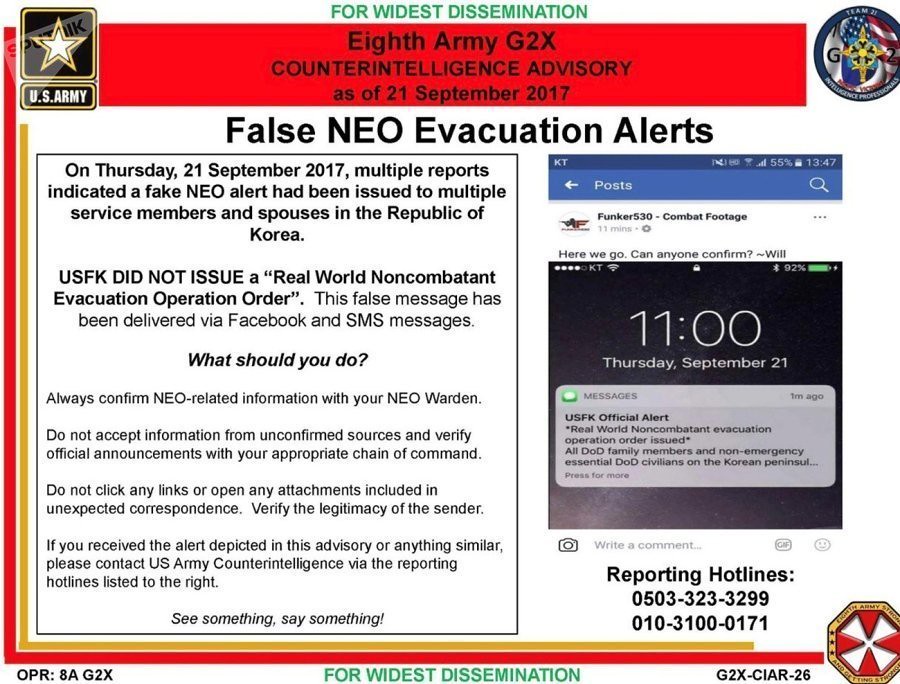
News Report: Fake Evacuation Orders Sent to US Forces Korea, Families

US Army Warning of Fake Alert (Click Image to Enlarge)
Two days after US President Donald Trump threatened to destroy North Korea, a flurry of false evacuation orders were sent to US service members and their families stationed on the Korean Peninsula.

The alert, delivered through text messages and Facebook, read: "Real World Noncombatant evacuation operation order issued. All DoD family members and non-emergency essential DoD civilians on the Korean Peninsula an evacuation order has been issued."

The hoax was shut down by officials within an hour after being reported on Thursday, and US Forces Korea quickly issued their own statement saying "USFK did not issue this message."

News Story: No Safe Place In Next War - The Army’s Expanded Battlefield

Bradley M2A3 IFVs are unloaded at Busan port RoK (File Photo)
By SYDNEY J. FREEDBERG JR.

What if the next war starts, not with a gunshot, but with a tweet? As tensions rise, US troops discover their families’ names, faces, and home addresses have been posted on social media as they prepare to deploy, along with exhortations to kill the fascists/imperialists/infidels (pick one). Trolls call them late at night with death threats, a mentally ill lone wolf runs over a soldier’s children, fake news claims the military is covering up more deaths, and official social media accounts are hacked to post falsehoods. The whole force is distracted and demoralized.

Meanwhile, defense contractors discover the networks they use to deliver supplies to the military have been penetrated. Vital spare parts go missing without ever leaving the warehouse because the serial number saying which crate they’re in has been scrambled in the database. As railways and seaports prepare to transport heavy equipment, they discover key railroad switches, loading cranes, and other equipment – civilian-owned but vital to the military operation – now malfunction unpredictably, forcing prolonged safety inspections.

US forces finally cut through this cyber thicket and begin to deploy abroad by air and sea – but now the shooting starts. A thousand miles from enemy territory, submarines sink transport ships with torpedoes, cruise missiles and covertly laid mines. A few hundred miles out, long-range anti-aircraft missiles blunt the US air offensive. While stealth fighters can penetrate the defenses, the lumbering fuel tankers that let them cover long distances cannot. Transport planes must unload the troops at airfields well outside the danger zone, while transport ships must unload at distant ports.

US forces face a long road march just to reach the ally they’re supposed to be defending. The whole way, they must fight through attacks by everything from surface-to-surface missiles to local malcontents stirred up by social media. By the time the Americans arrive, their ally’s territory is not only occupied but thoroughly defended by dug-in enemies.

Read the full story at Breaking Defense

18 September 2017

News Story: Brunei's Sultan cautions army of cyber-related threats

BANDAR SERI BEGAWAN, Sept. 17 (Xinhua) -- Brunei's armed force should be ready to deal with the cyber-related threats which prevailed in the digital age, said Haji Hassanal Bolkiah, Brunei's Sultan on Sunday.

Delivering a speech on the 56th Royal Brunei Armed Forces (RBAF) anniversary, the Sultan, who is also the country's minister of defense and supreme commander of RBAF, emphasized the importance for RBAF personnel to strengthen their respective internal fortress and adhere to the ethics of social media usage as part of the wider efforts to safeguard against radicalization and extremism.

Apart from this, the Sultan also raised the increasing prevalence of cyber-related threats in today's digital age and took note of the on-going efforts undertaken by the Ministry of Defense and the RBAF in enhancing Cyber Defense.

Read the full story at Xinhua

06 September 2017

News Story: China poised to achieve air supremacy over 'first island chain'

Click Image to Enlarge
MANILA, Philippines — China has demonstrated its ability to gain air supremacy over areas of the "first island chain" as it continues its military buildup in the region, according to a report from Taiwan's Ministry of National Defense (MND).

The "first island chain" covers major archipelagos on the East Asian continental coast including the northern Philippines, the Kuril Islands, the Japanese archipelago, the Ryukyu Islands, Taiwan and Borneo.

Focus Taiwan News Channel reported that Chinese bombers and fighter jets have been crossing the "first island chain" regularly, challenging US military presence in the Asia Pacific region.

Beijing has been conducting far-sea training and using its operational aircraft carrier to gradually increase its ability to take over the Taiwan Strait, the Taiwanese MND reported.

To strengthen its preparedness against Taiwan, the Chinese People's Liberation Army had been holding land drills to seize Taiwan's offshore islands, the report said.

Read the full story at PhilStar

21 August 2017

News Story: DPRK accuses Japan of planning cyberspace war of aggression

PYONGYANG, Aug. 19 (Xinhua) -- The Democratic People's Republic of Korea (DPRK) Saturday accused Japan of building a cyberspace attack force in its military under the pretext of self-defense.

The official newspaper Rodong Sinmun said the Japanese Defense Ministry is planning to boost the size and capability of its cyber unit under the excuse of self-defense against hackers.

The members of the cyber unit will be drastically increased and a department for specializing in cyber attack capability will be set up.

"Their cyber unit is not for merely protecting the computer system of the Self-Defense Forces (SDF) from hacking, but for attacking the computer systems of its rivals," said the newspaper, adding that once the unit has the capability to attack, the SDF will "completely turn into the force in attack formation."

Read the full story at Xinhua

19 August 2017

News Story: Trump orders elevation of cyber warfare unit

WASHINGTON, Aug. 18 (Yonhap) -- U.S. President Donald Trump said Friday he has ordered the military to elevate its cyber warfare unit to a stand-alone command.

Under the directive, the U.S. Cyber Command, which currently comes under the Strategic Command, will join the ranks of unified commands with oversight over military operations in the Pacific, the Middle East and elsewhere.

"I have directed that United States Cyber Command be elevated to the status of a Unified Combatant Command focused on cyberspace operations," Trump said in a statement.

The elevated command will "strengthen our cyberspace operations and create more opportunities to improve our Nation's defense," he said. The move demonstrates "our increased resolve against cyberspace threats and will help reassure our allies and partners and deter our adversaries," he added.

Read the full story at YonhapNews

News Story: U.S. lawmaker calls for 'massive cyber-attack' on N. Korea

WASHINGTON, Aug. 17 (Yonhap) -- The United States should carry out a "massive cyber-attack" on North Korea to disable its capabilities to launch missiles, an American lawmaker said Thursday.

Rep. Dana Rohrabacher (R-CA), chairman of the House Foreign Affairs Subcommittee on Europe, Eurasia, and Emerging Threats, made the case as tensions with North Korea have spiked over its two intercontinental ballistic missile tests in July.

Just last week U.S. President Donald Trump threatened to rain "fire and fury" on Pyongyang, to which the North Korean leadership responded with plans to fire ballistic missiles towards Guam.

Read the full story at YonhapNews

11 August 2017

News Report: US May Use Heavy Bombers in Guam for Preemptive Strike on North Korea

US President Donald Trump
The Pentagon has prepared a contingency plan to launch a preemptive strike against North Korea, which may involve US fighters on the Pacific island of Guam, US military sources told NBC on Wednesday.

MOSCOW (Sputnik) — Officials told the US news channel that six B-1B "Lancer" bombers were one of the options. A strike could also come from sea, land or cyberspace – if ordered by US President Donald Trump.

The US military has reportedly identified two dozens of targets in North Korea – launch sites, testing grounds and support facilities – that will come under the attack, the outlet said.

The United States has recently intensified training flights of B-1B bombers stationed at the Andersen air base in Guam after a rise in tension over the North’s missile tests.

On Thursday, North Korean state media said its military would complete a plan by mid-August to strike an area miles from Guam, in a show of force, after President Trump warned Pyongyang it would face "fire and fury" if it continued making threats.

This story first appeared on Sputnik & is reposted here with permission.

28 July 2017

News Story: North Korea Won’t Give Nukes Up ‘At Any Price’ - Top Korea Intel Officer

North Korean Dictator Kim Jong-un
By COLIN CLARK

OMAHA: The deep fissures over how to solve our knottiest national security problem, North Korea’s development of nuclear weapons, were on full display here this afternoon as the government’s top expert said Kim Jong-un “does not intend to negotiate those capabilities away at any price.”

Markus Garlauskas, the North Korea officer for the Director of National Intelligence, told the Strategic Command’s annual deterrence conference that the tubby young leader has diverged from the policies of his predecessors. They were willing to make concessions on their nuclear program — without ever giving it up — in exchange for economic concessions from the international community.

Today, Kim appears unwilling to make those trades for any reason. In addition to the seemingly endless series of ballistic missile tests and the work on miniaturizing nuclear warheads so they can fit on top of an ICBM realistic, Garlauskas said North Korea has invested in “more realistic training,” upgraded its artillery systems and continued to possess cyber capabilities. In addition to the famous cyber attack against Sony Pictures, the DNI expert said North Korea was able to launch “disruptive or destructive cyber attacks, including against US satellites.”

Read the full story at Breaking Defense

News Story: China's development not a threat to other countries - FM spokesperson

BEIJING, July 27 (Xinhua) -- China adheres to an independent foreign policy of peace and is committed to peaceful and cooperative development, Foreign Ministry spokesperson Lu Kang said Thursday.

Lu made the remarks at a daily press briefing in response to the U.S. Central Intelligence Agency Director Mike Pompeo's comments.

According to reports, Pompeo branded China, Russia and Iran as major future threats to the United States, and singled out China as the most serious security challenge due to its "robust economy" and "growing military power." He also said that Chinese spies have been cyberspying to gain both commercial and military secrets and technology from the United States.

"In his logic, whoever poses the strongest economic and military power becomes the biggest threat to the world," Lu said.

Read the full story at Xinhua

27 July 2017

AUS: Successful conclusion to Exercise Talisman Saber 2017

Talisman Saber 2017, Australia’s largest combined military exercise, concluded in Brisbane yesterday after meeting a number of key milestones and achievements.

Mr Luke Howarth MP, Federal Member for Petrie representing Minister for Defence, Senator the Hon Marise Payne, was joined by the United States Consul General, Ms Valerie Fowler; Commander US Pacific Fleet, Admiral Scott Swift; and Commanding General, US Army Pacific, General Robert Brown, at the closing ceremony aboard the carrier USS Ronald Reagan.

Chief of Joint Operations, Vice Admiral David Johnston, said the exercise, now in its seventh iteration, had been the most complex, challenging and fulfilling Talisman Saber to date.

“Cooperation between the ADF, other government agencies and the forces of the United States and other international participants has been exceptional,” Vice Admiral Johnston said.

News Story: From Concept To Combat - Making Multi-Domain Battle Real


By SYDNEY J. FREEDBERG JR

WASHINGTON: The concept called Multi-Domain Battle – a single seamless offensive across land, sea, air, space, and cyberspace – may seem futuristic, but the Army wants to start implementing at least parts of it right now. In wargames, doctrine, and interservice dialogue, “it’s actually becoming reality,” said Gen. David Perkins.

As one of the fathers of Multi-Domain Battle and head of the Army’s powerful Training and Doctrine Command, Perkins laid out three main efforts in a roundtable with reporters yesterday:
  • Wargames: The Army and Marines are jointly creating an experimental unit, the Multi-Domain Task Force. The roughly 1,500-strong formation will join in ongoing multi-domain exercises sponsored by Adm. Harry Harris, head of Pacific Command and the Navy’s most vocal advocate of the Army’s Multi-Domain Battle concept.
  • Collaboration: Army leaders are consulting with the other services and foreign militaries. One prominent example is a February conference among leaders of the Army’s Training & Doctrine Command, the Air Force’s Air Combat Command (ACC), Navy Fleet Forces Command, and NATO’s Allied Command Transformation, all conveniently close together in coastal Virginia. Perkins and ACC commander Gen. James Holmes are co-writing a paper on the concept.
  • Doctrine: This fall, TRADOC will issue a new edition of its pivotal Field Manual 3-0, Operations, that will incorporate Multi-Domain Battle. The Air Force, Navy, and Marines have all had input on the document, Perkins said. A new manual may seem a modest step, but for the first time, Multi-Domain Battle evolves from a broad concept about future operations into specific doctrine the Army can execute here and now.

Read the full story at Breaking Defense

12 July 2017

News Story: Singapore launches new bill to fight against cyber attacks

SINGAPORE, July 11 (Xinhua) -- Singapore has launched a new bill on cyber security in a bid to set up a framework to reduce cyber risks of the country, the Straits Times reported on Tuesday.

According to the proposed Cyber Security Bill, when a cyber attack occurs, Singapore's Cyber Security Agency (CSA) will be empowered to carry out an investigation and the affected company or entity have to share related information with the CSA.

As the fruit of almost two years of work of the CSA, the bill aims to blur the line between cyber threats to the public sector and the private sector by plugging security gaps in critical information infrastructure (CII), such as those used to run banking, telecoms, transport, healthcare and energy essential services.

The bill will also confer power on CSA's chief as Commissioner of Cyber Security to investigate threats and incidents to ensure essential services are not disrupted in the event of a cyber attack.

Read the full story at Xinhua

10 July 2017

News Story: Criticism mounts in S. Korea over China's refusal to end economic retaliations

By Kim Kwang-tae

SEOUL, July 7 (Yonhap) -- Chinese President Xi Jinping has apparently rejected South Korea's long-standing calls to end economic retaliations, sparking a torrent of criticism from the local business community.

China -- Seoul's largest trading partner -- has imposed restrictions on South Korean imports and banned the sale of group tour packages to the Asian neighbor. Such actions are widely seen as apparent economic retaliations over the deployment of an advanced U.S. missile defense system in South Korea.

Seoul and Washington said the Terminal High Altitude Area Defense (THAAD) system is only meant to counter North Korea's evolving nuclear and missile threats.

But China has repeatedly pressed South Korea to withdraw the THAAD missiles out of concern that the deployment could hurt Beijing's security interests.

On Thursday, South Korean President Moon Jae-in met with Xi in Berlin and asked him to end China's "various constraints," in a thinly veiled reference to China's economic retaliations against South Korea's business interests.

The two leaders are in Germany for the Group of 20 summit, the world's premier forum that handles economic, diplomatic and other hot-button issues.

Still, Xi told Moon that South Korea should seriously consider China's legitimate concern and handle the relevant issue in a way that makes sense to remove obstacles for the improvement and development of the bilateral relations.

Read the full story at YonhapNews

03 July 2017

News Report: Australia Launches New Cyber Warfare Unit

Phil Mercer

SYDNEY — Australia has a new Information Warfare Unit that will start operations within days. It will defend Australian military targets from cyber attacks and will be able to launch its own assaults on foreign defense forces.

Australia’s newest frontline forces are ‘keyboard warriors’ - analysts, technicians and computer experts who will lead the fight against cyber attacks.

The unit will run both defensive and offensive operations. It will allow Australia to respond to modern digital forms of conflict, as the United States, China and Russia increase their investment in electronic warfare.

The Information Warfare Unit will have 100 staff members, but that figure is expected to grow to about 900 in a decade’s time.

01 July 2017

AUS: Prime Minister, Minister for Defence and Minister Assisting the Prime Minister for Cyber Security - Capability to fight cyber criminals

The Turnbull Government is committed to protecting Australians online and stopping cyber criminals.

Cybercrime is conservatively estimated to cost the Australian economy $1 billion a year.

Since its inception at the end of 2014, there have been over 114,000 reports of cybercrime registered with the Australian Cybercrime Online Reporting Network (ACORN).

Notably 23,700 of these have been reported over the last 6 months, highlighting a growing occurrence of cyber criminal activity.

Given the growing cost of cybercrime to the Australian economy, the Government has directed the Australian Signals Directorate (ASD) to use its offensive cyber capabilities to disrupt, degrade, deny and deter organised offshore cyber criminals. This follows the Government’s public acknowledgement of ASD’s offensive cyber capability when we launched Australia’s Cyber Security Strategy in April 2016.

The use of this capability, which is currently used to help target, disrupt and defeat terrorist organisations such as Daesh, is subject to stringent legal oversight and consistent with our obligations under international law.

News Report: Australia to Set Up Cyber Warfare Unit to Protect Country From Hacking Attacks

The Australian Defense Forces will create a cyber warfare unit, which will improve the country's defense against cyberattacks and enable it to launch own attacks, local media reported Friday.

MOSCOW (Sputnik) – One hundred personnel and public service employees will work for the unit, with this number expected to grow to 900 in ten years, the ABC broadcaster reported.

The unit will be tasked with defending Australian military targets from cyberattacks, identifying foreign targets and launching own attacks. The targets could reportedly include China's South Sea Fleet.

The news come against the background of recent worldwide cyberattacks, with such malicious software as WannaCry and ExPetr affecting work of computers in companies and state agencies in many countries.

Australian authorities reportedly also fear alleged cyberthreat coming from Russia, as Washington repeatedly accused Moscow of meddling with US presidential election with the help of hackers, which Kremlin refuted as groundless.

This story first appeared on Sputnik & is reposted here with permission.

News Story: Australian gov't announces new offensive cyber warfare division

CANBERRA, June 30 (Xinhua) -- The Australian government has announced that a new cyber warfare division with offensive capabilities will go online from July 1 to ensure the country remains at the "cutting edge" of the cyber security landscape.

Making the announcement in Canberra on Friday, Minister Assisting the Prime Minister for Cyber Security Dan Tehan said the new Information Warfare Division would conduct both offensive and defensive cyber attacks, in a move he said was necessary due to the changing nature of modern warfare.

"From tomorrow, Australia will have an Information Warfare Division within the Defence Department," Tehan told the press.

"This is a result of the changing character of contemporary conflict. The division will have the responsibility for military cyber operations, military intelligence, joint electronic warfare, information operations and our military's space operations.

"It will integrate existing operations across our forces to protect and support our Australian Defence Force (ADF) personnel and systems, and the division is authorized to conduct self-defence, passive defence, active defence and offensive operations."

The minister said Australia's defence personnel were among the best in the world, and that under the new cyber warfare division, they would be able to stay "ahead of the curve" to keep Australians, businesses and governments safe from cyber attacks.

Read the full story at Xinhua

29 June 2017

USA: Exercise Talisman Saber 2017 highlights enduring US, Australia alliance

From U.S. Army Pacific Public Affairs

In this file photo, Royal Australian Navy and U.S. Navy ships steam together during Talisman Saber in 2015. (Royal Australian Navy photo) >>

FORT Shafter, Hawaii - More than 33,000 U.S. and Australian personnel will participate in the biennial military training exercise Talisman Saber 2017 in Australia, June 23 to July 25, 2017.

Talisman Saber, jointly sponsored by the U.S. Pacific Command and Australian Defence Force Headquarters Joint Operations Command, will incorporate U.S. Army, Navy, Marine Corps and Air Force and the Australian Defence Force as well as other government agencies from each country.

Featuring 21 ships, to include the U.S. Navy aircraft carrier USS Ronald Reagan (CVN 76), the Bonhomme Richard Expeditionary Strike Group, and more than 200 joint aircraft, this seventh iteration of the exercise will focus on training a Combined Task Force of U.S. and Australian forces in a mid-intensity, high-end warfighting scenario, incorporating interagency participation, along with a command post exercise involving a transition between a 3 and 4-star Headquarters. U.S. Pacific Command units and Australian forces will conduct live and virtual training exercises in multi domains on sea, land, air, cyber and throughout multiple training areas in and around Australia.

24 June 2017

News Story: Social media 'bots' from Russia distorting global politics - study

By Rob Lever

A wave of "computational propaganda," largely driven by Russia, is impacting politics around the world by spreading misinformation designed to manipulate public opinion, researchers said Tuesday.

The Oxford University team presented research in Washington on the use of automated programs or "bots" on social media aimed at influencing politics in nine countries, including the United States.

"Computational propaganda is one of the most powerful new tools against democracy," said the research paper directed by Oxford's Philip Howard and Samuel Woolley.

The research is not the first to note the existence of Twitter bots and other automated tools aimed at disrupting politics but offers insight into the global scale of efforts, which are traced mainly to Russia but also operate in China and in the target countries themselves.

Read the full story at SpaceDaily