Showing posts with label MLP. Show all posts

26 July 2017

USA: USNS Montford Point concludes skin-to-skin operations in Saipan

By MC1 Micah Blechner, CTF 73 Public Affairs

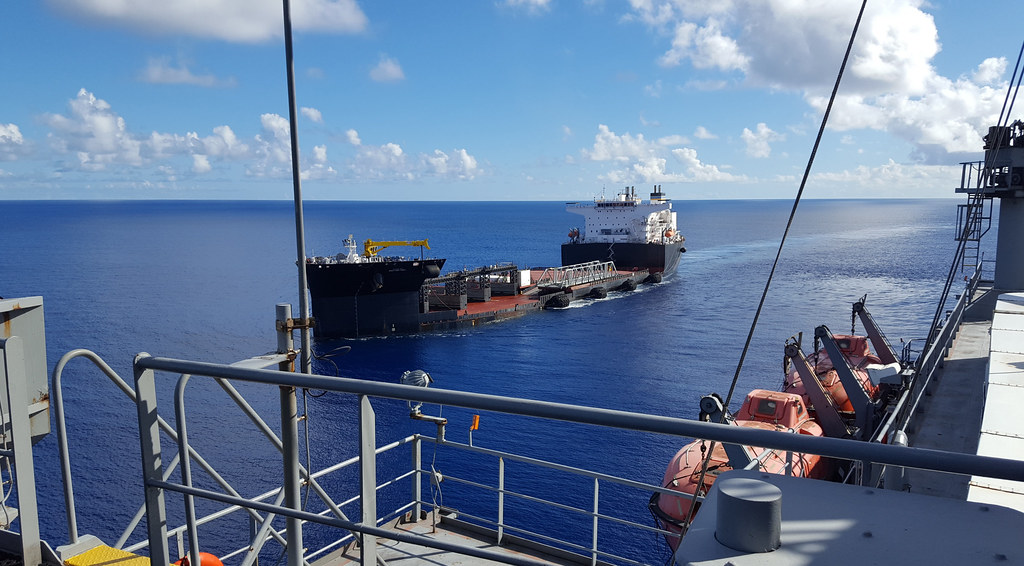
USNS Red Cloud (T-AKR 313), left, and USNS Montford Point (ESD 1) conduct “skin-to-skin” operations, July 11. (U.S. Navy photo) >>

SAIPAN - The expeditionary transfer dock USNS Montford Point (T-ESD 1) wrapped up a series of “skin-to-skin” operations in the vicinity of Saipan, July 22.

The operations took place over the course of 17 days and included complex maneuvering and positioning drills with ships from Maritime Prepositioning Squadron (MPSRON) 3.

“Skin-to-skin operations are game-changers when it comes to supporting the Marine Corps and other expeditionary forces with greater flexibility at sea,” said Mr. Paul Grgas, deputy director of operations for the Military Sealift Command Far East. “Expeditionary transfer docks like Montford Point can operate off shore and augment ship to shore movements during amphibious operations.”

23 June 2017

News Story: HASC Adds 5 Ships To Trump Request, But Where’s The $$?

Image: Flickr User - Greg Bishop
By SYDNEY J. FREEDBERG JR.

WASHINGTON: Is 13 the Navy’s lucky number? That’s how many ships the House Armed Service Committee wants to buy in 2018, five more than President Trump requested, the seapower subcommittee announced this afternoon. The problem: no one knows where the money’s coming from.

The increase is part of a bipartisan push towards the 355-ship fleet the Navy says it needs to counter China, Russia, and other threats, a fleet the Navy itself says it can’t begin to build under Trump’s current budget plans.

HASC wants to add a destroyer, an amphibious ship, an Expeditionary Support Base vessel, and two Littoral Combat Ships to the Trump budget’s request for eight.

“It takes the necessary first big step down the road of getting to 355,” said House seapower chairman Rob Wittman this morning. “We can’t get there overnight,” he added, noting a Congressional Budget Office estimate it will tale 20-to-25 years.

This year, though, the great unanswered question is how to pay for those extra ships — or whether they can be bought at all. The ranking Democrat on the seapower subcommittee, Rep. Joe Courtney, told me frankly yesterday he’s never seen so much uncertainty about what the final budget will be.

“Not having a Budget Committee report out, even a suggestion” — he laughed — “is unprecedented in my time,” said Courtney, who’s been in Congress since 2007. “The (GOP-led) Budget Committee has not given us a number to mark towards.”

Read the full story at Breaking Defense

15 June 2017

USA: Military Sealift Command exercises ‘floating-pier’ concept

By Grady Fontana

USNS Montford Point (T-ESD 1) approaches USNS Soderman (T-AKR 317) during a seabasing exercise near Saipan, July 13. (U.S. Navy photo) >>

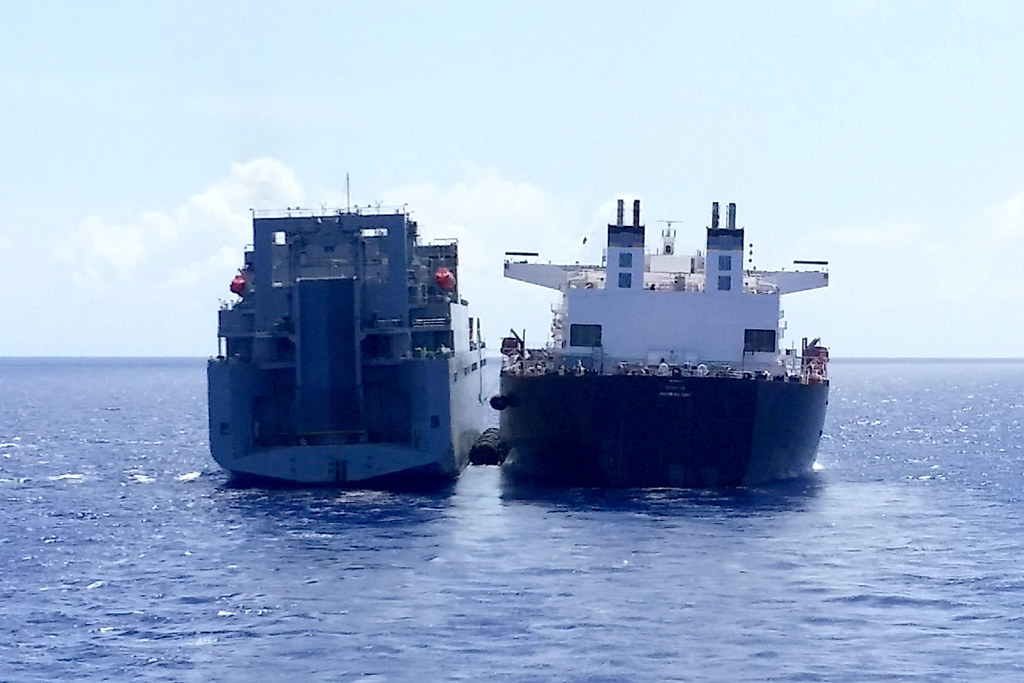
PACIFIC OCEAN - Military Sealift Command’s (MSC) expeditionary transfer dock USNS Montford Point (T-ESD 1) and large, medium-speed, roll-on/roll-off (LMSR) ship USNS Soderman (T-AKR 317) performed a “skin-to-skin” (S2S) maneuver in the vicinity of Saipan to demonstrate MSC’s unique seabasing capability, July 12-13.

The S2S maneuver is achieved by the two ships connecting while the Montford Point acts as a floating pier for a simulated offload. The event displayed the two ships’ ability to transfer large cargo at sea.

During the first day of the exercise, the two vessels conducted touch-and-go maneuvers, when the the ships navigated alongside each other and were moored together. On the second day, the vessels successfully conducted the S2S.

06 January 2017

News Report: Lt. Gen. Bailey Says F-35, Closer Partnerships Will Enhance Operations in 2017

A US Marine F-35B Lightning in hover as it lands
By: Megan Eckstein

THE PENTAGON – Marine Corps operations are set for some big changes in 2017 with the deployment of the F-35B Joint Strike Fighter overseas, a move towards distributed operations as called for in the Marine Corps Operating Concept, and the potential addition of more ships to move Marines around high-threat areas, the deputy commandant for plans, policies and operations told USNI News.

As the Marines’ first operational squadron of F-35Bs prepares to move to Japan in the coming weeks, “we intend to fully incorporate the F-35 into the [U.S. Pacific Command] area of operations,” Lt. Gen. Ronald Bailey said in a Dec. 22 interview.

“When you start talking the things that it will do in terms of its range, its capacity, I think that will change the whole environment and change how we view not only exercises and operations but how we will train,” he said of the new airplane.

“So I call it a crawl, walk, run; we have to get out there and start learning some lessons, which we will. VMFA-121 will go out with 10 aircraft, and six additional aircraft will go out as part of the [31st Marine Expeditionary Unit’s fall patrol from Japan]. So they’ll get out on ground and just start doing what I call familiarization, and then they’ll learn some lessons from that. Then they’ll go and participate in a couple exercises in calendar year ’17; one of the exercises that they’re going to participate in the PACOM region will be in Alaska. … That’ll be approximately 6,000 Marines, sailors and soldiers that will be in the exercise, and it will give them the opportunity to get in the air and test its capability” in a contingency response-type exercise, he said.

The Alaskan exercise, called Exercise Northern Edge, is a U.S.-only biennial exercise that U.S. Pacific Command holds “to replicate the most challenging scenarios in the Pacific theater to ensure joint U.S. forces are trained and prepared to respond to crises in the Indo-Asia-Pacific region, with over 6,000 U.S. service members and 200 aircraft from across the continental United States and Asian-Pacific,” Bailey’s office explained.

Additionally, the F-35 is expected to participate in Exercise Forager Fury in Guam this calendar year, and in Exercises Ssang Yong and Max Thunder in the Republic of Korea, Exercises Pitch Black and Southern Frontier in Australia, and Exercises Forager Fury and Valiant Shield in Guam in 2018.

Bailey said bringing the aircraft to the Pacific allows the squadron to exercise in training ranges much larger than those available at home, and eventually it will allow the squadrons to begin testing interoperability with allies in the area such as Japan and Australia.

For the time being, these allies won’t work directly with the F-35B but instead will open their airspace for training purposes. Once the Marine Corps learns best practices and gets farther along in writing tactics, techniques and procedures, then the service will begin sharing lessons learned with its allies – such as Japan and Australia, who are both buying the F-35A conventional take-off variant.

Megan Eckstein is a staff writer for USNI News. She previously covered Congress for Defense Daily and the U.S. surface navy and U.S. amphibious operations as an associate editor for Inside the Navy.

This story first appeared on USNI News & is reposted here under a Creative Commons license.

02 August 2016

USA: U.S., Indonesian navies set for CARAT maritime exercise

From Task Force 73 Public Affairs

In this file photo, USS Preble (DDG 88) and KRI John Lie conduct a maneuvering exercise during CARAT Indonesia 2015. (U.S. Navy/MC3 Alonzo M. Archer) >>

SINGAPORE - The U.S. and Indonesian navies will come together for the 22nd Cooperation Afloat Readiness and Training (CARAT) Indonesia bilateral exercise and exchange, Aug 3-8.

The exercise will take place on the ground in Surabaya and in the waters and airspace of the Java and Bali Seas.

“The United States and Indonesia share a common vision for maintaining a peaceful and prosperous environment at sea,” said Rear Admiral Brian Hurley, commander, Task Force 73. “Our shared interest in maritime security is what CARAT is all about – and it’s allowed our navies to develop a sustained and growing partnership that benefits both countries.”

More than 500 U.S. Sailors will participate in CARAT Indonesia alongside their counterparts from the Indonesian Navy, known as Tentera Nasional Indonesia - Angkatan Laut (TNI-AL). The exercise will feature complex at-sea training in surface and anti-submarine warfare, visit, board, search and seizure (VBSS) drills, mobile dive and salvage training, a gunnery exercise, maritime patrol operations, and exchanges between explosive ordnance disposal technicians.

06 June 2016

USA: U.S., Philippine, Malaysian navies to conduct multilateral Sulu Sea training

From Task Force 73 Public Affairs

In this file photo, U.S. and Philippine Navy ships operate together during exercise Cooperation Afloat Readiness and Training (CARAT) in 2014. (U.S. Navy/MC1 Jay C. Pugh) >>

SULU SEA - The U.S., Philippine, and Malaysian navies are scheduled to conduct a coordinated multilateral training activity in the Sulu Sea, June 4.

The training will take place between the bilateral phases of Cooperation Afloat Readiness and Training (CARAT) with Malaysia and the Philippines.

"This engagement is an important milestone as we seek opportunities to increase multilateral cooperation for the CARAT exercise series," said Rear Adm. Charles Williams, commander, Task Force 73. "The training provides our navies with an opportunity to broaden cooperative maritime security coordination with our partner nations as we would during real world contingencies or operations."

Ships and aircraft from the U.S. Navy will operate with separate surface action groups from Malaysia and the Philippines. The multilateral training will test the abilities of all three navies to coordinate maritime security operations in a geographically separated environment at sea.

17 March 2016

USA: MSC Ships Perform 'Skin-to-Skin' Maneuver

By Mass Communication Specialist 3rd Class Madailein Abbott

USNS GYSGT Fred W. Stockham (T-AK 3017) and USNS Montford Point (T-ESD 1) connect during exercise Ssang Yong off the coast of the Republic of Korea. (U.S. Navy/MC3 Madailein Abbott) >>

POHANG, South Korea - Military Sealift Command's maritime prepositioning force ship USNS GYSGT Fred W. Stockham (T-AK 3017) and expeditionary transfer dock USNS Montford Point (T-ESD 1) performed a "skin-to-skin" (S2S) maneuver as part of exercise Ssang Yong 16, March 13.

The operation enabled the two ships to test capabilities as well as practice transferring large cargo, such as vehicles, at sea.

The S2S maneuver is conducted by the two ships connecting side-by-side while the Montford Point acts as a floating pier for a simulated offload. The Stockham can discharge equipment onto the Montford Point through a connecting ramp. The equipment can then be loaded into landing craft air cushion (LCAC) for transfer to shore, further enhancing Marine Corps and naval integration.

08 March 2016

USA: MSC Arrives in Republic of Korea, Supports Exercises

By Grady Fontana, Military Sealift Command Far East Public Affairs

Marine Corps vehicles are discharged from Military Sealift Command’s Maritime Prepositioning Force ship USNS PFC Dewayne T. Williams (T-AK 3009). (U.S. Navy/Grady T. Fontana) >>

GWANGYANG, Republic of Korea - Four Military Sealift Command (MSC) ships offloaded hundreds of pieces of U.S. Marine Corps equipment, containerized supplies and personnel in support of exercises Freedom Banner 2016 (FB16) and Ssang Yong 2016 (SY16), Feb. 24 - March 4.

Freedom Banner 2016, a Navy and Marine Corps deployment and offload/backload exercise that is nestled within SY16, brought multiple commands together to offload Maritime Prepositioning Force (MPF) ships USNS GYSGT Fred W. Stockham (T-AK 3017), USNS PFC Dewayne T. Williams (T-AK 3009), and dry cargo/ammunition ship USNS Sacagawea (T-AKE 2); while high-speed vessel MV Westpac Express (HSV 4676) delivered hundreds of service members from various locations in the Pacific region to Korea to participate in the exercises.

14 October 2015

Interview: The Future of US Military Exercises in the Asia-Pacific

By Prashanth Parameswaran

The Diplomat talks with Rear Admiral Charlie Williams about the future prospects for U.S. exercises and America’s presence.

Rear Admiral Charlie Williams is the commander of the U.S. Seventh Fleet’s Task Force 73. Based in Singapore, he helps plan, organize and support the execution of key U.S.-led maritime exercises in the Asia-Pacific.

He recently spoke with The Diplomat’s associate editor Prashanth Parameswaran about the current state of and future prospects for these U.S. exercises and American presence in the region more generally. An edited version of that interview follows.

To begin, can you give us a general sense of some of the exercises that the United States conducts with its allies and partners, including CARAT and SEACAT?

We have multiple opportunities for engagement with partners and allies throughout the course of the year. One of the principal vehicles we use is our Cooperation Afloat Readiness and Training (CARAT) series. As you know, we have been doing that series of exercises now for 21 years; we’re in the 21st year right now. Originally it had six nations that we did the exercises with, we have expanded now to ten – really nine CARAT and then we do a naval engagement activity in Vietnam which is very similar to CARAT; just a different name.

Those exercises are done in company with our partner nations in a way that we work together to figure out what are the things we’re going to work toward. And that’s based on their desires, their capacity and also of course what are our goals in the exercise. So, the great thing about this exercise is that it allows for momentum, it allows for coming back and making the exercise more complex on a year to year basis. We’re having great success with that in every country from Singapore which is probably the high end of the exercise for us, and including other countries like Malaysia, Indonesia. This year Thailand was more complex than it has ever been before, and you know, it’s a common thread, a common theme of the exercise is increasing in complexity and increasing in capacity that we work towards.

Southeast Asia Cooperation and Training (SEACAT) is a maritime security exercise that we do right now with six partner nations, all of whom also participate in CARAT. It’s a bilateral, at sea event with a very multilateral command and control side here in Singapore where our partners including the United States will all be out of the same command and control center and communicating in a very multilateral sense. So it’s a great event for us and our partners.

Read the full story at The Diplomat

01 July 2015

News Story: PLA Navy receives its first mobile landing platform

Vessel 868: China's Mobile Landing Platform (MLP)
Guangzhou's Wenchong shipyard officially turned China's first mobile landing platform, known as vessel 868, over to the PLA Navy on June 26, reports overseas Chinese-language news outlet Duowei News.

Vessel 868 shares many similar characteristics with its American MLP counterpart, according to a Sina Military Network report. It is developed specifically to carry the PLA Navy's Zubr-class air-cushioned landing craft in future amphibious operations. With a displacement of 3,200 tonnes, vessel 868 was launched on Feb. 27 and completed its sea trial a month later.

Read the full story at Want China Times

26 June 2015

News Story: Dunford - Marines need more sea-basing options in the Pacific

Mobile Landing Platform (MLP)
By Hope Hodge Seck, Staff writer

Marines are eyeing new alternative shipping platforms to solve an emerging problem: how to bring Marine units in the Pacific together quickly in the event of a crisis.

A planned move of thousands of Marines from the Japanese island of Okinawa to other locations throughout the Asia-Pacific region will make the Corps more regionally capable, but create an "aggregation challenge" to major contingency operations, Marine Corps Commandant Gen. Joseph Dunford told lawmakers at a Washington, D.C., event hosted by the Shipbuilding Caucus Thursday morning. One possible solution: position new ships like the afloat forward staging base in key locations, ready to transport lots of Marines quickly.

"It isn't just about one ship, it's not just about one location, it's about dealing with a logistics challenge, a training challenge, a war-fighting challenge with a shortfall of platforms," Dunford said.

The Marine Corps is in the process of building training areas and barracks to house 5,000 Marines in Guam by 2021. About 1,000 Marines are now stationed in Darwin, Australia, on a rotational basis, and that number is expected to grow to 2,500 troops by next year in accordance with a bilateral agreement between the two countries. These moves are part of a long-range plan to reduce the Marine Corps' footprint on Okinawa, which has long hosted the bulk of the service's Pacific presence.

Read the full story at DefenseNews

27 May 2015

News Story: Leaked photos suggest PLA developing mobile landing platform

Photo suggests China is developing a Mobile Landing Platform

China appears to be developing a Mobile Landing Platform (MLP) similar in concept to that being built by the United States, reports the Beijing-based Sina Military Network.

Photos of a Chinese military vessel resembling the US Navy's MLP were recently released by the Chinese military magazine Modern Ships, leading to speculation that China is trying to develop its own "floating base."

CGI of US Navy Montford Point class MLP
The MLP is a type of amphibious assault ship described by Sina Military as "half-submarine and half-boat" because it has a semi-submersible deck for ease of transferring cargo and equipment.

The main purpose of the MLP is to transport heavy weaponry and combat supplies as well as act as a transfer point between large ships and small landing craft. It is different to ordinary landing ships and amphibious assault ships in that it is used primarily for transport as opposed to combat.

Read the full story at Want China Times

08 May 2015

USA: Navy, Marines to Conduct Joint Seabasing Exercise


From U.S. 3rd Fleet Public Affairs

<< In this file photo, USNS Montford Point (MLP 1), right, is moored alongside USNS Dahl (T-AKR 313) during exercise Pacific Horizon off Camp Pendleton, Calif., in October. (U.S. Navy)

PEARL HARBOR - U.S. Navy and Marine Corps expeditionary forces are scheduled to participate in exercise Culebra Koa (CK15) in the Hawaii Operating Area May 18-21, 2015.

CK15 is a U.S. Pacific Fleet training exercise designed to demonstrate and increase joint proficiency in expeditionary operations. The exercise will also serve as additional training for the USS Essex (LHD 2) Amphibious Ready Group (ARG) and 15th Marine Expeditionary Unit prior to deployment to the Western Pacific and Arabian Gulf.