Showing posts with label Y-8. Show all posts

31 August 2017

News Story: China Modernizes Bomber Fleet, Looks to Future With H-20

A Chinese H-6 Bomber (File Photo)
Though it has not received media attention equal to its fighter counterparts, the People’s Liberation Army Air Force (PLAAF) bomber fleet is steadily being modernized, and plans call for a next generation stealthy, multi-role bomber.

The Xian Aircraft Corporation (XAC) H-6K bomber proved its capabilities during the Aviadarts 2017 competition held earlier this month in China, edging out the Russian Tu-22M3/M3M Backfire in the bomber category. Chinese analysts credit the win to newer navigation systems and targeting radar, as well as rigorous aircrew training.

The PLAAF has also reportedly introduced a new imaging infrared (IIR) or optical seeker variant of the K/AKD-20/CJ-20 “Long Sword” cruise missile, which is the primary air-launched cruise missile of the H-6K. The CJ-20 is guided by an integrated GPS/inertial navigation system and terrain contour matching (TERCOM). The new seekers will ensure a higher survivability against electronic countermeasures and greater target accuracy at the terminal stage.

Enhancements to the H-6K continue; in late August, an amateur photo of a “green” H-6 with in-flight refueling probe surfaced on Weibo, the Chinese version of Twitter. This could be the alleged H-6N that reportedly flew for the first time in December. Many believe the H-6N could host the air-launched DF-21D anti-ship ballistic missile. The reworked airframe could have been modified and strengthened to accommodate the 11-meter missile and better shielded against radiation.

Read the full story at AINonline

27 July 2017

News Report: Chinese Navy Expands Submarine Detection Testing in the South China Sea

The Chinese navy will conduct a massive experiment with underwater drones equipped with "real-time data transmission technology," in hopes of building up Beijing’s capacity to detect hostile submarines in the South China Sea.

Beijing wants to accelerate the development of underwater monitoring technology, the South China Morning Post report said, in response to US President Donald Trump’s sanctioning the US Navy to conduct more freedom-of-navigation operations.

Twelve undersea "gliders" positioned in undisclosed locations in the South China Sea will transmit data back to control centers, SCMP noted. The unmanned sea drones will cruise around for a month to gather data on water temperature, salinity, cleanliness, oxygen levels and sea current velocity, a Chinese Academy of Sciences official told the Post.

27 June 2017

Think Tank: Sea, air, land and space updates (27-Jun-2017)

An unpainted Chinese Y-8Q/GX-6 ASW Aircraft during testing
Zoe Glasson, Sophie Qin, Madeleine Nyst and Patrick Kennedy
Sea State
Just in time for President Modi’s visit to Washington, the Trump administration has agreed to sell 22 Guardian drones to India, in a deal that’s been described as a ‘game changer’ for US–India relations. The drones would be a ‘force multiplier’ for the Indian Navy, improving its maritime surveillance and reconnaissance capabilities. Though yet to be approved in India, New Delhi reportedly sees the deal as ‘a key test of defence ties’. Defense News speculates that the sale of the unarmed Guardians could be a precursor to the purchase of armed drones—something India has sought previously but which is currently prohibited by US export laws. Finalising the deal is likely to require a fine balance between Trump’s “America First” platform and Modi’s “Make in India” policy.
Israel Aerospace Industries (IAI) successfully test-fired its Long-Range Artillery system (LORA) on 20 June. LORA’s strength is its portability: it launches from a container that can be trucked onto the deck of a cargo ship. According to The Drive, LORA’s relative low-cost and plug-and-play nature means that a range of auxiliary ships ‘could suddenly become impromptu combatants’. IAI says ‘several deals’ for LORA are underway, but it remains to be seen who’s in the market for the platform.
And for the final Sea State reads this week, here are two great pieces: one about how noisy herrings are creating (submarine) confusion; and another about marauding orcas fleecing fisherman.

23 June 2017

News Story: China deploys new anti-submarine aircraft to fringes of South China Sea

An unpainted GX-6/Y-8Q during testing (File Photo)
By: Mike Yeo

MELBOURNE, Australia — China has deployed its newest anti-submarine aircraft and stepped up unmanned aircraft deployments to Hainan island on the fringes of the South China Sea, according to satellite imagery obtained by Defense News.

Satellite photos taken on May 10 and May 20 by commercial satellite imagery company DigitalGlobe showed four Shaanxi Y-8Q turboprop aircraft with its distinctive magnetic anomaly detector boom parked on the ground at Lingshui Air Base in the southeastern part of China’s Hainan island. 

The satellite pass from May 10 also showed three Harbin BZK-005 high-altitude, long-range UAVs at the base. This is the largest number of BZK-005s to have been seen at Lingshui since they were first noted in 2016. The drones have also previously been observed at the Chinese air base at nearby Woody Island, in the disputed Paracel Islands.

A KJ-500 AEW&C Aircraft (File Photo)
In addition, two KJ-500 airborne early warning aircraft were also seen at Lingshui on both occasions. Defense News had previously reported on the deployment of the KJ-500 to Hainan at nearby Jialaishi Air Base that had been seen on satellite photos taken in March, which was the first time the KJ-500 had been seen deployed by the People’s Liberation Army Navy, or PLAN. 

This is the first time the Y-8Q has been seen at Hainan, with China having previously rotationally deployed maritime patrol aircraft detachments to Lingshui, made up of a mixture of older Y-8Js and Y-8Xs drawn from the PLAN's two special-mission aircraft regiments based in northern China.  

Read the full story at DefenseNews

13 June 2017

News Story: 81 bodies from crashed Myanmar military plane found - military

YANGON, June 12 (Xinhua) -- The search for victims aboard a crashed Myanmar military plane entered the 5th day on Monday when a total of 81 bodies had been recovered, the Office of the Defense Services said.

The latest five bodies were recovered along the Maungmakan beach area off the southern coast of Tanintharyi.

Read the full story at Xinhua

09 June 2017

News Report: Bodies, Debris Found in Search For Myanmar Military Plane

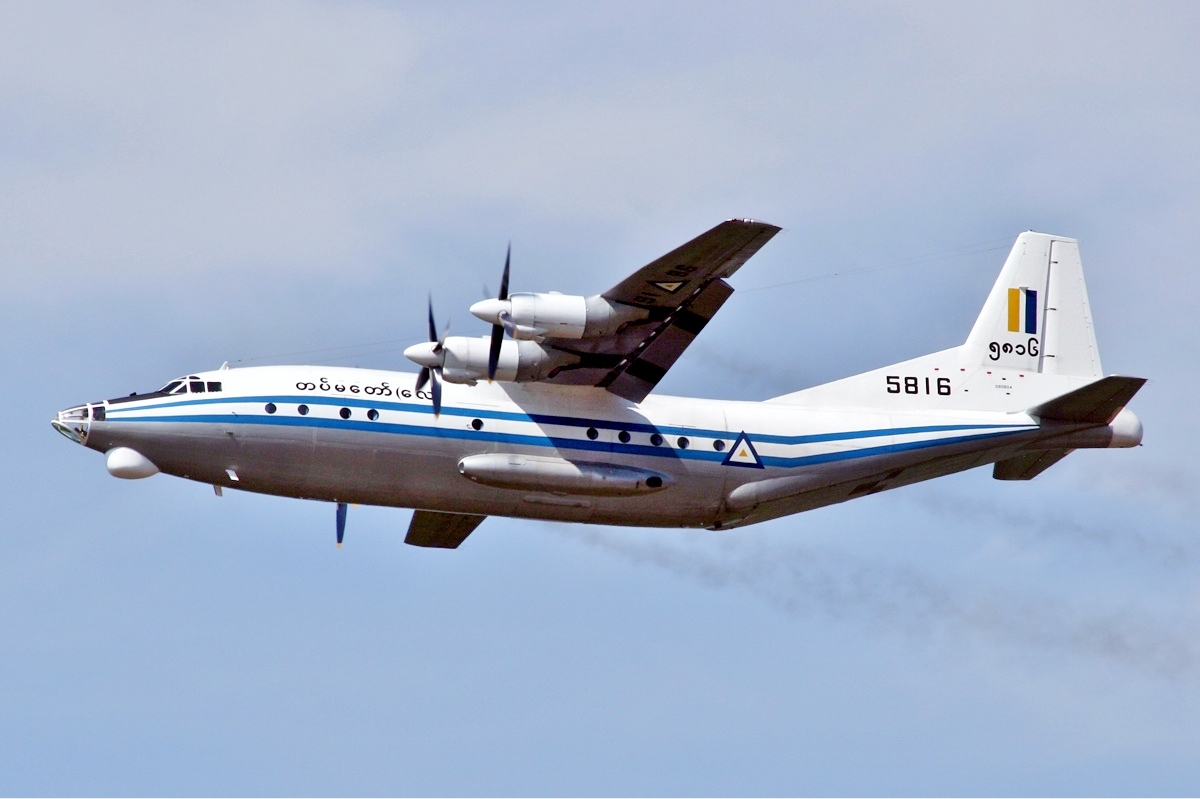
A Myanmar Air Force Shaanxi Y-8 (Image: Wiki Commons)
YANGON, MYANMAR — Myanmar's military said Thursday searchers have found 10 bodies and pieces of plane debris believed to be from a military aircraft that went missing Wednesday with 122 people on board.

A statement said the bodies included six adults and four children.There were also pieces of luggage, life jackets and a plane wheel found in the waters about 35 kilometers from the southern city of Launglon.

Nine naval ships and a group of airplanes and helicopters were sent out Thursday to search for the Chinese-made Y-8-200F plane, which Myanmar bought in March of last year and which the military said had 809 flying hours.

The plane, carrying mostly family members of military personnel, was traveling from the city of Myeik, also known as Mergui, in southeastern Myanmar on the Andaman coast. Most of the journey to Yangon, Myanmar’s largest city, would have been over the Andaman Sea.

“We found debris around Horseshoe Bay,” Tanintharyi Division Border Affairs and Security Minister Colonel Kyaw Zeya told VOA Burmese, saying their team went there as soon as locals tipped them on the location.

“Our rescue team includes police officers, a fire brigade team, and local Samaritans. First aid and paramedics teams also have set up a makeshift hospital at the nearest beach to take care of survivors,” he added.

VOA Burmese contributed to this report.

This story first appeared on Voice of America & is reposted here with permission.

13 May 2017

News Story: Satellite image shows Chinese deployment of new aircraft to South China Sea

KJ-500 AEW&C Aircraft
By: Mike Yeo

MELBOURNE, Australia — China has deployed its latest airborne early warning and control aircraft to an air base on the fringes of the disputed South China Sea, according to exclusive satellite imagery obtained by Defense News.

The photo taken March 24 by commercial satellite imagery company DigitalGlobe shows a pair of Shaanxi KJ-500 turboprop AEW&C aircraft with its distinctive radar dish on the ground at Jialaishi Air Base in the northern part of China’s Hainan island. Two other Y-8 aircraft — an older KJ-200 AEW&C aircraft, and the other possibly a Y-8J or Y-8X maritime patrol aircraft — can be seen alongside the KJ-500s. 

KJ-200 AEW&C Aircraft
This is the first time the KJ-500 has been deployed to Hainan, with China having previously rotationally deployed special mission aircraft detachments to the island. These detachments are drawn from two special-mission aircraft regiments of the Chinese People’s Liberation Army Navy, or PLAN, based in northern China. The detachments are usually made up of a mixture of KJ-200 AEW&C aircraft with Y-8Js and Y-8Xs, and they tend to operate from Lingshui on the southeastern tip of Hainan. 

Read the full story at DefenseNews

10 January 2017

News Report: Japan Scrambles Jet Fighters Amid Flight of Chinese Aircraft Over Korean Strait

Chinese H-6 Bomber
Japanese Air Self-Defense Forces were scrambled in response to Chinese Air Force aircraft flying over the Korean Strait near the islands of Tsushima and Kyushu, local media reported on Monday.

MOSCOW (Sputnik) — Six Xian H-6 jet bombers flew across the strait from the East China Sea in the direction of the Sea of ​​Japan, then made a U-turn and flew in the opposite direction. Shaanxi Y-8 and Shaanxi Y-9 transport aircraft were also registered in the region, NHK TV channel reported, citing the Japanese Defense Ministry.

Representatives of the ministry said that the Chinese planes did not violate Japanese airspace.

Tensions between Tokyo and Beijing are intensifying after China announced the establishment of an air defense zone over the East China Sea in November 2013, which spreads to the disputed Senkaku islands.

Earlier in the month, Japanese aircraft were scrambled, when six Chinese planes were flying over the Miyako Strait near Okinawa. The two countries exchanged accusations and criticism over the incident.

This story first appeared on Sputnik & is reposted here with permission.

29 October 2016

News Story: Latest Chinese Airpower To Debut at Zhuhai Airshow

KJ-500 AEW&C Aircraft
by Mike Yeo

China’s People’s Liberation Army Air Force (PLAAF) will be showcasing a number of new platforms at the 11th China International Aviation and Aerospace Exhibition, which will be held next week at Zhuhai airbase near Guangdong. They include Chengdu J-10B multirole fighter, the Xi’an H-6K bomber and the Shaanxi KJ-500 Airborne Early Warning (AEW) aircraft. Airshow organizers were also touting a “secret combat aircraft” belonging to the PLAAF for the flying display, which is thought to be the Chengdu J-20 stealth fighter, currently in low-rate initial production (LRIP). But it was missing from the updated line-up that they published today.

A pair of LRIP J-20s sporting a new two-tone dark gray splinter camouflage have been observed carrying out maneuvers and formation flying over Chengdu Aircraft Corporation’s facilities, further fueling speculation the type will make its debut at Zhuhai this year.

Meanwhile, the appearance of the J-10B confirms that the type has entered PLAAF service. The aircraft that is in Zhuhai carries tail serials for the PLAAF’s 2nd Air Division, 5th Regiment based at Guilin, Guangxi. Photos of J-10Bs in PLAAF colors have been appearing since late 2014, but with tail serials either blurred or edited out altogether, precluding identification of their unit.

Read the full story at AINonline
12 September 2016

News Report: China Intensely Investing in Creating Flexible and Capable Airborne Forces

Airborne forces are an important element of the Chinese military and Beijing will continue to invest in their development and upgrade their combat capabilities.

China is pursuing its global interests, including placing focus on expanding its international military presence, as part of its "active defense" doctrine.

Traditionally, Beijing used to rely on its ground forces, but over the recent years it has been heavily investing in the navy and the air force. Now, China is enhancing its airborne forces, a report by the American think-tank Stratfor read. 

According to the article, having capable airborne forces is of strategic importance for China. China is one of the largest countries in the world and has a number of remote places along its border. Moreover, China is surrounded by potential flashpoints, including at the border with India and North Korea. 

13 May 2016

News Report: Beijing Vows to Increase South China Sea Defenses, Calls U.S. ‘Greatest Threat’ in Region

Fiery Cross Reef (Sep 2015)
By: Sam LaGrone

Chinese officials took a rhetorical hard line this week calling U.S. military actions in the South China Sea the “greatest threat” to stability in the region and vowed to increase its own military presence in the region, according to a Wednesday statement from the Chinese military.

“China will intensify sea and air patrol and enhance construction of defense capabilities in the area as needed, firmly safeguard national sovereignty and security and resolutely maintain peace and stability in the South China Sea,” read a Wednesday statement from the Ministry of National Defense.

The statement follows a Tuesday U.S. freedom of navigation operation in which a U.S. destroyer sailed within 12 nautical miles of a Chinese controlled installation in the Spratly Island chain.

USS William P. Lawrence (DDG-110) conducted an innocent passage past Fiery Cross Reef, a Chinese-controlled artificial island — also claimed by Taiwan, the Philippines and Vietnam, according to the Pentagon.

In immediate response to the transit, China launched two Shenyang J-11 fighters and a Shaanxi Y-8 AWACS, according to a Wednesday release from the Chinese Ministry of Defence. Additionally, a guided missile destroyer and two frigates tracked Lawrence during its transit past Fiery Cross reef.

21 April 2016

News Story: China using military plane to transport sick workers from South China Sea reef lawful, rational (China's View)

BEIJING, April 20 (Xinhua) -- China's sending a military plane to transport sick workers from a reef in the South China Sea is lawful and rational.

A Chinese navy patrol plane on Sunday picked up three seriously sick workers on Yongshu Jiao and transported them to Sanya, Hainan Province, in South China.

But the humanitarian move gave rise to dissatisfaction from Washington, which questioned China's purpose behind using a military aircraft instead of a civilian one to evacuate the workers.

In fact, Washington's suspicion is needless and baseless.

First, dispatching a military plane to transport the workers from Yongshu Jiao does not violate international law.

China has indisputable sovereignty over the Nansha Islands and its surrounding waters. It is lawful for a Chinese plane to fly in China's own airspace and the United States has no right to criticize such a move.

Not to mention the participation of military planes in disaster relief, humanitarian assistance and evacuation of civilians is a common practice around the world.

Second, facing the heavily sick workers, the top priority is to save their lives instead of focusing on which type of planes was used.

Read the full story at Xinhua

10 December 2015

Editorial: Is China's Maritime Silk Road A Military Strategy?

By Anthony Kleven

The initiative may have a strong military dimension too.

Did Xi Jinping just acknowledge that the Maritime Silk Road has, in fact, a strong military dimension?

That seems to be the case, following a joint declaration made with his Djibouti counterpart, Ismail Omar Guelleh (IOG), on the sidelines of the Forum on China Africa Cooperation (FOCAC) in Johannesburg. According to Xinhua, the usually guarded Xi welcomed “Djibouti’s participation in developing Beijing-proposed 21st-century Maritime Silk Road in proper ways.”

However, in light of last week’s bombshell that China has chosen this sleepy East African nation to house its first military base, giving such a warm embrace to Djibouti’s “proper” participation in the Maritime Silk Road is, quite frankly, startling.

Read the full story at The Diplomat

17 November 2015

Editorial: China Showcases Military Hardware to Gulf States at 2015 Dubai Air Show

Wing Loong UCAV (File Photo)
By Benjamin David Baker

Chinese arms companies have some advantages in the regional arms trade competition, notably with their drones.

China’s global arms push continues. As my colleague Franz-Stefan Gady reported last week, China is showcasing some of its military hardware to potential buyers in the Persian Gulf at the ongoing Dubai Air Show. The jewel in China’s crown at the Air Show is the FC-31 stealth fighter, basically a replica of the F-35 Joint Strike Fighter–supposedly constructed with designs stolen from Lockheed-Martin back in 2009. Another interesting piece of news from Dubai is that China and Pakistan apparently have found an unnamed buyer for their jointly developed JF-17 “Thunder” fighter.

China has several other interesting items on show in Dubai. Shaanxi Aircraft Corporation has been promoting its venerable Y-8C and its modern Y-9 (basically the People’s Liberation Army Air Force’s version of a C-130 Hercules). According to Vasiliy Kachin at the Moscow Center for Analysis of Strategies and Technology, Iran has apparently ordered an undisclosed number of these aircraft. Iran has already airlifted troops to battlefields in Syria and has a requirement for more heavy transport aircraft.

But when it comes to promoting advanced defense products, China faces challenges in trying to sell to this part of the Middle East. In an interview with Defense News, Richard Bitzinger, a military transformation specialist at Singapore’s S. Rajaratnam School of International Studies, says that items like fighter jets and helicopters are just too complicated, and few countries will want to “take a chance on Chinese products, when it comes to performance and quality.”

Read the full story at The Diplomat

05 November 2015

Editorial: What China's 'Militarization' of the South China Sea Would Actually Look Like

By John Chen and Bonnie Glaser

A closer look at the specific military concerns posed by China’s artificial islands.

Much has been said about the legal and geopolitical aspects of Chinese land reclamation in the South China Sea, but U.S. PACOM Commander Admiral Harry Harris’s Congressional testimony last month gave a closer look at specific U.S. military concerns posed by China’s artificial islands. Harris detailed the military utility of deep water port facilities and 3,000 meter runways on three newly built Chinese islands, while Assistant Secretary of Defense for Asian and Pacific Security Affairs David Shear noted the threat that “higher end military upgrades, such as permanent basing of combat aviation regiments or placement of surface-to-air, anti-ship, and ballistic missile systems on reclaimed features” might pose.

What exactly is the nature of the potential Chinese military threat, and what implications does it have for the region?

What Might A Chinese Military Threat Look Like?

Each of the above military concerns merit further examination in spite of China’s vehement declarations that its new islands are for civilian purposes. China has a range of militarization options for its new South China Sea facilities, ranging from deploying intelligence, surveillance, and reconnaissance (ISR) assets, to missile batteries, to augmenting power projection capabilities, each with its own particular costs, benefits, and escalatory severity.

Read the full story at The Diplomat

06 August 2015

News Story: PLA targets Vietnam in S China Sea exercise, US in E China Sea

Chinese Navy Warships on patrol (File Photo)
The People's Liberation Army Navy last week held large-scale military exercises in the East China and South China seas, according to Sina's military news web portal.

On July 28, the South Sea Fleet led a live-fire exercise in an area of the South China Sea measuring several tens of thousands of square kilometers, along with the other PLA Navy fleets, the Guangzhou Military Region and the Second Artillery Corps; on July 30 and 31, the PLA Navy dispatched a fleet of electronic-warfare aircraft and Xian H-6 twin-engine jet bombers on several missions flying over the Miyako Strait, the waterway between Japan's Miyako Island and Okinawa Island, into the Western Pacific.

The targets of the two military exercises were not announced in the PLA press release. Military affairs websites have suggested that the South China Sea exercise is likely aimed at territory within what China calls the "first island chain" — the term the Chinese military uses to refer to the string of archipelagos extending from the Kuril islands south through Japan and its Ryukyu islands, Taiwan and the Philippines — likely in preparation for a potential scenario in which a US aircraft carrier war fleet break through the first island chain. Although this is a reasonable assumption, in a real combat scenario, relying on anti-ship missiles, conventional submarine-launched missiles and air-launched cruise missiles with a range of just 300 kilometers to take on a carrier fleet means that all the warships, planes and submarines would have to penetrate the carrier fleet's outer defenses and approach its inner defenses to fire their payload. This kind of scenario is hard to imagine playing out in reality, given the naval power of the US.

Read the full story at Want China Times

03 August 2015

News Story: PLA military planes fly near controversial Diaoyutai islands

China has recently extended its live air and military drills from the Taiwan Strait and South China Sea to parts of the East China Sea and the disputed Diaoyutai Islands, the Japan Coast Guard has reported.

The Coast Guard said on July 30 that two China's ocean research ships entered the exclusive economic zone of the Diaoyutai Islands (called the Senkaku Islands in Japan, which administers the islands) on July 29 and 30.

It said the research ships sailed about 100 kilometers northeast of Chiwei Island (called Taisho Island in Japan), one of the islands in the group. The ships were suspected of dropping detectors into the ocean in Japan's exclusive economic zone.

Two China Coast Guard ships also sailed into areas near the islands on July 29 and left after about two hours.

Read the full story at Want China Times

27 July 2015

News Story: PLA's underwater listening network is baloney - Taiwan colonel

Concept art of the PLA's purported underwater listening
network shown on a Chinese website. (Internet photo)
The claim made recently in Chinese media outlets that the People's Liberation Army can monitor the movement of US submarines as far away as Guam is unrealistic, says Colonel Wang Chih-peng, a reserve officer in Taiwan's navy.

China began the development of its underwater listening network in 1996 under the codename Program 863, according to the Beijing-based Sina Military Network. The article made the claims that various underwater listening devices connected by undersea cables enable the PLA Navy to monitor the activities of submarines at distances of more than 15,000 kilometers. Monitoring operations can be enhanced in the future with the use of unmanned underwater vehicles, warships and the Y-8 GX8 Electronic Intelligence aircraft, the report claimed.

Read the full story at Want China Times

09 July 2015

Editorial: China's Navy Just Got Better at Detecting and Taking Out Submarines

By Ankit Panda

With the commissioning of the Gaoxin-6, the PLAN’s anti-submarine warfare capabilities receive a major boost.

After years of development, China’s Gaoxin-6, a four-engine, fixed-wing, anti-submarine patrol aircraft, was commissioned into the People’s Liberation Army Navy’s (PLAN) North Sea Fleet. The aircraft will be a major boon to the PLAN’s anti-submarine warfare (ASW) capabilities, a neglected area despite China’s broader naval modernization. The Gaoxin-6 is, in essence, a heavily modified Shaanxi Y-8 transport aircraft and reports over the years have noted that China’s goal with this aircraft was to emulate the form and function of the United States’ Lockheed P-3C Orion patrol aircraft, the most widely deployed anti-submarine aircraft in the world. The Gaoxin-6′s commissioning, along with China’s growing fleet of anti-submarine corvettes (specifically, the Type 056 Jiangdao-class), marks a milestone in the PLAN’s ASW capabilities.

The Gaoxin-6 was developed by Shaanxi Aircraft Industry Corporation. It boasts a 6,000 km range and over eight hours of uninterrupted flight time. The aircraft’s two most notable features that set it apart from other Y-8 variants include its sea-search radar, mounted just under the cockpit, and its rear magnetic anomaly detector. The Gaoxin-6 does feature a bomb bay, but it is unclear precisely how much and what types of ordnance it is capable of delivering. The P-3C, by comparison, can carry 20,000 pounds of ordnance, including Harpoon anti-ship missiles and Maverick air-to-ground missiles. According to China Daily, the Gaoxin-6′s commissioning brings China into a club of five other nations that operate similarly sophisticated anti-submarine warfare ISR aircraft: the United States, Russia, Japan, the UK and France. A long-range anti-submarine ISR capability is critical for the Chinese navy’s blue-water ambitions. Without an ability to detect submarines in unfamiliar waters, the PLAN’s surface vessels would remain immensely vulnerable to hostile submarines.

Read the full story at The Diplomat

30 June 2015

Editorial: Meet China’s New Submarine Hunter Plane

By Franz-Stefan Gady

Beijing’s newest anti-submarine warfare weapon is closing a critical capability gap.

The four-engined Y-8GX6 (Y-8Q) turboprop anti-submarine warfare (ASW) aircraft has purportedly finally entered service with the Chinese Naval Air Force after several years of testing, according to IHS Jane’s Defence Weekly.

IHS Jane’s bases its report on an article published on a Chinese defense site, which notes that the ASW variant of the Shaanxi Aircraft Corporation (SAC) Y-8/Y-9 medium transport aircraft has been inducted into the North Sea Fleet.

The report neither elaborates on the number of aircraft that have entered service nor the precise induction date. However, it notes that the People’s Liberation Army Navy’s East and South Sea Fleet’s will receive the plane only at a later date.

Equipped with air-launched torpedoes (e.g., Yu-7), anti-ship missiles, sea mines, and sonobuoys the plane has an estimated maximum range of approximately 5,00 km and, according to Popular Science Magazine, can potentially carry over ten tons.

Read the full story at The Diplomat