Showing posts with label S-300 SAM. Show all posts

06 March 2017

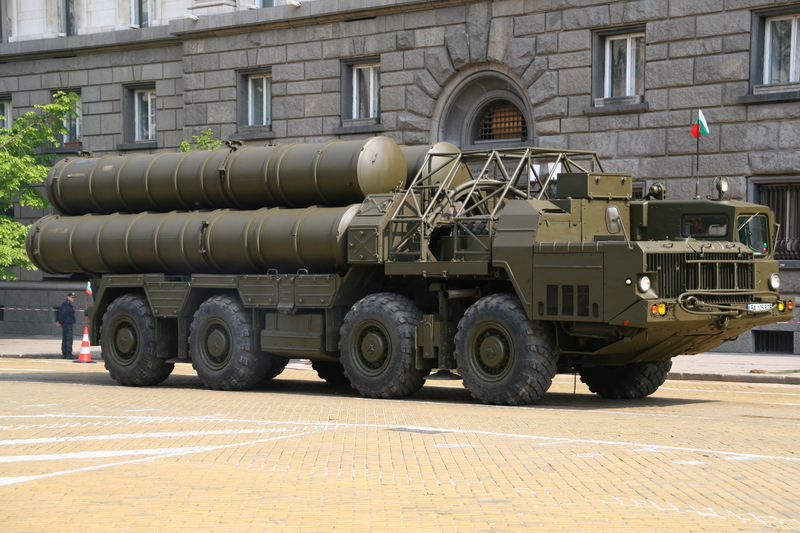
News Story: Iran's S-300 air defence system operational

S-300 (Image: Wiki Commons)
Iran's advanced S-300 air defence system, delivered by Russia following a July 2015 nuclear deal after years of delay, is now operational, state television reported on Saturday.

Iran had been trying to acquire the system for years to ward off repeated threats by Israel to bomb its nuclear facilities, but Russia had held off delivery in line with UN sanctions imposed over the nuclear programme.

"The S-300 air defence system has been tested... in the presence of government and military officials," the television said.

It said that the test at a desert base had seen several targets, including a ballistic missile and a drone, intercepted.

Air defence commander General Farzad Esmaili told the television that a domestically manufactured air defence system dubbed Bavar 373 which was "more advanced than the S-300" would be tested very soon.

Read the full story at SpaceDaily

21 February 2017

Nerws Story: Russia's Rostec to co-develop 5th-gen fighter with UAE

By: Jill Aitoro

Russia defense heavyweight Rostec will partner with the UAE Ministry of Defence to co-develop a fifth-generation light combat fighter, company CEO Sergey Chemezov said at IDEX in Abu Dhabi Monday. 

Development, which is based upon its MiG-29 twin-engine fighter aircraft, will kick off in 2018, and will take an estimated seven to eight years, Chemezov said during a media briefing with journalists. He elaborated in an exclusive one-on-one interview with Defense News. 

“That’s not fast, because it takes quite a long period of time to develop,” he said speaking through a translator. “We anticipate local production here in the Arab Emirates, for the needs of Emirates. And of course [we expect development to support the needs of] the neighboring countries." 

Details about how the partnership would be structured have not been finalized, though Chemezov said it could potentially function as a joint venture between the company and UAE or UAE's domestic suppliers. 

The announcement comes soon after confirmation by the company that it would support development of India’s fifth-generation advanced medium combat aircraft. Though Chemezov wouldn’t comment on deals still under negotiations, the company is expected to sign a contract for Su-35 aircraft for Indonesia any day. Egypt is another country that reportedly is in talks with Rostec for fighters – MiG-29 aircraft specifically. The two companies signed a $3.5 billion arms package in 2014 covering aircraft, missiles, and coastal defenses.

Read the full story at DefenseNews

09 January 2017

News Report: Playing It Safe - Duterte Invites Russian Navy, Gets Chummy With Trump

Philippine President Rodrigo Duterte has invited Russian naval ships to cast anchor at the country’s ports “as an ally to protect us,” but is in no hurry to cancel a defense pact with the US and has already backed off from promised defense cooperation plans with Russia and China.

"We welcome our Russian friends. Anytime you want to dock here for anything, for play, for replenish[ing] supplies or maybe [as]our ally to protect us," said Duterte while shaking hands with Rear Admiral Eduard Mikhailov on Friday during a tour of the Russian anti-submarine warship Admiral Tributs docked in Manila.

The Admiral Tributs and the tanker Boris Butoma were dispatched to the Philippines for an unprecedented visit.

The controversial Philippine president, who used to badmouth US President Barack Obama, called UN Secretary General Ban Ki-moon “a fool” and even compared himself with Adolf Hitler, earlier threatened to sever a defense cooperation pact with the United States that allowed Washington to deploy troops and hold military drills in the Philippines.

26 December 2016

News Story: Iran to stage large-scale air defense drills

TEHRAN, Dec. 25 (Xinhua) -- Iran will launch a large-scale air defense exercise in the country's southern regions on Monday, reported Tasnim news agency on Sunday.

Iran's Air Defense Commander Brig. Gen. Farzad Esmaili said that the drill, code-named "Defenders of Velayat Skies 7," will cover the southern provinces of Hormozgan and Bushehr along with the southwestern province of Khuzestan.

Read the full story at Xinhua

11 October 2016

Think Tank: Sea, air, land and space updates (11-Oct-2016)

Christopher Cowan, Thulasi Wigneswaran, Elisabeth Buchan and Alexander Vipond

Sea State

The UK announced last week that construction will soon begin on the first vessel of the Successor-class—the Royal Navy’s controversial new nuclear ballistic missile submarines. The Royal Navy awarded BAE Systems over £1.3 billion (AU$2.12 billion) to begin work on the vessel’s auxiliary machine space module, which houses electrical components for the ship’s nuclear reactor. The UK tabloid press is outraged that—sacré bleu!—the subs will be built using French steel.

That announcement comes on the heels of the US Navy awarding a US$101.3 million contract to General Dynamics Electric Boat for the first 22 missiles tubes of the US-UK Common Missile Compartment. The missile tubes will eventually be installed on both the Successor-class and the USN’s upcoming Columbia-class nuclear ballistic missile submarines.

In interesting news for Australia, the Italian Navy received its final anti-submarine warfare variant of the FREMM frigate last week. Fincantieri, the Italian manufacturer of the ships, has proposed an ‘Australianised’ variant for the Royal Australian Navy’s SEA 5000 program to replace its ANZAC frigates.

The USN’s recent changes to its 241-year-old rating system (mentioned last week) have received harsh criticism from affected Navy personnel. Navy commanders have tried to downplay the changes, with Chief of Naval Operations Admiral John Richardson calling on sailors to focus on plans to make more job fields and skills experience available.

01 September 2016

News Story: Khamenei says Iran against possession, proliferation of WMDs

TEHRAN, Aug. 31 (Xinhua) -- Iran's Supreme Leader Ayatollah Ali Khamenei said Wednesday that Iran should grow powerful militarily, and in the meantime, he is against the possession and proliferation of weapons of mass destruction (WMDs).

"We consider restrictions on the expansion of our defense industry," Khamenei said, according to the supreme leader's website. "The WMDs, such as chemical weapons and nuclear weapons, are forbidden based on our religious beliefs."

Iran had been under the sanction pressures of the West over its nuclear program for years. The western countries suspected of weapon grade dimensions of Iran's nuclear activities; however, the Islamic republic said it was against the WMDs and its nuclear program was for civilian purposes.

The Iranian leader stressed the increase in Iran's "defensive and aggressive" power as an "inalienable right of the country" in the face of threats and insecurity in the world.

"Iran will be secure when the powers feel the might of the country," he was quoted as saying.

Khamenei disapproved of what he called the "anger" of the western countries over Iran's purchase of some defensive weapons, and said that they are talking of "moral goodness" for possessing advanced weapons, while "they themselves are not committed to any moral codes."

Read the full story at Xinhua

29 July 2016

News Story: Will Russia and China Build an SCO-Based Joint Missile Defense System

Chinese HQ-9 Surface-to-Air Missile System
Russia and China may create a unified-missile defense system for the Shanghai Cooperation Organization. That's the conclusion of experts speaking at a forum dedicated to the US deployment of the THAAD anti-ballistic missile system in South Korea. What would the Russian-Chinese system look like? Sputnik investigates.

On Monday, experts in Moscow and Beijing spoke via video conference on the implications for regional security of the US deployment of missile defense systems in South Korea. And while the forum focused mostly on political and military implications of the THAAD deployment, experts also intrigued observers by indicating that it was possible for Russia and China to join together to create a single missile defense shield over the entirety of the Shanghai Cooperation Organization, the political, economic and military organization involving much of eastern Eurasia.

Regarding the THAAD deployment, Moscow has repeatedly indicated that it was categorically opposed to the move. THAAD, capable of monitoring ballistic and aerial targets at distances of up to 1,500 km, is expected to give the US military the capability to 'see' into the territory of the Russian Federation, and even further into that of China.

Speaking at the video conference on Monday, Vladimir Petrovsky, a senior researcher at the Moscow-based Center for the Studies and Forecasting of Russia-China Relations at the Institute for Far Eastern Studies, explained that the potential for a joint missile defense shield exists. Moreover, such a shield would be entirely appropriate given recent US moves, from its deployment of missile shield components in Eastern Europe to the deployment of THAAD in South Korea.

"Russia and China could become the driving force in the area of missile defense. Special attention should be paid to the land-based interception systems which we have at our disposal," the analyst said.

Read the full story at SpaceDaily

18 May 2016

News Story: Chinese Airpower Poses Serious Threat

J-20 Stealth Fighter
by Chris Pocock

China’s stealth fighter programs recieved high marks in the Pentagon’s latest annual report to the U.S. Congress on the country’s military and security progress, released last week. The J-20 has advanced, with a fifth and sixth prototype now in flight test. Meanwhile, the country’s other stealth warplane is being marketed for export, as the FC-31.

The unclassified report fails to confirm that the J-20 has entered production, although this has been reported by various open sources. However, the report says that both the J-20 and the FC-31 are fifth-generation aircraft with high maneuverability, low-observability and internal weapons bays, capable of operating in a network-centric environment. They could enter service as early as 2018, although the report is undecided on whether the FC-31 is for export only. Both of them have radars with advanced tracking and targeting capabilities, and protection against electronic countermeasures.

Y-20 Cargo Plane
The PLAAF “is rapidly closing the gap with western air forces across a broad spectrum of capabilities,” the report assesses. These include command-and-control, electronic warfare and datalinks. The J-10B, the latest version of the indigenous fighter that was unveiled in 2007, is expected to enter service shortly. Four J-11Bs (the Chinese-produced Su-27) have been deployed to one of the islands in the South China Sea that China has been expanding by land reclamation. An indigenous version of the Russian Kh-31P anti-radiation missile is being fielded on Chinese fighter-bombers

Read the full story at AINonline

19 April 2016

Think Tank: Sea, air and land updates (19-APR-2016)

Su-27 (Image: Wiki Commons)
Dione Hodgson, Ashleigh Sharp and Lachlan Wilson

Sea State

Navigating the dangerous iced-covered waters of the Antarctic just got easier for the British Royal Navy, with the entry into service of its new, low-cost 3D-printed drone. The SULSA unmanned aerial vehicle, which was launched from naval patrol vessel HMS Protector, is designed to utilise real-time imagery to scout a safe route for vessels. The £7,000 drone can cruise at speeds up to 97km per hour, and its four nylon-based parts can be snapped together by hand. Gizmodo has footage of the plane’s test flight off the coast of Dorset.

Adelaide will remain a hub for the shipbuilding industry, with Prime Minister Malcolm Turnbull and Defence Minister Marise Payne announcing on Monday that 12 offshore patrol vessels will be built in the city from 2018. Minister Payne confirmed construction of the vessels will begin in Adelaide, before moving to Henderson in Western Australia, and coupled with plans to build up to 21 Pacific patrol boats in Henderson, will directly secure more than 2,500 jobs in coming decades.

It’s official. RRS Boaty McBoatface emerged as the overwhelming winner of a public poll for naming rights of Britain’s new £200 million polar research vessel. Voting closed on 16 April with the memorable winning name collecting more than 124,000 votes. Regrettably, Britain’s science minister told the Daily Telegraph that ministers were unlikely to endorse the result.

13 April 2016

News Story: Iran takes delivery of first batch of S-300 missile systems

S-300 (Image: Wiki Commons)
by Carlo Munoz

The first tranche of Russian-built S-300 long-range surface-to-air missile systems are en route to the Iranian military, according to senior officials in Tehran.

The weapons transited to Iran via the Caspian Sea arriving this week, the country's Foreign Ministry spokesman Jaberi Ansari said Monday.

"We had already announced that despite several times of change in time of delivery, the deal is on its path of implementation and today I should announce that the first phase of the agreement is implemented and the process will continue," he said according to state-run Mehr News Agency.

Read the full story at SpeceDaily

02 March 2016

Think Tank: The next Battle of the Beams

Australia's 1st E/A-18G Growler during it's roll out at Boeing
James Mugg

The Battle of the Beams was a period during World War II concerning German attempts to harness radio navigation for night bombing in the UK and the resulting British countermeasures. The British eventually managed to jam or distort all three iterations of German radio signals, making it more difficult for the bombers to hit their targets. That episode dramatically illustrates the ephemeral nature of advantages in electronic warfare, especially when operating against an agile and sophisticated foe.

Since the end of the Cold War and the onset of the War on Terror, the principal targets of Western military power have been relatively low-tech groups in the Middle East. Electronic warfare platforms like the US Navy’s EA-6B Prowler were used to jam enemy communications during operations, and the relatively low tech of the enemy limited their ability to counter. But the constant threat to ground troops from improvised explosive devices (IEDs) led to the development of counter-IED jamming systems, and a new ‘invisible war’ emerged. As quickly as vehicle-mounted jammers could be reprogrammed, insurgents made use of a variety of commercial technologies—cell-phones, key-fobs, door remotes—to adapt.

25 February 2016

News Story: Russia negotiating S-300 missile systems' supplies to Iran

An S-300 TEL (Image: Wiki Commons)
Iran is discussing with Russia military supplies, including S-300 'new generation' missile systems, spokesman for the Iranian Foreign Minister Hossein Ansari-Jaberi said.

Earlier, Russian Defense Minister Sergei Shoigu paid an official visit to Tehran to meet with Iranian President Hassan Rouhani and the Iranian Defense Minister Hossein Dehghani.

Representatives of both countries discussed, among others, the sale of S-300 missile systems, Iranian news agency IRNA reported.

"Iran is negotiating with Russia its military needs, including new generation S-300 missile systems," Ansari-Jaberi commented on the visit of the Russian side, cited by IRNA

Read the full story at SpaceDaily