Showing posts with label AMCA (India). Show all posts

11 August 2017

News Story: India to finalize fifth-gen fighter deal

Russian T-50 PAK FA, base design for India's FGFA
By: Vivek Raghuvanshi

NEW DELHI — India is going ahead with the acquisition of a fifth-generation fighter aircraft with Russia after an internal committee of the Ministry of Defence recommended that the purchase of the aircraft will (NOT) duplicate India’s plan to develop a homegrown advanced medium combat aircraft, according to an MoD official.

“The internal committee, headed by retired Indian Air Force Air Marshal Simhakutty Varthaman, after studying technical parameters, has recommended India to acquire the Indo-Russian FGFA,” the MoD official said, referring to the fifth-generation fighter aircraft.

On the road ahead, the official said, a final agreement between India and Russia will be prepared that will pave the way for the release of over $5 billion toward India’s share to develop the FGFA.

A preliminary development agreement was signed in 2010 between Russia’s United Aircraft Corporation and India’s Hindustan Aeronautics Limited, or HAL, when India paid its 50 percent share of $250 million toward initial development cost.

“A firm order of 108 will be put in the final draft of the agreement being prepared,” said an IAF official.

India and Russia have yet to finalize the work share for the production and technology transfer.

“Defence Research and Development Organization has been involved regarding the work share and transfer of technology, whereas the IAF is involved in finalizing the operational requirements and the number of fighters,” said Daljit Singh, retired Indian Air Force air marshal and defense analyst.

“The involvement [of both Russia and India] is huge in the FGFA program, wherein HAL will be doing many systems like flight controls, avionics with inputs of DRDO and other establishments,” said the MoD official.

The level of transfer of technology by the Russians to India has been a sticky point between the two countries.

Read the full story at DefenseNews

01 August 2017

News Report: India Clears the Path for Its 5th Generation Fighter

A Russian T-50 PAK FA, design base for India's FGFA
Almost four years after completing the primary work for fifth generation fighter aircraft (FGFA) project, Indian defense ministry may soon clear its research and development phase.

New Delhi (Sputnik) — A high-powered expert committee examining the feasibility and benefit of the project submitted its report on July 7 and ruled out any conflict between the DRDO’s advanced medium combat aircraft (AMCA) project. The five-member expert committee was set up by former Defense Minister Manohar Parrikar in early 2017 after some concerns were raised by the ministry officials about the project.

“That the committee found no conflict between the FGFA and AMCA projects is a positive sign, though I cannot understand why this issue was not resolved years back as this project has been in the now-on-now-off mode for close to a decade. Be that as it may, it does pave the way for further movement but it cannot be a foregone conclusion that the R&D contract will be signed anytime soon,” Amit Cowshish, former financial advisor to Indian defense ministry, said.

21 February 2017

Nerws Story: Russia's Rostec to co-develop 5th-gen fighter with UAE

By: Jill Aitoro

Russia defense heavyweight Rostec will partner with the UAE Ministry of Defence to co-develop a fifth-generation light combat fighter, company CEO Sergey Chemezov said at IDEX in Abu Dhabi Monday. 

Development, which is based upon its MiG-29 twin-engine fighter aircraft, will kick off in 2018, and will take an estimated seven to eight years, Chemezov said during a media briefing with journalists. He elaborated in an exclusive one-on-one interview with Defense News. 

“That’s not fast, because it takes quite a long period of time to develop,” he said speaking through a translator. “We anticipate local production here in the Arab Emirates, for the needs of Emirates. And of course [we expect development to support the needs of] the neighboring countries." 

Details about how the partnership would be structured have not been finalized, though Chemezov said it could potentially function as a joint venture between the company and UAE or UAE's domestic suppliers. 

The announcement comes soon after confirmation by the company that it would support development of India’s fifth-generation advanced medium combat aircraft. Though Chemezov wouldn’t comment on deals still under negotiations, the company is expected to sign a contract for Su-35 aircraft for Indonesia any day. Egypt is another country that reportedly is in talks with Rostec for fighters – MiG-29 aircraft specifically. The two companies signed a $3.5 billion arms package in 2014 covering aircraft, missiles, and coastal defenses.

Read the full story at DefenseNews

05 January 2017

News Report: Delhi Wants to Ascertain Production, Export Right of Russia-India FGFA Project

Russian (PAK FA) - Indian (FGFA) Stealth Fighter
The Indian government has been hanging back from making a firm commitment on the Fifth Generation Fighter Aircraft (FGFA) project because it first wants to confirm whether the agreement will allow commercial production and exports.

New Delhi (Sputnik) — India and Russia are expected to sign the detailed design and development contract of Fifth Generation Fighter Aircraft (FGFA) in the next two to three months. This will enable Moscow to retain its position as the prime supplier of Indian Air Force's fighting strength.

India has signaled that negotiations on R&D are almost final except for some issues related to rights over export to third countries. "Secondary round i.e. R & D round is almost finalized except some issues related to the future of the aircraft. Because, when R&D phase will get over and you are not able to produce and sell, what is the point in developing? Whether we will have right to produce because there will be some IPRs over which Russia will have claimed. All these important aspects are being clarified properly," says Manohar Parrikar, India's Defense Minister in New Delhi.

13 October 2016

News Story: India Launches Global Search for Single-Engine Fighter Jets

Concept Art for Lockheed Martin F-16IN (File Photo)
By: Vivek Raghuvanshi

NEW DELHI - India has begun a fresh program to acquire single-engine fighter aircraft to be built in India on the basis of foreign technology, as invitations have been sent privately through Indian Embassies to "some overseas participants" to partake in the program, according to an official at the Ministry of Defence (MoD).

Among the planes expected to be in the running are Lockheed Martin's F-16 Block 70 and Saab's Gripen E. 

"If it is single-engine fighter, there are mainly two: Lockheed Martin and Saab," Muthumanikam Matheswaran, retired Indian Air Force Air Marshal says.

SAAB JAS-39D Gripen (File Photo)
"It appears that Lockheed Martin and Saab would get shortlisted if it is confirmed that only three countries, including Russia, have been  approached to seek their response," Daljit Singh, retired IAF Air Marshal and defense analyst, said.

The announcement for a fresh fighter program comes within a month after India committed to buying 36 Rafale fighters from France at a cost of $8.85 billion.

Read the full story at DefenseNews

06 June 2016

News Story: Modi Visit Underlines Changed India-US Relationship

Aaron Mehta and Joe Gould

WASHINGTON — When Indian prime minister Narendra Modi addresses a joint session of Congress on Wednesday, he will find a warm reception from lawmakers — something nearly unthinkable 15 years ago, when India still proudly existed as a non-allied state with the US.

But while Modi’s appearance on the Hill will garner headlines, the biggest change in the relationship between the two nations has been happening at the executive level.

The Obama administration has made strengthening ties with India a priority, something highlighted by the focus Defense Secretary Ash Carter has had on the South Asian nation. Carter has visited India twice, and repeatedly expressed his appreciation for both India generally and Minister of Defense Manohar Parrikar specifically.

Ashley Tellis, a former State Department official now with the Carnegie Endowment, calls the Modi visit “a culmination of what Obama has tried to do since he came into office, adding that “executive branch to executive branch — that is a dramatic transformation where the US today sees India as a security partner of choice in the broader Indo-Pacific region.”

Once chilly over India's nuclear tests, the US-India defense relationship now features technology exchanges, joint military exercises and, of late, an intensified maritime security dialogue undoubtedly meant to send a signal to China. Frank Wisner, an ambassador to India under President Clinton, said for all these reasons, the barriers to the relationship are no longer political, but based only on bureaucracy for the US and defense budgets for India.

"This is one of the biggest, fastest moving defense relationships in the world, period," said Wisner, now with the international law firm Squire Patton Boggs, adding later: "We have an interest in an India that is robustly armed. India is not a predatory power, and she is big enough and important enough that she helps anchor the balance of power in Asia. A good relationship with India is part of a good relationship with China."

Read the full story at DefenseNews

11 April 2016

News Story: Carter Heads Out on Pacific, Gulf Swing

US SecDef Ash Carter
Aaron Mehta

WASHINGTON — Secretary of Defense Ash Carter leaves Saturday for a two-week visit that will take him to India, the Philippines and through the Gulf region.

The visit has a dual purpose: to bolster partnerships in the Pacific, and then to discuss the ongoing fight against the Islamic State group, commonly known as ISIS or ISIL.

First in the Asia-Pacific, in both India and the Philippines, Secretary Carter will advance the United States growing security where we are developing new partnerships and modernizing long-standing alliances.

In India, Carter will visit both Goa and Delhi as a gust of Indian Minister of Defence at the host of Minister of Defense Manohar Parrikar.

While there, he will meet with Parrikar and Prime Minister Narendra Modi to discuss “the progress we have made together in aircraft carrier, jet fighter, and jet engine collaboration,” Carter said in remarks at the Council for Foreign Relations in New York on Friday. “And we will talk about exciting new projects, the details of which I cannot go into this afternoon, but stay tuned for when I'm with Minister Parrikar.”

Read the full story at DefenseNews

23 December 2015

News Story: Saab offers Gripen local production and technology transfer to India

Swedish defence major Saab has offered to manufacture its fifth generation Gripen fighter aircraft here with technology transfer to India, in a renewed bid for a pie in the multi-billion dollar worth Indian Air Force (IAF) modernisation plan. Saab, which had lost out in the Medium Multi-Role Combat Aircraft tender in 2011 which was won by French firm Dassault Aviation, anticipates that the IAF will need more the 36 Rafale fighter jets that India is buying from France to beef up its depleting fleet.

Saab is not only offering to set up a base here but also help in the development of aerospace capability for the next 100 years and partner in developing the next version of indigenous Light Combat Aircraft Tejas and the Advanced Medium Combat Aircraft (AMCA), being developed and designed by Aeronautical Development Agency.

Ulf Nilsson, head of Saab's aeronautics division, told PTI that the company is already doing its homework and identifying partners for collaboration.

Nilsson said the offer of technology transfer would be real as they are offering India 'full system control' and 'full software control'.

Read the full story at Air Recognition

11 December 2015

News Story: Jet Engine Technology a Top Priority in India-US Talks

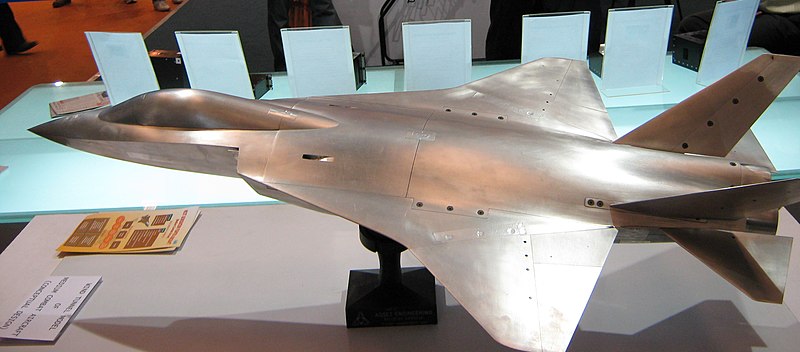
A Model of the AMCA (Image: Wiki Commons)
By Vivek Raghuvanshi

NEW DELHI — US cooperation in engine technology was a top issue for Indian Defence Minister Manohar Parrikar when he met US Defense Secretary Ash Carter Wednesday and Thursday in Washington, said an Indian Defence Ministry source.

India needs engine technology for its proposed homegrown advanced medium combat aircraft (AMCA), which is still on the drawing board. Availability of a higher thrust advanced engine would kick-start the AMCA program, under which India proposes to build medium combat aircraft similar to the Rafale, which it is buying from France, said a senior scientist of the Defence Research and Development Organisation (DRDO), which is developing AMCA.

Another priority is cooperation on development of an electro-magnetic aircraft launch system (EMALS) for the proposed Indigenous aircraft carrier INS Vishal, the MoD source added.

India and the US are already discussing cooperation in jet engine EMALS system for the carrier under the India-US Defense Technology and Trade Initiative (DTTI), a forum set by the two countries to identify defense projects that could be taken up under joint development.

The DTTI forum officials in three of their meetings have discussed the possibility of cooperation in jet engine technology, the MoD source added.

Read the full story at DefenseNews

02 December 2015

Editorial: Who Will Win Asia's Fifth-Generation Fighter Race?

China's J-31 Stealth Fighter Prototype (File Photo)


By Benjamin David Baker

China, Japan, South Korea and India are all developing advanced aircraft. How and why is this happening?

Tensions are rising high throughout the Asia-Pacific. From the Indo-Pakistani border, through Australia’s controversial border policies to China’s disputes with its neighbors in the South and East China Seas, Asian states have been increasing investments in their military capabilities. In all these cases, having forceful and credible aerial assets is a crucial part of deterrence. This is reflected in regional defense spending.

Meanwhile, the world is facing a generational shift in military aircraft. Since the final decade of the Cold War, the skies have been dominated by so-called “fourth-generation” combat aircraft: supersonic jets with increasingly sophisticated electronic capabilities, equipped with weaponry able to engage the enemy over several kilometers distance. These still make up the backbone of basically every modern air force around the world.

However, several states with large budgets and a high degree of military research and development spending are attempting to develop so-called “fifth-generation” aircraft. These jets incorporate stealth technology, which makes them difficult to detect on radar, powerful and secure communications, and advanced sensors that help pilots and ground control teams to keep “full spectrum dominance” of the battlespace.

The U.S. has been leading the way in this field. Although there is some contention as to what actually qualifies a combat aircraft for inclusion into the fifth-generation category, most sources agree that only one currently fully operational model meets the criteria: the Lockheed-Martin F-22 Raptor. The specs surrounding this aircraft are closely guarded secrets, and Washington does not export it to even close allies. Lockheed-Martin’s other fifth-generation aircraft, the F-35 Joint Strike Fighter, is slated for export to a number of allied states. However, the F-35 remains mired in controversy due to delays, overshot budgets, and technical glitches (see here, here and here).

The United States isn’t alone in its ambition to field fifth-generation tech. Several Asian countries are attempting to develop their own fifth-generation aircraft. China is attempting to design and produce a fighter which can offset the American advantage. In response, both Japan and South Korea are in the process of acquiring their own indigenous fifth-generation birds, with varying amounts of technology borrowed from the F-35. India is also pursuing a next-generation aircraft (although New Delhi’s is mostly looking to Moscow and its own indigenous research and development for its needs).

Read the full story at The Diplomat

07 October 2015

Editorial: India’s Air Force Will Field 42 Combat Squadrons by 2027

By Franz-Stefan Gady

The Indian Air Force chief is optimistic about expanding the number of IAF combat squadrons.

The head of the Indian Air Force, Air Chief Marshal Arup Raha, recently announced that the Indian Air Force (IAF) will in all likelihood be able to deploy 42 combat squadrons by 2027 the Business Standard reports.

“We are looking forward to building up our combat fleet to 42 squadrons by the end of the 14th plan, by 2027. I think it is possible, it is viable, there are a lot of options available with us, and discussions are already on,” he told reporters last Saturday in New Delhi.

The Indian Air Force currently operates 32 (some sources say 35) combat squadrons. However, the Indian government’s 35-member Standing Committee on Defense said in a report this April that the number of squadrons could drop as low as 25 (See: “The Indian Air Force’s Big Problem: Not Enough Pilots”).

The reason for the decline in active combat squadrons is that aircraft (primarily MIG-21) are more rapidly retired or are lost in crashes than replacements are available. Next to MIG-21 squadrons, the IAF’s 5 MIG-27 and 7 Jaguar squadrons will also have to be slowly phased out over the next years since the aircraft will have reached the end of their service life in the 2020s.

Read the full story at The Diplomat