Showing posts with label Military Mobilisation. Show all posts

25 August 2017

News Story: Use Allied Investments To Help Rebuild US Military

RAAF Wedgetail AEW/C Aircraft (File Photo)
By ROBBIN LAIRD

The shift from slo mo — counterinsurgency operations — to high intensity combat is a major challenge for the US military and its allies. It is a culture shift, a procurement shift and an investment shift. But mobilization is even more important than modernization.

To get ready for this shift, our weapons inventory needs to become more robust. In visiting US bases, a common theme we hear is the challenge of basic inventory shortfalls.

The Trump Administration came to power promising to correct much of this. But there simply is not enough time and money to do readiness and training plus ups, mobilization and rapid modernization.

As a businessman, Donald Trump might take a look at how the Pentagon actually functions as an effective business in equipping the force. Having highlighted the question of allied spending, he might be pleased to learn of significant allied investments in new combat systems which his own forces can use, saving American taxpayers money and enhancing our military effectiveness at the same time.

One way to augment US forces would be to do something which might seem to be at odds with the Make America Great notion. As one of my Danish friends put it well: “I have no problem with the idea of making America great again. For me, the question is how?”

One way would be to leverage existing allied capabilities which, if adopted by the US forces, would save money but, even more importantly, would ramp up the operational capability of the US forces and their ability to work with allies in the shortest time possible. It would also allow the US to target investments where possible in break through programs which allies are NOT investing in.

Read the full story at Breaking Defense
17 July 2017

USA: Hawaii gathering focuses on Pacific F-35B deployment

From MC1 Phillip Pavlovich, U.S. Pacific Fleet Public Affairs

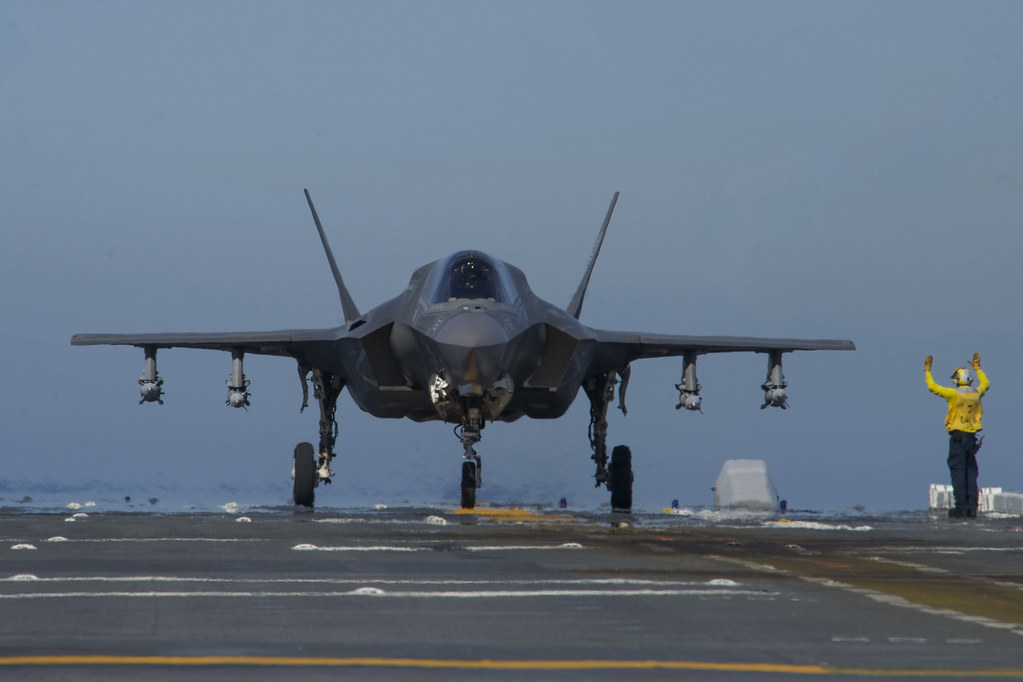
In this file photo, a Sailor directs an F-35B Lightning II aboard USS America (LHA 6) during operational testing in November 2016. (U.S. Navy/MC3 Kyle Goldberg) >>

PEARL HARBOR - Commander, U.S. Pacific Fleet (COMPACFLT) co-hosted a Joint Strike Fighter Sustainment Summit alongside Marine Corps Forces, Pacific at COMPACFLT headquarters, June 27-28.

Attendees focused on planning and preparing the logistical support for the F-35B Lightning II first deployment scheduled to happen within the next year.

"The summit was primarily built to maximize communication, elevate problems, and arrive at solutions. This aircraft has a unique maintenance and support structure, and it is unlike any aviation weapon system presently in the Navy and Marine Corps inventories," said Rear Adm. John Palmer, U.S. Pacific Fleet's director of logistics, fleet supply and ordnance.

A variety of organizations participated, including representatives Lockheed Martin, who built the aircraft, Pratt and Whitney, who built the engine, Marine Corps Headquarters, Defense Logistics Agency, Office of the Chief of Naval Operations, Commander Naval Air Forces Pacific, Commander Naval Air Forces Atlantic, Commander Naval Surface Forces Pacific, and Military Sealift Command.

08 July 2017

News Story: White House reportedly limits Pentagon on new Afghanistan troop levels

WASHINGTON, July 7 (Xinhua) -- The White House had put limits on the Pentagon's future deployment of extra U.S. troops to Afghanistan despite delegating to U.S. Defense Secretary Jim Mattis the authority to manage troop numbers, according to the Wall Street Journal.

According to the report, the White House sent a classified memo to the Pentagon days after President Donald Trump gave Mattis unilateral authority to set new U.S. troop levels in Afghanistan last month, stipulating that Mattis could send no more than 3,900 extra U.S. troops to Afghanistan without conferring with the White House.

Mattis said in mid-June that he would soon present to the White House a new Afghanistan strategy, including setting new troop levels.

Former U.S. President Barack Obama had planned to reduce the current number of 9,800 U.S. troops in Afghanistan to some 5,500 by the end of 2015 and withdraw all troops by the end of 2016 when his presidency came to an end.

However, given the deteriorating security situation in Afghanistan, the Obama administration repeatedly postponed the withdrawal.

Read the full story at Xinhua

09 June 2017

News Report: Plans For 2 Littoral Combat Ships in Singapore, 1 in Bahrain in 2018 Shaped By Lessons Learned

Austal USA-built Independence class LCS
By: Megan Eckstein

WASHINGTON NAVY YARD – The Navy is laying the groundwork now for more complex Littoral Combat Ship operations in Asia and the Middle East, preparing to deploy two simultaneously to Singapore and one to Bahrain in 2018, the program executive officer for LCS told USNI News.

The service has deployed three LCSs overseas so far, all one at a time to Singapore: the Lockheed Martin-built USS Freedom (LCS-1) and USS Fort Worth(LCS-3), and the Austal USA-built USS Coronado (LCS-4). Rear Adm. John Neagley said the PEO and operators have been collecting as many lessons learned as they can during these deployments in the hopes of feeding that information back into maintenance models and logistics assumptions the manning and training pipelines and plans to backfit the ships with upgrades.

In his first formal interview since assuming command last summer, Neagley told USNI News that these lessons learned will all come into play next year when the Navy ups the difficulty of its LCS operations – with two Independence-variant ships operating concurrently out of Singapore, and one Freedom-variant ship operating out of Bahrain for the first time in the program’s history.

22 April 2017

News Story: Chinese forces in normal training along China-DPRK border - Ministry

BEIJING, April 21 (Xinhua) -- Chinese forces are keeping their standard operational readiness and conducting normal training along the border between China and the Democratic People's Republic of Korea (DPRK), according to a statement from the Information Bureau of China's Ministry of National Defense.

Read the full story at Xinhua

11 January 2017

News Story: First F-35B Squadron Moves to Japan

An F-35B hovers during a vertical landing
By: Valerie Insinna

WASHINGTON — A Marine Corps F-35B squadron has transferred from the United States to Marine Corps Air Station Iwakuni in Japan, marking the first permanent international deployment of the joint strike fighter, the service announced Tuesday. 

Marine Corps spokesman Capt Kurt Stahl told Defense News that 10 F-35Bs from Marine Fighter Attack Squadron 121 (VMFA-121) departed Marine Corps Air Station Yuma in Arizona on Monday, with the first jets slated to arrive in Japan on Wednesday. All 10 F-35s will arrive at Iwakuni by Thursday. Eventually, an additional six jets will be relocated from Yuma to Iwakuni, bringing the squadron up to a full 16 aircraft. 

VMFA-121 is a part of the 3rd Marine Aircraft Wing.

“The transition of VMFA-121 from MCAS Yuma to MCAS Iwakuni marks a significant milestone in the F-35B program as the Marine Corps continues to lead the way in the advancement of stealth fighter attack aircraft,” the service said in a statement. 

Read the full story at DefenseNews

16 September 2016

News Story: Four Service Chiefs Say They Can’t Defend US Under Sequestration

F-35 Under-Construction
By COLIN CLARK

WASHINGTON: Today, we got a very clear look at the biggest problem with sequestration for the military. If the Budget Control Act goes into full effect, the heads of the Army, Navy, Air Force and Marines told the Senate Armed Services Committee today, they will not be able to protect the United States as they are charged to do.

Sequestration was meant to be the poison pill no one would swallow so Republicans and Democrats would be forced to negotiate a way out of America’s debt and funding problems. Then came the Tea Party, bellowing and fulminating that they would not support increases in federal spending. The GOP leadership collapsed. The White House didn’t help much either. Ever since, the Defense Department has been stuck between hoping for temporary deals to relieve sequestration and fulminating about how deaf both sides on the Hill have been to the dangers of sequestration to the military in the long term.

Lindsey Graham, who seems to increasingly serve as one of the few members of either chamber able to discuss sequestration in a rational manner, told the Joint Chiefs they need to go to the White House and tell President Obama that they cannot execute the current strategy of defeating one major power and hold another if sequestration continues.

The ultimate cost, Army Chief of Staff Gen. Mark Milley told the committee, will be that conflicts will last longer. That means, he said, “the butchers bill is paid with American lives.” Milley noted that Army weapons systems’ readiness already is “well below 90 percent, and that is great cause for concern.”

Read the full story at Breaking Defense
20 July 2016

News Story: Senior (Chinese) military officer urges combat preparedness

GUANGZHOU, July 19 (Xinhua) -- Fan Changlong, vice chairman of the Central Military Commission (CMC), has called for troops to be ready for combat and for improvements to equipment and logistical preparation.

Fan made the remarks, which were carried in a statement released on Tuesday, in an recent inspection tour of the Southern Theater Command.

Read the full story at Xinhua

17 June 2016

News Story: 10 battalions deployed in Sulu to attack Abu Sayyaf

After the Abu Sayyaf group reportedly beheaded two Canadian nationals in the last two months, at least 10 battalions or 5,000 government troops have been deployed to Sulu.

All resources from land, sea and air have been made available for Sulu operations said Maj. Filemon Tan Jr., spokesperson of the Western Mindanao Command.

Tan said troops from all the service commands like the Philippine Marines, Army, Air Force and Navy, and the different support commands like the Scout Rangers and Special Force have been operating in Sulu.

However, Tan refused to call it a “wide-scale” operation even at 5,000 troops.

“We focus on areas known to be supportive of the Abu Sayyaf Group. We will go to the communities known to provide refuge to bandits,” Tan stated as quoted by the Inquirer.

“There are selected target areas. These bandits have relatives and they hide in the populace,” he added.

Read the full story at Tankler

26 April 2016

News Story: China mulls new law to secure national defense transport

BEIJING, April 25 (Xinhua) -- Chinese lawmakers on Monday started to deliberate a draft law on national defense transport, covering the use of railways, waterways and air routes for defense purposes.

The new law is expected to regulate the planning, construction, management and use of resources in transportation sectors such as railways, roads, waterways, aviation, pipelines and mail services, for national defense. The draft was submitted to the bi-monthly session of the National People's Congress (NPC) Standing Committee, which runs from Monday to Thursday.

Drafters followed a concept of integrating military and civilian resources and stressed that national defense transport should be compatible with market and economic development, Zhao Keshi, head of the Logistical Support Department of the Central Military Commission, told the top legislature.

According to the draft, a national authority will be tasked with overseeing the national defense transport network and local governments, military departments and the military's theater commands will also be responsible.

A consultation mechanism will be established between local governments and military departments and to disseminate and discuss information on construction plans, ongoing projects and demands.

Read the full story at Xinhua

06 January 2016

Editorial: China Tests New Rail-Mobile Missile Capable of Hitting all of US

Image: Flickr User - Andrey Korchagin
By Franz-Stefan Gady

Beijing is using rail mobility to deploy one of its deadliest weapons.

On December 5, China conducted a launcher test of a new rail-mobile version of its newest intercontinental ballistic missile (ICBM), the DF-41 (CSS-X-20), IHS Jane’s Defence Weekly reports.

A DF-41 also underwent a flight test on the previous day (December 4) the publication states based on information obtained by the Washington Free Beacon. The launch of the DF-41 likely took place at the Wuzhai missile test center in central China’s Shanxi Province.

The December 5 test involved a ‘cold launch’ of a DF-41 from a canister with a gas charge without the engine of the missile being ignited. In a full test, the missile’s engine would ignite microseconds after exiting the launch tube.

China’s Defense Ministry confirmed at the end of December that the tests took place without going into details. “Scientific tests within the Chinese territory are conducted according to plan,” Defense Ministry spokesman Colonel Yang Yujun said at a press conference.

Read the full story at The Diplomat

03 December 2015

Editorial: Sino-Indian Border Talks Not Enough to Defuse Tensions

India's Arunachal Pradesh (orange box) is claimed by China


By Sarah Watson and John Chen


Unless India and China can take positive actions, they risk drifting into a growing conflict on their disputed border.

India hosted its highest-ranking Chinese military delegation in ten years November 15-17 for talks on the Sino-Indian border dispute. Despite the unusually high status of the participants in this year’s talks, the visit appears to mark only a brief pause in gradually rising tensions on the border between the two countries.

The 26-member Chinese delegation, headed by General Fan Changlong, vice chairman of the Central Military Commission (CMC), met with India’s chief of Army Staff, Lt. Gen. Dalbir Singh, Minister of Defense Manohar Parrikar, and Prime Minister Narendra Modi. Included in the Chinese group was Admiral Sun Jianguo, deputy chief of the General Staff of the People’s Liberation Army (PLA), China’s representative to this year’s Shangri-La Dialogue, and possibly the next chief of the PLA Navy.

In spite of the “star power” of the Chinese delegation, expectations were not particularly high. Following the talks, Indian media reported that both sides agreed the border was “generally stable” and that they had endorsed “concrete actions to implement the consensus reached by the two leaders on border issues.” These sensible suggestions gloss over the fact that China and India have been searching for “concrete” ways to enact that consensus, the Border Defense Cooperation Agreement, since that document was signed by then-Prime Minister Manmohan Singh and Premier Li Keqiang in October 2013. The Agreement alone was not able to prevent multiple flare-ups along the Line of Actual Control (LAC) in the past two years.

Read the full story at The Diplomat

06 November 2015

Editorial: New Taiwan Report Considers the China Threat

Chinese Navy Type 052D Destroyer
By Kevin Wang

A recently released defense report warns of the rapid development of the PLA.

China’s military expansion is still the biggest headache for Taiwan’s national security, says a new defense report issued Tuesday by Taiwan’s Ministry of National Defense.

The 204-page defense report [PDF], among other things, provides the domestic audience in Taiwan with a snapshot of current security threats. The report, the 13th of its kind, is a good reflection of Taiwan’s national defense focus and concerns. It is often monitored closely by Asian security experts because of its analysis of the latest trends and direction of Chinese military and defense, which is little presented in defense white papers published by China’s own defense ministry. The previous version was issued in 2013.

“Due to the increasing uncertainty of the global security environment, the environment Asia Pacific and Taiwan are facing is also becoming more and more complicated and severe, among which China’s military threat is the top challenge,” the latest report says.

The report spent a generous portion voicing concerns over the rapid advancement of the People’s Liberation Army (PLA), increasing Chinese defense spending, “more than 1,000” short-to-mid-range ballistic and cruise missiles placed across the Taiwan Strait, “continuing targeted military exercises,” as well as Beijing’s persistent stance regarding the use of force on Taiwan.

The report added that “the strategic competition in the Asia Pacific between the United States and China, as well as escalating maritime territorial disputes over islands in East and South China Seas, also bring challenges to Taiwan’s national security.” Just this week, the People’s Liberation Army Navy followed and warned a U.S. Navy destroyer that sailed within 12 miles of a Chinese-made artificial island in the South China Sea. Beijing saw the U.S. Navy’s move as provocative and trouble-seeking while the Pentagon insisted its forces are free to operate in open international waters and will continue to do so.

It also came just months before Taiwan’s general elections, where perceived Chinese threats are certain to be a top concern for voters.

Read the full story at The Diplomat

26 August 2015

Editorial: Why Did China Amass Tanks at the North Korean Border?

By Shannon Tiezzi

Was it simply good preparation — or was Beijing trying to send a message to Pyongyang?

Even as North and South Korea engaged in hours of talks over the weekend, in the hopes of defusing tensions, China was apparently making its own preparations for a worst-case scenario on the Korean peninsula.

On Saturday, Chinese social media users began posting pictures of tanks and other military equipment moving through city streets. The photos were purportedly taken in Yanji, China, the capital of Yanbian prefecture in Jilin province, which lies along the China-Korea border.

Other Chinese social media users posted pictures of a train appearing to carry more military equipment – but those pictures were explained as showing military technology on its way to Beijing for the upcoming military parade. There was some confusion about this point, with some of the same pictures being identified by different sources as taken in or outside of Yanji and Beijing.

Read the full story at The Diplomat

21 August 2015

Editorial: US Air Force’s Top-Secret Bomber More Expensive Than Thought

Lockheed Martin/Boeing LRS-B concept
By Franz-Stefan Gady

The U.S. Air Force misstated the costs for its top-secret program in a report to Congress.

The costs of the top-secret Long-Range Strike Bomber (LRS-B)–likely to be designated B-3–have gone up due to a calculation error, according to the U.S. Air Force. The 2014 Department of Defense’s ten-year budget estimate for fiscal years 2015-2025 for the bomber program was $33.1 billion. This year’s estimate for fiscal years 2016-2026 jumped up to $58.4 billion.

However, according to Bloomberg Business, the U.S. Air Force now claims that both numbers are wrong and that the actual ten-year costs (the first installment in the 30-year program) were $41.7 billion for each period. The USAF did not offer an explanation for the discrepancies.

“The Air Force is working through the appropriate processes to ensure” that the congressionally mandated report “is corrected, and that our reports in subsequent years are accurate,” an U.S. Air Force spokesperson told Bloomberg Business.

The U.S. Air Force is expected to buy 80 to 100 bombers. Northrup Grumman is competing against Boeing and Lockheed Martin, which have partnered up to be the primary contractor for the LRS-B. The contract is likely to be awarded in September, according to military.com.

Read the full story at The Diplomat

23 June 2015

Editorial: China Prepares Its 172,000 Civilian Ships for War

Container ship CSCL Saturn (Image: Wiki Commons)
By Franz-Stefan Gady

Chinese civilian shipbuilders have to ensure that their vessels can be used by the PLAN during times of ‘crisis’.

As my colleague Shannon Tiezzi reported a while back, the Chinese government has approved a plan to ensure that civilian vessels can support military operations of China’s maritime forces in the event of a crisis.

While the recruitment of civilian maritime assets for military purposes is not unusual (e.g., the Queen Elizabeth 2 transported the main British land fighting force to the Falkland Islands during the 1982 Falklands War), the recent announcement is nevertheless a sign of the growing aspirations of Chinese naval planners in developing naval expeditionary warfare capabilities.

According to the Chinese Ministry of National Defense’s website, China’s national transport war-preparedness office for national defense recently held a training session for Chinese shipping enterprises to familiarize the civilian shipping sector with a set of new guidelines, the Technical Standards for New Civilian Ships to Implement National Defense Requirements, in early June in Shanghai.

This document lays out the specific requirements for newly constructed civilian vessels to meet “national defense requirements”, the ministry website states. The guidelines, which were already approved in March 2015, are the result of a five-year research project by the Shipment Military Representative Office of the PLA Nanjing Military Area Command (MAC) and the CCS Shanghai Specification Institute.

Read the full story at The Diplomat

26 May 2015

News Story: Global Times explores PLA's growing might


The People's Liberation Army has rapidly developed into one of the world's most powerful militaries and could have up to 10,000 nuclear warheads in its arsenal, reports Huanqiu, the Chinese-language website of the nationalistic tabloid Global Times.

Citing a detailed report into the PLA's military might by Russian media, the Global Times notes the speed of which China's military technology has been developing since the turn of the century, rising to have the second highest defense budget in the world behind the United States while still maintaining the world's largest army by personnel numbers.

In 2013, China released PLA personnel numbers for the very first time, claiming that it has a total of 1.483 million troops, including 850,000 in the PLA Ground Force, 235,000 in the PLA Navy, and 398,000 in the PLA Air Force. The accuracy of those numbers have been questioned, however, as the US Department of Defense estimated in the same year that the PLA Ground Force alone has 1.25 million people.

China's massive mobilization potential has also not subsided since the start of the century, when estimates suggested that the country could mobilize up to 380 million people, of which 208 million are suitable for service.

Read the full story at Want China Times

08 May 2015

News Story: Japan prepares to deploy troops on Miyako and Ishigaki


After the finalization of new guidelines for defense cooperation between the United States and Japan, Tokyo is ready to deploy its Self-Defense Force to the Okinawa islands of Miyako and Ishigaki to face potential Chinese maritime expansion in the East China Sea, the Nippon Hoso Kyokai reports.

Japan wants to deploy troops to the two islands as a response to the now routine patrols by Chinese maritime security ships in the disputed East China Sea after the Japanese government nationalized the Diaoyutai islands (Senkaku to Japan, Diaoyu to China) in 2012. Japan will deploy a radar station to the western part of Yonaguni, only 110 kilometers away from Hualien on Taiwan's east coast, to monitor PLA naval movements.

Read the full story at Want China Times

07 May 2015

USA: 7th Fleet, Singapore, Malaysia and Indonesia Navy Leaders Meet to Enhance Multilateral Cooperation

By Mass Communication Specialist 1st Class Joshua Karsten

<< Senior leaders hold discussions aboard USS Blue Ridge (LCC 19) in Singapore, May 6. (U.S. Navy/MC1 Joshua Karsten)

CHANGI NAVAL BASE, Singapore - Senior navy leaders from the U.S. Seventh Fleet, Republic of Singapore Navy (RSN), Royal Malaysian Navy (RMN) and the Indonesian Navy (TNI) met for a professional exchange of ideas in a variety of technical and operational topics aboard the 7th Fleet flagship USS Blue Ridge (LCC 19) May 4 and 6.

The 7th Fleet staff first met with Singaporean navy subject mater experts for a day of discussions, or "staff talks," that included professional dialogue between the two staffs and were designed to share knowledge and develop methodologies for joint responses to any contingency within the Indo-Asia-Pacific.

17 March 2015

News Report: China's Army in Show of Force Along Myanmar Border After Fatal Bombing


China's People's Liberation Army on Monday set to work strengthening its presence along the border with Myanmar after the deaths of five people on its side of the border in Yunnan province fueled growing tensions between the two Asian neighbors.

Residents of Yunnan's Nansan township said two of the PLA's fighter jets were using a local high school sports field as a temporary airfield.

"We have been able to see the build-up of military forces in the direction of the border from here," a Nansan resident surnamed Xu told RFA.

"I have seen military vehicles carrying equipment and some artillery or big guns, [but] I don't know what they are," he said.

China's Sina news website on Monday said the PLA had sent "large numbers" of ground and air forces to Lincang, including anti-aircraft missiles and J-7 fighter jets.

J-10 and J-11 aircraft had been deployed as a second line of defense, it said.