Showing posts with label MBDA. Show all posts

25 August 2017

News Story: How 'Make in India' could impede India’s global hunt for anti-ship missiles

By: Vivek Raghuvanshi

NEW DELHI — India has launched first-ever global hunt for anti-ship missiles with a budget of $1 billion. But a requirement for those missiles, to be built by domestic companies, could be difficult to meet.

The medium-range anti-ship missiles must be capable of engaging fast-maneuvering targets within India’s exclusive economic zone in all weather conditions, and have land-attack capability.

A formal tender will be issued by mid-2018, and India hopes to negotiate a quick delivery of the product.

India’s Ministry of Defence wants the production license rights after it receives a transfer of technology for the medium-range anti-ship missiles.

Although no domestic company in India has ever manufactured an anti-ship missile, the MoD will award the contract to a local business as part of the Make in India policy; a foreign vendor will then have to tie up with the domestic company and bid for the tender, an MoD official explained.

Read the full story at DefenseNews

News Story: Use Allied Investments To Help Rebuild US Military

RAAF Wedgetail AEW/C Aircraft (File Photo)
By ROBBIN LAIRD

The shift from slo mo — counterinsurgency operations — to high intensity combat is a major challenge for the US military and its allies. It is a culture shift, a procurement shift and an investment shift. But mobilization is even more important than modernization.

To get ready for this shift, our weapons inventory needs to become more robust. In visiting US bases, a common theme we hear is the challenge of basic inventory shortfalls.

The Trump Administration came to power promising to correct much of this. But there simply is not enough time and money to do readiness and training plus ups, mobilization and rapid modernization.

As a businessman, Donald Trump might take a look at how the Pentagon actually functions as an effective business in equipping the force. Having highlighted the question of allied spending, he might be pleased to learn of significant allied investments in new combat systems which his own forces can use, saving American taxpayers money and enhancing our military effectiveness at the same time.

One way to augment US forces would be to do something which might seem to be at odds with the Make America Great notion. As one of my Danish friends put it well: “I have no problem with the idea of making America great again. For me, the question is how?”

One way would be to leverage existing allied capabilities which, if adopted by the US forces, would save money but, even more importantly, would ramp up the operational capability of the US forces and their ability to work with allies in the shortest time possible. It would also allow the US to target investments where possible in break through programs which allies are NOT investing in.

Read the full story at Breaking Defense

22 June 2017

News Report: French, Indian Companies Form Joint Venture to Develop Military Sensors

France's Thales Group and India's Reliance Defence and Engineering announced their intent to form a joint venture company to integrate and maintain radar and electronic warfare sensors in India.

Reliance Defence will be a majority shareholder with 51% of the new company's shares while Thales will hold 49% of shares in the joint venture. "The joint venture will develop… activity in the Special Economic Zone of Mihan-Nagpur together with an Indian supply chain for the manufacturing of microwave technologies and high-performance airborne electronics," Reliance Defence said in a statement.

"We are delighted to seal this strategic collaboration with Reliance Defence Limited. This joint venture resonates with our strategy to strengthen our industrial footprint in the country by building collaborations with the Indian industry. It reaffirms our commitment to India, and our active contribution to "Make in India"," Patrice Caine, Chairman and CEO, Thales, said.

21 March 2017

Sea, air, land and space updates (21-Mar-2017)

Zoe Glasson, Sophie Qin, Madeleine Nyst and Patrick Kennedy
Sea State
In its biggest show of naval force in the Asia–Pacific since WWII, Japan has unveiled plans to send its largest warship—the Izumo helicopter carrier—on a three-month tour of the South China Sea, kicking off in May. Stopping off in Singapore, Indonesia, the Philippines and Sri Lanka, its destination is the Indian Ocean, where it will join India and the US in the Malabar naval exercise. Japan’s drills last week with South Korea and the US in the Sea of Japan further demonstrated that its ‘naval forces [are] playing a bigger part in the region.’Unimpressed, China has promised to ‘take firm responsive measures’ should Japan ‘persist in taking the wrong actions’.
After last Monday’s hijacking of the tanker Aris 13 by Somali pirates off Somalia’s coast (the first since 2012), a new spate of attacks is feared, with one pirate warning: ‘In the coming days we are going to seize even more foreign ships.’ Somali officials have now called upon NATO—which ended its counter-piracy mission in November—to do more to stop illegal fishing in the area, which some believe provoked the attack.
Everyone’s favourite submersible, Boaty McBoatface, left Chile on Friday on board the RRS James Clark Ross. It’s headed to the Antarctic to explore ‘some of the deepest and coldest abyssal waters on Earth’… Better you than me, Boaty!

18 March 2017

News Story: Malaysian naval power suffers budget woes

By: Mike Yeo

MELBOURNE, Australia — Malaysia’s centerpiece plan for the restructure and recapitalization of its Navy has also been adversely affected by the country’s budget woes, leaving most of it underfunded or unfunded altogether. 

The so-called 15-to-5 plan, unveiled in 2015, calls for a reduction of the Royal Malaysian Navy order of battle from 15 to five classes of ships and submarines, which it hopes will trim sustainment costs by retiring older ships and reducing the number of ship classes operated by the RMN by 2030. 

The five ship classes will ideally consist of 12 French-designed littoral combat ships, 18 Kedah-class offshore patrol vessels, 18 Chinese-designed littoral mission ships, three multirole support ships of an as-yet undetermined design and four submarines. 

Of these, only six lightly-armed Kedah-class offshore patrol vessels are already in service together with two French Scorpene diesel-electric submarines. Malaysia has also ordered six littoral combat ships based on the French Gowind 2500 design under a $2 billion contract signed in 2011, with two ships in various stages of construction at Malaysia’s Boustead Naval Shipyard. 

The 3,000-ton ships will be armed with the Kongsberg Naval Strike Missile and MBDA’s vertical launch MICA for anti-ship and anti-aircraft work respectively, along with 57mm and 30mm guns as well as torpedo tubes. The first ship is expected to be delivered to the RMN in late 2019 or early 2020. 

Malaysia is also pressing forward with its Littoral Mission Ship program, signing a contract in early November 2016 with China’s State Administration of Science, Technology and Industry for National Defense for an initial four ships with two built by Boustead and the other two in China. 

Read the full story at DefenseNews


10 March 2017

News Story: Indian Navy seeks to replace Israeli Barak-1 air defense system

Barak-1 SAM (Image: Wiki Commons)
By: Vivek Raghuvanshi

NEW DELHI — India's Navy has launched a new program to buy short-range surface-to-air missile systems from overseas to replace its aging Israeli Barak-1 air defense systems. 

India has made a global request for information to purchase 10 SRSAM systems and 600 missiles at a cost of about $1.5 billion.

Once responses are received in the next two months, the Navy will issue a tender under the Make in India policy's global purchasing category after six months to acquire the SRSAM systems. Under the program, overseas defense companies would need to forge partnerships with domestic companies to carry out 30 percent offsets obligations and include indigenous technology in the SRSAM systems.

An Indian Navy official said the proposed SRSAM system should be capable of vertically launching Mach 3-class active seeker missiles that can provide 360-degree defense coverage to meet all naval air defense applications including the need to carry out multiple simultaneous engagements.

Each SRSAM system will have a command and control system, a fire control system, a command link radar and one launcher to carry between eight and 16 missiles depending upon the size of the warship. The system's is expected to be inducted within the next five years.

According to an Indian Navy official, the foreign companies expected to make a bid are European-wide MBDA; Thales of France; Saab of Sweden; KBP Tula of Russia; Israel Aerospace Industries and Rafael Advanced Defense Systems of Israel; Raytheon of the United States; and Doosan Group and Samsung of South Korea. 

Read the full story at DefenseNews

03 March 2017

News Report: Indian Navy Puts Out Request For Short Range SAMs

SRSAM systems will replace Israeli Barak-1 and its ageing Russian close-in weapon systems. French firm MBDA had agreed to transfer technology to India’s DRDO for vertical launch SRSAM.

New Delhi (Sputnik) — India has issued a global request for information (RFI) to procure vertical launch short range surface-to-air-missile (SAM) system for fitment onboard Indian Navy ships and would be utilized for Anti-Missile Defense and engaging other identified air targets by the Indian Navy. With this RFI, Indian Navy has started a keenly awaited process to replace the Barak 1 air defense system.

In a 14-page paper, the Navy says, "The all-weather system should be able to be queued by data from Air Surveillance radar. Requirement for installation of dedicated Fire Control Radar/ Surveillance radar. Vendors must specify the feasibility of using existing radars like Fregat MAE, Fregat M2EM, AMDR2D, AMDR 3D, RAWL 08/ 02, MFSTAR, 3D SAR."

22 February 2017

News Story: ‘Make In India’ Was the Key Focus of Aero India Show

Embraer EMB-145 AEW&C with DRDO Radar
by Chris Pocock

The 11th Aero India show at Bangalore last week was bigger than ever, as foreign manufacturers vied to offer attractive “Make In India” proposals to meet the country’s substantial defense needs. Meanwhile, the country’s own long-established aerospace company Hindustan Aeronautics Ltd (HAL) showed the Advanced Hawk jet trainer that has been co-developed with BAE Systems, and proposed an Indian multi-role helicopter (IMRH). Neither project has official backing in the form of a firm requirement or orders, but at the show HAL did sign a memorandum of understanding with the government for a large new helicopter testing and production facility in the state of Karnataka.

India’s fighter requirements were, as expected, high on the agenda. Saab made an aggressive pitch for the Gripen E, that included the proposed maritime version that could meet the Indian Navy’s requirement for 57 multi-role carrier-borne fighters. Kent-Ake Molin, commercial manager, said that Saab has “mobilized a robust global supply chain for India. We are not doing a copy and paste…the facility we will set up here will be new. Besides, we will bring in capabilities India has been wanting, such as superplastic forming and integration and use of software.” During the show, Saab Aeronautics head Ulf Nilsson told an Indian business daily that the Swedish company is talking about an Indian partnership to the Adani Group, which wants to build a 200-acre aerospace factory at Mundra. 

A Gripen took part in the flying display, and so did an F-16, another candidate for the Indian Air Force’s yet-to-be-fully-defined requirement for a new, possibly single-engine fighter to be produced in-country. But concerns about possible changes in U.S. technology transfer policy clouded Lockheed Martin’s pitch for Indian-based production of the F-16V version of the Fighting Falcon. The American company issued a statement noting that its current proposal “was supported by the Obama administration as part of a broader cooperative dialogue with the government of India…we understand that the Trump administration will want to take a fresh look at some of these programs and we stand prepared to support that effort to ensure that any deal of this importance is properly aligned with U.S. policy priorities.”

Read the full story at AINonline

18 February 2017

News Story: Low-key Aero India 2017 witnessed limited agreements

By: Vivek Raghuvanshi

BANGALORE, India — The aerospace and defense exhibition Aero India 2017 was low-key in terms of business activities, with no major deals signed or Ministry of Defence announcements on the Strategic Partners policy, which has the potential to boost business for the domestic private sector. 

Friday was the expo's final business day, but it remains open Feb. 18 for the general public.

More than 72 fighter aircraft participated at the event in the wake of the runup for a production tender for single-engine fighters for the Indian Air Force; however, the MoD did not announce introduce a road map for the tender. 

Mostly only joint venture agreements and memorandums of understanding were announced between overseas defense companies and Indian entities. Foreign companies partner with domestic businesses to stay connected to the Indian market, which will see all future big-ticket tenders awarded to domestic companies under a much-awaited MoD policy. 

A top MoD official said Aero India 2017 was productive, as it provided a platform to foreign original equipment manufacturers to forge partnerships with domestic defense companies to move forward Make in India defense initiatives. 

Read the full story at DefenseNews

17 February 2017

News Report: Indian Manufacturers Join Race to Cooperate With Foreign Defense Companies

SAAB Gripen Fighter Aircraft
The Indian government’s inviting proposals for single-engine fighter jets with a focus on pushing defense manufacturing in the country opens a potential business opportunity for local firms to partner with foreign defense manufacturers.

New Delhi (Sputnik) — Prime Minister Narendra Modi's 'Make in India' push is beginning to yield results with many Indian conglomerates exploring the possibilities of joint venture with major defense manufacturers from abroad. The latest Indian firm to join the race is industrialist Gautam Adani-led Adani Group, which reportedly is in talks with Sweden's Saab AB for a partnership.

The Swedish firm makes Gripen fighter jets, which reportedly is in the race for India's next multi-billion fighter jet order. The other is Lockheed Martin Corp. of the US, which makes the F-16 jets. Saab has promised to build the fighter jets locally if it wins the order. The Swedish firm participated at the Aero India 2017 air show in Bengaluru.

20 December 2016

News Story: Italy Sends FREMM Frigate on Promotional Tour of Australia

An Italian FREMM Frigate (Image: Wiki Commons)
By: Tom Kington

ROME - An Italian Navy FREMM frigate will visit Australia in January and February and hold exercises with the Australian Navy in the wake of the type’s short listing for acquisition by Australia.

The promotional tour, which is backed by Fincantieri, the ship’s builder, will include stops in Fremantle, Adelaide, Sydney and Melbourne, Italian Navy officials said on Dec. 16.

In April, Australia shortlisted proposals from BAE Systems, Fincantieri and Navantia for the country’s program to build nine new frigates.

The BAE offering is based on the Type 26 frigate, while Navantia is proposing a redesigned version of its Álvaro de Bazán (F100) class vessel.

The FREMM frigate making the trip, the Carabiniere, is an anti-submarine warship FREMM and was  delivered to the Italian Navy in April 2015, the fifth of ten to be commissioned. On the tour it will carry an NH90 helicopter and undertake ASW exercises with the Australians.

Read the full story at DefenseNews

04 November 2016

News Story: French Pilot Training Suffers at Expense of Rafale Sales Support

By: Pierre Tran

PARIS — The French Air Force plays a key role in the export drive for the Dassault Aviation Rafale, but its sales support places a burden on the time it takes to train pilots on the fighter jet, the air chief of Staff told the French Senate Foreign Affairs, Defense and Armed Forces Committee. 

“The more hunger there is for support for export, the more that reduces training for our crews,” André Lanata said, according to a Senate parliamentary record from Oct. 12 only recently made public. There is also a high operational combat rate, which puts pressure on time for training pilots and personnel on the full spectrum of skills. 

“All the challenge is there,” he said. 

Combat missions over Syria and Iraq have boosted fighter pilots’ flying hours to 168 hours this year, higher than 159 hours in the military budget law, he said. Pilots are expected to fly 164 hours next year. 

On top of that higher-than-expected operational rate, there are “significant requests for support for our export markets for the Rafale,” he said. “We have to congratulate this export success: this is good news for our industry, the air force, the military budget law and for France.” 

“The service we bring mainly consists of training,” he said. The service has “unique and sought after operational expertise,” which is the clients’ main interest, he said. “This is one of the reasons for the export success,” he added. Other factors include pilots flying the twin-engined fighter to air shows and in military exercises, loan of equipment, assigning kit, and personnel to help develop the plane to standards requested by the clients.   

All that is not neutral and comes on top of a demanding situation, he said. The Air Force delivering support helped the defense industry and strengthened long-term strategic partnerships between the air force, France and the acquiring nation. There's a need to pay close attention to staff levels, he added; the service essentially received payment for its support. 

Read the full story at DefenseNews

26 September 2016

News Story: Indian air force test fires long range air-to-air MICA missile

Air-to-Air MICA Missile (Image: Wiki Commons)
NEW DELHI, Sept. 24 (Xinhua) -- Indian Air Force has test fired long range air-to-air MICA missile on a manoeuvring target from a combat aircraft, a statement issued by Indian government's Press Information Bureau said Saturday.

"Tigers - the first squadron of Indian Air Force, successfully fired the recently acquired long range Beyond Visual Range (BAV) air-to-air MICA missile on a manoeuvring target from Mirage-2000 Upgrade aircraft," the statement read.

Indian Defense officials said the missile achieved a direct hit on a target which was much smaller than an actual aircraft and flying at low altitude.

Read the full story at Xinhua

--

Quote Story: The long-range nuclear capable ballistic missile, developed jointly with Israel

PacificSentinel: I really wish these people did their homework before they wrote stories, the Barak-8 is NOT a "nuclear capable ballistic missile", it's a Surface-to-Air Missile.

24 September 2016

News Story: India, France ink deal for 36 Rafale fighter jets & France's Hollande hails concluded Rafale deal with India

India, France ink deal for 36 Rafale fighter jets

NEW DELHI, Sept. 23 (Xinhua) -- India Friday formally signed a deal with France for purchase of 36 Rafale fighter jets, officials said.

The deal was signed in New Delhi by India's Defence Minister Manohar Parrikar and his French counterpart Jean-Yves Le Drian.

"India and France signed the deal for 36 Rafale jets," Parrikar wrote on twitter after finalizing the deal. "Rafale will significantly improve India's strike and defence capabilities."

(Le) Drain arrived in New Delhi on Thursday accompanied by CEOs of Dassault Aviation, Thales and MBDA to seal the multi-billion dollar deal for 36 Rafale fighter jets.

The aircraft will be equipped with latest missiles and weapon system.

Read the full story at Xinhua

--

France's Hollande hails concluded Rafale deal with India

PARIS, Sept. 23 (Xinhua) -- French President Francois Hollande on Friday hailed the conclusion of the Rafale fighter jet deal with India which he said was "a recognition" of French aeronautic industry and security technology.

French defense minister Jean-Yves Le Drian inked the agreement with his Indian counterpart Manohar Parrikar in New Delhi -- a deal for India to buy 36 Rafale worth about 7.9 billion euros (8.85 billion U.S. dollars), one of India's biggest defense deals in decades.

"The agreement... shows the great military and strategic power's recognition of operational performance, technological quality and competitiveness of the French aero space industry," Hollande said in a statement.

Read the full story at Xinhua

23 September 2016

News Story: French Defense Minister Travels to India in Wake of Rafale Jet Reports

By: Pierre Tran

PARIS — French Defence Minister Jean-Yves Le Drian traveled to India Thursday for a scheduled meeting on Sept. 23, as requested by President François Hollande, said the Ministry of Defence spokeswoman Valérie Lecasble. 

The minister’s travel plan has raised hopes France will sign Friday an agreement with India for the sale of 36 Dassault Aviation Rafale fighter jets in a deal widely reported to be worth €7.87 billion ($8.8 billion). 

Lecasble declined to comment on whether Le Drian would be signing a deal and the value of the expected acquisition, instead pointing to a statement from the French president's office. 

However, an official with the Indian Ministry of Defence, speaking on condition of anonymity, said Le Drian will meet his Indian counterpart, Defence Minister Manohar Parrikar, on Sept. 23 to sign an intergovernmental agreement for the Rafale jets. He would not provide further details. 

Read the full story at DefenseNews

12 September 2016

News Story: Land Forces 2016 - Australia’s GBAD jigsaw puzzle

SAAB RBS-70NG mounted on a Thales Hawkei
by Gordon Arthur

The topic of ground-based air defence (GBAD) and integrated air defence attracted much attention at Land Forces 2016 in Adelaide, although potential vendors are awaiting an RfT to learn more about how Australia will approach this jigsaw.

The 2016 Defence White Paper called for a deployable short-range GBAD system to replace the Saab RBS 70 MANPADS by the early 2020s. Furthermore, new medium-range GBAD missiles will be acquired in the mid-to-late 2020s. These contribute to project Land 19 Phase 7B.

Another consideration is project Air 6500 that will have two phases to replace the Vigilare air defence C2 system and to shape long-range air defence.

The sentiment of industry is that an RfP for Land 19 Phase 7B will appear in late 2016/early 2017. The previously issued RfI sought a sensor suite, effector suite (i.e. missiles) and C4I system that can absorb the existing functionality of Phase 7A.

There is considerable interest from vendors. For example, a spokesman confirmed to Shephard that MBDA is proposing EMADS for the short-to-medium range, and Mistral MANPADS for the lower level.

The former, which stands for Enhanced Modular Air Defence Solutions, has options for both the CAMM and CAMM-ER, which give a layered defensive range of 25km for the former and 45km for the latter. The UK is introducing the CAMM, which uses a soft vertical launch, as its Rapier replacement.

Importantly, Australia already has a foundation upon which to build a capable air defence network, which is what Saab is counting on for further involvement. Australia has the RBS 70, recently updated with IFF Mode 5, and Giraffe AMB radars.

Australian Giraffe Radar with MAN Truck in Afghanistan
Australia purchased the Giraffes plus SRCTec Light Counter-Mortar Radars as part of Land 19 Phase 7A as an urgent requirement for counter-rocket, artillery and mortar (C-RAM) purposes to protect troops in Afghanistan. However, these give only a sense and warn capacity, with no ability to kill incoming rounds.

These could form the basis of a more expansive system, a Saab Australia spokesman informed Shephard. ‘A little extra work can expand capability considerably,’ he said, plus a layered system could be phased in step by step. For example, the 9LV combat management system used on the navy’s upcoming Air Warfare Destroyers could be integrated.

Read the full story at Shephard

03 August 2016

News Story: India, France Move Closer to Rafale Fighter Deal

Vivek Raghuvanshi

NEW DELHI — India and France move closer to concluding a Rafale fighter-jet deal, estimated at around $9 billion, as the two countries have agreed to sign an inter-governmental agreement (IGA), which was one of the obstacles towards an eventual sale.

Defense Minister Manohar Parrikar told parliament Aug. 2 in a written reply that an agreement has been reached to sign the IGA.

"Both sides also agreed to conclude an Inter-Governmental Agreement (IGA) for supply of the aircraft. A negotiating team has been constituted to negotiate the terms and conditions of the procurement of 36 Rafale jets and recommend a draft agreement," the defense ministry said in a statement, quoting Parrikar.

In an earlier reply to the Indian parliament, on July 19, Parrikar had said "negotiations are underway and IGA and offset contract are yet to be finalized."

The Indian defense minister had then said then that the 36 aircraft being procured will have advanced features like Advanced Electronically Scanned Array radar, mid-air refueling and advanced electronic-warfare equipment as part of its design.

Read the full story at DefenseNews

07 July 2016

News Story: France Imposes New Conditions on Rafale Deal With India

Vivek Raghuvanshi

NEW DELHI — France has quietly insisted that an $8.9 billion government-to-government (G2G) deal with India be signed before a 50 percent offset deal for Rafale fighters is finalized, according to a French Embassy source in India.

"We have concluded multiple discussions with state-owned Defence Research and Development Organisation (DRDO) and other agencies to execute 30 percent offsets in India's ongoing and futuristic military aerospace programs, but no [offset] deal will be finalized until the final Rafale contract is signed," said the source, who spoke on condition of anonymity.

As part of the Rafale deal, France has made a 30 percent offset commitment for military aerospace research and development programs and a 20 percent offset commitment for making components for Rafale fighters with domestic firms in India.

French defense companies Safran, Thales, MBDA and Dassault have also committed to proving stealth, radar, thrust vectoring for missiles technologies and materials for electronics to DRDO and domestic defense companies.

Read the full story at DefenseNews

07 April 2016

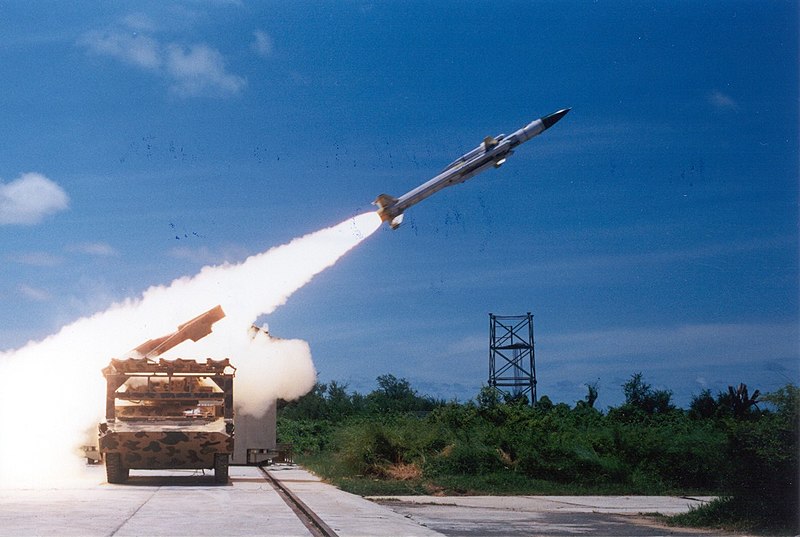
News Story: Indian Army Seeks New Source of Surface-to-Air Missile Defense System

Akash missile being test fired (Image: Wiki Commons)
Vivek Raghuvanshi

NEW DELHI — The Indian Army is lobbying to purchase quick reaction surface-to-air missile systems (QRSAM) because the homemade Akash air defense system is slower and ineffective while on the move, an army official said.

"The reaction time of Akash is longer and has a radar coverage less than 360 degrees. QRSAMs are needed to defend formations in the forward tactical battlefield area whereas Akash is being used for guarding its assets located in deeper areas inside the country," said the official, who spoke on condition of anonymity.

Rahul Bhonsle, a retired Indian Army brigadier general, said: "Akash is suited for static air defense where the response time may be longer, thus the same may not be suitable for employment in the tactical battle area given the need for quick reaction and speedy engagements. Moreover, it appears that the Army also wants a mobile AD system whereas the Akash may not be as agile and also has a larger footprint."

No Ministry of Defense (MoD) official would comment on the Indian Army's demand that MoD purchase a surface-to-air missile system to supplement the Akash.

Read the full story at DefenseNews

30 March 2016

News Story: Indo-French Surface-to-Air Missile Unveiled at Defexpo

Vivek Raghuvanshi

GOA, India — India and France are showcasing a static mock-up of a vertical-launch short-range surface-to-air missile (SRSAM) for naval applications at the MBDA stand at Defexpo.

India's state-owned Defence Research and Development Organisation (DRDO) and MBDA of France will jointly develop and build SRSAM systems in India to meet the requirements of the Indian Navy and other nations' navies.

SRSAM systems will replace the Indian Navy's Israeli Barak-1 air defense systems and its ageing Russian close-in weapon systems.

One DRDO scientist said the project is still awaiting the Indian government's blessing for final approval but declined to comment when the contract will be awarded.

Read the full story at DefenseNews