Showing posts with label ASAT. Show all posts

01 August 2017

News Story: Build Bare-Bones Network & Small Satellites For Multi-Domain Battle

US Army HiMARS Truck based missile launcher
By SYDNEY J. FREEDBERG JR.

WASHINGTON: The Navy wants the Army’s help win a future Multi-Domain Battle with China, a senior defense official told me last week, but to get it, the two services have to connect through a simple, robust network using small and rapidly-launched satellites.

We don’t need massive bandwidth to handle video teleconferences, full motion video from drones, PowerPoint briefings, and all the digital tools of “micromanagement,” the official believes. We just need a regional command-and-control network for voice commands and bare-bones-data – I’m here, the enemy’s there, shoot them not me – that can run off a single small satellite.

“It doesn’t have to be a big network,” he told me. “You could have one satellite…a temporary small satellite that you’ve popped up.”

This is in keeping with the early Concept of Operation developed for the Air Force’s Operationally Responsive Space program (although the official didn’t mention ORS by name). ORS seeks to end the US military’s dependence on highly capable, highly complex and highly expensive satellites. These multi-billion-dollar masterpieces would take months or years to replace if an adversary shot them down— as China demonstrated it could in 2007.

Read the full story at Breaking Defense

20 June 2017

News Story: India kick-starts military satellite programs

An Indian Space Rocket Launch (File Photo)
By: Vivek Raghuvanshi

NEW DELHI — To meet military space requirements, India plans to launch a 550-kilogram homemade military satellite within the next fortnight to join the heaviest homemade rocket, the Geosynchronous Satellite Launch Vehicle Mark III, according a Ministry of Defence source. 

The GSLV Mk III rocket, fired earlier this month into space, has the capacity to carry the 4-ton class of satellites, prompting some analysts here to say this is a prerequisite for an anti-satellite weapon. 

"The capability to launch heavy rockets with heavier payloads is a prerequisite to put up anti-satellite weapons in the space," said a scientist with the Indian Space Research Organisation, which developed the rocket.

India officially maintains that space is for peaceful use and, as such, does not have an anti-satellite, or ASAT, program. However, sources within the state-run Defence Research and Development Organization say such a program does exist. 

On the relevance of the heavy GSLV Mk III rocket to an ASAT program, Ajey Lele, a senior fellow with the Institute for Defence Studies and Analyses, doesn't believe the GSLV Mk III is related to ASAT weaponry. "In fact, heavy satellites (more than 2 tons) are normally communication satellites, and they are in geostationary orbit. The concept of ASAT for satellites in that orbit is not possible with present level of technological expertise with any country in the world." 

But Rajeswari Pillai Rajagopalan, a senior fellow with the Observer Research Foundation, disagrees. "If you are aiming at satellites in low-Earth orbits, PSLV [Polar Satellite Launch Vehicle] would be sufficient to launch 'killer' ASAT satellites, but if you are aiming to destroy satellites in geostationary orbits, such as communication satellites, then of course GSLV Mk III would be useful." 

Pillai, however, said India doesn’t have any ASAT program. 

Read the full story at DefenseNews

05 April 2017

News Story: US dominance in space set to be challenged

The United States military should make clear that it is ready for space warfare. Navy Vice Adm. Charles Richard, deputy commander of US Strategic Command (USSTRATCOM) said that the US should demonstrate it is ready for warfare extending into space. According to him, such a preparation would help prevent conflicts from flaring up in space.

"Just as nuclear assets deter aggression by convincing potential adversaries there's just no benefit to the attack, we have to maintain a space posture that communicates the same strategic message," Richard was quoted as saying by Space.com.

"I submit [that] the best way to prevent war is to be prepared for war, and we're going to make sure that everyone knows we're going to be prepared to fight and win wars in all domains, to include space," he added.

According to him, US supremacy in the field is under threat today as Russia and China are creating anti-satellite weapons.

"While we're not at war in space, I don't think we can say we're exactly at peace, either," the vice admiral said.

Richard underscored that the standoff between global powers has been back on the agenda in an unprecedented way in the last 15-20 years and it applies also to space.

Read the full story at SpaceDaily

11 March 2017

News Report: Inside China’s High-Tech Space-Based Laser Arsenal

In an effort to counteract a network of US navigation, intelligence, and communication satellites capable of unmatched precision strikes, China is developing its own arsenal of electromagnetic railguns, powerful microwave weapons, and high-powered lasers. This weaponry could feature in future space-based ‘light war’ satellite attacks.

Researchers, Zeng Yu-quang, Wang Zhi-hong, and Gao Ming-hui first wrote about the notion of a space-based laser weapon in 2013 in the Chinese Optics journal. All three scientists work for leading laser-weapons technology organization the Institute for Optics, Fine Mechanics and Physics.

"In future wars," they wrote, "the development of ASAT [anti-satellite] weapons is very important…Among those weapons, laser attack system enjoys significant advantages of fast response speed, robust counter-interference performance and a high target destruction rate, especially for a space-based ASAT system. So the space-based laser weapon system will be one of the major ASAT development projects."

If Beijing’s military, which oversees the country’s space program, provides the funding for the scientists’ proposed five-ton chemical laser, it could be operational by 2023. The weapon would be capable of destroying enemy satellites in orbit from its position in lower Earth orbit.

10 December 2016

News Report: Pentagon Claims China Preparing Anti-Satellite Missile Test

Beijing is gearing up to test fire a powerful new asymmetric-warfare weapon, a missile designed to destroy satellites in space.

Pentagon officials detected preparations for testing the Dong Neng-3 anti-satellite missile at a military facility in Central China, according to the Free Beacon. Beijing announcing the closure of airspace along the DN-3’s presumed flight path on December 7, and December 8 clued in US intelligence agencies to their plans. 

According to Asia Affair writer Henri Kenhman, test firing may occur at the People’s Liberation Army’s (PLA) Jiuquan satellite launch site in inner Mongolia, along with the Korla launch site in Western China’s Xinjiang region. Beijing’s last anti-satellite missile test took place at the Korla complex, in October 2015.

25 October 2016

USA: Stratcom Commander Addresses Strategic Deterrence in 21st Century

StratCom (Image: Wiki Commons)
By Terri Moon Cronk
DoD News, Defense Media Activity

WASHINGTON, Oct. 24, 2016 — Global security threats today must be viewed in a transregional, multidomain and multifunctional context, the commander of U.S. Strategic Command said Oct. 21.

Speaking at Kansas State University’s Landon Lecture Series, Navy Adm. Cecil D. Haney addressed U.S. military strategic deterrence in the 21st century.

Haney discussed Russia, China, North Korea, Iran and the Islamic State of Iraq and the Levant as the five evolving challenges the military faces, and he emphasized that strategic deterrence capabilities are used every day to maintain strategic stability.

“As we look in the rear-view mirror over the last year and extrapolate into the future, our global security environment remains dynamic and uncertain,” the Stratcom commander said. “Some nation-states are developing and modernizing their nuclear weapons capabilities,” he said. “Nuclear and non-nuclear nation states aspire to or have demonstrated their ability to employ not just a variety of missile capabilities, but also cyber, counter-space and other asymmetric capabilities.” 

21 September 2016

News Report: Military Superpower - China Muscling Up to the World

With the Chinese Navy leaving Russia’s behind and posing a serious challenge to the US’ naval might, Russian military expert Vasily Kashin told Gazeta.ru about China’s growing military muscle.

“China’s armed forces are the biggest around, which gives them a consistent edge over its Asia-Pacific neighbors and also the US forces stationed in the West Pacific,” Vasili Kashin said. 

He added that even though technologically it still trails behind the US and Russia, China has done a lot of catching up in recent years and in some types of weapons is now on par with the United States, Western Europe and Russia. 

“The Chinese are now building fourth-generation fighter planes bristling with the most advanced radar systems, air-to-air missiles, along with modern air-defense missile systems, high-precision ballistic and cruise missiles,” Kashin noted, adding that China’s artillery systems, such as the PLZ-05 155 mm howitzers and A100 heavy multiple rocket launchers, win tenders leaving their Russian and Western competition empty-handed.

03 September 2016

News Report: Beijing Develops New Long Range Bomber as Part of ‘Transformation’ Process

China's H-6 Bomber Aircraft (File Photo)
Chinese Air Force chief Ma Xiaotian told state media Friday that China is developing a new long-range bomber as part of an initiative to modernize the country’s military.

At an Air Force Open Day, Ma told the Global Times that China’s capabilities in striking distant targets has increased, and that more development is forthcoming. 

"We are now developing a new generation of long-range bomber, and you'll see it in the future," he said, giving no further details. 

Ma’s announcement comes a year after Beijing revealed a next-generation H-6K strategic bomber. Armed with DH-20 land-attack cruise missiles, the new bomber has the ability to strikes targets as far away from the Chinese mainland as Australia.

The aircraft has flown patrols over the South China Sea, the center of a regional dispute, as well as numerous training missions over the Western Pacific. 

02 April 2016

News Story: No plans for killer US military robots... yet

ACTUV: The USA's future Anti-Submarine Drone Ship
By Thomas WATKINS

Robotic systems and unmanned vehicles are playing an ever-growing role in the US military -- but don't expect to see Terminator-style droids striding across the battlefield just yet.

A top Pentagon official on Wednesday gave a tantalizing peek into several projects that not long ago were the stuff of science fiction, including missile-dodging satellites, self-flying F-16 fighters and robot naval fleets.

Though the Pentagon is not planning to build devices that can kill without human input, Deputy Secretary of Defense Robert Work hinted that could change if enemies with fewer qualms create such machines.

"We might be going up against a competitor that is more willing to delegate authority to machines than we are, and as that competition unfolds we will have to make decisions on how we best can compete," he said.

Work, who helps lead Pentagon efforts to ensure the US military keeps its technological edge, described several initiatives, including one dubbed "Loyal Wingman" that would see the Air Force convert an F-16 warplane into a semi-autonomous and unmanned fighter that flies alongside a manned F-35 jet.

"It is going to happen," Work said of this and other unmanned systems.

"I would expect to see unmanned wingmen in the air first, I would expect to see unmanned systems undersea all over the place, I would expect to see unmanned systems on the surface of the sea," Work told an audience at a discussion in the capital hosted by The Washington Post.

The US military has over the past 15 years invested heavily in unmanned drone technology, used to surveil vast parts of the Middle East and Africa and sometimes conduct deadly strikes -- though remote human operators decide when to fire.

Read the full story at SpaceDaily

30 March 2016

News Story: Analysis – A Chinese Way of War

Wendell Minnick

CRS Warning for America’s China Watchers

TAIPEI, Taiwan — A new paper by the US Congressional Research Service (CRS) warns of misreading Chinese tea leaves, such as the tendency of US-based China-watchers to use mirror imaging, ignore China’s lack of transparency and use of subterfuge, and the fact that the Chinese military advocates no differentiation between peace-time and war-time use of cyberwarfare.

Written by Ian E. Rinehart, a CRS analyst in Asian affairs, the report was released on March 24 for members of the US Congress. Entitled: “The Chinese Military: Overview and Issues for Congress,” Rinehart argues the US Congress must begin to examine “a Chinese way of war.”

These include numerous factors that are largely ignored in the US China-watching community that will greatly determine the winner of a war.

Read the full story at DefenseNews

24 March 2016

News Story: China's Extraterrestrial Goals Growing Concern

Chinese Rocker Launch
China plans to initiate 20 space missions this year including the testing of its most sophisticated rocket and the launching of a habitual space module. But security analysts in the US are expressing suspicions they have military implications.

China is already testing surface-to-air missiles that could strike targets in orbit and it's also working with experimental lasers that can scramble or "blind" satellites. But as China keeps looking up to space, it's raising some concern down below.

The United States is already at odds with Beijing over cyber-warfare accusations and China's militarization in the South China Sea. Now, security officials are worried that China's armament might spread to outer space, home to US satellites vital to American interests.

Read the full story at SpaceDaily

02 March 2016

News Story: Carter Draws Hard Comparison With China on Cyber, Naval Policies

US Secretary of Defense Ash Carter
Aaron Mehta

SAN FRANCISCO — Secretary of Defense Ash Carter used a keynote address in San Francisco on Tuesday to draw stark parallels between the policies of the United States and those of China, particularly on freedom of commerce and the Internet.

Speaking to the Commonwealth Club, Carter highlighted three major areas — the sea, cyber and space — that he said the US helps protect as an open commons, before contrasting the Pentagon’s policies with those of China.

His speech is the opening salvo of a weeklong, West Coast swing where Carter will be talking to tech industry leaders as he seeks to convince them to partner more with the Department of Defense.

A senior defense official, speaking on background before the speech, made it clear the secretary’s comparisons to China were there for a reason.

“Whereas we believe the United States helps support our global economy, we’re seeing another nation play a spoiler on that role, and I think the secretary wants to draw that contrast heading into a week where he’ll be engaging with a number of leaders in the business community,” the official said.

That term “spoiler” appeared throughout Carter’s prepared remarks, and while the secretary included a reach out to China, it was hard not to see he was trying to spell out a comparison for the Silicon Valley crowd.

“America’s efforts in this region have never been aimed to hold any nation back or push any country down. The United States wants every nation to have an opportunity to rise,” he said.

Read the full story at DefenseNews

27 January 2016

Editorial: US Admiral Warns of China’s and Russia’s Growing Space Weapons Arsenal

An artists impression of an ASAT killing a satalite
By Franz-Stefan Gady

In a speech, the head of U.S. Strategic Command also warned of China’s long-range precision strike weapons program.

Speaking last week at an event hosted by the Center for a New American Security, the head of U.S. Strategic Command, Admiral Cecil D. Haney, struck a familiar tone when warning about Russia’s and China’s burgeoning space warfare capabilities.

“Once thought of as a sanctuary, space is more congested, contested, and competitive than ever, and it is becoming increasingly vulnerable. Other nations understand our reliance on space and the advantages we have reaped in defense and commercial sectors,” he noted.

“Adversaries and potential adversaries want to exploit those dependencies by turning them into vulnerabilities.” He cautioned that threats are evolving faster than the U.S. military ever imagined and that they could “potentially threatens national sovereignty and survival.”

Read the full story at The Diplomat

11 November 2015

Editorial: Revealed - China Tests Secret Missile Capable of Hitting US Satellites

By Franz-Stefan Gady

A previously unknown anti-satellite weapon was recently tested in western China.

China has conducted a flight test of a new anti-satellite missile, the The Washington Free Beacon reports. The test of a so-called Dong Neng-3 missile occurred on October 30 at the Korla Missile Test Complex in western China. Details surrounding the launch of the missile remain murky and it is unknown whether the test was successful.

According to the Hong Kong-based newspaper Ming Pao the “final-phase missile interception test had been conducted in the upper atmosphere.” However, in the past, China has repeatedly tried to disguise anti-satellite tests as missile defense interceptor tests. Since 2005, China has conducted eight anti-satellite tests. Tests conducted in 2010, 2013, and 2014 were labelled “land-based missile interception tests.”

China’s burgeoning anti-satellite capabilities first got public attention in 2007 when it destroyed a defunct weather satellite with a missile. A ballistic missile (DN-2) tested in 2013 almost reached geosynchronous orbit ascending to around 30,000 kilometers (18,600 miles) above earth.

U.S. defense officials familiar with the DN-3 told The Washington Free Beacon that it is “primarily a direct-ascent missile designed to ram into satellites and destroy them, even if intelligence assessments hold that the weapon has some missile defense capabilities.”

Read the full story at The Diplomat

23 October 2015

Editorial: Should the US Fear China’s New Space Weapons?

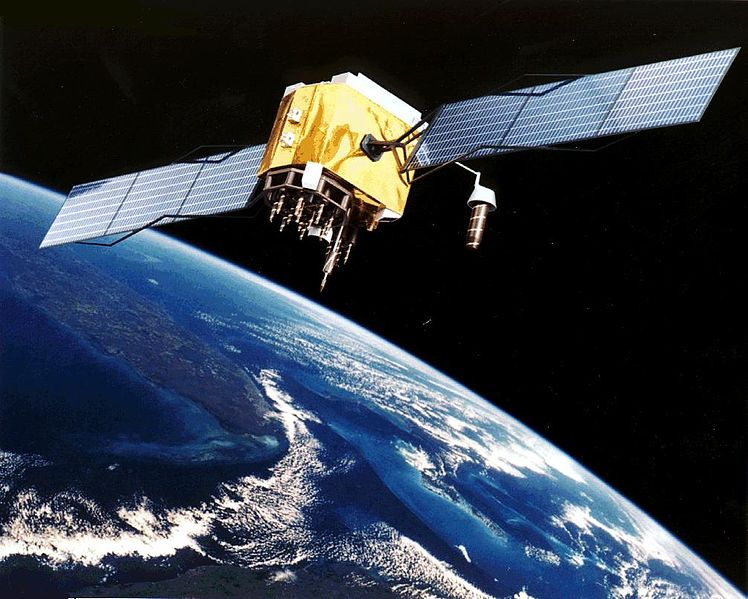
GPS Satellite (Image: Wiki Commons)
By Franz-Stefan Gady

Beijing is working on a host of different weapon systems designed to destroy or disable U.S. satellites in space.

A new report by the U.S.-China Economic and Security Review Commission offers insights into China’s burgeoning space weapons program designed to attack U.S. satellites and undermine American C5ISR capabilities in the event of a conflict.

The Washington Times obtained a copy of the report, which will be published next month. “China is pursuing a broad and robust array of counterspace capabilities, which includes direct-ascent anti-satellite missiles, co-orbital anti-satellite systems, computer network operations, ground-based satellite jammers and directed energy weapons,” the report reads.

The People’s Republic’s counterspace capabilities play a pivotal role in the Chinese military’s overall anti-access/area denial (A2/AD) doctrine to counter U.S. conventional superiority based on network centric warfare. The 2014 iteration of the U.S.-China Economic and Security Review Commission report quotes [PDF] a Chinese military analyst, who notes that the development long-range precision strike weapons “cannot be separated from space power.”

Read the full story at The Diplomat

21 October 2015

Editorial: Is This China’s Newest Tool To Thwart US Military Power?

Image: China Defense Forum
By Franz-Stefan Gady

Beijing has recently successfully completed a test flight of its largest high-altitude airship.

China has reportedly conducted a 48 hour test flight of its largest high-altitude airship, the Yuanmeng (Dream) in near space–the atmosphere between 20 kilometers to 100 kilometers altitude–IHS Jane’s Defense Weekly reports.

The Yuanmeng, according to a Chinese media outlet, ascended to an altitude of 20 kilometers at a test area near Xilinhot in Inner Mongolia using solar power to power its three propeller engines.

Beijing’s new high-altitude aircraft is one of the largest solar-powered airships in existence to date. According to Popular Science, the Yuanmeng has a volume of 18,000 cubic meters, a length of 75 meters and a height of 22 meters. It can carry a payload of 5 to 7 tons including “broadband communications, data relay, high-definition observation, space situational awareness, and airborne imaging systems” all powered by the sun.

A Chinese scientist involved with the project told Want China Times that the airship has been made of an extremely lightweight material capable of enduring tremendous pressure and that it is equipped with a highly efficient solar battery and lightweight avionics. “The biggest challenge for the near-space airship is the big temperature difference in the day and night,” another scientist told The People’s Daily Online.

Read the full story at The Diplomat

29 September 2015

Editorial: China-US War Over Taiwan and Spratlys - Which Side Would Win?

By Franz-Stefan Gady

A new RAND report analyzes US and Chinese military capabilities based on two future war scenarios.

While the People’s Liberation Army (PLAN) is still far away from catching up with U.S. military aggregate capabilities, Chinese forces can still pose a formidable challenge to American power in China’s immediate periphery.

That’s the major conclusion of a new 430-page RAND report written by 14 scholars titled “The U.S.-China Military Scorecard: Forces, Geography, and the Evolving Balance of Power, 1996-2017.”

The study notes that China has made progress in most operational areas “with startling speed” while, however, simultaneously emphasizing that “U.S. forces retain some important advantages” in most categories.

In detail, the RAND scholars analyze ten different categories of military capabilities deemed crucial in the event of a Sino-U.S. conflict over Taiwan (closer to Mainland China) or the Spratly Islands (farther from Mainland China), looking at these capabilities during four specific different time periods from 1996 to 2017. The analysis pays particular attention to geography and distance in each scenario.

Read the full story at The Diplomat

19 September 2015

News Story: RAND Says US Facing Tough Fight With China

By Wendell Minnick

TAIPEI — A new RAND report challenges the US military to rethink a war with China. The report examines US and Chinese military capabilities in 10 operational areas, producing a “scorecard” for each, from four years: 1996, 2003, 2010, and 2017. Each of the scorecards evaluates capabilities in the context of geography and distance, each of the scorecards evaluates capabilities in the context of two scenarios: a Taiwan invasion and a Spratly Islands campaign. These scenarios center on locations that lie roughly 160 km and 940 km, respectively, from the Chinese coastline.

The 430-page report, U.S.-China Military Scorecard: Forces, Geography, and the Evolving Balance of Power, 1997-2017, was written by 14 scholars, including RAND’s wargaming whiz David Shlapak; modeling and simulation specialist Jeff Hagen; Kyle Brady, formerly with Lawrence Livermore; and operations researcher Michael Nixon.

This report is about muscle and machines, not about policy and political issues. This is an objective ‘where the rubber meets the road’ analysis that looks at China’s capabilities at clobbering US air bases in the region, sinking US aircraft carriers with new anti-ship ballistic missiles, and turning American spy and communication satellites into space junk.

The scorecard format with analysis gives the reader a sports-like feel for how bad things can go for the US military in a conflict with China. The 10 scorecards each address relative US and Chinese capabilities in a specific operational areas: air (1-4), maritime (5-6), space, cyber, and nuclear (7-10).

Read the full story at The Diplomat

20 August 2015

Editorial: China Challenging All Foundations of US Military Power - Ex-US Official

Chinese DF-21D Anti-Ship Ballistic Missile
By Prashanth Parameswaran

The former director of the Missile Defense Agency offers a stern warning.

China is challenging all major foundations of American military power, a former U.S. defense official said in a speech Wednesday.

Since the end of the World War II, U.S. military superiority has relied on three major foundations, Trey Obering, the former director of the Missile Defense Agency (MDA), told an audience at the Hudson Institute, a Washington, D.C.-based think tank. These were superior strategic intelligence, surveillance and reconnaissance capabilities (ISR); the ability to project power globally; and an overwhelming dominant technological advantage across a spectrum of conflict.

But China, Obering said, was now challenging all three of these major foundations of American power.

“I believe that China is challenging the United States, specifically targeting our strategic ISR, our power projection capabilities, and our technological advantages with their missile programs,” he said.

Obering, who had a military career spanning 35 years before becoming executive vice-president at Booz Allen Hamilton, addressed China’s threat to each of these three foundations in turn.

Read the full story at The Diplomat

18 August 2015

News Story: J-20 may become China's future stealth bomber - Duowei

The Chengdu J-20, China's first fifth-generation stealth fighter, may be developed into the nation's first stealth bomber in the future, overseas Chinese outlet Duowei News reported on Aug. 14.

After the completion of the test flight of the sixth J-20 prototype known as 2015, it is expected to take a further two to three years for the fighter to enter service. It is the job of the Chengdu Aircraft Design Institute to decide what kind of aircraft the J-20 should become in the future. Earlier predictions said the J-20 may be developed as a carrier-based stealth fighter, but Shenyang Aircraft Corporation's J-31 seems more suitable for that role.

Read the full story at Want China Times