Showing posts with label Palestine. Show all posts

11 August 2017

News Story: Malaysian police nab 290 foreigners in latest counter-terror operation

KUALA LUMPUR, Aug. 10 (Xinhua) -- Malaysian police rounded up some 290 foreigners in its latest anti-terror raids ahead of the Southeast Asian Games, but none of them has terrorism links, local media reported Thursday.

The foreigners, mainly from Yemen, Pakistan, Syria, Bangladesh, India, Nepal, Palestine and Sudan including students, were detained in the country's digital hub of Cyberjaya during the operations on Wednesday night and early Thursday, state news agency Bernama reported.

Police's counter-terrorism head Ayob Khan Mydin Pitchay said those arrested undergone screening process at Sepang police headquarters, but none of them were found to have links to terrorist activities.

Read the full story at Xinhua

04 July 2017

News Report: As Modi Visits Israel, India Embraces Growing Ties with Jewish State

Anjana Pasricha

NEW DELHI — Twenty-five years after establishing diplomatic relations with Israel, India is openly embracing its growing ties with Jerusalem as Narendra Modi becomes the first Indian prime minister to travel there on Tuesday.

New Delhi, traditionally a supporter of the Palestinian cause, has quietly fostered growing ties with Israel, but avoided high profile visits.

India’s Hindu nationalist leader will set aside that caution and hesitation as he holds official talks with his Israeli counterpart Benjamin Netanyahu in Jerusalem.

Relationship out in the open

“The Modi government is a lot less constrained by the previous political thinking about not upsetting the Arabs or visibly giving up on the Palestinian cause or for that matter courting the India Muslim sentiment at home,” says strategic affairs expert, Bharat Karnad at the Center for Policy Research in New Delhi.

In comments to the Indian Express newspaper, India’s ambassador to Israel, Pavan Kapoor, called it the “formal coming out of the relationship.”

It is not a coincidence that this is happening under Modi — he has been a long admirer of Israel’s military and technical expertise.

31 May 2017

News Report: Not for All the Tea in China - Beijing Wants ‘Active Role’ in Mideast Peace

China on Monday signaled a willingness to broker peace between Israel and Palestine, according to local sources.

Citing comments by Chinese special envoy to the Middle East Gong Xiaosheng, the official Palestinian news agency Wafa reported on Tuesday that Beijing now seeks to enter the historically fraught relations between Palestine and Israel.

While meeting with Palestinian President Mahmoud Abbas in Ramallah on Monday, Gong reiterated Beijing's support for a Palestinian state while learning about Abbas's April visit to Washington, a Russian trip in early May and the Palestinian leader's meeting with US President Donald Trump in Bethlehem last week, the Jerusalem Post reported.

Following Trump's first trip outside the US as president, the White House has signaled that it also seeks to broker a peace deal between the historically opposed states.

China, according to Wafa, seeks to widen its role in the region, and is particularly interested in striking a peace deal between Israel and Palestine, as well as seeing an end to the ongoing Syrian civil war and its attendant refugee crisis.

22 April 2017

News Story: DPRK delegation visits Arab countries amid sanctions

PYONGYANG, April 21 (Xinhua) -- The Democratic People's Republic of Korea (DPRK) Friday sent a delegation of diplomats to visit some Arab countries amid mounting international sanctions clamped on it due to its missile and nuclear tests.

The Korean Central News Agency (KCNA) said DPRK Vice Foreign Minister Sin Hong Chol and his delegation left here to visit some Arab countries, without specifying the countries.

Earlier, Kim Jong Un, the supreme DPRK leader, exchanged messages with Syrian President Bashar al-Assad on the anniversaries of each others' important national events, said KCNA.

Read the full story at Xinhua

25 February 2017

News Story: Hundreds protest against arrival of Israeli Prime Minister Netanyahu in Australia

SYDNEY, Feb. 24 (Xinhua) -- Hundreds of Pro-Palestine protesters marched in Sydney on Thursday evening to demonstrate against the historic four-day visit of Israeli Prime Minister Benjamin Netanyahu.

"Today's rally is to show that people in Australia vehemently disagree with our government for inviting this war criminal into country, and we stand with the victims of Netanyahu, the Palestinians who have been under occupation for the last 60 years," One of the rally's organizers, Damian Ridgwell told Xinhua.

The heavy police presence of 80 officers kept the situation firmly under control with mounted horses, riot response teams and a surveillance helicopter. They described the demonstration as "peaceful."

Read the full story at Xinhua

15 February 2017

News Story: Former Aust'n Prime Minister calls for gov't to recognise Palestine

SYDNEY, Feb. 14 (Xinhua) -- Former Australian Prime Minister, Bob Hawke, called on the Australian Government to officially recognise Palestine on Monday, ahead of a visit by the Israeli Prime Minister Benjamin Netanyahu next week.

Hawke penned a harsh rebuke to Israel in the Australian Financial Review, despite being well known for his support of their sovereignty, and says the Israeli government's decision to construct 2,500 new settlements on the West Bank in January displayed "contempt" for the United Nations.

"Australia was there at the very beginning. The least we can do now, in these most challenging of times, is to do what 137 other nations have already done, grant diplomatic recognition to the State of Palestine," Hawke said.

The opinions held by Hawke have also found support from within the Australian Jewish community, with the Australia/Israel and Jewish Affairs Council (AIJAC) releasing a statement on Tuesday from their national chairman, Mark Liebler, and executive director Colin Rubenstein, that echoed the sentiments of the former Australian leader, but tempered restraint in terms of Palestine.

Read the full story at Xinhua

25 January 2017

News Report: 'Lawfare' Could Become Trump Tool Against Adversaries

Steve Herman

STATE DEPARTMENT — Use of the law as a weapon of war may find favor with the Trump administration, according to some scholars and attorneys.

The concept is popularly known as "lawfare," and is used to reach strategic objectives traditionally achieved by the use of lethal weapons.

One lawfare specialist predicts the new U.S. president will find the practice familiar, noting Donald Trump's use of law as a weapon in his business.

Trump "sued his business adversaries some 1,900 times in the past decades, which, according to the study, is far out of proportion from what similar businesses were doing," said Arizona State University law professor Orde Kittrie, a senior fellow at the Foundation for Defense of Democracies. "And if you look at quotes from Donald Trump, and you look at quotes from people associated with him, they see law as a weapon to be used to advance their business interests and crash their adversaries in business."

The Trump administration is still putting into place its top layers at various agencies, including the State Department.

"I don't know what plans the Trump administration may have to incorporate lawfare into its foreign policy strategy, but if we have an opportunity to use law instead of more traditional weapons to address foreign policy issues, I'm all for it," said professor Charles Dunlap, executive director of Duke University's Center on Law, Ethics and National Security.

27 December 2016

News Story: Trump Promises Change To U.S Policies at UN

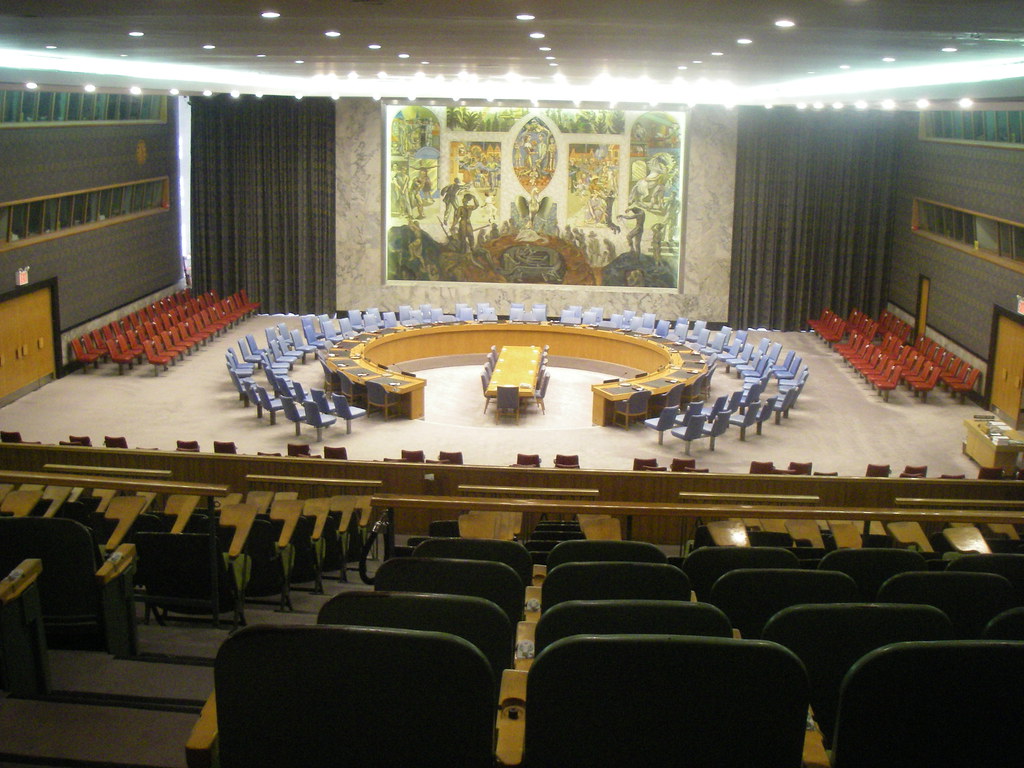
Image: Flickr User - FabienA380
"As to the UN, things will be different after Jan 20th," he said on Twitter, referring to the date of his inauguration.

US President-elect Donald Trump on Friday vowed that the country's policies at the United Nations will change after he takes office.

"As to the UN, things will be different after Jan 20th," he said on Twitter, referring to the date of his inauguration.

The tweet came after the United States refrained from vetoing the adoption of a Security Council measure calling on Israel -- its closest Middle East ally -- to halt settlement activities in Palestinian territory.

The rare step by the U.S allowed the measure to pass by a vote of 14 in favor in the 15-member council.

Read the full story at TOLOnews

26 December 2016

News Story: UN anti-settlement resolution a legal foundation for solution - Abbas

BETHLEHEM, West Bank, Dec. 24 (Xinhua) -- Palestinian President Mahmoud Abbas said on Saturday the United Nations Security Council resolution 2334 that condemned Israeli settlement in Palestine confirms the legal foundations for a solution to the conflict in the Middle East.

Abbas' remarks, which were published by the official Palestinian News Agency WAFA, were made during a dinner held in the West Bank city of Bethlehem on the occasion of Christmas.

"The voting in favor of the resolution hasn't resolved the Palestinian cause, but defined it," said Abbas, according to WAFA, adding "the resolution stressed on the legal basics for a solution and reiterated that Israeli settlement is illegal."

The voting on the resolution was made upon the request of Venezuela, Senegal, Malaysia and New Zealand, just 24 hours after Egypt, which leads the Arab group in the UNSC, suddenly asked to postpone the voting.

Read the full story at Xinhua

24 December 2016

News Report: Even Before Inauguration, Trump Asserts Himself on Policy Matters

William Gallo

Donald Trump won't become president for another four weeks, though at times you'd hardly know it.

Since winning the election, President-elect Trump has repeatedly asserted himself on foreign and domestic issues, whether via his Twitter account, cable news interviews, or official transition team statements.

Trump's behavior strains a longstanding "one president at a time" tradition observed by presidents-elect. Many critics say that in doing so, Trump risks muddying U.S. policy and could set a precedent that complicates future presidential transitions.

"He's obviously trying to make himself a player, and I think that crosses a line that other presidents-elect have been reluctant to cross," said Bruce Buchanan, who specializes in presidential politics at the University of Texas.

01 November 2016

News Story: France "determined" to hold int'l peace conference - Palestinian diplomat

RAMALLAH, Oct. 31 (Xinhua) -- France is "determined" to hold an international peace conference amid the deteriorating situation in the Palestinian territories and the region, a Palestinian diplomat said Monday.

French special peace envoy Pierre Vimon stressed his country's willingness to hold the conference amid the deterioration in the region, especially in the Palestinian territories as a result of Israel's settlement expansion, Salman Al-Hirfy, Palestinian ambassador to France, told official Voice of Palestine radio.

A-Hirfy added he discussed with Vimont in Paris on Friday an experts committee meeting that was held a day earlier on the conference's preparations, including a final date for the event.

Read the full story at Xinhua

30 September 2016

News Story: New Zealand extends commitment to UN peacekeeping in Golan Heights

WELLINGTON, Sept. 29 (Xinhua) -- The New Zealand military contribution to the United Nations peacekeeping mission in the Golan Heights has been extended until September 2018, Defence Minister Gerry Brownlee said Thursday.

"The United Nations Truce Supervision Organisation is the United Nations' oldest peacekeeping operation, and is an important and visible mission to help preserve peace between Israel and its neighbors," Brownlee said in a statement.

"The New Zealand Defence Force has been a longstanding and respected contributor since 1954 through the monitoring role played by our military observers."

The renewed commitment would see eight personnel continue to support the mission, which was New Zealand's largest current contribution to a UN-led peacekeeping operation.

Read the full story at Xinhua

05 August 2016

News Story: New Orders Boost AW139 Market Leadership, Says Maker

Leonardo (AgustaWestland) AW139
by Chris Pocock

Leonardo Helicopters said that Pakistan has become the latest government customer for the AW139 medium twin-engine helicopter, ordering an undisclosed number for transport and medical evacuation missions. The Italian Coast Guard ordered two more of the same type, bringing its total fleet to 12. The Italian company, previously named AgustaWestland, claims market leadership for the AW139 in the intermediate weight class, with more than 960 sold to almost 240 customers in over 70 countries.

A significant proportion of those sales have been for defense and parapublic applications, such as trooplift, search and rescue, border patrol and maritime surveillance. Government customers for the AW139 include Algeria, Bangladesh, Cyprus, Estonia, Italy, Ireland, Japan, Korea, Malaysia, Panama, Qatar, Spain, Sweden, the UAE and the UK. Repeat orders have boosted the total, such as one from the Thai Army last October for eight, adding to the pair that it originally acquired.

Read the full story at AINonline

30 April 2016

News Story: Chinese president's address on Asian security cooperation answers real needs - experts

Chinese President: Xi Jinping
BEIJING, April 29 (Xinhua) -- China's approach to and vision of regional security cooperation, outlined by Chinese President Xi Jinping at a key regional security conference on Thursday, are a pragmatic and timely answer to real needs of the region, international experts said.

The address shows once again that China attaches great importance to Asia's security, and will help maintain regional peace and stability, they said.

In an address at the opening ceremony of the fifth Foreign Ministers' Meeting of the Conference on Interaction and Confidence Building Measures in Asia (CICA) held in Beijing, Xi said it is important to adhere to and implement the vision of common, comprehensive, cooperative and sustainable security in Asia.

Andrei Ivanov, a senior fellow at the Moscow State Institute of International Relations, said that China's foreign policy is one of the key factors for maintaining Asian and world peace and stability.

Observers noted that Xi reaffirmed China's position of adhering to dialogue and consultation on hot-button international issues, including the Korean Peninsula situation, Afghanistan's reconstruction, Syria's situation, Palestinian-Israeli conflicts, and the South China Sea issue.

Ivanov agreed with China's position on the Korean Peninsula situation, saying that the Chinese leader's timely statement calling for all sides to keep restraint will help bring the nuclear issue on the Korean Peninsula back to the track of negotiations.

Tokon Mamytov, former vice prime minister of Kyrgyzstan, told Xinhua that China's vision of Asia's security is "an effective prescription" to solve the Korean Peninsula nuclear issue as well as other challenging security issues.

Read the full story at Xinhua

29 April 2016

News Story: Xi addresses CICA foreign ministers' meeting

BEIJING, April 28 (Xinhua) -- Chinese President Xi Jinping addressed the opening ceremony of the fifth foreign ministers' meeting of the Conference on Interaction and Confidence Building Measures in Asia (CICA) in Beijing on Thursday.

Xi's speech covered the Korean Peninsula nuclear issue and the South China Sea.

On the nuclear issue, Xi reiterated China's full adherence to the UN Security Council resolution, and its commitment to denuclearization of the Korean Peninsula, securing peace and stability on the peninsula and resolving issues through dialogue and negotiation.

He urged all the parties involved to exercise restraint, avoid provocation, and pull the nuclear issue back to a track of dialogue and negotiations at an early date.

The president said China is always committed to peace and stability in the South China Sea. While China will firmly safeguard its sovereignty, rights and interests, it is willing to peacefully solve the disputes through friendly consultation and dialogue with the countries directly involved, he said.

Read the full story at Xinhua

20 April 2016

News Story: Israel, Singapore Pledge Expanded Cyber Cooperation

Barbara Opall-Rome

Singapore's Prime Minister Calls for Israel-Palestine Negotiations

JERUSALEM — Israel Prime Minister Benjamin Netanyahu and his counterpart from Singapore, Lee Hsien Loong, pledged Tuesday to expand cyber defense cooperation and high-tech trade ties.

In the first ever visit here by a head of the southeast Asian republic, Lee publicly credited Israel for decades of traditionally secret military support and defense trade, vowing to strengthen ties across numerous sectors.

“It all started in fact with defense relations between us,” Lee told Netanyahu at a Jerusalem press gathering. “We are very grateful to Israel for the assistance it granted us when independence was thrust upon us in August 1965 and when Singapore’s security and survival were in doubt. You helped us, the Israel Defense Forces helped us to build up the Singapore Armed Forces when other countries turned us down.”

Israeli defense officials and industry executives are traditionally closed-lipped — at Singapore’s request, they say — but noted that defense and security ties preceded formal diplomatic relations codified in 1969. They estimated the extent of bilateral defense cooperation, which includes defense exports and joint R&D, at an annual average of $500 million over the past decade.

In the early days of Singapore’s independence, Israeli Air Force officers and local industry helped build the country’s Air Command and Control Center and integrate Israeli air-to-air missiles on fighters procured from the US and other suppliers. Similar technical and conceptual experience was provided to Singapore’s Navy and Ground Forces; and the two countries enjoy routine training across a spectrum of combat disciplines, sources here said.

Read the full story at DefenseNews

26 January 2016

Editorial: Why India Is Getting Serious About Its Relationship With Israel

Image: Flickr User - MEAphotogallery
By Harsh V. Pant

India’s relationship with Israel is slowly but surely changing for the better.

In recent days, India has reached out to its Middle Eastern partners in a major way. Last week, External Affairs Minister Sushma Swaraj went to Bahrain to attend the first ministerial meeting of the India-Arab League Cooperation Forum. This was an opportunity to engage with the 22 member countries of the Arab League at a time when the region is going through a major crisis and sectarian divisions are rearing their heads like never before.

Further cementing the goodwill generated by the visit of Indian President Pranab Mukherjee to Israel and Palestine some three months ago, Swaraj also visited Israel and Palestine. Her visit has paved the way for a possible visit by Israeli Prime Minister Benjamin Netanyahu to India later this year and it is also likely that Prime Minister Narendra Modi may pay a return visit to Tel Aviv.

A hallmark of the Modi government’s foreign policy has been a self-confident assertion of Indian interests. This is reflected in his government’s moves vis-à-vis Israel, marking a distinct break from the unnecessary and counterproductive diffidence of the past. Despite sharing 24 years of diplomatic ties and working closely on defense, counterterrorism, agriculture, and energy-related issues, no Indian prime minister or president had visited Israel until Mukherjee’s visit last year.

There has been a steady strengthening of India’s relationship with Israel ever since the two established full diplomatic relations in 1992. It is a tribute to Prime Minister Narasimha Rao’s foresight that he was able to lay the foundation of the Indo-Israeli partnership. In contrast to the back-channel security ties that existed before the normalization of bilateral relations, India has been more willing in recent years to carve out a mutually beneficial bilateral relationship with Israel, including deepening military ties and liaising on countering the threat terrorism poses to the two societies.

Read the full story at The Diplomat

14 January 2016

Editorial: Revealed - China's Blueprint for Building Middle East Relations

By Shannon Tiezzi

The first “Arab Policy Paper” provides Beijing’s official vision for China-Middle East relations.

On Wednesday, one week before Chinese President Xi Jinping is reportedly scheduled to arrive in Egypt for his first visit to the Middle East, China issued a lengthy explanation of its approach to the region in a document titled “China’s Arab Policy Paper.” The paper briefly traces the history of China-Arab relations, from exchanges via the ancient Silk Road to the founding of the China-Arab State Cooperation Forum in 2004, before outlining China’s plan for expanding cooperation in the future.

Some caveats, first: like China’s 2015 policy paper on Africa, the “Arab Policy Paper” does not lay out specific policies for specific countries (in fact, there’s not a single country named in the paper, besides China). The paper presents a blanket vision for regional relations, without getting in to the complexities of how that vision will be realized in bilateral relationships with individual states. This is a paper about China’s approach to “Arab countries,” not China’s approach to say, Egypt or Saudi Arabia. For China’s purposes, the “Arab countries” are those with membership in the League of Arab States, which serves as the basis of the China-Arab State Cooperation Forum.

Right now, China’s relationship with the Arab world is largely defined by its energy imports — meaning, of course, oil. As the policy paper notes, “Arab countries as a whole have become China’s biggest supplier of crude oil.” The full truth is even more striking: Saudi Arabia alone is China’s largest supplier of oil, and when you factor in Iraq, Kuwait, Oman, and the United Arab Emirates, the Arab world accounts for over 40 percent of China’s total oil imports.

Read the full story at The Diplomat

07 July 2015

Editorial: India's Position on Israel and Palestine - Change or No Change?

By Ankit Panda

Much is being made of India’s decision to abstain on a recent UN HRC vote on the 2014 Gaza Conflict. Is it justified?

India was one of five countries–the others being Kenya, Ethiopia, Paraguay, and Macedonia–to abstain on a UN Human Rights Council (HRC) vote on July 3 adopting the Report of the Independent Commission of Inquiry on the 2014 Gaza Conflict. The report largely condemns Israel’s actions during last year’s Operation Protective Edge, a seven-week-ling military operation by Israel into the Hamas-controlled Gaza Strip. The Indian vote is being seen as emblematic of the ongoing rapprochement between the governments of India and Israel. India’s new government, led by Prime Minister Narendra Modi and the right-wing Bharatiya Janata Party (BJP), is partly recalibrating New Delhi’s approach toward Israel, development that will no doubt be welcome by Israeli Prime Minister Benjamin Netanyahu. 41 HRC members voted in favor of the resolution and the sole vote against came from the United States, Israel’s traditional ally and supporter at the United Nations.

As I’ve written in The Diplomat before, Israel has climbed its way up New Delhi’s diplomatic agenda since Narendra Modi came to office in May 2014. Modi will become the first Indian prime minister to travel to Israel since the two countries established diplomatic ties in 1992. An Indian “rapprochement” with Israel, however, traces its origins to before Modi’s ascendance. As Nicolas Blarel also recalled in The Diplomat, India’s previous BJP-led government, which was in power from 1999 to 2004, was similarly seen to have initiated a recalibration of New Delhi’s policy toward Israel. Israeli Prime Minister Ariel Sharon’s landmark visit to Delhi in 2003 appeared to represent a sharp turn in New Delhi, but that momentum was short lived. Afterward, India’s Congress-led United Progressive Alliance (UPA) government maintained close ties with Israel–certainly as an important defense partner–without considerably showing support for Israel in the Arab-Israeli policy.

Read the full story at The Diplomat