Showing posts with label Jordan. Show all posts

08 June 2017

USA: Australia, U.S. Discussions Ranged the Globe, Dunford Says

By Jim Garamone 
DoD News, Defense Media Activity

PEARL HARBOR, Hawaii, June 7, 2017 — The Australia-U.S. Ministerial Consultations in Sydney this week were not just a formality, but an effort to sync the relationship and strengthen it for the future, the chairman of the Joint Chiefs of Staff said today.

Secretary of State Rex Tillerson, Defense Secretary Jim Mattis, Australian Foreign Minister Julie Bishop and Defense Minister Marise Ann Payne were the principles at the meeting held in the Government House on Sydney Harbor. Marine Corps Gen. Joe Dunford and Navy Adm. Harry Harris, the commander of U.S. Pacific Command, also attended.

Dunford told reporters traveling with him that the discussions were comprehensive and covered the range of interests the two nations share. “We talked North Korea, we talked South China Sea, we talked about the insurgency in the Philippines, we talked about the maritime domain in the Sulu Sea and so forth,” Dunford said.

14 March 2017

News Story: White House plan to gut foreign military financing would cost defense jobs, senators warn

US President Donald Trump
By: Joe Gould

WASHINGTON — The Trump administration is mulling plans to kill U.S. subsidies for foreign allies to buy American-made weapons outright and replace them with a loans program.  

The proposal is a bullet point in White House budget director Mick Mulvaney’s controversial plans to slash funding for diplomacy and development, first reported by the Washington Post and confirmed to Defense News by multiple sources. The idea is to replace all FMF grants with loans, save for the security aid committed to Israel— which makes up more than half of the $5.7 billion program. 

While it has uncertain prospects in Congress, it has frustrated key U.S. lawmakers, who say such a move would trash both a critical national security tool and a buttress for the domestic defense industry — just as President Trump says U.S. jobs are his top priority.  

Sen. Lindsey Graham, chairman of the Senate Appropriations Subcommittee on State and Foreign Operations, earlier this month said deep State Department cuts are “dead on arrival” in Congress. On Thursday, he defended FMF.

“Sometimes we have to subsidize the allies’ purchases, but they buy American equipment and they do pay,” Graham, R-S.C., said of the FMF program. “You have to show me where a loan is better for our national security … This part of the [federal] budget is a percent of a percent. 

A key argument for FMF is that if America ends arms subsidies, it lets strategic allies get weaker and cedes business and influence to Russia and China, its largest rivals strategically and for global defense markets.

“The last thing I want allies to do is go to the Russians and the Chinese because we are penny-wise and pound foolish,” Graham said. 

Read the full story at DefenseNews

20 February 2017

News Story: Russia's Middle East power play

By: Matthew Bodner

Moscow — A week after concluding its combat mission in Syria, Russia’s flagship Admiral Kuznetsov aircraft carrier had one final mission in the Mediterranean. It was, perhaps, a mission for which the ship was most capable: impressing Third-World strongmen.  

On Jan. 11, Russian news agencies reported that East Libyan general Khalifa Haftar was flown aboard the Kuznetsov for a personal tour from the ship’s captain and a video conference with Russian Defense Minister Sergey Shoigu. The publicized comments were vague and predictable.  

“They discussed pressing issues in the fight against international terrorist groups in the Middle East,” the Defense Ministry was quoted by the RIA Novosti news agency as saying. It was the latest evidence that Moscow is courting Haftar as part of a broader effort across the region.  

In November, Haftar visited Moscow to meet with Foreign Minister Sergey Lavrov. Details of that meeting, too,  were scant. But Haftar reportedly asked the Kremlin to assist him in fighting Islamic terrorists in Libya.   

Read the full story at DefenseNews

03 February 2017

News Story: Refugees Play an Important Role in Foreign Relations

US President Donald Trump
Victoria Macchi

WASHINGTON — “Do you believe it?” U.S. President Donald Trump tweeted late Wednesday.

“The Obama Administration agreed to take thousands of illegal immigrants from Australia. Why?” he raged, pledging to “study this dumb deal!”

What Canberra and Washington agreed late last year had nothing to do with illegal immigrants though. Instead, it was another domestically contentious issue in the U.S. The previous administration agreed to take an undisclosed number of asylum-seekers intercepted at sea while trying to get to Australia by boat.


In other words, the U.S. would take in refugees from a longtime ally to help the ally out.

By some media accounts, the deal sparked a testy phone exchange Saturday between Trump and Australian Prime Minister Malcolm Turnbull — a day after Trump suspended the U.S. refugee resettlement program.

31 January 2017

News Story: Trump Immigration Order Shakes US-Iraq Alliance Against ISIS

US President Donald Trump
By: Joe Gould

WASHINGTON — US President Donald Trump’s executive order on immigration is rocking the relationship with Iraq, America's key ally in the fight against the Islamic State group.

As the US and Iraq prepare to take the ISIS stronghold of Mosul, the Iraqi parliament has passed a measure banning Americans from traveling to the country in response to Trump's ban on travel from Iraq and six other Muslim-majority countries, The Associated Press reported. 

“This decision by the U.S. is arbitrary,” Intisar Al-Jabbouri, a Sunni lawmaker from northern Iraq, told Time magazine. “The Iraqi government has the right to reciprocate.”

The Trump administration is facing political heat domestically over its order, which includes a 90-day ban on travel to the US by citizens of Iraq, Syria, Iran, Sudan, Libya, Somalia and Yemen, and a 120-day suspension of the US refugee program. 

The order has also reverberated among US allies in the Muslim world, where it should be found “pretty disturbing,” said Ryan Crocker, a former US ambassador to Iraq, Pakistan, Syria, Kuwait, Lebanon and Afghanistan. That’s because the US signed a bilateral agreement with Iraq that calls for strategic cooperation at every level.

“They know we’re heavily involved in the fight to take Mosul, and they have to be asking themselves, if they’ll do this to the Iraqis, they’ll do it to us,” Crocker said. 

The move raised concerns of both a violent backlash against US advisers and troops, who are in the Middle East for the counter-ISIS fight, and that ISIS could use a perceived Muslim immigration ban as a recruiting tool.

“The Iraqis are of course going nuts, just as they’re about to do the next phase against the Islamic State, and Islamic State social media is celebrating,” Crocker said. 

Read the full story at DefenseNews

07 January 2017

News Story: Trump aims to destroy IS, but radical group already on the run - expert

by Matthew Rusling

WASHINGTON, Jan. 5 (Xinhua) -- While U.S. President-elect Donald Trump has vowed to get rid of the Islamic State (IS) once and for all, the radical group is already on the run due to increased pressure over the past year, an expert said in an interview with Xinhua.

Trump reiterated promises to defeat the group after the recent deadly attack on a Christmas market in Berlin, which killed 12 and injured dozens more innocent people. The billionaire president-elect has blasted outgoing President Barack Obama for still not having defeated IS in the radicals' Middle East stronghold.

But Wayne White, former deputy director of the State Department's Middle East Intelligence Office, said actually most of the heavy lifting has already been done, and IS appears to be on its way out.

Ongoing U.S. and coalition aerial bombardment, plus U.S.-backed efforts on the ground by Syrian Kurds, Iraqi Kurds, the Iraqi Army, Sunni Arab Iraqi tribes, Iraqi Shi'a militias, and most recently the Turkish Army in one area, have vastly reduced IS' original territory and seriously degraded its combatant forces and cut it off from abroad, White said.

"Once Mosul is cleared -- the only truly large urban area remaining under (IS) control -- the going will be far easier in Iraq," he said.

Read the full story at Xinhua

30 November 2016

News Report: Former CNO Roughead - Stepping Back From Alliances Like NATO ‘Perilous’ to U.S.

By: John Grady

When thinking of America’s military alliances, it’s important to not boil down relationships to security spending but understand value beyond military support, a former chief of naval operations said Monday.

Speaking Monday at the Center for Strategic and International Studies, a Washington, D.C., think tank, retired Adm. Gary Roughead, said, “We are simplistic in our math” when focus is put on allies’ security spending. He added the United States avoids costs by having allies with capacity and capability that it does not have to spend more on. Allies also providing savings in not having to spend on using a rotational force versus on stationing a naval force in Japan where Tokyo is picking up much of the expense.

During the campaign, President-elect Donald Trump called on NATO allies to meet an agreed-upon two percent of their gross domestic product on their own security and defense or the United States would re-think its commitment to the alliance. Only five of 28 alliance countries reach that threshold.

Alliances, such as NATO, offer benefits in shared values and economic growth, he said at a forum to introduce a CSIS initiative examining alliances and United States leadership in the future.

Roughead said stepping back from international alliances would be an “uncomfortable, regrettable and perilous” move.

24 November 2016

News Story: Australia, Jordan sign anti-terror agreement

CANBERRA, Nov. 24 (Xinhua) -- Australia and Jordan have signed an anti-terror agreement to stamp out terror funding and money laundering, Australia's Justice Minister announced on Thursday.

Michael Keenan, who is also Minister Assisting the Prime Minister for Counter-Terrorism, said the agreement between Australia's financial intelligence agency, AUSTRAC, and its Jordanian counterpart, the AMLU, would "facilitate the immediate exchange of vital financial intelligence" on matters of serious financial crime including terror funding.

"Given Jordan's close proximity to the conflict in Syria, Iraq, and that foreign terrorist fighters are constantly looking for new ways to finance their despicable acts, this Memorandum of Understanding is crucial in our fight against terrorism," Keenan said in a statement released on Thursday.

Read the full story at Xinhua

05 November 2016

News Story: Number of Americans killed in Jordan rises to 3

AMMAN, Nov. 4 (Xinhua) -- The number of American trainers killed in an exchange of fire in Jordan rose to three, the state-run PETRA news agency reported.

Two American trainers were killed in Jordan on Friday in exchange of fire, a source at the Jordan Armed Forces said earlier.

A third American trainer who was injured early Friday in the incident also died at hospital later Friday.

Read the full story at Xinhua

30 September 2016

News Story: New Zealand extends commitment to UN peacekeeping in Golan Heights

WELLINGTON, Sept. 29 (Xinhua) -- The New Zealand military contribution to the United Nations peacekeeping mission in the Golan Heights has been extended until September 2018, Defence Minister Gerry Brownlee said Thursday.

"The United Nations Truce Supervision Organisation is the United Nations' oldest peacekeeping operation, and is an important and visible mission to help preserve peace between Israel and its neighbors," Brownlee said in a statement.

"The New Zealand Defence Force has been a longstanding and respected contributor since 1954 through the monitoring role played by our military observers."

The renewed commitment would see eight personnel continue to support the mission, which was New Zealand's largest current contribution to a UN-led peacekeeping operation.

Read the full story at Xinhua

16 August 2016

News Story: Trump Unveils Plan to Fight ISIS

Image: Flickr User - KAZ Vorpal
Joe Gould

WASHINGTON — Donald Trump laid out his strategy aimed at defeating radical Islamic terrorism, likening it to an ideological struggle akin to the Cold War.

In a speech the Republican presidential nominee delivered on Monday on Ohio, Trump pledged to build a bipartisan and international consensus, re-classifying US allies as any nation that will stand with Washington against "radical Islamic extremism."

“Our approach, which must be shared by both parties in America, by our allies overseas and by our friends in the Middle East, must be to halt the spread of radical Islam,” Trump said. “All actions should be oriented around this goal, and any country which shares this goal will be our ally. We cannot always choose our friends, but we can never fail to recognize our enemies.”

In this, Trump said he plans to work with Jordan, Egypt, NATO and Russia, which has a “big, big problem with ISIS.”

Read the full story at DefenseNews

14 July 2016

News Story: Standoff Brews Over the Future of US Security Assistance

Joe Gould and Aaron Mehta

WASHINGTON — The US government’s military foreign-assistance programs are facing a quiet but consequential overhaul that has State Department officials privately balking at proposed changes to the division of labor between Foggy Bottom and the Pentagon.

The complex system of policies involved in propping up foreign forces — allies to some, enemies to others — is often derided as an impediment to national security. So when the Senate Armed Services Committee decided to reform the system in this year’s defense policy bill, the 2017 National Authorization Act, its attempts to consolidate authorities, create a flexible funding pool and boost congressional oversight should have cruised by with little pushback.

But the effort to fix the Pentagon’s security-cooperation bureaucracy, which has ballooned since the 9/11 terrorist attacks, is prompting panic at the State Department. Diplomats there believe that the bill will let DoD muscle State out of the military aid business permanently.

“The new NDAA is the end of State Department security assistance,” one US government official said bluntly, using shorthand for the pending bill. “The writing is on the wall.” That stance has in turn prompted frustration and pushback from Senate Armed Services Committee staff, whose version of the legislation passed the full Senate with the reform language intact. Committee spokesman Dustin Walker said the goal is not to pick a side in the long-simmering turf battle, but to get the two departments to stop talking past each other.

“The Senate NDAA is designed to make DoD’s current role in security cooperation more efficient, more effective and more responsive to emerging national-security requirements,” Walker said. “An important part of that effort is formalizing and strengthening coordination between DoD and the State Department. The NDAA would require more integration of DoD and State security cooperation efforts, not less.”

Be that as it may, officials at Foggy Bottom are on high alert over the language, and they are trying desperately to stop, or at least change, what the Senate wants to do.

Read the full story at DefenseNews

15 June 2016

News Report: Pakistan to Consider Jordanian F-16 Jets Offer After US Deal Fail

After the failure to purchase US F-16s, Pakistan is considering an offer to buy Jordanian used F-16 jets.

Several Pakistani fighters are due to be decommissioned in the next few years and the government has said it still needs aircraft for replacement. After Pakistan's plan to buy eight F-16 Block 52 jets from the United States was called off, Jordan has put in an offer to sell its used Block-30 F-16s.

"The chapter of seeking F-16 fighter jets from the US has been closed. We are now going for a third party transfer of F-16s and have an offer from Jordan," Pakistan's Defense Secretary Alam Khattak said at a session of the Senate Committee on Defense and Foreign Affairs on Monday.

Adviser to the Prime Minister on Foreign Affairs Sartaj Aziz told the meeting that the government made the right decision when it did not agreed to the US conditions. "If the conditions affect national interest, it is better not to accept them. It was an issue of choices," he said.

Pakistan-US ties strained after Congress blocked the funding of the sale from the US government's Foreign Military Financing Program, effectively scuttling the deal.

One of the reasons for tense relations with the US was Pakistan's close relationship with China, according to Pakistan's Foreign Secretary Aizaz Chaudhry. He said that strained relations with the US were nothing new for Pakistan.

The relationship further suffered when the US carried out a drone strike in Balochistan, killing Afghan Taliban chief Mullah Akhtar Mansour, termed by Pakistani leadership as a violation of the country's sovereignty.

This story first appeared on Sputnik & is reposted here with permission.

09 May 2016

AUS: Military and Security Communication Workshop Strengthens Regional Ties

The role of military and security public information in addressing violent extremism was the centrepiece of an international military workshop held in Canberra this week (2-6 May 16).

A total of 24 military and security personnel from 10 countries attended the strategic communication workshop hosted by the Department of Defence, the fourth of its kind held since 2010 in support of the Defence Cooperation Program.

The strategic communication workshop provided a forum for Australian and foreign military and security officers to discuss the military’s role in the provision of public information.

Participating countries include Pakistan, Indonesia, the Philippines, Singapore, Thailand, Malaysia, Jordan, Lebanon, Papua New Guinea and Vanuatu.

Participants contributed to discussions on public information support to major events, countering violent extremism, and the use of social media.

03 November 2015

USA: Essex Amphibious Ready Group, 15th MEU Depart 5th Fleet

From Essex Amphibious Ready Group Public Affairs

In this file photo, Naval Air Crewman 3rd Class Justen Thurman communicates with pilots from Helicopter Sea Combat Squadron (HSC) 21 as USS Essex (LHD 2) conducts maneuvers in the Gulf of Aden last week. (U.S. Navy/MC3 Christopher A. Veloicaza) >>

INDIAN OCEAN - The Essex Amphibious Ready Group (ARG) and the embarked 15th Marine Expeditionary Unit (MEU) departed the U.S. 5th Fleet area of operations (AOO) Nov. 1.

While on station in the U.S. 5th Fleet AOO, the ARG and MEU supported theater security cooperation efforts and provided a forward naval presence with crisis response, humanitarian assistance and combat capabilities. Additionally, MEU and ARG elements engaged in many operations and exercises, including bi-lateral training with the French military in Djibouti, and training with Jordanian marines. The ARG/MEU team also conducted more than a dozen subject matter expert exchanges with partner nations throughout the region.

Beginning in mid-August, AV-8B Harriers assigned to the MEU's aviation combat element launched from Essex's flight deck as part of the multinational coalition participating in Operation Inherent Resolve. The missions continued until mid-October when Essex began preparations to depart the theater.

01 September 2015

News Story: Australia Urges More European Nations To Join IS Airstrikes

Australian Foreign Minister Julie Bishop
(Image: Flickr User - UN Geneva)
SYDNEY — Australia on Monday urged more European nations to begin airstrikes against Islamic State group in Syria and Iraq as a way of tackling the escalating refugee crisis gripping the continent.

Foreign Minister Julie Bishop said jihadists were responsible for driving hundreds of thousands of migrants to Europe and a broadening of the coalition fighting them was necessary.

"Over 40 percent of the people currently seeking asylum in Europe are from Syria, and we need a united front to defeat the terrorist organizations that are driving the displacement of so many people," she told reporters in Sydney.

"Already there are about 60 countries that are providing support in one way or another to the US-led coalition.

"But there's more countries can do in terms of supporting the air strikes which are proving effective in stopping Daesh (IS) from claiming territory off sovereign governments and from inflicting so much barbaric violence."

Read the full story at DefenseNews

28 July 2015

Think Tank: Sea, air and land updates (28-Jul-2015)

Amelia Long, Palmo Tenzin and Sarah Hately

Sea State

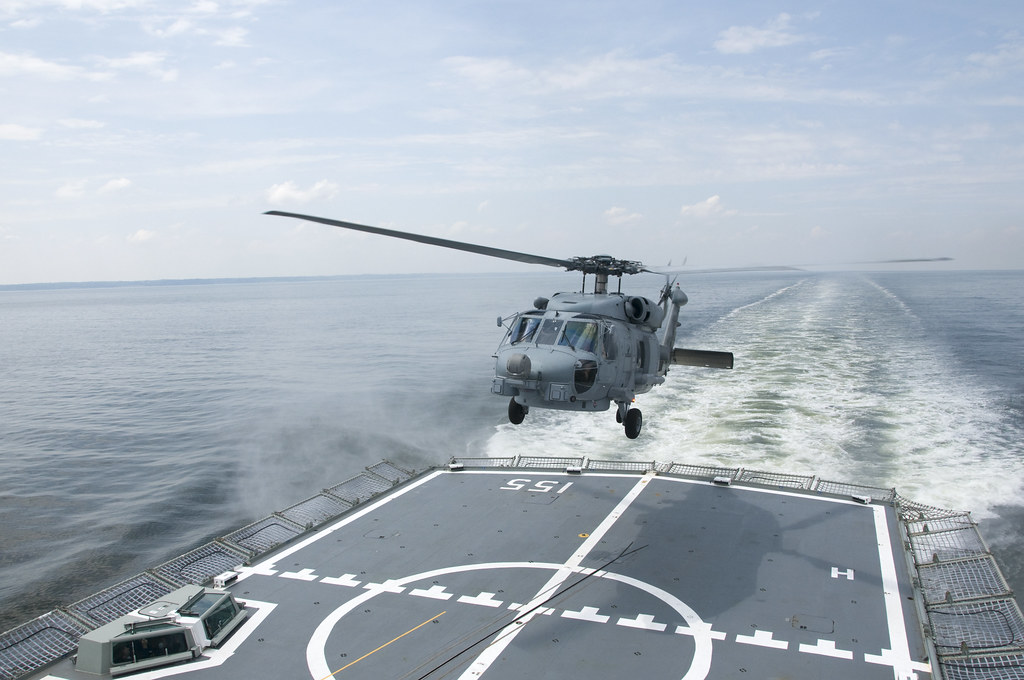
The Taiwanese Navy will procure eight to ten MH-60R Seahawk anti-submarine warfare (ASW) helicopters in a US$700–800 million deal under the US Foreign Military Sales program, with a letter of acceptance expected in 2016. The Seahawks, which are designed to operate from frigates, destroyers, cruisers and aircraft carriers, will replace the current MD500 Defender helicopters, which were originally procured in 1980.

For an all-encompassing update on China’s muscle flexing in the South China Sea and its intentions to become a global maritime power, have a look at the video of The Aspen Institute’s panel discussion on the topic. Featuring PACOM’s Admiral Harry B. Harris, Bonnie Glaser from CSIS, author Gordon Chang and Time’s Massimo Calabresi as moderator, the panel touches on a range of interesting questions, from whether missiles located on the built-up features in the South China Sea could harm US shipping interests, to the likelihood of military confrontation between the US and China.

And finally, as well as participating in the competitive evaluation process for RAN’s future submarines, ThyssenKrupp Marine Systems is increasing its efforts for the SEA 5000 campaign. A brochure for the Blohm + Voss MEKO A-400RAN frigate design [PDF]—first made public at ASPI’s Future Surface Fleet conference earlier this year by the company’s Senior Vice President, Rear Admiral Jonathan Kamerman—has now been printed.

07 April 2015

News Report: Several Factors Motivate Saudi Outreach to Pakistan

Pakistan, Saudi Arabia Military Exercise (File Photo)

Pamela Dockins

STATE DEPARTMENT—Saudi Arabia’s bid to get Pakistani military support for the Saudi-led effort against Houthi rebels in Yemen is designed to “scare” the Iranians, says Charles Schmitz, an analyst at the Middle East Institute.

Schmitz says Pakistan would be a much greater threat to Iran than the Saudis are. He said bringing Pakistan in “increases the pressure on the Iranians,” who are backing the Houthi rebels.

“The Pakistanis are very effective. They are militarily accomplished,” said Schmitz. “They are trained and disciplined and “battle-ready units,” he said.

07 March 2015

Editorial: Assessing US Military Power


By Akhilesh Pillalamarri

A new report takes a look at the U.S. military’s strength across the world, including the Asia-Pacific.

Politicians are fond of telling Americans that they have the most powerful military in the history of mankind. However, rarely is it explained how they reached that conclusion.
As it turns out, despite the seemingly endless number of government and think tank reports being released all the time, there isn’t a single index measuring America’s military power against the threats it is asked to defend the country from. Or at least, there didn’t used to be.
Last week, the Heritage Foundation released the first edition of what will be an annual report on America’s military might. The report, entitled 2015 Index of U.S. Military Strength: Assessing America’s Ability to Provide for the Common Defense, is modeled on Heritage’s widely successful Index of Economic Freedom.
The military Index assesses America’s hard power, the condition of which is measured in terms of the military’s “capability or modernity, capacity for operations, and readiness to handle assigned missions successfully.” The report also assesses “the ease or difficulty of operating in key regions based on existing alliances, regional political stability, the presence of U.S. military forces, and the condition of key infrastructure.” 

Read the full story at The Diplomat

17 February 2015

Think Tank: Flight Path (17-Feb-2015)


By Palmo Tenzin

We’re excited to launch a new weekly update, Flight Path, that’ll chart the major developments and debates in airpower and space technology. Opening this week’s post is news on the F-35.

On 27 January, RAAF Squadron Leader Andrew Jackson became the first Australian to begin training for his first F-35A flight at Eglin Air Force Base, Florida. In preparation for the arrival of the F35s in 2018, the Defence Minister Kevin Andrews confirmed BAE Systems and TAE(formerly Tasman Aviation Enterprises) have won contracts to manage regional maintenance, repair, overhaul and upgrade responsibilities. The news comes as F-35 manufacturers Lockheed Martin reported the program for the A-variant lagged behind 2014 goals due to the prioritisation of the F-35B. The F35-B program however achieved significant progress, passing the halfway point. Despite this, the project continues to attract criticism, with the US Chief of Naval Operations Admiral Jonathan Greenert last week expressing ambivalence about the stealth and speed of F-35s. In his speech, Greenert called for a consideration of technologies using ‘unmanned systems—or employing electronic-warfare payloads to confuse or jam threat sensors rather than trying to hide from them.’