Showing posts with label NH-90/MRH-90. Show all posts

08 August 2017

News Story: New Zealand issues RFT for NH90 helicopter simulator

RNZAF NH-90 (Image: Wiki Commons)
By: Nick Lee-Frampton

WELLINGTON, New Zealand — New Zealand’s Ministry of Defence has issued a request for tenders for a simulator to train pilots to operate the NH90 medium utility helicopters flown by 3 Squadron of the Royal New Zealand Air Force.

The service operates eight of the TNZA variant of the NH90 helicopters from the Ohakea air base located north of Wellington, the capital of New Zealand. The Air Force anticipates an annual “flying“ rate for the simulator of between 1,500 and 1,900 hours.

A minimum requirement for the simulator’s software and hardware is meeting the NATO Helicopter Management Agency’s final operating configuration, including five multifunction displays — and level-three standards as detailed in European Aviation Safety Agency certification specifications for helicopter flight simulators; however, the MoD said that “a full-motion simulator is also acceptable.“

The timeline from when a contract is signed to delivery to New Zealand will be approximately two years. The RFT closes Sept. 28, 2017.

A request for proposals for simulator services was awarded in September 2016 to Helicopter Flight Training Services GmbH. This, the MoD told Defense News, was done to allow interim access to simulation training while a decision was made on potential procurement of a simulator for operation within New Zealand.

Read the full story at DefenseNews

01 August 2017

Think Tank: Sea, air, land and space updates (1-Aug-2017)

Jack Viola, Eliza Chapman, Jacqueline Westermann and Harley Comrie
Sea state
This year’s parades and celebrations for Russia’s annual Navy Day had a distinctly global feel. Events were held across Russia, and even at the Syrian port of Tartus. The celebrations aim to ‘revive the tradition started by Peter the Great’. The main event was held in St Petersburg, and included three Chinese ships. Those ships had recently conducted joint live-fire drills with their Russian counterparts in the Baltic. In response to Western concerns about the drills, Chinese news agency Xinhua has said the West needs to ‘take a chill pill’.
The Indian government has released a request for information (RFI) to six international companies as part of a program to build six new submarines. India’s comptroller and auditor general recently released a damning report (PDF) on the state of the country’s navy. Of particular concern was the state of its submarines, which the report claims were fitted with only one periscope due to bureaucratic failings, severely diminishing their effectiveness. The RFI comes amid heightened tensions with China arising from its increasing assertiveness in the Indian Ocean.

15 June 2017

News Story: Airbus proposes upgrade for Australian attack helicopters

By: Nigel Pittaway

LONDON — In the lead up to the 2017 Paris Air Show, European giant Airbus has revealed details of its two-stage proposal to upgrade the Australian Army’s Tiger armed reconnaissance helicopter.

The managing director of Airbus Group Australia Pacific, Tony Fraser, said Airbus Helicopters is proposing an interim upgrade based on the Tiger Mark 2 development being mulled by European operators, including France. Beyond that, Fraser says a Mark 3 variant now on the drawing board will form the basis of a future armed reconnaissance helicopter, or ARH, replacement program flagged by the Australian government for the middle of the next decade. 

Australia has 22 Tigers and was to undertake an extensive capability assurance program, or CAP, to keep the fleet relevant in the coming years. However, the ARH program has been mired in controversy since the first helicopters were delivered at the end of 2004, suffering a lower-than-expected rate of effort and a higher-than-desired cost of ownership to the commonwealth.

Australia's 2016 Defence White Paper and the associated Integrated Investment Program singled the helicopter out from all Australian Defence Force platforms for criticism, describing the program as "troubled."

Most recently, a 2017 report by the Australian National Audit Office, or ANAO, into the ARH program was scathing of the helicopter, which only achieved final operational capability last year, despite being in operational service for more than a decade.  

The program is now seven years late, and although it hasn’t reached planned levels of availability and reliability, recent remediation efforts by the Australian Army; the Defence Capability Acquisition and Sustainment Group of Australia's Defence Department, or CASG; and industry continue to improve performance indicators to the point where the Tiger’s cost of ownership has dropped by almost a third since 2012.

Read the full story at DefenseNews

24 April 2017

News Story: (New Zealand) Air Force effectively grounds NH90 fleet after engine failure

RNZAF NH-90 (Image: Wiki Commons)
Lloyd Burr

All eight of the Air Force's NH90 helicopters have been all but grounded after a mid-air engine failure near Blenheim on Sunday.

Newshub understands the $630 million fleet isn't allowed to fly over water or dangerous terrain, and cannot carry VIPs. 

The restriction comes after the left engine of an NH90 failed while flying over Cook Strait on Sunday, forcing it to make an emergency landing at a private aerodrome at Cloudy Bay.

Read the full story at NewsHub

28 January 2017

News Story: Airbus Helicopters Boasts Rise in Military Rotorcraft Sales

By: Pierre Tran

PARIS — Airbus Helicopters sales of military rotorcraft rose to 57 percent of 2016 revenue, up from a 50-50 split with civil sales in the previous year, company CEO Guillaume Faury said in a phone briefing Friday. 

That increase of sales to armed forces helped the company weather a severe downturn in the global civil helicopter market, weighed by a slide in sales to the oil and gas market. 

The increase in military sales was “significantly higher than previous years,” Faury said. “It is the same in orders,” he added, although there were no details in percentage terms. 

The company, based in Marignane, southern France, won “very important military contracts last year,” boosting the number of units and also the value “very significantly,” he said. 

Orders for the light H145M helicopter showed the importance of converting a civil platform into a military version, he said. 

Much of the 2016 military sales were due to deliveries of the NH90 transport helicopter and the 19 Tiger attack helicopters, he said. Last year saw the handover of the 300th NH90. A US selection for service of the Lakota program was a big boost for the company in the service sector. 

The 2017 outlook was a similar split between military and civil sales, although the majority of units would be in the civil market, he said. 

Read the full story at DefenseNews

19 July 2016

AUS: HMAS Canberra achieves first with United States Marine Corps MV-22 Osprey

Department of Defence (author), 
LSIS Helen Frank (photographer)

A United States Marine Corps MV-22B Osprey aircraft takes off from the flight deck of HMAS Canberra off the north east coast of Hawaii during Exercise Rim of the Pacific (RIMPAC) 2016 >>

HMAS Canberra has successfully landed a United States Marine Corps (USMC) MV-22 Osprey tiltrotor aircraft on its flight deck for the very first time.

The trial was conducted as part of the Sea Phase for Exercise Rim of the Pacific (RIMPAC) 2016 off the north east coast of Hawaii.

Commander Air, HMAS Canberra, Commander Adrian Capner said the trial was the culmination of twelve months work.

“The achievement has been very rewarding,” he said.

“It demonstrates that we are capable of interacting with our coalition partners, in particular the United States.

“It also shows that we can adapt and remain agile to operate a whole range of international aircraft, not just aircraft in the Australian fleet.”

03 May 2016

Think Tank: The ‘Contract of the Century’ - France reacts to the Australian submarine deal

Christopher Cowan

The announcement that French defence contractor DCNS had been selected as Australia’s international partner to build RAN’s new fleet of 12 submarines was big news in Australia. That’s understandable considering the multi-billion dollar, decades-long contract. It was also big news in France. Combing through a range of French media outlets reveals several interesting trends.

First, domestic politics is the focal point of French reporting. DCNS’s victory has been trumpeted by the government as a massive success for France and its defence industry. L’Elysée, the office of French President François Hollande, called the decision ‘historic’(‘historique’), and thanked Australia for its confidence in France and its companies. French Prime Minister Manuel Valls took to Twitter to describe the contract as a ‘magnificent success for DCNS and our industry’ (‘magnifique succès pour DCNS et notre industrie’). In a radio interview for Europe1, French Minister of Defence Jean-Yves Le Drian struck a similar tone, stating that the contract would create ‘thousands of jobs in France’(‘milliers d’emplois en France’).

21 April 2016

News Story: Singapore Close To Super Puma Replacement Choice

RSAF Super Puma on the USS Harpers Ferry during
CARAT 2007 (Image: Wiki Commons)
by Mike Yeo

Singapore is close to selecting a replacement for its Super Puma medium-lift helicopters. The Republic of Singapore Air Force (RSAF) currently operates the survivors of 34 Super Pumas acquired in 1985 and 1991, which subsequently had an avionics and capability upgrade beginning in the latter half of the 2000s. The RSAF is also planning to replace some older Boeing CH-47 Chinook heavy-lift helicopters.

In a recent speech to the Singapore Parliament, Defence Minister Ng Eng Hen said that the country is “finalizing our evaluations and expects the new RSAF helicopters soon.” Typically very secretive about its military acquisition programs, Singapore has neither announced the number of Super Puma replacements it is seeking nor disclosed the specifics of its requirement. However, the AgustaWestland AW101, Airbus Helicopters NH90 and H225M Caracal, and Sikorsky S-92 were prominent in the display halls at the recent Singapore Airshow, which could point to the likely contenders for the replacement program.

The RSAF uses the Super Pumas and Chinooks primarily in support of army operations, lifting troops and underslung equipment. In addition, both types have carried out search-and-rescue (SAR) missions in Singapore’s large SAR region and supported humanitarian assistance and disaster relief operations in the region.

Read the full story at AINonline

31 March 2016

AUS: HMAS Canberra returns from Fiji

HMAS Canberra off the Fijian coast launches a MRH-90
HMAS Canberra returns to Australia today following its successful maiden deployment to Fiji in the wake of Tropical Cyclone Winston.

Following a request from the Fijian Government, HMAS Canberra was deployed to Fiji on 1 March to deliver much needed humanitarian aid and assistance.  

HMAS Canberra was loaded with 60 tonnes of emergency relief supplies, three MRH-90 helicopters and around 760 Australian Defence Force personnel including engineers, carpenters, electricians and plumbers. Australian forces worked closely with Fijian authorities to conduct recovery efforts and engineering assessments. 

At the request of the Fijian Government, around 200 Defence personnel will remain as a Suva-based humanitarian assistance and disaster relief force. Four MRH-90 helicopters from Townsville’s 5th Aviation Regiment will also remain to support Fiji’s National Disaster Management Office. 

HMAS Canberra will unload Queensland-based personnel and equipment in Brisbane today before arriving in Sydney later this week.

We thank the families of the men and women deployed to Fiji under Operation Fiji Assist for their support. 

24 March 2016

AUS: HMAS Canberra on operation for the first time

© Australian DoD
LSIS Helen Frank (author), 
POIS Yuri Ramsey (photographer)

HMAS Canberra launches a helicopter from her flight deck as the ship sits off the coast of Suva, Fiji. >>

HMAS Canberra has deployed on its first operational tasking, delivering humanitarian assistance and disaster relief as part of Joint Task Force 635, the Australian Defence Force’s support to the Australian whole-of-government response to a request by the Fiji government.

Setting sail on the evening of 25 February, the amphibious ship left Brisbane as part of Operation FIJI ASSIST 2016, with more than 760 Australian Defence Force personnel, 30 vehicles, 60 tonnes of emergency relief supplies and two additional MRH-90 helicopters.

Commanding Officer, Captain Chris Smith said the ship was specifically designed with this type of mission in mind.

"The ship itself brings a huge amount of capacity both in the aid it can carry and the personnel we can transport," Captain Smith said.

04 March 2016

News Story: New Zealand military steps up aid operation in cyclone-battered Fiji

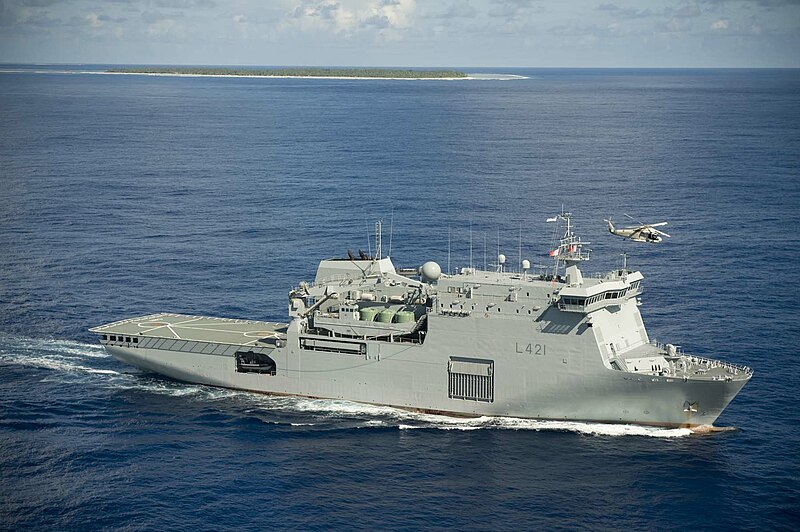
HMNZS Canterbury (Image: Wiki Commons)
WELLINGTON, March 3 (Xinhua) -- Almost 300 New Zealand military personnel have arrived in cyclone-ravaged Fiji with much needed relief supplies, the New Zealand Defence Force (NZDF) said Thursday.

The NZDF humanitarian aid operation was in full swing with the arrival of multi-role naval vessel HMNZS Canterbury carrying 106 tonnes of emergency supplies, said Colonel Glenn King, commander of the task group in Fiji.

"Canterbury will serve as the maritime base for New Zealand's post-disaster recovery operations in Fiji's northern outer islands," King said in a statement.

"We work to the Fiji government's priorities and their request to us is to get food, water and shelter to the disaster-struck remote communities in the northern outlying islands."

Commander Simon Rooke, commanding officer of the Canterbury, said the ship would sail later Thursday to the northern Lau group of islands after disembarking two New Zealand air force NH90 helicopters, loading additional aid supplies.

Read the full story at Xinhua

01 March 2016

News Story: Australia's biggest naval ship arrives in Fiji to assist disaster relief

HMAS Canberra departs Sydney (2015)
SUVA, March 1 (Xinhua) -- HMAS Canberra, the 230-meter flagship of the Australian Navy, arrived in Suva on Tuesday to assist in the relief operation in the cyclone-hit country.

The Australian Navy's largest ship has a hull of 10 meters while places in the Suva Harbor are only 2 meters deep.

Australian Deputy High Commissioner, Karinda D'Aloisio led a team to observe the handover of command of the Australian forces in Fiji, according to reports on Newswire on Tuesday.

The HMAS Canberra which departed Brisbane on Feb. 26 is carrying approximately 60 tonnes of emergency relief supplies on board with family kits which include hygiene, shelter, kitchen and bedding materials that many people in Fiji need right now.

Read the full story at Xinhua

29 February 2016

Think Tank: (Australian) DWP 2016 - the future Army

Lachlan Wilson

The new Defence White Paper outlines spending of up to $80 billion on land combat and amphibious warfare out to 2025–26. In terms of equipment modernisation, the plans have focused on greater protected mobility, situational awareness, aviation, firepower, and force sustainability. Those improvements are intended to enhance and broaden the armed forces combat and non-combat capacity.

These are the key proposals that the Army will procure and advance over the next decade:
  • An agile procurement system for infantry soldiers that will allow for the continuous upgrade of key infantry weapons systems, personal equipment, and force protection
  • New combat reconnaissance, infantry fighting, and protected mobility vehicles
  • Upgrades to extend the operational lifespan of the M1 Abrams to 2035
  • New armed intelligence, surveillance and reconnaissance unmanned aircraft
  • The acquisition of a long-range rocket system by mid-2020 that will provide long-range fire support up to 300km to supplement the ADF’s current artillery capability
  • Logistic enablers to aid the amphibious operations involving the newly acquired Canberra Class ships
  • The re-establishment of Riverine Patrol capabilities, with a fleet of lightly armed boats for river and estuarine operations marked for delivery near 2022
  • Special operations forces will receive a boost in wide range of capabilities which include high-end close combat capabilities, force protection, enhanced command and situational awareness networks, the acquisition and improvement of specialist transportation systems, and an armada of light reconnaissance and attack helicopters

27 February 2016

AUS: Australian support to Fiji expands

HMAS Canberra leaves Sydney
The Australian Government has sent HMAS Canberra to Fiji as part of Australia’s ongoing support to Fiji in the wake of Tropical Cyclone Winston. This will be the first deployment of HMAS Canberra in support of an Humanitarian and Disaster Relief Operation (HADR) overseas.

HMAS Canberra, with approximately 880 personnel, is expected to arrive in Fijian waters from early next week. This will boost the substantial Australian aid effort in Fiji, which is already providing humanitarian relief to over 40,000 people.

HMAS Canberra is carrying Army engineering assets, three MRH-90 helicopters and approximately 60 tonnes of emergency relief supplies including water purification equipment and medical supplies. This capability will assist Fijian authorities to clear debris, restore power, purify water and conduct engineering assessments.

26 February 2016

Think Tank: Tiger, Tiger, not so bright

Andrew Davies

There was a new acquisition project that was given a lot less prominence than the big ticket naval items in today’s White Paper launch. In the paper’s paragraph 4.56, we find this:

‘The Government will replace the 22 Tiger Armed Reconnaissance helicopters with a new armed reconnaissance capability from the mid-2020s.’

It’s certainly to the point, but a more accurate—if slightly wordier—way of putting it would be this:

After almost a decade of effort and a $2.03 billion project budget, the Government has decided to give up trying to integrate the Tiger helicopter into Army’s emerging C4ISR architecture, let alone the wider ADF. We’ll try something else instead. (Now, where’s the FMS catalogue?)

23 February 2016

AUS: Australian aircraft to provide assistance to Fiji

MINISTER FOR FOREIGN AFFAIRS
The Hon Julie Bishop MP

MINISTER FOR DEFENCE
Senator the Hon Marise Payne

The Australian Government has authorised the first deployment of Australian Defence Force flights to transport personnel and humanitarian supplies to Fiji in the aftermath of Tropical Cyclone Winston.

A C-17A Globemaster arrived in Fiji overnight with advance personnel and equipment.

Australian Defence Force flights will also transport humanitarian supplies to provide urgent lifesaving support to people affected by the cyclone, supplementing prepositioned Australian supplies already being distributed in Fiji.

Our assistance will help ensure the Government of Fiji and agencies responding to the crisis to meet the needs of Fiji’s citizens, who have been forced to move to evacuation centres and other temporary accommodation.

09 December 2015

AUS: New ADF Pilot Training System

The Australian Government has contracted Lockheed Martin Australia to provide and support the new Australian Defence Force Pilot Training System.

The acquisition and services contracts worth $1.2 billion will see Lockheed Martin Australia deliver 49 Pilatus PC-21 aircraft, seven Flight Simulators, a modern learning environment for students, updated courseware, along with, support for an initial seven-year term.

Minister for Defence Senator the Hon Marise Payne said the new training system would ensure undergraduate pilots developed the necessary knowledge and skills before progressing to advanced military aircraft.

“Pilots will receive training for aircraft including the F-35A Joint Strike Fighter, Tiger Armed Reconnaissance Helicopter, MH60R Seahawk helicopter, and MRH-90 helicopter,” Minister Payne said.

26 October 2015

AUS: Chinooks commence Canberra trials

CMDR Nathan Robb (author), 
LSIS Yuri Ramsey (photographer), 
LSIS Helen Frank (photographer), 
ABIS Sarah Williams (photographer)

A CH-47D Chinook conducts load lifting trials with HMAS Canberra in Jervis Bay (Image: Navy Image Library) >>

The Navy’s Aircraft Maintenance and Flight Trials Unit along with C Squadron, 5 Aviation Regiment has conducted a ‘quick look’ trial of the CH-47D Chinook onboard the Navy’s Flag Ship, HMAS Canberra. The trials were conducted over a week with preliminary work being conducted at HMAS Albatross and the flying trials conducted at sea on 20-21 October 2015.

The Chinook helicopter conducted a series of evolutions to HMAS Canberra’s flight deck including launch and recoveries along with an assessment of external load operations known as vertical replenishment or VERTREP. An assessment was also made of aircraft lashing schemes and refuelling procedures.

This trial was the precursor for a full First of Class Flight Trial planned for the CH-47F in late 2016. The CH-47D and CH-47F are both operated by C Squadron from Townsville in Queensland.

10 September 2015

AUS: Australia’s newest Military capability on exercise

Army MRH-90 helicopters landing on HMAS Canberra
Australia’s newest military capability, the Amphibious Ready Element embarked in HMAS Canberra, is continuing to hone its skills during Exercise Sea Explorer in Far North Queensland.

The element has been conducting the second of the “Sea Series” of exercises under command of the Amphibious Task Group Headquarters that comprises the Navy’s biggest ship, Air Force assets and supported by the Army’s 2nd Battalion, Royal Australian Regiment and other Army units.

The focus of the exercises is on training and assessing the Amphibious Ready Element in a permissive environment scenario which is currently taking place in waters off the North Queensland coast from August through to October.

01 September 2015

AUS: HMAS Canberra Initial Operational Capability

The Royal Australian Navy’s Amphibious Ship, HMAS Canberra, has completed a graduated operational test and trials program to achieve a key milestone towards Initial Operating Capability.

The program included integration of landing craft as well as trials for both the crew, ship and aviation systems. The Navy’s S70B Seahawk, Army’s S70A Blackhawk and the joint MRH-90 Taipan helicopters have now all been evaluated for operations from the Canberra class ships.

Chief of Navy Vice Admiral Tim Barrett, AO, CSC, RAN, said the milestone meant that Canberra had successfully conducted the required training and evaluation to undertake specific Government directed operations.

“Canberra now has another two months of more complex joint collective training and exercises to integrate other elements of the Australian Defence Force amphibious capability,” VADM Barrett said.