Showing posts with label Dassault Mirage. Show all posts

20 May 2016

News Story: IAF Upgrades Delayed by Duty on Imported Engines and Parts

Vivek Raghuvanshi

NEW DELHI — The Indian Air Force (IAF) has been hit by customs duties on aircraft engines and related spare parts leading to one MiG 29-K aircraft being stranded at Goa naval air base, said an IAF official in private.

Spare engines and related equipment have also been stranded at various other airports for nonpayment of customs duties, the official said.

IAF was caught unaware by the new requirement, which began April 1, but arrangements are being made to find funds to get the equipment released in the near future, the IAF official said.

Finance Minister Arun Jaitley in his 2016-17 budget allocations lifted blanket customs duty exemptions on several defense goods, including aircraft engines and related parts.

The move requiring payment of customs duties is in line with the "Make in India" policy, said an official of the Ministry of Defense (MoD), but it has caught the user [IAF] by surprise.

Read the full story at DefenseNews

03 May 2016

Think Tank: The ‘Contract of the Century’ - France reacts to the Australian submarine deal

Christopher Cowan

The announcement that French defence contractor DCNS had been selected as Australia’s international partner to build RAN’s new fleet of 12 submarines was big news in Australia. That’s understandable considering the multi-billion dollar, decades-long contract. It was also big news in France. Combing through a range of French media outlets reveals several interesting trends.

First, domestic politics is the focal point of French reporting. DCNS’s victory has been trumpeted by the government as a massive success for France and its defence industry. L’Elysée, the office of French President François Hollande, called the decision ‘historic’(‘historique’), and thanked Australia for its confidence in France and its companies. French Prime Minister Manuel Valls took to Twitter to describe the contract as a ‘magnificent success for DCNS and our industry’ (‘magnifique succès pour DCNS et notre industrie’). In a radio interview for Europe1, French Minister of Defence Jean-Yves Le Drian struck a similar tone, stating that the contract would create ‘thousands of jobs in France’(‘milliers d’emplois en France’).

31 December 2015

News Story: Will Pakistan Land a Deal With US for New F-16s?

F-16 Fighting Falcon (File Photo)
By Usman Ansari

ISLAMABAD — Pakistan continues to talk to the US about purchasing a new tranche of F-16 fighters, but analysts here warn that it is unclear if or when such a deal could close.

Air Chief Marshal Sohail Aman, head of the Pakistani Air Force, was quoted in local media here Monday saying Pakistan was "in talks with US defense officials to get some [of the] latest F-16s but the deal may take some time." He spoke at an event to mark Pakistan Aeronautical Complex having manufactured its target of 16 JF-17 Block II for 2015.

That follows reports from mid-October that Prime Minister Nawaz Sharif would use a visit to Washington to push for the sale of eight F-16s for his military.

Pakistan currently operates a number of F-16 variants, so the addition of eight more jets is unlikely to have much impact on the local power balance between Pakistan and India.

However, the US Congress has historically been skeptical of arms sales to Pakistan, in no small part due to Indian lobbying, and any discussion of defense deals naturally must take this into account.

But circumstances could now be in Pakistan's favor. In addition to the Washington's speculated desire to maintain influence in Pakistan, there is a need to keep the F-16 production line open, which in the absence of domestic US orders can only be achieved through exports.

Read the full story at DefenseNews

08 December 2015

News Story: JF-17 Still an Option in Egypt-Pakistan Defense Cooperation Drive

By Usman Ansari

ISLAMABAD — Despite having opted for French and Russian fighter aircraft earlier this year, Egypt has reportedly expressed an interest in the Sino-Pakistan JF-17 Thunder. This has come as a surprise to analysts who had considered the possibility of Egypt acquiring the JF-17 to be lost.

The interest comes as part of a wider push to increase defense industry cooperation between the two countries, according to a Dec. 4 news release by the Pakistani government's Press Information Department. It outlined how the Egyptian ambassador to Islamabad, Sherif Shaheen, met Pakistan's Minister for Defence Production Tanveer Hussain to discuss improving bilateral defense cooperation.

A cadet exchange program is already in place, but both sides were "looking at collaboration in defense industry as the core of relations between Pakistan and Egypt," according to the news release.

As a matter of policy, officials in Pakistan do not discuss potential defense deals until they are signed.

However, author, analyst and former Pakistani Air Force pilot Kaiser Tufail says there are two main reasons the JF-17 appeals to developing nations.

Read the full story at DefenseNews

24 November 2015

Editorial: Dassault’s Rafale Struggles in the Asia-Pacific

By Benjamin David Baker

Dassault faces tough competition in the region.

As previously reported by The Diplomat, several Asian states are on a military shopping spree. Countries such as Indonesia, Malaysia and China are buying new fighters; Australia and Pakistan are getting new submarines. In contrast to the Cold War, when military purchases were primarily dictated by political affiliation with either Washington or Moscow (or, more rarely, London, Beijing, or Paris), the Asian arms market today involves dealers from all over the world.

French company Dassault is one of the players trying to expand its operations in the region. Known for its series of popular fighters, the Mirage, Dassault has previously delivered hardware to such diverse states as Israel, Argentina and Taiwan. These fighters proved popular, both due to their reliability and costs, as well as the fact that they represented an alternative to U.S. and Soviet models.

Dassault’s latest fighter, the Rafale, is a good platform. The fighter is a twin-engine, fourth generation multirole fighter, which means that it is supposed to be able to conduct a wide range of missions, including air-to-air combat, air-to-ground and air-to-sea strikes, and long-range reconnaissance. Furthermore, it is nuclear-capable, and constitutes a part of France’s “force de dissuasion”–its sea and air-based nuclear deterrence. In service since 2001, the Rafale serves as France’s main fighter, alongside the Eurofighter Typhoon and Dassault’s other modern fighter, the Mirage 2000. The Rafale has previously seen service in Libya, Mali, and Afghanistan and is currently involved in the French operation in Syria. The aircraft has been exported to Egypt and Qatar, which have each ordered 24 Rafales. (For technical specifications on the Rafale, see here and here.)

However, Rafale’s largest export market is India. Originally hailed as the “Mother of all Defense Deals,” India was set to purchase 126 Rafales back in 2012. However, as reported by Ankit Panda and Franz-Stefan Gady for The Diplomat, this deal has hit many roadblocks due to disagreements over price, offsets, and Indian specification demands their Rafales. The purchase has now been scaled down to 36 fighters in a government-to-government, of which the final details on offsets and technology transfers are still under negotiation.

Read the full story at The Diplomat

05 February 2015

Editorial: Pakistan Tests New Air-Launched Cruise Missile


By Franz-Stefan Gady

Pakistan’s Ra’ad nuclear-capable, air-launched cruise missile has a 350 km range.

On Monday, February 2, Pakistan successfully tested a cruise missile with stealth capabilities capable of carrying conventional and nuclear payloads. The Hatf-VIII (Ra’ad) is an air-launched cruise missile with an operational range of 350 km and has been first tested by the Pakistani Air Force in August 2007. Other tests were conducted in 2008 with a Dassault Mirage III Rose fighter jet used as a launch platform and in 2011 and 2012 respectively. It is not known whether the weapon can also be launched from Pakistani F-16s. In the future, the JF-17 may also be a likely platform.  This week’s test constitutes the fifth time that the Pakistani Air Force tested the missile.
According to media reports, the successful launch was lauded by President Mamnoon Hussain and Prime Minister Nawaz Sharif, who congratulated the scientists and engineers for their accomplishments. The Pakistani Army only tersely commented the test: “The state of the art Ra’ad cruise missile with stealth capabilities is a low altitude, terrain hugging missile with high maneuverability and can deliver nuclear and conventional warheads with pinpoint accuracy.” The army also notes the missiles “strategic standoff capability” on land and sea, which implies that the army is planning to use this new weapon for precision airstrikes on both land and sea targets. 

Read the full story at The Diplomat

30 May 2014

Editorial: Pakistan, China Conclude Shaheen-III Air Exercise

Pakistani Air Force JF-17 Fighter

By Ankit Panda

The Pakistani and Chinese air forces honed their interoperability with the Shaheen-III exercise.

China and Pakistan concluded the three-week-long Shaheen-III air exercise on Wednesday. The exercise was the third installment of the Shaheen (Falcon) series of bilateral exercises between the two countries’ air forces, according to Defense News. The exercise is intended to boost cooperation between China and Pakistan and is a source of valuable experience for pilots on both sides. The exercise is “multi-dimensional” and involves operations in “near real [scenarios].”
“A contingent of People’s Liberation Army Air Force (PLAAF), comprises combat pilots, air defence controllers and technical ground crew besides a Pakistan Air force (PAF) contingent are participating in the exercises[sic],” noted Air commodore Tariq Mehmood of the Pakistan Air Force. The PLAAF used its Chengdu J-10 and J-7 combat aircraft while the PAF used its JF-17 Thunder, Mirage, and F7 PG fighters. “The Air Exercises between the two professional Air Forces would not only cement the already existing friendly bonds but would also give an opportunity to learn from each other’s combat experience,” said one PAF spokesperson during the exercises. Shaheen-III is the first exercise in the series to involve the PAF’s JF-17 Thunder. 

Read the full story at The Diplomat

28 May 2014

News Story: Sino-Pak Shaheen III Air Exercise Commences in Pakistan

Chengdu J-10 (File Photo)

By USMAN ANSARI 

ISLAMABAD — China and Pakistan commenced their third installment in the Shaheen (Falcon) series of bilateral exercises here over the weekend, according to a Pakistan Air Force (PAF) spokesman.

Shaheen III is described as a multi-dimensional joint exercise aimed at boosting cooperation and imparting knowledge gained through flying/combat experience conducted in a near real scenario, allowing participants to familiarize themselves with the latest concepts and practices.

Though the location within Pakistan of the exercise has not been revealed, the Chinese are participating with a Chengdu F-7 and a Chengdu J-10 aircraft, along with associated support crews and equipment. The PAF is participating with JF-17 Thunder, Mirage and F-7PG aircraft.

Read the full story at DefenseNews

28 October 2013

News Story: First upgraded Mirage fighter for IAF undergoes flight test

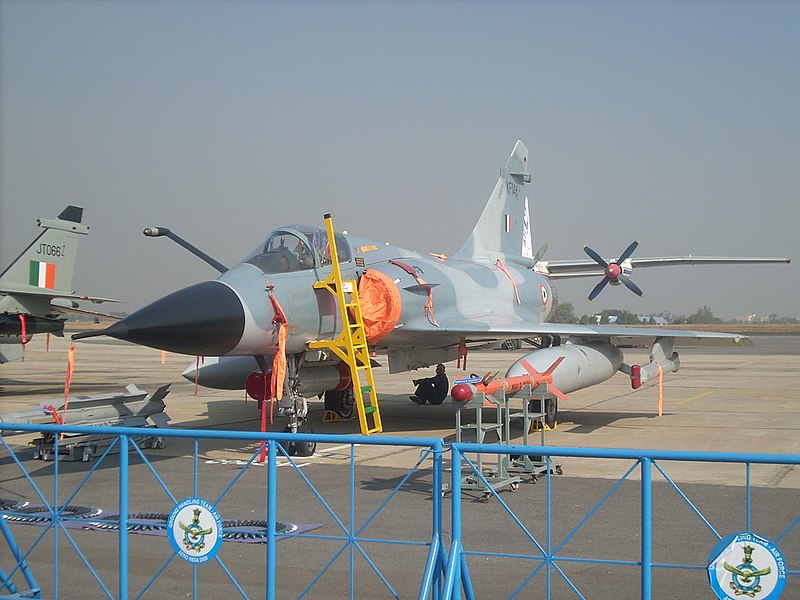
IAF Mirage 2000 at Aero India 2009 (Image: Wiki Commons)

NEW DELHI (PTI): Under IAF's over Rs 10,000 crore modernisation programme, the first Mirage 2000, upgraded by its manufacturer, has successfully completed its maiden flight at an air base in France.

India had signed an upgrade programme worth over Rs 10,000 crore with the French manufacturer Dassault Aviation for upgrading the fleet of its Mirage 2000 aircraft.

"The upgraded Mirage 2000 has successfully completed its maiden flight on schedule as envisaged by the campaign programme," Dassault Aviation said.

Read the full story at Brahmand

10 September 2013

News Story: China and Pakistan Begin Biannual Air Exercise Shaheen 2

Pakistani F-7PG (Wiki Info - Image: Wiki Commons)

By USMAN ANSARI

ISLAMABAD — China and Pakistan last week began a three-week air exercise titled Shaheen 2 (Falcon 2) in Hetian Prefecture of China’s northwestern Xinjiang Uygur Autonomous Region.

The exercise, which lasts until Sept. 22, is the second in a series of such exercises, the first of which was held in Pakistan in March 2011.

Shaheen 2 will be the first time an air force of another country will be participating in such an exercise in Chinese airspace.

The Associated Press of Pakistan (APP) first reported the exercise was to take place, citing the Chinese Defense Ministry.

The Air Force here did not reveal any further details, such as participating aircraft, or if there had been any changes to the size, scope or format of the exercise since 2011.

Read the full story at DefenseNews
05 September 2013

News Story: Pakistani jets leave for wargame in China

PAF F-7PG (Wiki Info - Image: Wiki Commons)

ISLAMABAD (PTI): A contingent of Pakistan Air Force fighter jets have left for China to participate in a joint exercise, the first time that any country will join manoeuvres in Chinese airspace.

The Shaheen-II exercise will be conducted by the PAF and Peoples Liberation Army Air Force during September 3-22. The PAF's Mirage and F-7PG aircraft are taking part in the wargame.

"It is a historic event as it is the first time that the air force of any country would be participating in a joint air exercise in Chinese airspace," a statement said on Tuesday.

The exercise will focus on air combat and use of air power in any future conflict.

Read the full story at Brahmand

22 June 2013

News Story: Pakistan May Speed AF Procurements Despite Economy

JF-17 Thunder (Wiki Info - Image: Wiki Commons)

By USMAN ANSARI

ISLAMABAD — Despite its crippling economic situation, Pakistan may be forced to fund its Air Force’s most important procurement programs on an emergency basis, or at least ensure sufficient finances for their regular progress.

Salma Malik, assistant professor in the Department of Defence & Strategic Studies, at Quaid-i-Azam University, Islamabad, said the “linkage between economic progress, energy sufficiency and security as well as physical security” has never before been so deeply felt in Pakistan.

This is highlighted by the predicament facing the Air Force, which has not received any finances for its modernization efforts since 2007 under the Armed Forces Development Plan 2025 (AFDP2025).

Also, it has received only a portion of its allocated share of the general defense budget under the recently ousted Pakistan People’s Party government.

In addition to the financial woes, Malik highlights the “qualitative” and “quantitative edge” of the India Air Force developed through “upgrades or procurements.”

Read the full story at DefenseNews

08 February 2013

News Story: Despite Missile Integration, Nuke Role Unlikely for Pakistan’s JF-17

JF-17 Thunder (Wiki Info - Image: Wiki Commons)

By Usman Ansari

ISLAMABAD — Pakistan is integrating its nuclear-capable Hatf VII/Vengeance VII Ra’ad air launched cruise missile onto its JF-17 Thunder aircraft, but analysts are unsure if this signifies a nuclear deterrence role for the aircraft.

Air Commodore Khalid Mahmood at the JF-17 Project Management Office said integration work was ongoing with Chinese and Pakistani weapons, and that “most weapons have been integrated”.

“Ra’ad and the H-4 [glide bomb] will be for the Block I and Block II” aircraft currently in or about to enter service, not just the forthcoming Block III variant, he said.

Former Air Force pilot and analyst Kaiser Tufail said, “It makes good sense to get on with the wiring as well as flight trials of these weapons on the JF-17 at this stage. For one thing, all subsequent production aircraft would have the mod integrated from the outset and there will be no need for retrofits that also result in long down times at the flight lines. Secondly, the whole process is lengthy and it was about time we started it.”

He added, “Possibly, by the time the mods are in place on the JF-17, the first of the older Mirages would be retiring.”

The Mirage III carries the Ra’ad and is the delivery platform for Pakistan’s airborne arm of its nuclear deterrent. Its avionics were upgraded in the 1990s under the Retrofit Of Strike Element (ROSE) program.

They have been in service for many years, however, and are approaching the end of their useful lives.

Read the full story at DefenswNews