Showing posts with label Turkmenistan. Show all posts

25 August 2017

News Report: Pakistan to Seek Consensus With Russia, China Over Trump's New South Asia Policy

Pakistani Foreign Minister says his country will work together with Russia and China in the light of the new US strategy for Afghanistan.

MOSCOW (Sputnik) — Pakistan will reach out for Russia and China among other regional powers to work out a response to the new policy in the South Asia, proposed by US President Donald Trump, Pakistani Foreign Minister Khawaja Asif said Thursday.

On Monday night, Trump unveiled his new strategy for Afghanistan during a speech in which he called on Pakistan to do more to crack down on terrorist safe havens, warning that otherwise the United States would cut its aid to the country. On Wednesday, Politico news website reported, citing senior US administration officials, that the United States may impose sanctions on Pakistani officials with links to terrorist organizations.

"We will contact China, Russia [and other countries of the region] in the coming days in order to get a regional consensus and a solution," Asif told the Geo TV broadcaster.

24 April 2017

News Story: DPRK seeks closer cooperation with Turkmenistan, Russia's Far East

PYONGYANG, April 22 (Xinhua) -- The Democratic People's Republic of Korea (DPRK) has called for stronger economic cooperation with Turkmenistan and Russia's Far East Region amid tightening economic sanctions by the United Nations after its nuclear and missile tests.

Turkmenistan and Russia, both oil producers, could see their supplies of crude oil affected by the sanctions.

A working delegation of the DPRK Foreign Ministry recently visited Turkmenistan, where the two sides talked on "matters of further developing the DPRK-Turkmenistan friendly and cooperative relations" and "exchanged views on the regional and international issues of mutual concern," the Korean Central News Agency (KCNA) reported Saturday.

Read the full story at Xinhua

01 March 2017

News Story: Pakistan wants ECO as "strong economic block"Pakistan wants ECO as "strong economic block"

ISLAMABAD, Feb. 28 (Xinhua) -- Pakistan Foreign Affairs Adviser Sartaj Aziz on Tuesday urged members of the Economic Cooperation Organization (ECO) to transform the grouping into a strong economic block through full exploration of its human and material resources.

Speaking at the opening session the ECO council of foreign ministers, which will finalize agenda for the summit to be held on Wednesday, he said that "immediate attention should be paid to intra-regional trade, which is far below its potential."

He underscored the need for implementation of ECO trade agreement and removal of trade and non-trade barriers besides establishing a Free Trade Area in the region.

Aziz also said that lack of regional connectivity is a major impediment to economic cooperation and said there should be focus on projects for greater connectivity.

Read the full story at Xinhua

21 January 2017

News Story: Afghan forces kill 4 militants, detain 2 foreigners

SARIPUL, Afghanistan, Jan. 20 (Xinhua) -- At least four Taliban fighters have been killed and four others injured as security forces attacked militants' positions in Sayad district of the northern Saripul province on Thursday, provincial governor Mohammad Zahir Wahdat said Friday.

"Four Taliban rebels have been killed, four others injured and two foreign nationals have been arrested," Wahdat told reporters here.

"One of the arrested foreign nationals is from Turkmenistan and the other from Kazakhstan," the official said, adding, "both of them received terrorist training in Wazirustan tribal area of Pakistan."

Read the full story at Xinhua

28 November 2016

News Report: Afghan, Pakistani Leaders Discuss Tense Bilateral Ties

Ayaz Gul

ISLAMABAD — Pakistani and Afghan leaders met Saturday on the sidelines of an international conference in Turkmenistan to discuss issues straining ties between their two countries.

Prime Minister Nawaz Sharif and Afghan President Ashraf Ghani discussed bilateral relations and regional issues, Pakistani officials said without giving further details.

Sharif and Ghani are attending the first Global Sustainable Transport Conference the United Nations has convened in the Turkmen capital, Ashgabat.

The two-day international gathering is aimed at highlighting the fundamental role of sustainable transport in fighting climate change and achieving a sustainable future.

News Story: Afghan, Turkmen Relations Improved Development - Ghani

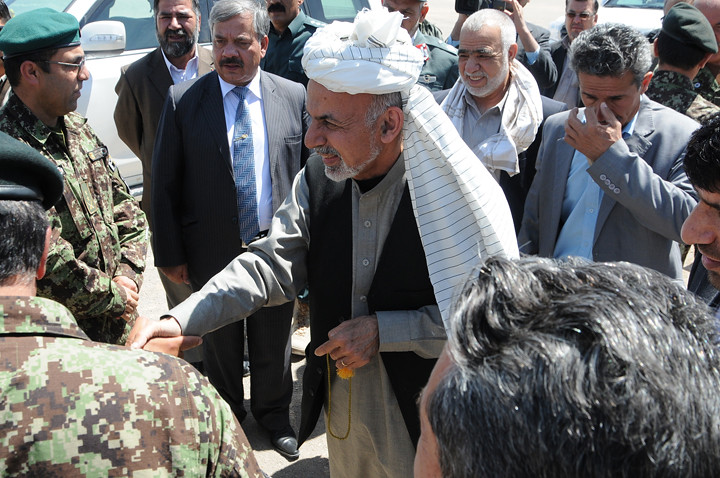
President Ashraf Ghani said on Saturday night at a meeting with Turkmen President Gurbanguly Berdimuhamedow that strengthened relations and cooperation between Afghanistan and Turkmenistan in the past two years has improved development in region.

The Presidential Palace said in a statement that Ghani also discussed with Berdimuhamedow the role of The Global Sustainable Transport Conference and said that the conference will help to open transit ways in the region.

Both sides also discussed cooperation in sports and Berdimuhamedow told Ghani that his country is ready to help Afghans in sport events, it said.

Ghani travelled to Turkmenistan late Friday to attend the 1st Global Conference on Sustainable Transport.

Read the full story at TOLOnews

08 April 2016

News Story: IS gaining clout in Afghanistan, Russian Deputy FM says

ALMATY, April 7 (Xinhua) -- The Islamic State (IS) militant group has been strengthening its position in Afghanistan since the end of 2015 and now there are about 6,000 IS militants there, the Russian deputy foreign minister has said.

Supporters of the organization had been found in 25 of Afghanistan's 34 provinces, Russian Deputy Foreign Minister Grigory Karasin said in an interview with Kazakh newspaper "Kazakhstanskaya Pravda" published on Thursday.

Among these fighters were citizens from countries in Central Asia and the North Caucasus, such as Kyrgyzstan, Tajikistan, Uzbekistan and North Caucasian republics of Russia, said Karasin.

He disagreed with those who said that the threat from Afghanistan was allegedly often exaggerated.

Read the full story at Xinhua

15 February 2016

Editorial: Can China Really Save Central Asian Economies?

By Casey Michel

Beijing may not, after all, provide the economic deus ex machina Central Asian governments have hoped for.

Ever since the Eurasian recession began in earnest — or, predating that, when it was clear that Russia’s economic engine would stall under Vladimir Putin’s third term — there has nonetheless been a source of hope for Central Asia’s economies: China. On the backs of China’s One Belt, One Road (OBOR) platform, Beijing has stepped in to provide Central Asian economies with the necessary trade, transport, and internal investment to offset a reeling Russia and sinking hydrocarbon prices. For the past few years, China has stood as the region’s economic trump card — a rising Chinese tide would, as the regional governments assumed, raise their fortunes as well.

Despite China’s recent economic troubles, there was little outward sign that this prognostication would change anytime soon. The OBOR’s schematics proceeded as planned, and the recent rail transit from China to Iran further illustrated the potential integration Beijing can provide.

But even as Beijing denies any external ramifications from its current economic slowdown, a bit of news may call into question the notion that China can serve as an economic out for Central Asia. As Raffaello Pantucci, the director of International Security Studies at the Royal United Services Institute, wrote this week, “softening domestic gas needs have led to the suspension of the Line D gas line bringing hydrocarbons from Turkmenistan to China through Uzbekistan.” The suspension appears to stem, in part, from a decision out of Tashkent, with Interfax reporting that Uzbek officials said “technical reasons” necessitated the postponement.

Read the full story at The Diplomat

10 February 2016

Editorial: New Alliances in Central Asia

By Pierre-Olivier Bussieres

Why Russo-Indian relations matter.

As China’s One Belt, One Road policy unfolds in Central Asia, strategic alliances within the region are becoming increasingly complex. While existing partnerships are deepening, new opportunities are emerging for key South Asian players. India, a long-standing absentee in the region, may very well hold the key to the balance of power in Central Asia as a potential ally of Russia.

Missed Opportunities

India began to develop a presence in Central Asia following the collapse of the Soviet Union. In 2002, Russia and India signed an agreement to launch the International North South Transport Corridor (INSTC). In 2012, New Delhi devised its official Central Asian policy, a 12-point list aiming at increasing connectivity among the five Central Asian stans, taking advantage at the energy potential of the region and developing its banking sector. Opening roads to Central Asia, China’s prime objective in the region, has also been India’s priority for a decade. Ensuring that these roads aren’t carrying only Chinese goods, however, will remain a key priority for India as it does for Russia. This is one of the reasons why the two countries may both stand to gain significantly from active collaboration in the region.

Narendra Modi has been more proactive than his predecessors on Central Asia policy. The Indian prime minister toured the five Central Asian countries in July 2015. Among the multiple deals signed with Central Asian leaders, Modi secured an agreement with Kazakhstan to supply 5000 tons of uranium to Delhi for the next four years. The belated Turkmenistan-Afghanistan-Pakistan-India (TAPI) gas pipeline was discussed with Turkmenistan, poised to take the lead on the project. Although a recent boom in construction, IT and pharmaceuticals has stirred the Kazakh, Turkmen and Uzbekistan economies, poor infrastructure and geographic distance has severely limited trade between India and the region.

Conversely, India figures relatively high in Central Asia. New Delhi enjoys a reputation as a neutral country. A former leader of the non-aligned world during the Cold War, its presence in Central Asia threatens neither China and Russia. India’s clearly stated willingness to engage in the multinational bodies associated with the region is a relief in the context of fears over Chinese and Russian dominance.

Read the full story at The Diplomat

05 January 2016

Editorial: Afghanistan in 2016 - Ashraf Ghani's Case for Cautious Optimism

By James L. Creighton and Martin Fleischer

There is an astounding optimism within the Afghan leadership. Is it justified?

In 2015, the Taliban made gains in Afghanistan–a not quite unforeseeable chain of events–but less expected were gains made by the Islamic State. In addition, in 2015 tthe economic consequences of coalition forces’ withdrawal began to be felt. However, there is an astounding optimism within the Afghan leadership. Is this optimism justified?

News from Afghanistan remains pessimistic. The litany of challenges facing the country has mounted as the Afghan National Security Forces (ANSF) fought through a tough fighting season. Despite these daunting challenges, President Ashraf Ghani maintains a positive vision of Afghanistan in the future. This might seem counter intuitive but there are opportunities for Afghanistan to engage regionally, in order to capitalize on the progress made in the last 13 years and take advantage of both the resources left behind by the coalition expansion and the natural resources that are readily available in the near term. Focusing on what can be done while working toward more aggressive objectives may be a way to keep Afghanistan slowly on a positive path.

The withdrawal of coalition forces left ANSF leaders with fewer critical combat systems they had come to rely on, such as close air support, medical support and coalition intelligence systems. The Army performance on the defense has been spotty at best. However, as the loss and subsequent retaking of Kunduz demonstrates, when they turn to the offense, they have been much more successful. The police force has been severely tested in Kabul and more recently in Kandahar. While the ability of the Taliban to attack in large cities has created a bunker type mentality where leaders and foreign representatives stay largely behind “Texas Wall” compounds, the Afghan National Police have been able to respond in good order to restore the peace.

The ANSF has a long way to go in order to be a completely effective fighting force, however; they have been good enough to keep the Taliban and emergent Daesh (Islamic State) threat at bay in the major cities and much of the rural areas.

Read the full story at The Diplomat

31 December 2015

Editorial: Can South Asia Make Nice in 2016?

Image: Flickr User - ResoluteSupportMedia
By Muhammad Akbar Notezai

This month has seen yet another attempt at repairing fractious relationships.

Early this month, the fifth Heart of Asia-Istanbul Process Summit was opened by Prime Minister Nawaz Sharif and Afghan President Ashraf Ghani in Islamabad, Pakistan’s capital. Attending were the foreign ministers of ten countries – including all four of Pakistan’s neighbors. Chinese Foreign Minister Wang Yi was making his second visit to Islamabad this year, and was joined by Afghan Foreign Minister Salahuddin Rabbani, Indian Minister for External Affairs Sushma Swaraj and Iranian Foreign Minister Jawad Zarif.

Afghan President Ashraf Ghani had reportedly been reluctant to visit Islamabad given an upsurge in Taliban violence in Afghanistan and the derailing of the peace talks with the Afghan Taliban following the revelation of the death of Taliban leader Mullah Mohammad Omer, both developments severely straining bilateral ties.

However, according to Afghan media reports, China’s ambassador in Kabul conveyed a message from the Chinese leadership, advising Ghani to make the trip. The Pashtun leadership of Pakistan also visited Kabul to convince Ghani to attend the conference. When Ghani did arrive, it was to an impressively warm welcome. Islamabad-based analysts believe that both the political and military leaderships of Pakistan are now keen to improve ties with Kabul, although skeptics say that it is Beijing that has been robustly pushing Islamabad to amend ties with Kabul ever since the announcement of China’s $46 billion investment in Pakistan.

Farooq Sulehria, a senior Pakistani journalist based in Sweden, told The Diplomat, “Civilians have no control over foreign policy, in particular Afghanistan and India-related policies. They cannot issue a press statement on their own. It is a shame that civilians have capitulated so comprehensively. If capitulation is tantamount to similarity of views, we can say that they (political and military leadership) are on the same page. But ‘to be on same page,’ implies having equal strength. This is clearly not the case. Civilians utter the mundane statements they are told to say in public.”

Afghanistan’s intelligence chief Rahmatullah Nabil, a favorite of American officials and a staunch critic of his government’s policies toward Pakistan, resigned in apparent protest at Ghani’s efforts to achieve a rapprochement with Pakistan.

Read the full story at The Diplomat

15 December 2015

Editorial: Could TAPI Bring Peace to Afghanistan?

Image: Flickr User - DVIDSHUB
By Catherine Putz

If history is any indication, no.

As expected, on December 13, leaders from Turkmenistan, Afghanistan, Pakistan, and India attended the groundbreaking for the TAPI pipeline project in Mary, Turkmenistan. The 1,814 kilometer pipeline project is expected to cost at least $10 billion and planned to route through some of the most unstable parts of Afghanistan and Pakistan. The groundbreaking on Sunday was attended by Turkmen President Gurbanguly Berdimuhamedov, Afghan President Ashraf Ghani, Pakistani Prime Minister Nawaz Sharif, and Indian Vice President Mohammad Hamid Ansari.

Last week, ahead of the TAPI groundbreaking, I wrote that it is neither the diversification Turkmenistan needs nor is the security of the project something to be dismissed casually.

The groundbreaking was nonetheless rife with hopeful statements.

“TAPI is designed to become a new effective step towards the formation of the modern architecture of global energy security, a powerful driver of economic and social stability in the Asian region,” Berdimuhamedov said. Sharif commented that the project “will usher in a new era” and Ansari said it was “the first step to the unification of the region.” Ghani highlighted the political will behind the project.

Read the full story at The Diplomat

08 December 2015

Editorial: Confirmed - Ghani to Attend Heart of Asia Conference in Islamabad

By Catherine Putz

The Indian Foreign Minister, Sushma Swaraj, is also to attend.

Afghan President Ashraf Ghani said Monday that he would be attending the Heart of Asia conference this week in Pakistan. Ghani’s initial efforts to achieve a rapprochement with Pakistan fizzled earlier this year as peace talks with the Taliban, facilitated by Pakistan, fell apart. The confirmation that the Taliban’s leader Mullah Omar had died two years ago in Pakistan not only sidelined Afghanistan’s efforts to smooth relations with Pakistan but also fractured the Taliban.

The Heart of Asia conference, part of the so-called Istanbul Process, will take place on December 8 and 9 in Islamabad. It is the fifth such ministerial meeting, with previous editions taking place in Beijing, Almaty and Kabul. At the heart of the Istanbul Process is an attempt to get regional states to work together on a multifaceted agenda that ranges from security to economics with peace in Afghanistan at the center of its efforts.

As Habib Wayand write today for The Diplomat “this week’s conference gives both Pakistan and Afghanistan a real opportunity to work out their differences and negotiate a settlement.” But Ghani isn’t taming his rhetoric just because he’s going to the conference,

According to TOLOnews, Ghani “said Pakistan has been in an undeclared war with Afghanistan for 14 years now and that peace needs to be secured between the two countries.”

Read the full story at The Diplomat

Editorial: The ‘Heart of Asia’ Conference: A Fresh Start?

Image: Flickr User - DFID - UK Department for
International Development
By Habib Wayand

A regional conference in Islamabad this week offers another chance at peace and reconciliation in Afghanistan.

Pakistan will be soon hosting a crucial regional conference in Islamabad. The conference will discuss the situation in Afghanistan with particular focus on helping the war-torn country’s economy, although the security situation will doubtless also be a major issue. More specifically, the meeting aims to look at ways to strengthen cooperation, deal with security challenges, and build economic ties.

The “Heart of Asia” conference is scheduled to run from December 8 to 10. Pakistan has been trying to convince Afghan President Ashraf Ghani to attend along with Prime Minister Nawaz Sharif. At the time of writing, official confirmation of the participation of Ghani as well as that of Indian Minister for External Affairs Sushma Swaraj was still pending. However, Ghani and Sharif did meet on the sidelines of the COP21 Climate Change Conference in Paris last week, a meeting mediated by British Prime Minister David Cameron and prompted by a recent visit to Kabul by Pashtun leaders from Pakistan.

Ghani’s courageous outreach to Pakistan following his inauguration suffered a huge setback when the Murree talks in July this year failed. Pakistan had promised the Afghan president that it would bring the Taliban leaders to the negotiating table, but the last minute confirmation of the death of Mullah Omar, the former spiritual head of the Taliban, not only derailed the talks but raised serious doubts about Pakistan’s intentions.

As the talks failed Kabul witnessed several major terrorist attacks – worse than it had experienced at any time over the past 14 yearss. The incidents prompted Kabul to rethink its approach towards Pakistan, deciding only to initiate talks with Islamabad when the latter was ready to talk honestly about peace in Afghanistan.

This week’s conference gives both Pakistan and Afghanistan a real opportunity to work out their differences and negotiate a settlement. The other key stakeholders, like Swaraj and Chinese Minister of Foreign Affairs Wang Yi, along with senior representatives from Azerbaijan, China, Iran, Kazakhstan, Kyrgyzstan, Russia, Saudi Arabia, Tajikistan, Turkey, Turkmenistan, and the UAE could also use this platform to pressure Afghanistan and Pakistan to reach a peace settlement with insurgent groups on both sides of the border.

Read the full story at The Diplomat

28 November 2015

Editorial: Turkey-Russia Tensions Put Caspian States in a Bind

By Evan Gottesman

Moscow’s broader international military engagements might worry its Caspian neighbors.

Russia’s intervention in the Syrian Civil War is leaving the former Soviet republics on the Caspian Sea littoral in an uncomfortable place. Caught between their historic relationships with Moscow and concerns for their own security, Kazakhstan, Turkmenistan, and Azerbaijan are clearly in an unenviable political position. Moreover, unprecedented Russian military action risks destabilizing otherwise steady diplomatic ties.

A November 4 security agreement concluded by Kazakhstan and Azerbaijan is one indication that something is amiss in the Caspian Sea. The plan notably provides for joint Kazakhstan-Azerbaijan naval exercises on the inland sea.

Emerging Kazakhstan-Azerbaijan defense cooperation is likely derived, at least in part, from anxiety over Moscow’s use of the Caspian Sea in its Middle East operations. Russia’s Caspian Sea Flotilla fired cruise missiles at targets in Syria in October and November. While Astana has tempered its own statements on Russian military activity in the Caspian, Turkmenistan’s President Gurbanguly Berdimuhamedov spoke for his northern neighbors during a November 23 meeting with President Vladimir Putin. There, Berdimuhamedov indicated to his Russian counterpart that, “Our Kazakh colleagues are allegedly worried over what is going on over the Caspian Sea, which is linked with military issues.”

While Berdimuhamedov claimed to convey Kazakh fears, Turkmenistan may also be troubled by Russian operations on the Caspian. Turkmenistan maintains a distinctly neutral foreign policy platform. Still, the Turkmen government has lent rhetorical support to Ukraine in Kiev’s conflict with Russia. Turkmenistan expressed its apprehension over Moscow’s 2008 invasion of Georgia by conducting military drills in the Caspian—not unlike Kazakhstan and Azerbaijan’s planned exercises.

Read the full story at The Diplomat

17 November 2015

Editorial: Fear of Terrorists Ripples from Paris to Moscow

By Catherine Putz

A deputy speaker in the State Duma floated the idea of restricting entry to Russia for citizens of Tajikistan, Turkmenistan, and Uzbekistan.

On Friday night, a series of terrorist attacks in the French capital, Paris, left 129 people dead and injured 300 more. The devastating attacks drew international attention and set off a series of reactions–from sympathy to fear. In Russia, one of the responses has been to float the idea of restricting entry to the country for citizens of Tajikistan, Turkmenistan and Uzbekistan. No mention was made of Kazakhstan or Kyrgyzstan.

The attacks in Paris were claimed by the so-called Islamic State of Iraq and Syria (ISIS) and followed by swift retaliation. On Sunday, French fighter jets bombed ISIS’s self-declared capital in Raqqa, Syria. Over the weekend, additional details have emerged about the attackers and their accomplices. At least one of the attackers appears to still be on the loose, a Belgian named Salah Abdeslam–whose brother, Ibrahim, blew himself up on Boulevard Voltaire. Another Belgian, Abdelhamid Abaaoud, is said to have masterminded the attacks. One of those who assaulted the Bataclan concert hall–where 80 people were killed–was a French citizen named Ismael Omar Mostefai. A Syrian passport was found on one of the dead attackers, but French authorities say it is a fake–as Matt Ford wrote in The Atlantic this is “casting doubt on whether its bearer was a genuine refugee or even the person named in it.”

So far, none of those linked to the Paris attacks have been identified (or even rumored) to have come from Tajikistan, Turkmenistan and Uzbekistan.

Read the full story at The Diplomat

27 October 2015

Editorial: Taliban Stuck on an Island Between Afghanistan and Turkmenistan

A fence further down the Amu Darya, where it divides
Uzbekistan from Afghanistan near the Uzbek city of
Termiz. (Image: Wiki Commons)
By Catherine Putz

With Taliban militants marooned on an island in the Amu Darya, Ashgabat can no longer deny there is trouble on the border.

Mere weeks after chastising Kazakh President Nursultan Nazarbayev for mentioning his concern about “incidents” along the Turkmen-Afghan border, Ashgabat is allegedly in contact with Afghan forces who say they chased a few dozen Taliban militants onto an island in Amu Darya, which separates Afghanistan from Turkmenistan.

On October 15, after a bilateral meeting with Russian President Vladimir Putin, Nazarbayev included in his remarks a comment about the security of region’s southern reaches, saying “We already know about the incidents on the border with Turkmenistan and we are concerned about Tajikistan.”

Turkmenistan immediately pushed back, issuing a strongly-worded statement in which it expressed “its extreme incomprehension and concern at this statement by the Kazakhstan side which is irrelevant to the situation on the state border of Turkmenistan.” Ashgabat urged the Kazakhs to “use more relevant information in the future when assessing the situation in Turkmenistan.”

To steal a line from Shakespeare: Turkmenistan doth protest too much, methinks.

Read the full story at The Diplomat

03 October 2015

Editorial: Central Asia and the ISIS Phantom

By Cholpon Orozobekova

The region’s leaders have been playing up the ISIS threat. How real is it?

On September 16, just after the CSTO summit held in Dushanbe, Tajik authorities arrested 13 active members of the Islamic Renaissance Party and removed the passports of other 50 members to prevent them from travelling abroad. The next day, the General Prosecutor`s Office released a statement explaining the arrests as an action to prevent new acts of terrorism and crimes of an extremist nature, accusing the party of being affiliated with the armed group led by General Abduhalim Nazarzoda and of involvement in a violent attack on a police station and weapons depot that began on September 4. “Nazarzoda was acting on orders from the party, including the exiled party leader, Muhiddin Kabiri,” says the General Prosecutor`s office.

The exiled leader of a recently banned Islamic Renaissance party in Tajikistan, Kabiri has rejected Tajik authorities’ accusations that he ordered to Nazarzoda to instigate and lead the deadly mutiny in September. He insisted that neither he nor his party had anything to do with the incidents.

International human rights organizations have condemned the detention of opposition party members and demanded their immediate release. Amnesty International warned that all are at risk of torture and unfair trial.

“These arrests represent a full-scale assault on dissent in Tajikistan,” said Hugh Williamson, Europe and Central Asia director at Human Rights Watch. “Tajik authorities have the obligation to charge these men promptly with specific crimes or release them and to maintain the presumption of innocence. They cannot hold opposition activists on spurious claims of preventing future crimes.”

Ivar Dale, senior advisor and representative in Central Asia for the Norwegian Helsinki Committee, told The Diplomat that Tajik authorities are now destroying what little credibility they still had with the international community. “To outside observers, it’s obvious that Rakhmon wants to close down the opposition. If he would allow journalists to freely investigate and report on what is happening, perhaps the situation would be different. But right now this looks like a rough take-down of the political opposition, and we also see connections to recent attacks on civil society. Tajik authorities should think long and hard on how they want their state to be perceived abroad. They’re doing an extremely bad PR job right now.”

Dale added that the Islamic threat has been an excuse for the Uzbek regime to silence opposition and civil society for years. “Tajikistan has held a somewhat lighter hand over these groups, but what we are seeing now is a total ban, even on ordinary opposition,” he said.

Read the full story at The Diplomat

22 September 2015

Editorial: Will China and Russia’s Partnership in Central Asia Last?

By Tao Wang and Rachel Yampolsky

Beijing should approach its partnership with Moscow in Central Asia with a degree of caution.

Leaders in Beijing and Moscow have both been making a concerted effort to extend their connections with Central Asia in recent months. In July, Russia hosted the latest BRICS summit as well as a gathering of the Shanghai Cooperation Organization in Ufa near the border with Kazakhstan. Earlier, in May, on his fifth visit to Russia since becoming president, President Xi Jinping reached an agreement with President Vladimir Putin to coordinate China’s One Belt One Road (OBOR) initiative with the Russia-led Eurasian Economic Union (EEU) in Central Asia. While both countries have clear economic incentives to cooperate in this region in the short term, they will need to overcome a number of hurdles to set their partnership on a path that can be sustained further into the future.

In the past year, Russia and its Central Asian neighbors have faced sobering economic challenges. Russia’s GDP contracted by almost 2 percent in the first quarter of 2015, at least in part as a result of the falling price of oil and Western sanctions, and the ruble lost nearly half of its value against the dollar in August 2015 compared with one year earlier. The impact was felt in Central Asia too, given its close economic interdependence with Russia. Both the oil- and gas-exporting nations of Turkmenistan and Kazakhstan saw declining oil and gas revenues, currency devaluation, and reduced gas exports to Russia, a market that is now oversupplied given weakened European demand. Remittances are another source of income suffering strong disruption – the World Bank has estimated that remittances of some Central Asian countries have fallen by as much as 30 percent since last year. This has a dramatic impact when seen in the context of the share remittances that make up of these countries’ GDP, half in the case of Tajikistan.

Meanwhile, China’s trade with the region reached $50 billion in 2014, a figure that exceeded that of Russia for the first time. According to calculations by the authors based on figures from the Heritage Foundation, total Chinese investment in the region reached $30.5 billion between 2005 and the first half of 2014, including an extensive network of oil and gas pipelines, oil and gas exploration, power plant financing, and even electric grid construction in Tajikistan. The China-Central Asia network of pipelines could supply up to 55 billion cubic meters of natural gas to China every year, or more than half of China’s total gas imports.

Read the full story at The Diplomat

11 September 2015

Editorial: Understanding China’s Eurasian Pivot

By Michael Clarke

The “One Belt, One Road” strategy provides a guide to the future of China in Eurasia.

The People’s Republic of China’s (PRC) Eurasian frontiers have once more emerged as major factor in Beijing’s foreign policy. Indeed, President Xi Jinping’s recent enunciation of China’s “One Belt, One Road” (OBOR) strategy, comprising an initiative to enhance Eurasian economic connectivity through the construction of a Silk Road Economic Belt (SREB) and a Maritime Silk Road (MSR), has placed Eurasia “front and center” in China’s contemporary foreign policy. This has led some to argue that Beijing is in the process of its own “pivot” to Asia that will have far-reaching strategic consequences.

Matthew Burrows and Robert Manning recently argued that this “pivot west to Eurasia seeks to turn its vulnerability – a border with fourteen nations – into a strategic asset. Together they seek to realize Mackinder’s vision of a Eurasian heartland unopposed.” The success of this Eurasian pivot may well prove to be a “nightmare” for the United States as Beijing’s economic and strategic heft attracts a weakened Russia into a partnership to stabilize and modernize Eurasia on the basis of “authoritarian state-centric capitalism.” In contrast, Jeffrey Payne responds that such fears “should be pushed aside,” as Beijing will not only have to confront a region of unpredictable and uncontrollable political forces but also latent, and mutual, Sino-Russian suspicion.

Read the full story at The Diplomat