Showing posts with label Azerbaijan. Show all posts

28 July 2017

News Story: Pakistan to sell 10 Super Mushshak aircraft to Azerbaijan - officials

Super Mushshak (Image: Wiki Commons)
ISLAMABAD July 27 (Xinhua) -- Pakistan on Thursday signed an agreement with Azerbaijan for sale of 10 Super Mushshak training aircraft to Azerbaijan Air Force, Pakistan Air Force (PAF) said.

The contract was signed at Azerbaijan, where Air Marshal Arshad Malik, Chairman Pakistan Aeronautical Complex at the town of Kamra represented Pakistan, whereas Azerbaijan was represented by Air Force Commander Azerbaijan Lieutenant General Ramiz Tahirov at the occasion.

This contract would also include operational training and technical support and assistance to Azerbaijan Air Force, said a PAF statement issued in Islamabad.

"This landmark agreement will further strengthen the bilateral ties between the two brotherly countries," it said.

Read the full story at Xinhua

01 March 2017

News Story: Pakistan wants ECO as "strong economic block"Pakistan wants ECO as "strong economic block"

ISLAMABAD, Feb. 28 (Xinhua) -- Pakistan Foreign Affairs Adviser Sartaj Aziz on Tuesday urged members of the Economic Cooperation Organization (ECO) to transform the grouping into a strong economic block through full exploration of its human and material resources.

Speaking at the opening session the ECO council of foreign ministers, which will finalize agenda for the summit to be held on Wednesday, he said that "immediate attention should be paid to intra-regional trade, which is far below its potential."

He underscored the need for implementation of ECO trade agreement and removal of trade and non-trade barriers besides establishing a Free Trade Area in the region.

Aziz also said that lack of regional connectivity is a major impediment to economic cooperation and said there should be focus on projects for greater connectivity.

Read the full story at Xinhua

13 February 2017

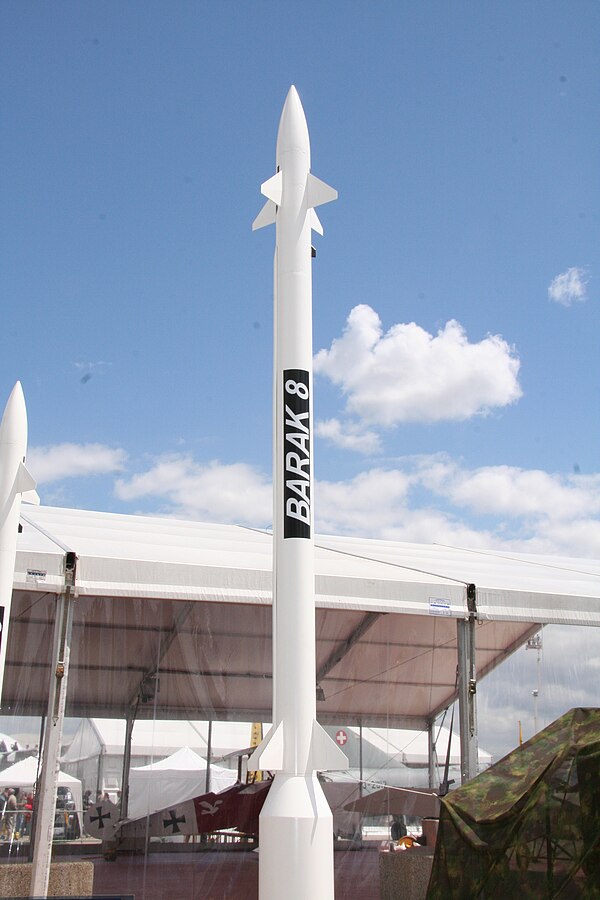
News Story: IAI's Barak-8 test-fired at sea

Barak-8 (Image: Wiki Commons)
by Ryan Maass

Israel Aerospace Industries' Barak-8 surface-to-air missile was recently test-fired at sea to verify its capabilities.

The Barak-8 is operated by the armed forces of Israel and India as a means to defend against airborne threats including fixed-wing aircraft, helicopters, unmanned aircraft, anti-ship missiles, and cruise missiles.

Read the full story at SpaceDaily

02 February 2017

News Story: Four terror suspects killed in Azerbaijan

BAKU, Feb. 1 (Xinhua) -- Four suspects were killed and another arrested in a raid on a group suspected of planning terror attacks in Azerbaijan, the State Security Service said Wednesday.

The group reportedly pledged allegiance to terrorist groups involved in armed conflicts abroad, purchased guns and explosives and was preparing terrorist attacks in Azerbaijan, it said.

Read the full story at Xinhua
26 November 2016

News Story: One terrorist suspect killed in Azerbaijan

BAKU, Nov. 25 (Xinhua) -- A terrorist suspect was killed by security forces in Azerbaijan, the country's State Security Service said Friday.

The suspect, Ramig Rahimov, opened fire at security forces in the Khachmaz district during an anti-terrorist operation, and was killed in an exchange of fire.

Read the full story at Xinhua

08 November 2016

News Story: Russian Amphibious Jet Gets Update and Chinese Order

Beriev Be-200 (Image: Wiki Commons)
by Vladimir Karnozov

China has signed for two Beriev Be-200 amphibious jets with an option for two more, Russia's minister for industry and trade Denis Manturov told journalists on November 2. He did not provide further details, but added that the Indonesian government is also considering buying two or four such aircraft. So far, the type has been exported only to Azerbaijan.

This announcement comes after the first Be-200ChS assembled at TANTK Beriev performed a 15-minute test flight on September 16, with test-pilots Nikolai Kuleshov and Eugeny Yurasov at the controls. This aircraft made a public appearance at GydroaviaSalon’2016 show at Gelendzhik on the Black Sea Coast held September 20 to 25.

Previously, the type was in production at Irkut Corporation’s IAZ plant in Irkutsk, which assembled a Be-200 prototype in 1998 and eight production-standard aircraft from 2003 through to 2011. The latter came in the Be-200Ch customized version for Russia’s Ministry for Emergencies (Emercom), which specializes in firefighting, search and rescue, medical evacuation and ecological monitoring. Emercom operates six aircraft and Azerbaijan one; the other two remain with the manufacturer, available for payable services.

Read the full story at AINonline

14 May 2016

USA: Secretary Kerry's Travel to Saudi Arabia, Austria, Belgium, Burma, and Vietnam

U.S. Secretary of State John Kerry will travel to Saudi Arabia, Austria, Belgium, Burma, and Vietnam from May 14 to May 26.

On May 15-16, the Secretary will travel to Jeddah, Saudi Arabia, for meetings with Saudi government officials to discuss a range of bilateral and regional issues.

Secretary Kerry will then travel to Vienna, Austria, May 16-17. The Secretary will co-host a ministerial meeting on Libya with Italian Foreign Minister Gentiloni to discuss international support for the new Government of National Accord, with a focus on security. He will also co-host the ministerial meeting of the International Syria Support Group to reaffirm and strengthen the Cessation of Hostilities, to discuss ways to ensure humanitarian access throughout the country, and to expedite a negotiated political transition in Syria. Together with Russia and France, the United States will also co-host a meeting on the Nagorno-Karabakh conflict with Armenian President Sargsyan and Azerbaijani President Aliyev.

23 March 2016

News Story: Nepal officially becomes SCO dialogue partner

BEIJING, March 22 (Xinhua) -- Nepal has officially become a Shanghai Cooperation Organization (SCO) dialogue partner after a memorandum was signed Tuesday.

The memorandum was signed by SCO secretary-general Rashid Olimov and Nepalese Foreign Secretary Shanker Das Bairagi. Nepalese Prime Minister K. P. Sharma Oli attended the signing ceremony.

The SCO was established in 2001 to promote cooperation on security-related issues and strengthen mutual trust, friendliness and neighborliness among the member states, Nepalese Deputy Prime Minister and Minister of Foreign Affairs Kamal Thapa said at the ceremony.

He said that Nepal would "adhere to the principles, values and objectives" of the vibrant regional organization, and participate actively in its future activities and progress.

Read the full story at Xinhua

08 February 2016

Editorial: China in the Caucasus

Wiki Info - Image: Wiki Commons
By Emil Sanamyan

For Armenia, Azerbaijan, and Georgia, China is an important investor and possible regional stabilizer.

On his first visit to Beijing, then-Armenian defense minister Vazgen Sargsyan is said to have thrown the hosts into a state of mild confusion when he remarked that (paraphrased) “as we say in Armenia, together with the Chinese there is more than a billion of us.” Jokes and linguistic barriers aside, the comment reflected the main motivating factor behind Armenia’s outreach to China. When dealing with larger and often hostile neighbors, it is only natural for small countries to seek out support or, as a paper published by the Armenian government’s think tank put it, a “special partnership,” externally.

The Caucasus, hemmed in by Russia, Turkey, and Iran, is particularly rife with conflicts. Armenia and Azerbaijan are engaged in low-intensity attrition warfare with non-existent bilateral relations. Turkey has largely sided with Azerbaijan and kept its economic ties with Armenia to a minimum. This leaves Armenia reliant on Georgia, itself in conflict with Russia, and Iran, which until recently faced international sanctions. While Azerbaijan is in much less restricted geopolitical position, its relations with Iran, as well as Russia, have also been quite testy.

Read the full story at The Diplomat

08 December 2015

Editorial: Confirmed - Ghani to Attend Heart of Asia Conference in Islamabad

By Catherine Putz

The Indian Foreign Minister, Sushma Swaraj, is also to attend.

Afghan President Ashraf Ghani said Monday that he would be attending the Heart of Asia conference this week in Pakistan. Ghani’s initial efforts to achieve a rapprochement with Pakistan fizzled earlier this year as peace talks with the Taliban, facilitated by Pakistan, fell apart. The confirmation that the Taliban’s leader Mullah Omar had died two years ago in Pakistan not only sidelined Afghanistan’s efforts to smooth relations with Pakistan but also fractured the Taliban.

The Heart of Asia conference, part of the so-called Istanbul Process, will take place on December 8 and 9 in Islamabad. It is the fifth such ministerial meeting, with previous editions taking place in Beijing, Almaty and Kabul. At the heart of the Istanbul Process is an attempt to get regional states to work together on a multifaceted agenda that ranges from security to economics with peace in Afghanistan at the center of its efforts.

As Habib Wayand write today for The Diplomat “this week’s conference gives both Pakistan and Afghanistan a real opportunity to work out their differences and negotiate a settlement.” But Ghani isn’t taming his rhetoric just because he’s going to the conference,

According to TOLOnews, Ghani “said Pakistan has been in an undeclared war with Afghanistan for 14 years now and that peace needs to be secured between the two countries.”

Read the full story at The Diplomat

Editorial: The ‘Heart of Asia’ Conference: A Fresh Start?

Image: Flickr User - DFID - UK Department for
International Development
By Habib Wayand

A regional conference in Islamabad this week offers another chance at peace and reconciliation in Afghanistan.

Pakistan will be soon hosting a crucial regional conference in Islamabad. The conference will discuss the situation in Afghanistan with particular focus on helping the war-torn country’s economy, although the security situation will doubtless also be a major issue. More specifically, the meeting aims to look at ways to strengthen cooperation, deal with security challenges, and build economic ties.

The “Heart of Asia” conference is scheduled to run from December 8 to 10. Pakistan has been trying to convince Afghan President Ashraf Ghani to attend along with Prime Minister Nawaz Sharif. At the time of writing, official confirmation of the participation of Ghani as well as that of Indian Minister for External Affairs Sushma Swaraj was still pending. However, Ghani and Sharif did meet on the sidelines of the COP21 Climate Change Conference in Paris last week, a meeting mediated by British Prime Minister David Cameron and prompted by a recent visit to Kabul by Pashtun leaders from Pakistan.

Ghani’s courageous outreach to Pakistan following his inauguration suffered a huge setback when the Murree talks in July this year failed. Pakistan had promised the Afghan president that it would bring the Taliban leaders to the negotiating table, but the last minute confirmation of the death of Mullah Omar, the former spiritual head of the Taliban, not only derailed the talks but raised serious doubts about Pakistan’s intentions.

As the talks failed Kabul witnessed several major terrorist attacks – worse than it had experienced at any time over the past 14 yearss. The incidents prompted Kabul to rethink its approach towards Pakistan, deciding only to initiate talks with Islamabad when the latter was ready to talk honestly about peace in Afghanistan.

This week’s conference gives both Pakistan and Afghanistan a real opportunity to work out their differences and negotiate a settlement. The other key stakeholders, like Swaraj and Chinese Minister of Foreign Affairs Wang Yi, along with senior representatives from Azerbaijan, China, Iran, Kazakhstan, Kyrgyzstan, Russia, Saudi Arabia, Tajikistan, Turkey, Turkmenistan, and the UAE could also use this platform to pressure Afghanistan and Pakistan to reach a peace settlement with insurgent groups on both sides of the border.

Read the full story at The Diplomat

28 November 2015

Editorial: Turkey-Russia Tensions Put Caspian States in a Bind

By Evan Gottesman

Moscow’s broader international military engagements might worry its Caspian neighbors.

Russia’s intervention in the Syrian Civil War is leaving the former Soviet republics on the Caspian Sea littoral in an uncomfortable place. Caught between their historic relationships with Moscow and concerns for their own security, Kazakhstan, Turkmenistan, and Azerbaijan are clearly in an unenviable political position. Moreover, unprecedented Russian military action risks destabilizing otherwise steady diplomatic ties.

A November 4 security agreement concluded by Kazakhstan and Azerbaijan is one indication that something is amiss in the Caspian Sea. The plan notably provides for joint Kazakhstan-Azerbaijan naval exercises on the inland sea.

Emerging Kazakhstan-Azerbaijan defense cooperation is likely derived, at least in part, from anxiety over Moscow’s use of the Caspian Sea in its Middle East operations. Russia’s Caspian Sea Flotilla fired cruise missiles at targets in Syria in October and November. While Astana has tempered its own statements on Russian military activity in the Caspian, Turkmenistan’s President Gurbanguly Berdimuhamedov spoke for his northern neighbors during a November 23 meeting with President Vladimir Putin. There, Berdimuhamedov indicated to his Russian counterpart that, “Our Kazakh colleagues are allegedly worried over what is going on over the Caspian Sea, which is linked with military issues.”

While Berdimuhamedov claimed to convey Kazakh fears, Turkmenistan may also be troubled by Russian operations on the Caspian. Turkmenistan maintains a distinctly neutral foreign policy platform. Still, the Turkmen government has lent rhetorical support to Ukraine in Kiev’s conflict with Russia. Turkmenistan expressed its apprehension over Moscow’s 2008 invasion of Georgia by conducting military drills in the Caspian—not unlike Kazakhstan and Azerbaijan’s planned exercises.

Read the full story at The Diplomat

20 July 2015

Editorial: New Revelations on Surveillance Tool Sales

By Casey Michel

Further information emerges on Western companies selling surveillance tools to oppressive Central Asian regimes.

A few months ago, The Diplomat wrote a piece about surveillance practices and programs in Central Asia. Working from an in-depth report from Privacy International [PDF], it didn’t take much digging to find Western companies – including U.S.-based Verint Systems and the Israel-based NICE Systems – guilty of selling Central Asian regimes programs to track citizens, opposition, and dissidents.

Now, we have further information about how these organizations funnel their wares to repressive Central Asian governments – as well as how much they’re paid in return. A massive hack earlier this month into the inner workings of Hacking Team, an Italy-based surveillance software manufacturer, pried some 400GB worth of data, including, according to Wired, “directories, audio recordings, emails and source code.” Prior to the leak Hacking Team’s proclivities had grown so pronounced that Reporters Without Borders placed the company on its Enemies of the Internet Index. Rumors of Hacking Team’s alleged improprieties have swirled for years, led most notably by Citizen Lab, which determined the company had sold its Remote Control Systems (RCS) to Uzbekistan and Kazakhstan.

Read the full story at The Diplomat

09 July 2015

Editorial: What to Expect as Leaders of BRICS, SCO and EEU Gather in Russia

By Catherine Putz

BRICS to chart a course, SCO to expand, and the EEU to link up with the Chinese Silk Road.

Leaders from the BRICS countries and members of the Shanghai Cooperation Organization (SCO) are arriving in Ufa, Russia for their twin summits. Russian media is also reporting a meeting of the Eurasian Economic Union (EEU) countries. RT is live-blogging, Modi tweeted a picture shortly after arriving and the Chinese released a handy explainer cartoon complete with a bicycle built for nine (ridden by the leaders of the BRICS and SCO). The festive atmosphere—RT reports that 10,000 visitors are expected to come through Ufa—belies serious questions of what direction the various organizations are moving in, how much, if at all, they matter, and how the Russo-Chinese relationship will shape the region’s future.

Russia seems to be the center of Eurasian diplomacy at the moment–coincidentally both summits are held on a rotating basis–hosting lends Moscow a glamour of international support. As Greg Shtraks pointed out in his preview of the BRICS/SCO summits last month, two sides have emerged globally–with Russia, China, and a “coterie of Eurasian autocracies” standing apart from the G-7, led by Europe and United States, which has reinforced its relations with East Asia. But while Russia is hosting, it is China’s economy (not counting the current stock-market meltdown), that drives the BRICS and China’s demand for energy and Silk Road plans that enrich Central Asia.

Read the full story at The Diplomat

30 March 2015

Editorial: China’s Growing Presence in Russia’s Backyard

Emblem of the Eurasian Economic Union
(Image: Wiki Commons)

By Neil Thompson

Russia’s traditional dominance of Central Asia is being tested by China’s economic appeal.

Russia’s President Vladimir Putin famously described the collapse of the Soviet Union as “the greatest geopolitical catastrophe” of the 20th century. A conservative Russian nationalist, Putin has lamented the break-up of the old Soviet Union, not because he regretted the disappearance of communism, but because of the severing of the numerous and deep economic, linguistic, social, and cultural connections that linked most of the fifteen constituent republics of the old USSR. It is these ties he is keen to recreate, albeit in a looser supranational union than the old federal structure which bound the fifteen national-homelands into one communist “state.”
This vision, if not exactly shared by a majority of the peoples living in the lands of the former Soviet Union, was received with some sympathy – at least until Ukraine’s easternmost Russian-speaking regions were roused to revolt by Russian intelligence operatives. For example, Kazakhstan’s President Nursultan Nazarbayev pushed hard for a customs union encompassing all of Soviet space for almost two decades without any Russian pressure to do so. His efforts recently culminated in the official launch in January of the Eurasian Economic Union (EEU), with Kazakhstan, Belarus and Russia as the founding members and ex-Soviet states such as Armenia being enticed to follow.
The three countries presently in the EEU are home to 173 million people and have a combined GDP of $2.4 trillion. But they all have high levels of corruption and state interference in the economy. With their inefficient bureaucracies and brittle authoritarian regimes it is an open question whether their squabbling governments can integrate Eurasia into a rules-based market economy. The organization is already suffering from a credibility gap in Europe, with Georgia, Ukraine and the Baltic States having already tilted towards the West, while Azerbaijan treads warily between the EU and Russia. Perhaps more surprisingly in view of their lower levels of economic development and greater geographic distance from the lucrative markets of the West, most of the Central Asian republics have held back as well. This leaves the EEU unlikely to attract many other ex-Soviet states, except for Kyrgyzstan and Armenia.
Read the full story at The Diplomat

03 October 2014

Editorial: After Summit, Caspian Sea Questions Linger


By Joshua Kucera

Despite some signs of progress, the littoral states remain apart on key issues.

Presidents of the five countries surrounding the Caspian Sea held a summit last week in Astrakhan, on the Russian shore of the sea. And while the Russian hosts declared that the summit moved the Caspian countries closer than ever to a final resolution of the stickiest issue – formalizing the sea’s international boundaries – strong differences of opinion linger not far under the surface.
Since the collapse of the Soviet Union, the question of who controls which parts of the Caspian has been in dispute. The disagreements have resulted in uncertainty over the sea’s substantial oil and natural gas reserves, and has helped to fuel a naval arms race on the sea.
After the summit, Russian President Vladimir Putin announced that “we have every reason to expect that we will soon have the convention ready for signing and will thus successfully conclude the work that has been going on for 18 years now.” A Russian presidential aide said that the long-debated agreement could be signed next year. 
Read the full story at The Diplomat

12 September 2014

Editorial: Cambodia’s Foreign Policy Grand Strategy


By Heng Sarith

Cambodia needs to step up its foreign policy, if it is to play a more active role in the region.

The glory days of the Khmer Empire, from the 9th to the 15th century, and Angkor Wat are the pride of Cambodia. The Khmer Empire was in its time a major power in Southeast Asia in terms of military might, diplomacy and trade. Unfortunately, it did not last. The collapse of the empire combined with internal conflict signaled the beginning of the Dark Ages of Cambodia, colonization, and conflict..
Today, Cambodia is perceived as a war-torn country, one plagued by civil war, landmines, and foreign intervention. Nevertheless, with civil war at an end, the country has the potential to start of a promising new chapter, one in which it pursues its core national interests, most notably stability, sovereignty, economic development, and image building. After successful national reconciliation and regional integration, Cambodia is now well on its way to becoming a lower middle-income country with annual GDP growth of around 7 percent.
However, as the international landscape changes, for instance with the rise of China and the U.S. “rebalancing” to Asia, new regional challenges are emerging. If it is to deal successfully with these challenges and become a relevant player within the region, Cambodia must have a grand strategy for its foreign policy. According to Hal Brands, a grand strategy can be an integrated set of principles and priorities that helps a country navigate a complex and dangerous international environment to achieve its national interests.
In looking at what the Cambodian government has done with its foreign policy to date, it appears that Cambodia’s grand strategy rests on three pillars. 

Read the full story at The Diplomat

26 May 2014

Editorial: South Korea - Asia’s New Powerhouse Arms Exporter


By Tae-jun Kang

Rapidly emerging as a regional arms supplier, South Korea sees benefits in both jobs and security.

Philippines has recently signed a deal in which it will acquire 12 FA-50 fighter jets from South Korea in an attempt to bolster its military power.
The deal between South Korea and the Philippines was signed on March 28 at an event in Manila attended by high-level officials from both countries.
With this deal, the Philippines will import a total of 12 fighter jets from South Korea by 2017, and South Korea is expected to make over $400 million.
“The fresh acquisition will draw the force closer to its goal of achieving a minimum credible defense capability,” Philippine Air Force spokesman Col. Miguel Ernesto Okol said after the deal was made.
The Philippines is not the first country to look to South Korea for fighter jets: Seoul has previously completed sales to Indonesia and Iraq, in 2011 and 2013 respectively.
With more and more countries deciding to purchase arms from South Korea, it is emerging as one of Asia’s arms exporting powerhouses. 

Read the full story at The Diplomat

22 March 2014

Editorial: East Asia Arms Imports Surged by 25% in 2013


By Zachary Keck

According to IHS Jane’s, East Asia’s arms imports increased by one-fourth in 2013. India’s increased by $1.8 billion.


Arms imports in the Asia-Pacific surged in 2013, according to a new report.
IHS has released its second annual Balance of Trade report covering the year of 2013. IHS’s data show that imports from East Asia surged nearly 25 percent last year, from $9.8 billion in 2012 to $12.2 billion in 2013.
Meanwhile, IHS reports that “Exports to South, West, and Central Asia rose from USD7.8 billion in 2012 up to USD8.8 billion in 2013.” This export increase was driven primarily by India’s imports rising by $1.8 billion, with many of the additional weapons coming from the United States, including the Boeing P-8 Poseidon maritime surveillance aircraft.
On the other hand, Pakistan’s imports declined by $200 million, from $1.5 billion in 2012 to $1.3 billion in 2013. About 25 percent of this $1.3 billion was in the form of China’s deliveries of the CAC JF-17 fighter to Pakistan. Data from the Stockholm International Peace Research Institute (SIPRI) indicate that China was the source of 54 percent of Pakistan’s arms imports between the years of 2009 and 2013. Beijing also sold Bangladesh an astonishing 82 percent of all its foreign weaponry during the same period. For 2012, IHS Jane’s estimates Bangladesh imported about $350 million worth of arms from China.

Read the full story at The Diplomat

28 December 2013

Editorial: Pakistan Begins Producing Block-II JF-17 Aircraft


By Ankit Panda

The Block-II variant of the JF-17s entered production recently, with more advanced weapon systems and avionics.
According to reports by DefenseNews and DefenseTalk, Pakistan launched production of the Block-II JF-17 combat aircraft at the Pakistan Aeronautical Complex near Islamabad. The Diplomat reported earlier this year that Pakistan expected to begin exporting the JF-17 in 2014; the beginning of production last week is set to keep it on track to meet that deadline.

The Pakistan Aeronautical Complex has already produced 50 older, less-advanced Block-I JF-17s for the Pakistan air force. The newer Block-II variants possess more advanced weapons systems and avionics. The JF-17s are low-cost multirole single engine fighters jointly developed between Pakistan and China. China refers to the JF-17 as the FC-1 Xiaolong.

Pakistani Prime Minister Nawaz Sharif visited the Pakistan Aeronautical Complex last week for “briefings on the exports of the Pakistan Air Force’s aircraft, the JF-17 Thunder,” according to a report by The Tribune. The event was intended to inaugurate the beginning of the production of the Block-II JF-17s and was attended by Chinese delegates and the Pakistan air force. Sharif said the JF-17 project would “expand the friendship between China and Pakistan.” 

Read the full story at The Diplomat