Showing posts with label US-Japan Relations. Show all posts

25 September 2017

News Story: Seoul, Washington voice concern about distorted Japanese reports

SEOUL, Sept. 23 (Yonhap) -- High-ranking officials from South Korea's presidential office Cheong Wa Dae and the White House held telephone talks Saturday and expressed concern about some distorted reports in the Japanese media about the recent trilateral summit involving President Moon Jae-in, U.S. President Donald Trump and Japanese Prime Minister Shinzo Abe in New York, a source said.

The White House, in particular, voiced serious concern that distorted reports by some Japanese media outlets could harm the three countries' policy coordination against the increasingly provocative regime in Pyeongyang, said the source.

The high-ranking officials from Cheong Wa Dae and the White House talked on the phone for 30 minutes, beginning at 7:30 a.m. (Seoul time), the source noted. They discussed follow-up measures to North Korean leader Kim Jong-un's strongly worded warning against the U.S. as well as Trump's visit to Seoul, which is expected to happen in November this year.

Following the three-way summit of Moon, Trump and Abe in New York on Thursday, some Japanese media reported that the U.S. leader had been angered by Seoul's decision to provide US$8 million in aid to the North.

The Cheong Wa Dae official was quoted by the source as saying in the phone conversation, "Some Japanese media, citing government sources, have carried several reports that distort what was discussed at the South Korea-U.S.-Japan summit. It is very serious and regrettable and may pose difficulties in maintaining trilateral coordination."

Read the full story at YonhapNews

20 September 2017

News Story: Japanese gov't reluctant to reveal details of SDF cooperation with US forces

The Japanese government is reluctant to disclose the details of Self-Defense Force (SDF) operations to cooperate with U.S. forces in peacetime, which have been expanding under the security legislation enacted two years ago.

How to fulfill accountability for SDP cooperation with U.S. forces is posing a challenge to the government.

Defense Minister Itsunori Onodera underscored the significance of the security-related laws at a news conference on Sept. 15. "The Japan-U.S. alliance has further strengthened, and U.S. and other concerned countries' confidence in Japan has increased," he said.

Following repeated missile launches by North Korea, the Japan Maritime Self-Defense Force carried out a mission to guard U.S. Navy vessels in peacetime for the first time in May this year. Moreover, SDF supply vessels have been engaged in a mission to refuel U.S. Aegis destroyers, which are on alert against missile launches, once or twice a month since April.

Read the full story at The Mainichi

18 September 2017

USA: Defense Secretary Speaks With Japanese Counterpart

DoD News, Defense Media Activity

WASHINGTON, Sept. 16, 2017 — Defense Secretary Jim Mattis spoke by phone with Japanese Defense Minister Itsunori Onodera on the evening of Sept. 14 following the latest North Korean missile launch, Pentagon spokesman Army Col. Rob Manning said in a readout yesterday.

The defense secretary reassured his Japanese counterpart of America's unwavering commitment to the defense of Japan and the broader security of the region, Manning said. Mattis and Onodera agreed that the North Korean provocation called for a strong demonstration of a unified front between the United States, Japan and South Korea, the colonel said, and they agreed on the importance of robust trilateral defense cooperation between the three nations.

04 September 2017

News Story: Abe, Trump vow to "make N. Korea change its policies"

Prime Minister Shinzo Abe and President Donald Trump
TOKYO (Kyodo) -- Prime Minister Shinzo Abe said Sunday he and U.S. President Donald Trump agreed in telephone talks that they need to step up pressure on North Korea to make the country change its policies.

"We completely agreed that we must thoroughly coordinate with each other and with South Korea, and cooperate closely with the international community, to increase pressure on North Korea and make it change its policies," Abe told reporters at his official residence.

Read the full story at The Mainichi

31 August 2017

News Story: Japan Left Vulnerable After US Reneges on Radar Delivery

CGI of an Aegis Ashore System
The US has so far declined to furnish Japan with a new longer-range radar, causing concern that this will leave Tokyo’s planned missile defense system ill-equipped to deal with aggression from North Korea.

By 2023, Japan wants to have an operational land-based version of the Aegis ballistic missile defense (BMD) system as an answer to advances Pyongyang has made in its ballistic missile program.

According to Reuters, the range of the powerful Spy-6 radar is needed to accommodate a new generation of BMD interceptor missiles. Without it, Japan will be forced to field the Aegis system with its current radar technology, which has a shorter range.

This means that even though the interceptor has the range to strike a high-flung missile, the radar won’t be able to detect the projectile until it becomes closer to land. The Spy-6 technology boosts the radar dozens of times over, but Tokyo has not been successful in its effort to procure the radar from Washington.

30 August 2017

USA: Secretary Tillerson's Calls With Japanese and Republic of Korea Foreign Ministers

The following is attributable to Spokesperson Heather Nauert:

Secretary Tillerson spoke on separate calls with Japanese Foreign Minister Taro Kono and Republic of Korea (R.O.K.) Foreign Minister Kang Kyung-wha to discuss North Korea’s launch of a missile that overflew Japan.

They agreed the launch was an escalation of North Korean provocations and showcased the dangerous threat posed by North Korea to the United States, Japan, the R.O.K., and countries around the world.

Secretary Tillerson reaffirmed with Ministers Kono and Kang the strength of our alliances with Japan and the R.O.K., as well as the ironclad commitment of the United States to their defense.

Secretary Tillerson agreed with the two ministers to continue close coordination on efforts to increase pressure on North Korea to show the regime that its repeated violations of UN Security Council resolutions will only result in condemnation and isolation from the international community.

News Report: Trump - All Options on the Table After N. Korea Missile Launch


President Donald Trump says that "all options are on the table" following another missile launch by North Korea Tuesday.

North Korea "has signaled its contempt for its neighbors, for all members of the United Nations, and for minimum standards of acceptable international behavior," Trump said in a statement released by the White House. "Threatening and destabilizing actions only increase the North Korean regime’s isolation in the region and among all nations of the world. All options are on the table."

When asked by VOA what specifically he planned to do about North Korea Tuesday morning, the president replied "We'll see, we'll see", without elaborating before boarding the Marine One helicopter on the South Lawn.

The missile launched by North Korea early Tuesday morning flew over Japan.

26 August 2017

News Story: Japan to hold drills deploying missile interceptors at U.S. bases

Japanese Patriot (PAC-3) Missile Launcher
TOKYO, Aug. 25 (Xinhua) -- Japan's Air Self-Defense Force (ASDF) will hold drills deploying missile interceptors at three U.S. military bases here to prepare for any contingencies stemming from heightened tensions in the Korean Peninsula, Defense Minister Itsunori Onodera said Friday.

"The drills will contribute to further strengthening the Japan-U.S. alliance," Onodera told a press briefing on the matter.

The Defense Ministry said the exercises will take place at the U.S. Yokota Air Base in western Tokyo and at the Marine Corps Air Station Iwakuni in Yamaguchi Prefecture in Japan's southwest, next Tuesday.

On Sept. 7, similar drills will be held at the Misawa Air Base in Aomori Prefecture in northern Japan, the ministry also said.

Such drills would mark the first time that exercises deploying missile interceptors have been held at U.S. bases in Japan, the Def Ministry said.

Read the full story at Xinhua

21 August 2017

News Report: Top US General Commits to Work With Tokyo to Strengthen Missile Defense

General Joe Dunford (Image: Wiki Commons)
Carla Babb

TOKYO — The top U.S. general and his Japanese counterpart have agreed to work together to strengthen missile defenses for Japan, as Tokyo announced that they will introduce the land-based Aegis Ashore system for additional protection against the North Korean missile threat.

General Joe Dunford, the Chairman of the Joint Chiefs of Staff, told a small group of reporters in Tokyo that his meetings with Admiral Katsutoshi Kawano and Japanese Prime Minister Shinzo Abe reaffirmed the "extraordinarily healthy military-to-military relationship" between Japan and the United States.

"I think this is probably about as important a place that I could be … in the wake of recent activity by Kim Jong Un, making sure our allies have no confusion at all about where we are in our overall policy [and] where we are with regards to the military dimension of that policy," Dunford said Friday.

Dunford was visiting Japan after talks with Chinese and South Korean leaders in Beijing and Seoul earlier in the week. He said he offered Abe some of the perspectives picked up during his time in China, while also focusing on the challenge of North Korea and the trilateral efforts that the U.S., Japanese and South Korean militaries needed to deal with the threat.

"I think it's important that allies and friends have complete transparency, so I wanted him to know the nature of my conversations in China," Dunford explained.

19 August 2017

News Report: China Concerned by US, Japan’s Remarks on Disputed Senkaku Islands

Beijing expressed concern over the recent joint remarks by Washington and Tokyo, which reaffirmed Japan’s control over the disputed Diaoyu (Senkaku) Islands in the East China Sea, Chinese Foreign Ministry’s spokeswoman Hua Chunying said Friday.

MOSCOW (Sputnik) — On Thursday, a meeting between the US and Japanese officials took place in Washington. The sides said they opposed any actions of third parties, which could undermine Japan’s control over the islands and reaffirmed that the Article 5 of the US-Japan security treaty applies to the disputed archipelago.

"The so-called the US-Japan Treaty of Mutual Cooperation and Security is a product of the Cold War and should not be used as a support for Japan's illegal claims or to undermine China's territorial sovereignty and other relevant interests … The Chinese side strongly urges the US and Japan to adopt a responsible attitude on the relevant issue, stop make erroneous remarks and do more things that are conducive to regional peace and stability," the statement, attributed to the Chinese Foreign Ministry’s spokeswoman, read.

News Story: Japan seeks new missile defense ‘assets,’ increased cyber cooperation

CGI of an Aegis Ashore Missile Defense System
By: Aaron Mehta

WASHINGTON — Japan is seeking new missile defense assets in light of the North Korean threat, while also looking at ways to expand a 2015 defense agreement with the United States.

Japanese Defense Minister Itsunori Onodera, speaking Thursday at the State Department following a meeting with Japanese Foreign Minister Taro Kono, U.S. Secretary of State Rex Tillerson and U.S. Secretary of Defense Jim Mattis, said that the threat from Pyongyang is driving Japan to look to accelerate certain defense decisions.

Among those changes is an increased focus on missile defense capabilities. In his opening comments, Onodera, speaking through a translator, said “we will continue to promote cooperation in ballistic missile defense, including acquisition of new assets,” a signal that the Japanese government would consider adding to its defensive capabilities.

While nothing official was announced during the 2+2, the Japan Times newspaperreported shortly before the event that officials expect to procure an Aegis Ashore missile defense system. The same report, citing government sources, said the Ministry of Defense is pushing to speed up planned procurement of another Aegis destroyed.

Japan currently has missile defense systems aboard its Aegis class ships, along with Patriot systems on the ground. If Japan sought the Aegis Ashore system, it would join Romania and, by 2018, Poland as partner nations using that design.

Read the full story at DefenseNews

News Story: Japan's Abe holds talks with top U.S. military officer

TOKYO, Aug. 18 (Xinhua) -- Japanese Prime Minister Shinzo Abe held talks Friday with the chairman of the U.S. Joint Chiefs of Staff on Japan-U.S. alliance and regional tensions.

Marine Corps Gen. Joseph Dunford told Abe at the meeting that the bilateral alliance between the two countries remained solid.

"The nature of our bilateral relationship, particularly at the military level, is rock solid," Dunford was quoted as saying.

Read the full story at Xinhua

News Story: New US envoy, Abe vow to fortify alliance amid N. Korea threat

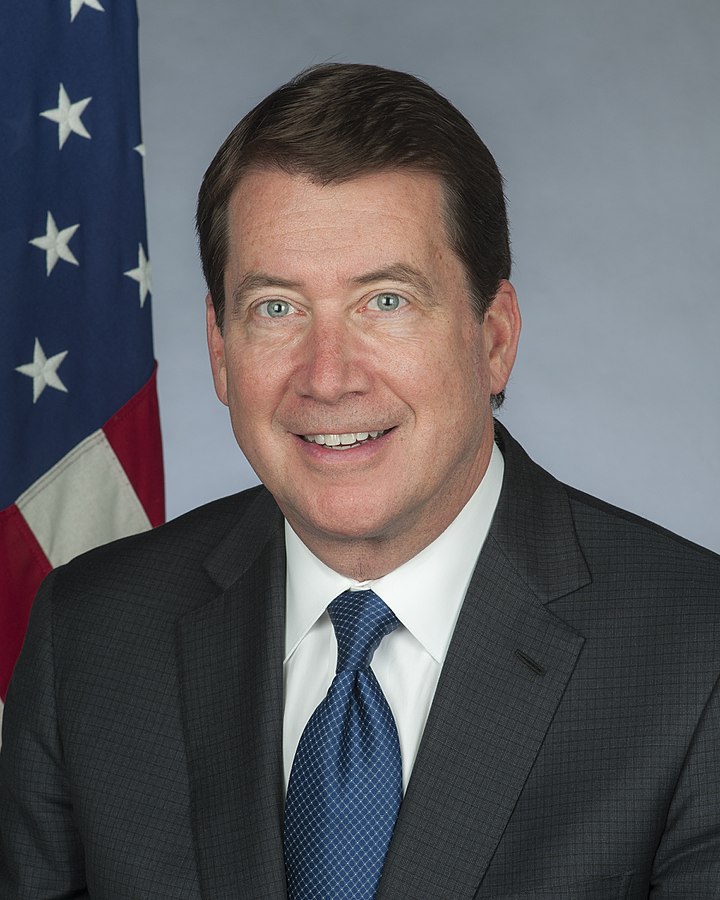
U.S. Ambassador to Japan William Hagerty
(Image: Wiki Commons)
TOKYO (Kyodo) -- New U.S. Ambassador to Japan William Hagerty met Prime Minister Shinzo Abe on Friday, with both expressing the will to work to strengthen the countries' alliance in light of heightened concern over North Korea.

Hagerty said after the meeting that he is convinced Abe and U.S. President Donald Trump are on the same page on North Korea, which last week threatened to fire ballistic missiles across Japan to waters near the U.S. territory of Guam in the western Pacific.

"I think that the prime minister and President Trump see the situation identically," Hagerty told reporters after his "very constructive dialogue" with Abe at the latter's office.

"We are working together very closely, and we're examining every option that we have to contain the (North Korean) regime," Hagerty said.

At the outset of the meeting, Abe told Hagerty of his hope that "we will be able to work together to further strengthen the Japan-U.S. alliance."

Read the full story at The Mainichi

News Story: US Osprey takes part in joint drill in Japan despite safety fears

SAPPORO (Kyodo) -- A controversial U.S. military Osprey aircraft took part Friday in a joint exercise between the Japanese Ground Self-Defense Force and the U.S. Marine Corps on Japan's northernmost main island of Hokkaido.

The MV-22 tilt-rotor transport aircraft joined the exercise despite local opposition, after the central government withdrew an earlier request to the United States to stop flying the plane for a period of time following a fatal crash of an Osprey off Australia.

The accident record of Ospreys, which take off and land like helicopters but cruise like airplanes, has raised concern in Japan.

Friday's exercise, open to the press, is the first time an Osprey has participated in Japan-U.S. joint drills since one of the aircraft based in Okinawa was involved in the Aug. 5 deadly crash in waters off Australia.

Defense Minister Itsunori Onodera said Tuesday that up to six Ospreys would join the exercise.

Read the full story at The Mainichi

18 August 2017

News Story: Japan, US conduct live-fire drill amid regional tension

Some 300 Japanese and US military personnel on Wednesday carried out live-fire artillery training in northern Japan, officials said, amid high regional tensions over North Korean missile threats.

The drill, part of a 19-day exercise, came after a tense war of words between the United States and North Korea over Pyongyang's threats to fire missiles towards the Pacific island of Guam.

Troops from Japan's Ground Self-Defence Force (GSDF) and US Marines fired live ammunition from armed vehicles at a manoeuvre area on the northern island of Hokkaido.

The two forces began the Northern Viper 2017 exercise on August 10, involving a total of 1,300 GSDF troops and 2,000 Marines.

"It is the first joint exercise between the GSDF and US Marines in Hokkaido," a defence ministry spokesman said.

The spokesman denied any link between the drill and recent regional tension over North Korea.

"This is not conducted with a particular country or region in mind," he said.

Read the full story at SpaceDaily

News Story: New US envoy says commitment to Japan's security 'ironclad'

U.S. Ambassador to Japan William Hagerty
(Image: Wiki Commons)
TOKYO (Kyodo) -- New U.S. Ambassador to Japan William Hagerty made clear on Wednesday he will focus on maintaining the "ironclad" security and economic alliance between Tokyo and Washington.

In a video message released by the U.S. Embassy in Tokyo ahead of his arrival, Hagerty said "there is no bilateral relationship more important to the United States than our alliance with Japan. Our commitment to the security of Japan and our economic partnership is ironclad."

Citing his three-year stay in Japan more than two decades ago, Hagerty called Japan his second home, and said, "As ambassador, I'm committed to bringing our two countries even closer together."

Hagerty built ties with Japan through his posting to Tokyo from the late 1980s to early 1990s while working for the management consulting firm Boston Consulting Group.

Read the full story at The Mainichi


01 August 2017

News Story: Abe, Trump agree to take new action after 2nd N. Korean ICBM

TOKYO (Kyodo) -- Japanese Prime Minister Shinzo Abe said he and U.S. President Donald Trump agreed in telephone talks Monday that they must take fresh action to tackle the threat from North Korea following Pyongyang's second test of an intercontinental ballistic missile.

"I completely agreed with President Trump on the recognition that we must take further action," Abe told reporters after the talks.

A senior Japanese official later said Abe and Trump agreed on the need to immediately impose measures against the North that are stronger than those previously discussed at the United Nations.

"We have made repeated efforts to resolve the North Korean issue peacefully, coordinating between Japan and the United States and with the international community, but North Korea has trampled all over these efforts and unilaterally escalated (the situation)," Abe said.

"China, Russia and the rest of the international community must take seriously this undeniable fact and increase their pressure," he said.

The ICBM launched late Friday night travelled for 47 minutes, according to North Korea's official media, before falling into the Sea of Japan inside Japan's exclusive economic zone.

Read the full story at The Mainichi

31 July 2017

News Story: New U.S. envoy eager to visit Okinawa to learn about base issues

WASHINGTON (Kyodo) -- New U.S. Ambassador to Japan William Hagerty expressed his eagerness Friday to visit Okinawa after his posting to Tokyo around mid-August so as to "better understand" issues involving U.S. military bases in the southernmost island prefecture.

Speaking at his first news conference since securing Senate confirmation on July 13, Hagerty said, "I indeed intend to go to Okinawa and to visit all of our military installations. I have a great fondness and appreciation and gratitude for the communities that host our military and make our military a fabric of their community life."

Asked about the impasse over the planned relocation of U.S. Marine Corps Air Station Futenma within the prefecture, he said, "My objective is to get to Japan and better understand the conflict that may exist."

"I think that the United States should play a constructive role," the 57-year-old businessman-turned-envoy said.

Many Okinawa residents oppose a Japan-U.S. plan to move the Futenma airfield from a crowded residential area of Ginowan to the less populated Henoko coastal area of Nago. Okinawa Gov. Takeshi Onaga has demanded that the base be moved outside the prefecture.

Read the full story at The Mainichi

21 July 2017

USA: USS Milius to forward deploy to Japan in 2018

From U.S. Naval Forces Japan Public Affairs

In this file photo, USS Milius (DDG 69) returns home to San Diego in 2015 following a deployment. (U.S. Navy/MC2 Ryan J. Batchelder) >>

YOKOSUKA, Japan - The U.S. Navy announced today that the ballistic missile defense (BMD)-capable guided missile destroyer USS Milius (DDG 69) will become part of the Forward Deployed Naval Forces (FDNF) based at Commander Fleet Activities Yokosuka, Japan in 2018.

The ship was initially planned to arrive this summer, but Naval Surface Forces, Pacific Fleet delayed the ship’s arrival to ensure completion of the ship’s maintenance and modernization, as well as to ensure that the ship completed testing and certification before joining the 7th Fleet.

Milius is undergoing a midlife modernization and will be fitted with the Aegis Baseline 9 combat system, which includes state of the art air defense, BMD, surface warfare and undersea warfare capabilities.

05 July 2017

News Story: Japan-U.S. security talks postponed

TOKYO (Kyodo) -- Japan and the United States have postponed security talks involving their foreign and defense chiefs planned for mid-July because U.S. Secretary of State Rex Tillerson will not be available around that time, a Japanese government source said Monday.

The postponement of the "two-plus-two" talks comes as Japanese Defense Ministry Tomomi Inada remains under pressure to resign over her gaffe in an election campaign speech, which has been said undermines the political neutrality of the Self-Defense Forces.

With Inada widely expected to be replaced in a Cabinet reshuffle rumored to be held soon, Tokyo is likely to go into the talks with a new defense minister.

Read the full story at The Mainichi