Showing posts with label Harrier. Show all posts

06 June 2017

USA: USS Bonhomme Richard arrives in Okinawa, embarks 31st Marines

By MC2 Kyle Carlstrom, USS Bonhomme Richard Public Affairs

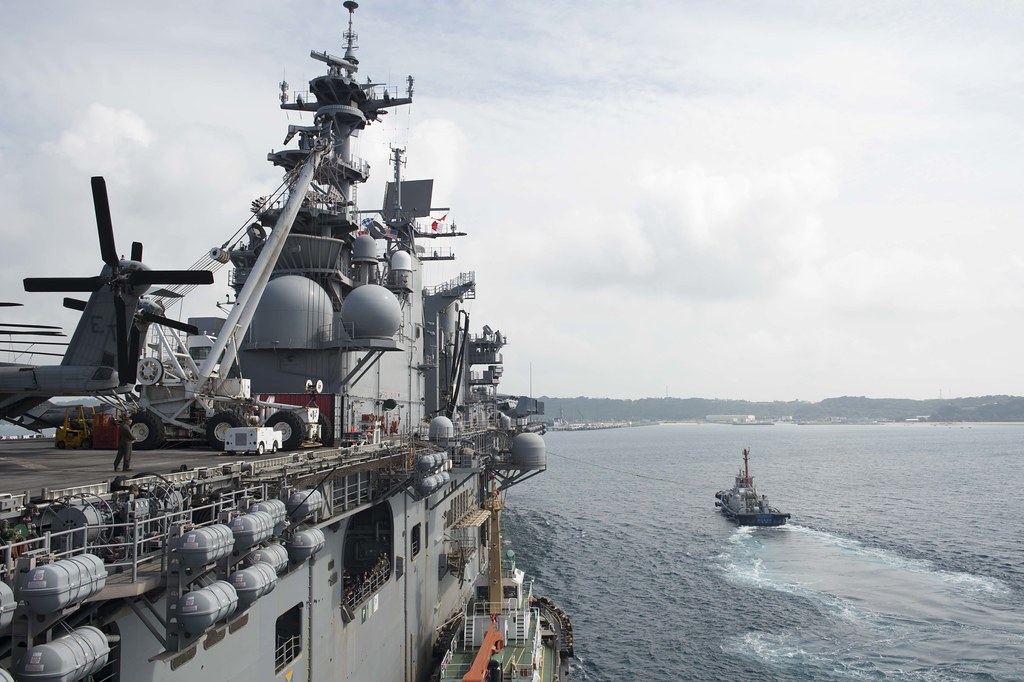
Tugboats guide USS Bonhomme Richard (LHD 6) as the ship arrives to White Beach Naval Facility to embark Marines of the 31st Marine Expeditionary Unit, June 5. (U.S. Navy/MC3 Cameron McCulloch) >>

OKINAWA, Japan - The Amphibious assault ship USS Bonhomme Richard (LHD 6) arrived at White Beach, Okinawa to embark Marines of the 31st Marine Expeditionary Unit (MEU), June 5.

During the visit, the ship will embark 31st MEU personnel, vehicles and equipment, prior to continuing a scheduled patrol.

During the transit from Sasebo, Japan, landing craft air cushions (LCACs) of Naval Beach Unit (NBU) 7, MV-22B Ospreys of Marine Medium Tiltrotor Squadron (VMM) 265, CH-53E Super Stallions of Marine Medium Tiltrotor Squadron (VMM) 262, AV-8B Harriers of Marine Attack Squadron (VMA) 311 and MH-60S Sea Hawks of Helicopter Sea Combat Squadron (HSC) 25 have all joined the Bonhomme Richard crew.

25 April 2017

News Report: US, South Korea Conduct Joint Air Combat Exercises Amid North Korea Tensions

Amid growing tensions on the Korean Peninsula, US and South Korean military forces have conducted joint air exercises in order to improve combat coordination between the two nations.

WASHINGTON (Sputnik) — US and South Korean military forces recently executed a joint air-to-air combat exercise at Kunsan Air Base in South Korea, US Pacific Command said in a press release on Monday.

"VMA-311 [US Marine Corps] AV-8B Harrier pilots combined forces with [South Korea] and US Air Force pilots and were split between two sides, red air and blue air, where they conducted a defensive counter air mission set," the release stated. "Blue air pilots were the allies and red air pilots played their invading adversaries."

The pilots fired simulated missiles against each other in a realistic dogfighting scenario requiring air combat fire and maneuver, with the "red air" pilots attacking friendly territory protected by the "blue air" pilots, the release explained.

Pacific Command said the April 17 exercise mixed South Korean and US military forces as an opportunity to fly co-op missions to improve combat coordination between the two nations.

The ongoing exercises are occurring amid tensions with North Korea, which most recently threatened to sink a US Navy strike group led by the aircraft carrier Carl Vinson.

This story first appeared on Sputnik & is reposted here with permission.

06 March 2017

USA: USS Bonhomme Richard arrives in Okinawa to embark Marines

From USS Bonhomme Richard Public Affairs

USS Bonhomme Richard (LHD 6) approaches White Beach Naval Facility , March 4. (U.S. Navy/MC3 William Sykes) >>

OKINAWA, Japan - Amphibious assault ship USS Bonhomme Richard (LHD 6) arrived at White Beach, Okinawa, March 4.

During the port visit, the ship will embark Marines of the 31st Marine Expeditionary Unit (MEU), along with their vehicles and cargo prior to departing for a routine patrol.

“We are going to be very busy while in port receiving a variety of equipment and assets,” said Gunnery Sgt. Matthew Armour, a combat cargo senior non-commissioned officer in charge. “There will be a lot of moving parts that have to be properly secured for sea.”

Armour explained that the primary focus will be preparing for Amphibious Integration Training (AIT) and certification exercise (CERTEX).

14 February 2017

USA: USS Bonhomme Richard completes underway unit-level training

By MC2 Diana Quinlan, USS Bonhomme Richard Public Affairs

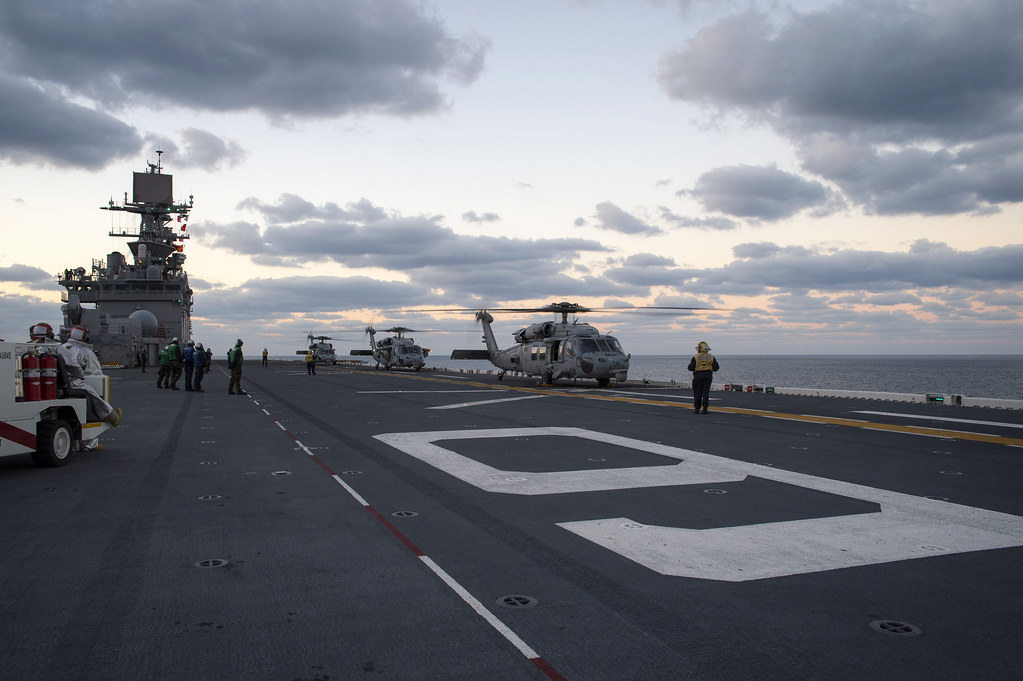
MH-60S Sea Hawks assigned to Helicopter Sea Combat Squadron (HSC) 25 prepare to depart USS Bonhomme Richard (LHD 6), Feb. 13. (U.S. Navy/MC3 William Sykes) >>

SASEBO, Japan - Amphibious assault ship USS Bonhomme Richard (LHD 6) returned to Sasebo, Japan, after completing unit-level training with Afloat Training Group Western Pacific (ATGWP), Feb. 13.

Above and below decks, Sailors and Marines worked hard to meet the goals set in front of them, whether it was launching AV-8B Harriers on the flight deck or keeping the ship’s boilers lit deep inside machinery rooms.

“Out at sea, ship’s readiness and operability are the responsibility of all hands,” said Capt. Jeffrey Ward, USS Bonhomme Richard, commanding officer. “During this short underway, our Sailors have completed monumental tasks ranging from engineering and firefighting drills to flight deck certifications. I am immensely proud of each and every Sailor aboard and the job that they do.”

09 February 2017

News Story: Top Marine Corps aviator wants F-35Bs faster than planned

An F-35B Lightning hovers as it comes in to land
By: Valerie Insinna

WASHINGTON — The Marine Corps’ top aviator is hungry for more F-35Bs, telling reporters on Wednesday that he would like to see the service’s buy rate increase to 37 jets per year. 

That would almost double the planned rate of F-35B procurement over the next few years, which is projected to sit at 20 aircraft per year from fiscal years 2018 to 2021. 

"We have the infrastructure in place,” said Lt. Gen. Jon Davis, deputy commandant for aviation. "Bottom line is we've had a very anemic ramp, so we've been holding onto the older airplanes longer. If asked by the American people to get the airplanes faster, I guarantee we'd put them into play very, very quickly. 

“We'd transition squadrons faster is what we'd do,” he said, adding that if the service were allowed to purchase 37 B-variants a year, it would be able to retire its legacy F/A-18 Hornet and Harrier planes by 2026. 

The Marine Corps currently owns about 50 F-35Bs in test, training and operations squadrons, and is gradually making the shift from Hornets and Harriers to F-35s, Davis said. In January, it relocated 10 F-35Bs from Marine Fighter Attack Squadron (VMFA) 121 from Marine Corps Air Station (MCAS) Yuma, Arizona to MCAS Iwakuni, Japan — marking the first international deployment of the short-takeoff-and-vertical-landing version. 

Read the full story at DefenseNews

24 September 2016

News Story: Okinawa gov't appeals high-court ruling backing U.S. base relocation plans

Futenma Air Station
TOKYO, Sept. 23 (Xinhua) -- The Okinawa prefectural government on Friday lodged an appeal to a ruling made by the Naha branch of the Fukuoka High Court supporting the central government's controversial moves to relocate a U.S. base within Japan's southernmost prefecture.

Okinawa Governor Takeshi Onaga was initially shot down by the high-court ruling made on Sept. 16, which found that Onaga's revocation of a landfill permit last October previously granted by his predecessor was "illegal."

The governor is a staunch advocate of blocking the central government's plans to relocate the U.S. Marine Corps Air Station Futenma from the crowded residential area of Ginowan to the less populated coastal area of Nago in Henoko, also on the island.

The court also found that Onaga's subsequent rejection of the government's calls to scrap the revocation were also against the law, stating that the authorization for the land reclamation by former Okinawa Governor Hirokazu Nakaima in 2013 was "legal."

The central and prefectural government have been locked in a fierce standoff over the issue, with both sides suing and counter suing each other over the matter, leading to a court mandated settlement in March this year.

Read the full story at Xinhua

30 July 2016

News Story: US To Return Land to Japan Used for Jungle Training

TAIPEI, Taiwan — The US military will return 4,000 hectares (15.4 square miles) of land in Okinawa back to the Japanese government, reducing the amount of land administered by the US military by 17 percent, according to a news release issued by the Public Affairs Office at Yokota Air Base, Japan, on Friday.

The area is a section of the Northern Training Area on Okinawa used for jungle warfare. The conditional land return is part of the 1996 Special Action Committee on Okinawa (SACO) report. This will be the largest parcel of land returned to the Japanese government since Okinawa’s reversion in 1972, said the news release.

The partial return of the Northern Training Area is one portion of other initiatives and agreements with Japan to consolidate US military facilities on Okinawa, with the eventual goal of returning most facilities south of Kadena Air Base. Kadena is home of the 18th Wing and includes two squadrons of F-15C/D fighter aircraft.

Read the full story at DefenseNews

12 May 2016

News Story: Indian Navy putting several remedial measures to avoid aircraft crash - naval chief

NEW DELHI, May 11 (Xinhua) -- Asserting that air safety is of paramount importance to the Indian Navy, the naval chief said on Wednesday that the force is putting up several remedial measures to avoid aircraft crashes.

"Air safety is of paramount importance to us and we have strict regulations to ensure that our aircraft follow standard operating procedures so that highest standards of safety are maintained," Indian Navy chief Admiral R.K. Dhowan told the media in the western state of Goa.

He added "In the life and the operation of an aircraft, there are various reasons where incidents occur. Every single incident is analysed, evaluated and we put in place remedial measures even before the board of inquiry comes out (with report)."

Read the full story at Xinhua

22 March 2016

News Story: Indian Navy Retires Sea Harriers

Indian Navy Sea Harrier (Image: Wiki Commons)
Vivek Raghuvanshi

NEW DELHI — The Indian Navy has retired the Sea Harrier fleet that operated from its aircraft carrier INS Viraat, and plans to replace them with MiG- 29Ks that India has bought from Russia.

The Indian Navy bought 30 British-made Sea Harriers in 1983 but only 11 now remain. The Navy once considered upgrading  the Sea Harriers but abandoned the plan.

The Sea Harrier pilots are now being trained to fly the Russian MiG 29K fighter aircraft. India had planned to replace the Sea Harriers with the homemade Light Combat Aircraft (Naval) version but the program is more than 15 years behind schedule, said an Indian Navy official.

Read the full story at DefenseNews

26 January 2016

News Story: F-16 Crash in US Part of Taiwan’s Secretive 'Gamblers' Program

By Wendell Minnick, Defense News

TAIPEI — The Jan. 21 crash of an F-16 fighter aircraft stationed at Luke Air Force Base, Arizona, was one of the few times the US government had acknowledged the existence of a Taiwan fighter trainer program within the continental United States.

According to a statement released by the Taiwan Air Force, Maj. Kao Ting-cheng died during air-to-air combat training when his fighter crashed in Yavapai County, north of Phoenix. He was a member of Taiwan’s 455th (4th) Tactical Fighter Wing (TFW), 22nd Fighter Group (FG), at Chiayi Air Force Base in west-central Taiwan.The American Institute in Taiwan (the de facto US Embassy) in Taipei acknowledged the crash and the death of the pilot in a news release issued by its director, Kin Moy, on the same day.

On Tuesday, Defense News will be given access to Chiayi AFB for a live exercise of the Air Force’s preparedness during the upcoming Chinese New Year, scheduled for Feb. 7 to 13. The 455th will demonstrate the F-16's capability in the event of a surprise attack by China.

Since Washington switched relations from Taipei to Beijing in 1979, China has pressured the United States to end all military activities and arms sales with Taiwan. Despite China’s best lobbying efforts, arms sales, including training, have continued to shore up the fledgling democracy.

Read the full story at DefenseNews

03 November 2015

USA: Essex Amphibious Ready Group, 15th MEU Depart 5th Fleet

From Essex Amphibious Ready Group Public Affairs

In this file photo, Naval Air Crewman 3rd Class Justen Thurman communicates with pilots from Helicopter Sea Combat Squadron (HSC) 21 as USS Essex (LHD 2) conducts maneuvers in the Gulf of Aden last week. (U.S. Navy/MC3 Christopher A. Veloicaza) >>

INDIAN OCEAN - The Essex Amphibious Ready Group (ARG) and the embarked 15th Marine Expeditionary Unit (MEU) departed the U.S. 5th Fleet area of operations (AOO) Nov. 1.

While on station in the U.S. 5th Fleet AOO, the ARG and MEU supported theater security cooperation efforts and provided a forward naval presence with crisis response, humanitarian assistance and combat capabilities. Additionally, MEU and ARG elements engaged in many operations and exercises, including bi-lateral training with the French military in Djibouti, and training with Jordanian marines. The ARG/MEU team also conducted more than a dozen subject matter expert exchanges with partner nations throughout the region.

Beginning in mid-August, AV-8B Harriers assigned to the MEU's aviation combat element launched from Essex's flight deck as part of the multinational coalition participating in Operation Inherent Resolve. The missions continued until mid-October when Essex began preparations to depart the theater.

25 August 2015

Think Tank: Sea, air and land updates (25-Aug-2015)

HMAS Canberra leaving Sydney Harbor
James Mugg, Mercedes Page and Zoe Hawkins

Sea State

Australia’s second Canberra-class Landing Helicopter Dock (LHD), HMAS Adelaide, is currently undergoing its final sea trials with a crew of BAE Systems employees and RAN personnel. Additionally, HMAS Canberra, the first of the LHDs, is in Townsville ahead of Sea Series amphibious exercises in Queensland’s far north.

A large Japanese delegation is visiting South Australia this week in support of Japan’s bid for Australia’s Future Submarine project, SEA 1000. The delegation is reportedly looking into negotiating local Australian industry participation in the project, should the Japanese bid be successful. French and German contenders, DCNS and TKMS, have also been touring Australia in support of their own bids for the submarine project.

David Shear, Assistant Secretary of Defense for the Asian-Pacific, has outlined the United States’ Asia–Pacific maritime security strategy in a Pentagon news conference. The strategy reiterates US desires to see territorial disputes in the South and East China Seas resolved peacefully. The US is also aiming to build greater transparency and risk reduction measures in the region to reduce the chances of ‘miscalculation’ around East Asian flashpoints.

13 July 2015

USA: Amphibious operations storm ashore for Talisman Sabre 2015

by Staff Sgt. Alexander Martinez
Pacific Air Forces Public Affairs

150708-N-NI474-171 FOG BAY, Australia (July 8, 2015) U.S. Marines, assigned to 2nd Battalion, 5th Regiment, practice an amphibious assault using assault amphibious vehicles during Talisman Sabre 2015 at Fog Bay, Australia, July 8, 2015. (U.S. Navy photo by Mass Communication Specialist 2nd Class Daniel M. Young/Released) [Image: Flickr User - U.S. Pacific Command] >>

FOG BAY, Australia - U.S. and Australian forces stormed the beaches of Fog Bay July 11, executing joint amphibious operations, the largest and most complex joint amphibious training of its kind, as part of Talisman Sabre 2015.

To kick off the amphibious landing, a line of assault amphibious vehicles (AAV) crashed ashore, releasing hundreds of joint forces to survey and secure the beach, and prepare the area for the landing of vehicles, cargo and personnel that would follow. 

Participating assets included U.S. Navy ships and aircraft as part of an offshore amphibious readiness group, forces from the 31st Marine Expeditionary Unit and 2nd Brigade, Royal Australian Regiment soldiers.

News Story: Thai Chinese Sub Buy Challenges US Pivot

By Wendell Minnick

TAIPEI — Thailand's move to purchase Chinese submarines has exacerbated tensions with the US and poses a challenge to Washington's "pivot" to the Pacific.

The military junta, which declared a coup in May 2014 and created the National Council for Peace and Order, could turn to China for political and military support and cooperation, analysts said. The junta-led Cabinet approved the purchase of three Type 039A (Yuan) attack submarines in early July.

After the coup, the US reduced its presence at the annual Cobra Gold military exercises held with Thailand, and postponed further discussion on planning 2016 exercises.

There are fears in the region that US sanctions are pushing Thailand into China's political sphere, said Martin Sebastian, head of the Centre for Maritime Security and Diplomacy, Maritime Institute of Malaysia.

"The US is giving the junta the cold shoulder, apparent during the Cobra Gold Exercise," he said.

The sub decision will worsen the drift in Thai-US relations and frustrate the US' rebalance strategy, said Thitinan Pongsudhirak, director of the Institute of Security and International Studies at Bangkok's Chulalongkorn University.

"It is building into a kind of brinkmanship from Bangkok which will require the US to weigh its values and interests carefully," he said

Read the full story at DefenseNews

05 June 2015

News Story: PLA VTOL fighter could turn reefs into 'unsinkable carriers'

US Marine Corps AV-8B Harrier II (Image: Wiki Commons)
China is planning to continue developing its short-range vertical take-off and landing (VTOL) fighter, according to Russian state-owned news agency Sputnik International, cited by the military news web portal of China's state-run Reference News.

Given the cost of the project, there is seemingly an important strategic decision behind it, according to the report.

Vasily Kashin, a researcher with the Moscow-based non-governmental research organization the Center for Analysis of Strategies and Technologies, said that the aircraft will be mainly used for maritime combat.

Theoretically the fighter could be used in areas without airports, including difficult and mountainous terrain, according to the report. The Soviet Union tried to use vehicle-towed platforms to allow its VTOL Yakovlev Yak-38 strike fighter to operate in Afghanistan in the 1980s. However, in mountainous regions the aircraft's lift jets were ineffective, so such a large aircraft found vertical take-off difficult, according to the website.

The US Marine Corps frequently used the McDonnell Douglas (now Boeing) AV-8B Harrier II ground attack aircraft in Afghanistan. However, these aircraft used conventional air bases, not making use of their VTOL functions. In theory, whenever a runway is destroyed by enemy forces, the VTOL function comes into play. However, the AV-8B is rather limited in capability compared to other fighters.

Read the full story at Want China Times

04 August 2014

News Story: US enhances nuclear strike capability at Guam - Sankei Shimbun


The United States is enhancing its nuclear strike capability at Guam for a potential confrontation against China in the Far East, the Tokyo-based Sankei Shimbun reported on July 30.

General John M Paxton Jr, the assistant commandant of the Marine Corps, said at a Navy hearing that the US military forces in Japan are improving their capability to launch amphibious operations against the China coast should conflict break out in the East or South China seas. He said the US Marine Corps has a total of four amphibious assault ships and amphibious transport docks under its command at United States Fleet Activities Sasebo.

Read the full story at Want China Times

20 June 2014

Think Tank: (AUS) LHD and STOVL - An engineer’s view


By Steve George

As a military aircraft engineer, I’ve been associated with STOVL aircraft operations for around 30 years, and have worked on the F-35 program. So I’ve followed the current discussions around potential use of F-35B from the Canberra-class LHDs with interest.

In my view, it’s remarkable how much the debate focuses on the problems that the aircraft would face in operating from those ships rather than the potential benefits to be gained. Assertions abound about the ‘limited’ nature of F-35B operations from an LHD, and the ‘severe challenges’ involved in generating a militarily ‘decisive impact’ from ‘small’ platforms. And yet for 30 years or more the UK and US (using AV-8Bs and Sea Harriers) have delivered significant operational effect from similar platforms. Clearly, STOVL at sea can work. So I’d like to offer a few observations that might assist and inform the debate.

For STOVL aircraft, the Canberra class isn’t a ‘small’ ship. They’re actually much larger than the RAN’s last carrier, HMAS Melbourne, and significantly bigger than the UK’s highly effective Invincible class. Their flight decks are nearly as big as Wasp class LHDs decks, for which the F-35B was designed. Indeed, the Canberra class actually have more suitable decks for F-35B operations; their ski jumps would deliver significantly improved launch payloads and safer launches. The point here is that STOVL is a truly disruptive technology. It allows LHD-sized vessels to deliver a level of maritime aviation capability previously limited to large conventional carriers.

14 June 2014

India: Prime Minister to Embark INS Vikramaditya Tomorrow

INS Vikramaditya (File Photo)

The Prime Minister Shri Narendra Modi is scheduled to embark INS Vikramaditya, the latest aircraft carrier inducted into the Indian Navy, for a ‘Day at Sea’ with the Western Fleet tomorrow ( 14 Jun 14). The Prime Minister would be embarking the ‘carrier at sea’ by helicopter and is likely to witness a host of exercises by the frontline warships and aircraft of the Indian Navy. 

Shri Modi would be received at INS Hansa (Naval Air Station at Goa) by the Chief of Naval Staff Admiral RK Dhowan and a 150 men ceremonial ‘Guard of Honour’ would be presented to him on arrival. 

During the day, the Prime Minister would witness ‘Air Power Demonstration’ by various naval aircraft including MiG 29K, Sea Harriers, P 8 I Long Range Maritime Patrol Anti-Submarine Warfare aircraft, TU 142M, IL 38 SD, Dorniers, Kamov and Sea King helicopters. He will also watch high speed manoeuvres by Western Fleet ships including aircraft carrier INS Viraat, Delhi class destroyers, Talwar class frigates etc. The Prime minister shall also witness the take-off and ‘arrestor wire landing operations’ and high speed low level operations of MiG29 K integral fighters onboard the flight deck of INS Vikramaditya. 

The Prime Minister is also scheduled to meet and interact with the crew onboard and address the officers and sailors of the Indian Navy.

01 April 2014

USA: Waves of ROK, U.S. Marines roll onto beach


By Lance Cpl. Cedric R. Haller II
III MEF/MCIPAC Consolidated Public Affairs Office

<< Pohang, Gyeongsangbuk province, South Korea - More than 20 U.S. Navy and Republic of Korea (ROK) ships, from the Bonhomme Richard Amphibious Ready Group (ARG), Boxer ARG and ROK Flotilla Five, participate in a joint amphibious landing training exercise March 31. The Bonhomme Richard Amphibious Ready Group, 3rd Marine Expeditionary Brigade, and ROK Flotilla Five are participating in Exercise Ssang Yong, an annual combined exercise conducted by U.S. Navy and Marine forces with the Republic of Korea in order to strengthen interoperability across the range of military operations. (U.S. Navy photo by Chief Mass Communication Specialist Wendy Wyman/Released)

POHANG, Republic of Korea -- Republic of Korea, U.S. and Australian armed forces demonstrated combined amphibious landing capabilities during Ssang Yong 2014 in Pohang, Republic of Korea.

Ssang Yong 14 incorporates more than 13,600 U.S. and ROK Navy-Marine and Australian Army forces, and effectively demonstrates the unique abilities of forward-deployed Marine air-ground task forces with allied partners.

“This is a combined exercise that we began planning for many months ago and we’ve worked very hard with our ROK Marine partners,” said U.S. Marine Lt. Gen. John Wissler, commanding general of III Marine Expeditionary Force. “It began with the academics of studying the art of amphibious techniques.”

27 March 2014

Editorial: Are Fighters the New Capital Ships?


By Robert Farley

Air war has, in effect, become as costly as naval war. What are the implications for strategy?

Admirals are notoriously conservative regarding their capital ships. By the early twentieth century, the cost of a battleship and the time required for construction demanded extraordinary care with respect to the survival of the vessels. Capital ships do not simply represent or implement national power; because of their great cost and the long periods of construction, they effectively constitute national power. The loss of a battlefleet represented a catastrophic expenditure of national treasure, not to mention blood. This logic was on the minds of the German and British commanders at Jutland, as well as dear to the Japanese admirals who so desperately husbanded their strength into 1944.
Air forces have not, historically, conceived of air frames in the same way.  Cheaper, with quicker production times, and carrying fewer personnel, generals have viewed aircraft as more expendable. Even as late as Vietnam, the USAF suffered the loss of over 2,000 aircraft across the course of the conflict. 

Read the full story at The Diplomat