04 September 2014

Editorial: Is China A Lonely Diva?


By Vasilis Trigkas

Chinese scholars are debating whether Beijing should abandon its non-alignment policy. But it may have already done so.

External balancing or alliance formation has been one of the pillars of realpolitik in interstate politics going back to Thucydides’ declaration that alliance formation was a leading indicator for the forthcoming war between Athens and Sparta in Classical Greece.
Recently the United States has intensified its external balancing behavior by reengaging with old friends in Asia-Pacific (Philippines, Japan, Korea) and looking to make new ones (MyanmarIndiaVietnam). The U.S. has sought to solidify its triangular alliance with Tokyo and Seoul while some strategic analysts and generals have even called for an Asiatic version of NATO as a strategic response to China’s increasing assertiveness.
Omnipotence post-WWII and post-Cold War, along with the ideological and pragmatic preeminence of the “liberal global order,” have endowed the United States with a global network of political and military alliances. It is in striking contrast with the recovering yet lonely “diva” like China.
Historically, before the concept of nations, China was an economic and military, soft and hard power center for eastern Asia. Whether seeking trade or in need of protection, countries gravitated towards China as part of the tributary system. Yet today China is a lonely power with a single ally: North Korea. After the original world revolutionary zeal of the 1950s and 60s and the alliance of necessity with Stalin’s Soviet Union, Beijing has followed a non-aligned trajectory, with strategic non-binding engagement on an ad hoc basis only, first with the U.S. against the Soviet Union and lately with Russia against the Western interventions or Pakistan against India. 

Read the full story at The Diplomat

Editorial: How India Can 'Balance' Relations with Japan and China


By Ankit Panda

Decoupling economic issues from strategic issues might be the best way for New Delhi to keep both Tokyo and Beijing happy.

Both Nitin Gokhale and Sanjay Kumar have cautioned in these pages that as India deepens its strategic partnership with Japan, it must be careful to consider its bilateral position vis-a-vis China. Given geopolitical realities in Asia today, Beijing is noticeably and understandably concerned with the growing rapprochement between Asia’s largest and richest democracies. While neither India nor Japan can independently stand against China on most standard measures of state power, together they form a considerably robust bulwark for the status quo in the region. For New Delhi, the ideal scenario would be to maintain positive economic relations with both countries while deepening security and strategic cooperation with Tokyo and maintaining an amicable detente with Beijing. In short, New Delhi seeks a positive-sum outcome with both countries. Achieving this won’t necessarily require traditional balancing, where New Delhi modifies its behavior to comply with the preferences of other actors (in this case Beijing). Rather, India’s interests would be best served by decoupling material and economic questions from broader strategic and security issues.
“Decoupling” is something that nearly every diplomatically mature state does — or at least tries to do. Simply put, the term describes the management of economic relations, including investment, development, and trade agreements, independent of broader strategic issues. The contemporary relationship between the United States and China is a good example of a relatively successfully decoupled bilateral relationship — major strategic issues persist but economic interdependency is amply developed, resulting in stability and mutual growth. India would do well to take this diplomatic paradigm to heart when it comes to interactions with both Beijing and Tokyo. As Modi’s recent visit to Japan demonstrates, in the India-Japan relationship, strategic issues, such as defense cooperation and even the civil nuclear cooperation agreement, run on a different track than economic issues. Modi returned from Tokyo with $34 billion in Japanese investment in tow while issues like the ShinMaywa US-2 aircraft deal, civil nuclear cooperation, and the two-plus-two dialogue were set aside for later. In broader terms, since the 2006 declaration of a “Strategic and Global Partnership (PDF),” economic and strategic relations have grown at different paces. 

Read the full story at The Diplomat

Editorial: Will the Islamic State Gain Influence in South Asia?


By Ankit Panda

The Islamic State will have a hard time gaining a foothold in South Asia.

Following its sudden rise to international notoriety this summer, the Islamic State (IS, formerly ISIS/ISIL) seems to slowly be gaining traction with Islamic extremist groups across the world. Following its declaration of a caliphate encompassing the inner Levant, IS has allegedly expanded its influence eastward, toward South Asia. IS is reportedly distributing pamphlets in Dari and Pashto in Afghanistan as well as in Pakistan. According to Pakistan’s Tribune, the extremist group distributed a booklet titled “Fatah” in Peshawar as well as in Afghan refugee camps.
The group has also found some traction with local extremist groups. Earlier this week, the BBC reported that a Taliban-aligned Islamic militant group in Afghanistan, Hezb-e-Islami, would join the caliphate. Although the group has denied the claims made by the BBC report, the group wouldn’t have been the first in the region to declare its allegiance to the IS and the caliphate. Earlier this summer, Tehreek-e-Khilafat, a Pakistan-based terror group, pledged its allegiance to Abu Bakr al-Baghdadi, the leader of IS and its self-declared caliph.
Read the full story at The Diplomat

03 September 2014

AUS: ADF completes military stores mission to Iraq


An Australian C-17A Globemaster aircraft has landed at Al Minhad Air Base in the United Arab Emirates (UAE) after delivering military stores to Erbil, Northern Iraq.

The aircrew flew from Al Minhad Air Base over the weekend via Tirana, Albania where the aircraft was loaded.

The aircraft’s crew has confirmed that no shots were fired at the aircraft and that their mission was carried out without incident.

Chief of Joint Operations, Vice Admiral David Johnston said further aid, stores and support flights may be planned to assist the people of northern Iraq, who remain under threat from extremist Islamic fighters.

“The aircrew and support staff at Joint Task Force 633 have done a great job to successfully coordinate this mission to assist the people of northern Iraq,” Vice Admiral Johnston said.

USA: George Washington Continues Patrol in Indo-Asia-Pacific


By Mass Communication Specialist 3rd Class Chris Cavagnaro

<< In this file photo, USS George Washington (CVN 73) returns to Yokosuka, Japan, Aug. 8 following a Western Pacific patrol. (U.S. Navy/MC3 Liam Kennedy)

YOKOSUKA, Japan - The U.S. Navy's forward deployed aircraft carrier USS George Washington (CVN 73) departed Fleet Activities Yokosuka, Japan, to patrol the Indo-Asia-Pacific region as the flagship for the George Washington Carrier Strike Group (GWCSG), Sept. 2.

George Washington spent the last month in port conducting a scheduled maintenance period after spending more than two months at sea.

"I'm extremely proud of the work the crew accomplished during the maintenance availability period to prepare the ship for the remainder of our patrol," said Capt. Greg Fenton, George Washington's commanding officer. "Our time in port was very successful. We were able to take care of a lot, reset and get us ready to go for what should be a rigorous and rewarding patrol."

USA: Humanitarian Operations, Airstrikes Will Continue in Iraq

A C-17 Globemaster drops cargo during training (File Photo)

By Claudette Roulo
DoD News, Defense Media Activity

WASHINGTON, Sept. 2, 2014 – Air operations in Iraq continue in support of President Barack Obama’s directives to support Iraqi and Kurdish forces in their fight with terrorists from the Islamic State of Iraq and the Levant, provide humanitarian assistance to Iraqi civilians and protect U.S. personnel and facilities, Pentagon Press Secretary Navy Rear Adm. John Kirby said today.

Aircraft from U.S. Central Command, Australia, France and the United Kingdom delivered humanitarian aid over the weekend to thousands of Shia Turkomen living in the Iraqi village of Amirli, Kirby said at a Pentagon news conference. The village was besieged by ISIL forces two months ago and has been cut off from food, water and medical supplies since then.

News Story: Chinese War Plans


Can China defeat U.S. forces in the Western Pacific with a surprise attack? According to the Chinese, at least in public statements, they believe they can. Developing this capability has been in the works since the 1990s, as China built up its force of ballistic missiles (with high explosive warheads) on their coast to deal with Taiwan and Japan. There are over a thousand of those missiles now, plus a dozen or so that, in theory, can hit an American carrier at sea. Chinese warplanes have been practicing attacks over water and the Chinese fleet is at sea lot more. Chinese subs are stalking American warships and China triumphantly announces “successes” when these subs sneak up on an American carrier. China is also known to have stolen a lot of American defense secrets via over a decade of Internet based espionage.

The problem here is that, in any major war, both sides do not know everything about what the other side has, nor is able to accurately predict how the known and concealed plans of each side will turn out once the fighting starts. This is an important point for the Chinese as they need to win quick because a protracted war would produce economic collapse in China. That would produce major political problems for China’s leaders. According to the Chinese military this is not a problem because the Chinese generals and admirals seem increasingly confident of a quick victory via surprises.

Read the full story at StrategyPage

News Story: Expansion boosts Woody Island's strategic use for China


To strengthen its presence in the disputed South China Sea, China is expanding its runway and redeveloping a harbor on Woody Island, the largest of the Paracel Islands, which are claimed variously by Vietnam, China and Taiwan, the London-based Jane's International Defence Review reported on Aug. 29.

Known in China as Yongxing Island, Woody Island was occupied by the People's Liberation Army in 1956, although it had previously been occupied by the Republic of China from 1946 to 1950, before going unmanned for six years. Facilities including a military garrison, coastal defensive positions, a runway, four large aircraft hangars, a communications facility, and municipal headquarters have since been established on the island, which is now the government seat of Sansha, set up in 2012 to administer the Paracels, Spratlys and Macclesfield Bank. The entire territory is disputed.

Read the full story at Want China Times

News Story: Taiwan develops new weapons to counter PLA's J-20 and S-400

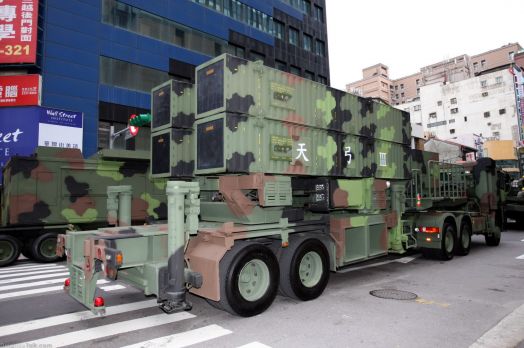
Tian-Gong III (SkyBow III) Air Defense System

Taiwan has invested about US$2.5 billion to develop and purchase new air defense systems to counter the threat of the People's Liberation Army's J-20 fifth-generation stealth fighter in any potential military conflict, according to a report from Agence France-Presse on Sept. 1.

According to Lin Yu-fang, a legislator for the ruling Kuomintang, the defense ministry plans to replace the older US-built HAWK air defense system with domestic Tien Kung-III (Sky Bow) missiles between 2015 and 2024. Lin said that the missile, designed by the Chung-Shan Institute of Science & Technology, is aimed at defense against advanced PLA ballistic missiles and fighters like the J-20 in a potential conflict. The purchase is aimed directly at strengthening Taiwan's air defense capabilities, according to Lin.

Read the full story at Want China Times

News Story: China incapable of full attack on Taiwan proper - defense ministry


China's military is capable of seizing Taiwan-held islands near the mainland and taking over islets in the disputed South China Sea area, but cannot yet launch a full scale attack on Taiwan proper, Taiwan's Ministry of National Defense (MND) said Monday.

In a report on China's military might in 2014 and another report on Taiwan's military overhaul plan for the next five years, the ministry said that any move by China against Taiwan at this time could include military intimidation, blockade or military strikes.

With the use of electromagnetic, air and sea warfare, China could paralyze most of Taiwan's combat ability and seek to land on the island for a quick decisive occupation, the ministry said.

It said, however, that China does not have enough military vessels to transport its amphibious forces and is therefore incapable of launching a full scale attack on the main island of Taiwan.

Read the full story at Want China Times