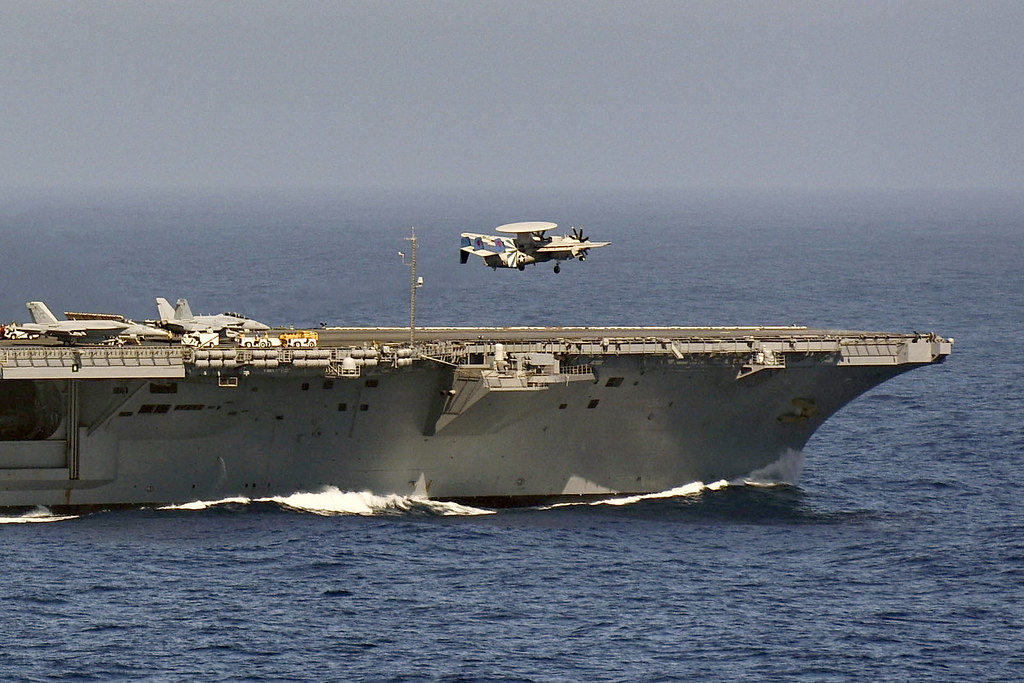
Showing posts with label E-2 Hawkeye. Show all posts

10 August 2017

News Story: 5 U.S. early warning planes arrive at base in W. Japan as part of realignment plan

E-2 Hawkeye (Image: Wiki Commons)
TOKYO, Aug. 9 (Xinhua) -- Five U.S. military E-2D early warning airplanes arrived at the Marine Corps Air Station Iwakuni in western Japan on Wednesday, in the first phase of the relocation of an air wing from a U.S. base near Tokyo.

The E-2D "Hawkeye" planes, an all-weather, carrier-capable tactical airborne early warning (AEW) aircraft, are among 61 aircraft that will be relocated from the Naval Air Facility Atsugi in Kanagawa Prefecture, near Tokyo, to the U.S. Marine Corps Air Station Iwakuni in Yamaguchi Prefecture.

The move is based on an accord reached between Japan and the United States in 2006 on the realignment of U.S. forces in Japan.

The pact will also involve attack aircraft and other planes that have been operating from the aircraft carrier Ronald Reagan, which is based at the Yokosuka naval base in Kanagawa Prefecture near Tokyo

The move from Atsugi was also based on the government's bid to reduce noise pollution suffered by local residents largely related to the aircraft deployed on the carrier.

Local residents have filed a number of lawsuits calling for an early realignment of the planes.

The relocation is expected to be completed by next spring, with the Iwakuni base set to accommodate 120 aircraft and 3,800 extra personal.

Read the full story at Xinhua

27 February 2017

News Story: Japan scrambling more fighters in response to China activities

TOKYO (Kyodo) -- Japan's Defense Ministry has doubled the number of fighter jets scrambled in each response to foreign airplanes approaching its airspace on the back of China's intensifying military activities around the disputed Senkaku Islands in the East China Sea, government sources said Saturday.

Japan's Air Self-Defense Force began scrambling four fighter jets since last year in each case of potential airspace violation by foreign aircraft, they said.

The ASDF previously sent two jets in each scramble since it began such missions in 1958.

The number of scrambles by Japan and China has been surging in areas near the Japan-controlled, China-claimed Senkaku Islands in Okinawa Prefecture where the two countries' air defense identification zones overlap.

The two countries have yet to establish a communication mechanism to avoid any accidental aerial or maritime clash.

Read the full story at The Mainichi

03 February 2017

USA: E-2D Advanced Hawkeye aircraft arrive in Japan

From Naval Forces Japan Public Affairs

Five E2-D Advanced Hawkeye aircraft with Carrier Airborne Early Warning Squadron (VAW) 125 taxi the runway after arriving at Marine Corps Air Station Iwakuni. (U.S. Navy/MC1 Gabriel S. Weber) >>

IWAKUNI, Japan - Carrier Airborne Early Warning Squadron (VAW) 125 arrived at Marine Corps Air Station (MCAS) Iwakuni, Feb. 2.

The "Tigertails" of VAW-125 are relieving the "Liberty Bells" of VAW-115 as the early-warning squadron of the U.S. Navy's Carrier Air Wing (CVW) 5, supporting the Ronald Reagan (CVN 76) Carrier Strike Group.

"We are excited to join the forward-deployed naval forces at Marine Corps Air Station Iwakuni in the amazing city of Iwakuni," said Cmdr. Daniel Prochazka, VAW-125's commanding officer. "I would like to thank the city for its hospitality and for warmly welcoming us to this incredible place. This is my second time in the forward-deployed naval forces. My fond memories make me personally very thrilled to be back."

02 February 2017

News Story: Indian Navy Releases RFI for New Carrier-borne Fighter

F/A-18E Supper Hornet Fighter
by Neelam Mathews

The Indian Navy has released a detailed Request for Information for procurement of 57 Multi-Role Carrier Borne Fighters (MRCBF). The move follows the navy’s rejection of the naval version of the indigenous HAL Light Combat Aircraft (LCA) for its planned IAC-2 (Indian Aircraft Carrier) that is designed for catapult launch and arrested recovery, and the existing IAC-1, which has a ski-ramp for launch. The Boeing F/A-18 Super Hornet would appear to be the leading contender, with the Dassault Rafale M another possibility.

The RFI states that the MRCBF should be a day and night capable, all-weather multi-role combat aircraft that can be used for air defense; air-to-surface operations; buddy refueling; reconnaissance; and electronic warfare missions. The life-cycle cost of the aircraft (post warranty) is an important consideration, with two depot-level repair facilities. India wants the transfer of critical technology and the participation in that process by Indian second-tier suppliers and those who can contribute to the supply chain.

The deadline for responses to the RFI is May 17. The Request for Proposal will be released once the RFI is reviewed. The deliveries of the aircraft should start within three years of signing the contract, and be completed within a further period of three years.

Read the full story at AINonline

06 January 2017

USA: Navy's E-2D Advanced Hawkeye to deploy to Japan

From Naval Forces Japan Public Affairs

In this file photo, an E2-D Advanced Hawkeye from VAW-121 preforms a touch and go on USS Nimitz (CVN 68) in October. (U.S. Navy/MC2 Siobhana R. McEwen) >>

YOKOSUKA, Japan - The U.S. Navy's newest airborne early warning and control aircraft, the E-2D Advanced Hawkeye, will join the Forward Deployed Naval Forces (FDNF) as part of Carrier Air Wing (CVW) 5 in Japan in February 2017.

Carrier Airborne Early Warning Squadron (VAW) 125, which flies the E-2D, will forward deploy to Marine Corps Air Station (MCAS) Iwakuni, and replace Airborne Early Warning Squadron (VAW) 115, which flies the older E-2C. VAW-125, coming from Naval Station Norfolk, Va., is the first VAW squadron to transition to the Advanced Hawkeye.

The U.S. Navy is also scheduled to begin a phased relocation of CVW-5's fixed-wing aircraft from Naval Air Facility (NAF) Atsugi to MCAS Iwakuni. The move comes as part of the Defense Policy Review Initiative (DPRI) as directed in the May 1, 2006 Security Consultative Committee Document (also known as the U.S.-Japan Roadmap for Realignment).

15 November 2016

USA: Ronald Reagan Carrier Strike Group Completes Biennial Keen Sword Exercise with JMSDF

USS Ronald Reagan (File Photo)
By Commander, Task Force (CTF) 70 Public Affairs

WATERS SOUTH OF JAPAN (NNS) -- Directed by the commander of U.S. Forces Japan and the Chief of Staff of the Japan Joint Staff, KS17 is the latest in a series of joint and bilateral field training exercises since 1986 involving U.S. military and Japanese Self Defense Force (JSDF) personnel designed to increase combat readiness and interoperability of the Japan-U.S. alliance.

Japan Maritime Self-Defense Force (JMSDF) Rear Adm. Tatsuya Fukuda, commander, Escort Flotilla Four, and six JMSDF officers embarked USS Ronald Reagan (CVN 76) for the duration of the exercise. The embarked JMSDF personnel worked closely with Destroyer Squadron (DESRON) 15 on the watchfloor aboard Ronald Reagan to take charge of the 10 U.S. and JMSDF surface forces participating in the exercise. 

"We came aboard Reagan for two reasons," said Rear Adm. Fukuda. "To coordinate and seamlessly liaison with DESRON 15 for KS17 events, and, more importantly, to learn firsthand the latest maritime tactics and procedures. The United States always has the most cutting edge technology and command and control structures; it is good to learn from our ally."

09 August 2016

USA: CVW-5, Japanese squadron continue milestone exercise

By Lt. Brian Dallaire, VFA-195 Public Affairs

An E-2C Hawkeye from VAW-115, an F/A-18E Super Hornet from VFA-195, and an F-4EJ Phantom II fighter from the JASDF's 302nd Tactical Fighter Squadron fly in formation as part of the second Benkyoukai training exercise. (U.S. Navy/Cmdr. Guy Snodgrass) >>

ATSUGI, Japan - The second annual Benkyoukai training event between the Japan Air Self Defense Force (JASDF) and Carrier Air Wing (CVW) 5 was conducted Aug. 1-4.

The weeklong event, led by the Dambusters of Strike Fighter Squadron (VFA) 195, incorporated dissimilar air combat training (DACT) with the Japanese 302nd Tactical Fighter Squadron (TFS).

“We are incredibly pleased with the results from this most recent round of training and are already looking forward to the next Benkyoukai event,” said Capt. John Enfield, commanding officer of CVW-5, “The next series of events will significantly expand the number of participants as USN and JASDF forces continue to build upon a strong start.”

The first Benkyoukai, a Japanese word that translates to mean partnership and collaborative learning, took place in April and incorporated F-15J Eagles from the 305th TFS, F-4EJ Phantom II fighters from the 302nd TFS, and F/A-18E Super Hornets from VFA-195.

05 August 2016

Industry: Northrop Grumman Begins Work on Second Japanese E-2D Advanced Hawkeye

An E-2C Hawkeye of the US Navy (Image: Wiki Commons)
FALLS CHURCH, Va., Aug. 3, 2016 (GLOBE NEWSWIRE) -- Northrop Grumman Corporation (NYSE:NOC) has received a U.S. Navy contract to begin production of a second Japanese E-2D Advanced Hawkeye airborne early warning (AEW) and surveillance aircraft.

The first Japanese E-2D is in production and will be delivered in 2018.

The aircraft will be produced at the company's Aircraft Integration Center of Excellence in St. Augustine, Florida. Northrop Grumman will manufacture the Japanese E-2D on the same multiyear production line used for U.S. aircraft, which allows for a more efficient and affordable delivery schedule. The E-2D is the world's only AEW aircraft in production.

"For more than 50 years, Northrop Grumman has partnered with Japan by providing a range of capabilities and technologies in defense, security and communications," said Jane Bishop, vice president, E-2D Advanced Hawkeye programs, Northrop Grumman. "We are honored to continue this strong partnership through the E-2D program, which brings Japan a powerful new tool that meets their immediate airborne surveillance needs and facilitates information sharing across many platforms, making it a force multiplier for the future as well."

In 2014, the Japanese Ministry of Defense competitively selected the E-2D to fulfill the nation's AEW requirements. The Japan Air Self-Defense Force has operated the E-2C Hawkeye since the 1983. The E-2C is also currently used by Taiwan, France and Egypt.

06 January 2016

Industry: Northrop Grumman to Produce First Japanese E-2D Advanced Hawkeye

US Navy E-2D Hawkeye (Image: Wiki Commons)
REDONDO BEACH, Calif., Jan. 5, 2016 (GLOBE NEWSWIRE) -- Northrop Grumman Corporation (NYSE:NOC) has received a U.S. Navy contract modification for non-recurring engineering and recurring support to configure the first Japanese E-2D Advanced Hawkeye.

The E-2D is an all-weather, airborne early warning (AEW), command and control aircraft that will meet the Japanese Defense Ministry's requirements for a future airborne early warning platform, according to a statement it released in November 2014. The aircraft will be produced at the company's Aircraft Integration Center of Excellence in St. Augustine, Florida.

24 November 2015

USA: USS Theodore Roosevelt Returns from World Deployment

From Theodore Roosevelt Strike Group Public Affairs

Sailors and Marines man the rails as USS Theodore Roosevelt (CVN 71) arrives in San Diego on Monday. (U.S. Navy/MCSN Chad M. Trudeau) >>

SAN DIEGO - Aircraft carrier USS Theodore Roosevelt (CVN 71) arrived at her new homeport of Naval Air Station North Island, Coronado, California, with embarked Theodore Roosevelt Carrier Strike Group (CSG) 12, Carrier Air Wing (CVW) 1 and Destroyer Squadron (DESRON) 2, following a scheduled eight and a half-month deployment to the U.S. 5th, 6th and 7th Fleet areas of operation (AOO) Nov. 23.

The aircraft carrier’s arrival in San Diego is part of the three-carrier shift involving USS Ronald Reagan (CVN 76) and USS George Washington (CVN 73).

“It has been a long and unique deployment as the Theodore Roosevelt Carrier Strike Group has deployed around the world,” said Rear Adm. Roy Kelley, Commander, Theodore Roosevelt Carrier Strike Group. “The team has flawlessly executed combat missions on ISIL targets in Iraq and Syria, and provided maritime security from the Arabian Sea, to the Indian Ocean, the South China Sea and on into the Pacific. With pride and perfection they have answered the call of their nation… operating where it matters, when it matters.”

29 September 2015

USA: Ronald Reagan Strike Group Air Defense Exercise Improves Mission Readiness

USS Ronald Reagan (CVN 76) underway
By Mass Communication Specialist 2nd Class Raymond D. Diaz III, USS Chancellorsville Public Affairs

USS CHANCELLORSVILLE, At Sea (NNS) -- Ronald Reagan Carrier Strike Group (CSG) conducted an air defense exercise (ADEX) Sept. 23 - 24, in the training ranges in the Guam operating area.

The objective of ADEX was to protect the Nimitz-class aircraft carrier USS Ronald Reagan (CVN 76) from any simulated airborne threats that the ship may encounter out at sea. This evolution is the first time that the strike group has gotten to work together in this type of environment.

Participants of the two-day ADEX comprised of the Ticonderoga-class guided-missile cruiser USS Chancellorsville (CG 62), the Arleigh Burke-class guided-missile destroyer USS Preble (DDG 88), Ronald Reagan along with their embarked Carrier Air Wing (CVW) 5 and other squadron entities. 

25 July 2015

News Story: US could delpoy F-35C stealth fighter to S China Sea

The potential deployment of a Lockheed Martin F-35C fifth-generation stealth fighter to the Asia-Pacific region has attracted the attention of Beijing, according to China's nationalist tabloid Global Times.

In his final Navigation Plan announced on July 20, US chief of naval operations Admiral Jonathan W. Greenert suggested the US Navy to focus on the development of the Gerald R Ford-class aircraft carrier, a littoral combat ship, Flight III Arleigh-Burke-class destroyers, Joint High Speed Vessels and Virginia-class attack submarines. By the year of 2020, the US Navy must increase the number of warships it has in the Asia-Pacific from 95 to 115, according to Greenert.

Read the full story at Want China Times

02 June 2015

USA: Possible Foreign Military Sale to Japan for E-2D Advanced Hawkeye AEW&C Aircraft

An E-2D Hawkeye flies over Naval Base Norfolk
(Image: Wiki Commons)
WASHINGTON, Jun 1, 2015 - The State Department has made a determination approving a possible Foreign Military Sale to Japan for E-2D Advanced Hawkeye Airborne Early Warning and Control Aircraft and associated equipment, parts and logistical support for an estimated cost of $1.7 billion. The Defense Security Cooperation Agency delivered the required certification notifying Congress of this possible sale today.

The Government of Japan has requested a possible sale of four (4) E-2D Advanced Hawkeye (AHE) Airborne Early Warning and Control (AEW&C) aircraft, ten (10) T56-A-427A engines (8 installed and 2 spares), eight (8) Multifunction Information Distribution System Low Volume Terminals (MIDS-LVT), four (4) APY-9 Radars, modifications, spare and repair parts, support equipment, publications and technical documentation, personnel training and training equipment, ferry services, aerial refueling support, U.S. Government and contractor logistics, engineering, and technical support services, and other related elements of logistics and program support. The estimated cost is $1.7 billion.

21 January 2015

News Story: Taiwan Arrests Alleged Chinese Spy


By Wendell Minnick

TAIPEI — Taiwan has arrested an alleged Chinese spy, the first such apprehension in Taiwan in decades, according to the National Security Bureau.

The question many here in Taipei are asking is whether China will attempt some sort of swap to get him back. China is holding two Military Intelligence Bureau agents who were captured in Vietnam more than a decade ago.

On Jan. 16, Taipei prosecutors went forward on indictments on mainlander Zhen Ziaojiang's alleged spy ring, which included five Taiwanese accused of spying for China. The indictment charged former Army Maj. Gen. Hsu Nai-chuan, Air Force Lt. Col. Chou Chih-li, Air Force pilot Sung Chia-lu, Air Force official Yang Jung-hua, and karaoke club owner Lee Huan-yu.

According to media outlets, Zhen was a captain and an intelligence officer in the People's Liberation Army. This has given rise to the assumption that the Army's Second Department of the General Staff Department was in charge of the operation.

In 2005, Zhen obtained residency in Hong Kong and began flying to Taiwan ostensibly on business and tourist trips, which were allegedly missions to recruit Taiwan military officers, according to government statements to the press. Zhen's alleged mainland intelligence contact has been identified as a "Mao Shangyu," most likely a pseudonym, based in Xiamen City, Fujian Province, the statements said.

Read the full story at DefenseNews

12 January 2015

News Story: Japan's military budget reaches US$42bn for 2015


Facing a potential conflict with the People's Liberation Army over the East China Sea, Japan's defense budget has reached US$41.7 billion for the fiscal year of 2015, China's nationalistic tabloid Global Times reported on Jan. 9.

Under the Mid-Term Defense Program, Japan's defense budget will rise 0.8% each year until 2018. By 2016, the defense budget of Japan is expected to exceed US$42 billion. The last time Japan's defense budget was so high was in 2002 when it reached US$41 billion under the premiership of Junichiro Koizumi. From that point the amount decreased, until Shinzo Abe began his second term as prime minister in 2012.

Read the full story at Want China Times

22 November 2014

News Story: Japan Officially Selects Osprey, Global Hawk, E-2D

Bell-Boeing V-22 Osprey (File Photo)

By AARON MEHTA

WASHINGTON — Japan has officially decided to procure the V-22 Osprey for its military tilt-rotor requirement, as well as the Global Hawk unmanned surveillance system and E-2D Hawkeye command and control aircraft.

The choice of the Osprey, while widely expected ever since the country laid out a requirement for 17 such aircraft in its National Defense Program Guidelines, released in April, may have political ramifications for the government of Japanese Prime Minister Shinzo Abe.

The choice of the Osprey was announced on the Ministry of Defense’s website Friday. There does not appear to have been any other competitors for the competition.

Designed by Bell Boeing, the V-22 is a tilt-rotor, multi-mission transport aircraft capable of moving 24 combat troops, 20,000 pounds of internal cargo or up to 15,000 pounds of external cargo. It is used primarily by the US Marines, which has a standing requirement for 360 MV-22 units around the world. US Air Force Special Forces currently operate 32 of the CV-22 variant.

In a statement, Boeing spokeswoman Caroline Hutcheson said the Bell Boeing team was “honored” by Japan’s selection and pledged to work with the US government to arrange the foreign military sale portion of the agreement.

Read the full story at DefenseNews