Showing posts with label Cook Islands. Show all posts

11 July 2015

Editorial: The Pacific Implications of China’s Proposed NGO Law

By Stephen Noakes and Victoria Brownlee

China’s new draft law for foreign NGOs could undermine engagement in the South Pacific.

If the aim of China’s strategy in the Pacific is to foster trust and deepen collaboration, Beijing’s proposal to toughen supervision of international development organizationscould compromise its relationships with key regional partners.

Back in April, the National People’s Congress heard the second reading of the “Overseas NGO Management Law,” which NPC spokespeople identified as necessary for “safeguarding national security and maintaining social stability.” The draft law was back in the news last week, drawing criticism from a range of international human rights groups arguing that it amounted to a violation of free association and effectively shrunk the already too-small space for freedom of expression in mainland China.

The new law is designed to accomplish a variety of objectives. It increases government oversight of foreign groups by requiring that they obtain approval from an appropriate supervising entity, extending the already dense and burdensome registration requirements for foreign charities and foundations. It also precludes Chinese groups from accepting any funding from unregistered foreign partner organizations and from conducting activities on behalf of unregistered overseas partners, including those based in Hong Kong and Macau. Those found in violation of the new regulations face closure, the possible detention of staff, and fines of up to 50,000 RMB (approximately $8000).

Most worrying of all, the legislation transfers responsibility for the registration and supervision of foreign NGOs from the Ministry of Civil Affairs, which previously oversaw all matters related to the management of foreign and domestic social organizations, to the Ministry of Public Security. The move effectively brands global non-profits, churches and charities such as the Bill and Melinda Gates Foundation, Doctors Without Borders, and the Salvation Army as security threats, and escalates action taken against them to the same level as counter-terrorism efforts.

Read the full story at The Diplomat

02 May 2015

AUS: Papua New Guinea joins Pacific Maritime Security Program

Users of the Pacific class Patrol Boat supplied by Australia

Papua New Guinea today advised it would join the Pacific Maritime Security Program.

Papua New Guinea is now the twelfth regional partner to join the Pacific Maritime Security Program.

This Program provides a regional solution to regional security issues. Papua New Guinea’s participation further strengthens the benefits of the cooperative program, expanding the region’s capacity to secure maritime resources and provide humanitarian assistance.

The Pacific Maritime Security Program will replace the current Pacific Patrol Boat Program as the centrepiece of Australia’s security engagement in the South Pacific.

The initiative includes delivery of replacement Australian-built Pacific Patrol Boats, integrated aerial surveillance activities, and enhancement to regional coordination.

Australia will build up to 21 new patrol boats, creating $594 million worth of Australian defence industry opportunities, plus a further $1.38 billion to support 30 years of through-life sustainment and personnel costs.

Other Pacific Maritime Security Program partners include Solomon Islands, Palau, the Federated States of Micronesia, Kiribati, Samoa, Vanuatu, Fiji, Tuvalu, Tonga, Cook Islands and the Republic of the Marshall Islands.

05 March 2015

AUS: Tender announced for Pacific Patrol Boat Replacement Project

Pacific class Patrol Boat HMPNGS Drege

Today, the Government announces the Request for Tender (RFT) for the replacement – Australian-made – Pacific Patrol Boats under the Pacific Maritime Security Program, Project SEA3036 Phase 1.

This project represents a significant investment in Australian defence industry with the Australian-made patrol boats worth $594 million in addition to through life sustainment and personnel costs estimated at $1.38 billion over 30 years.

Building towards the release of the Defence White Paper, in December last year, the Government announced a plan that will allow for a sustainable naval shipbuilding industry that supports shipbuilding jobs. The Government recognises the significant value to our nation of a skilled naval shipbuilding workforce. 

The current Pacific Patrol Boat Program is the centrepiece of the Australian Government’s engagement in the South Pacific.

25 July 2014

Think Tank: ANZAC divergence—where to from here?


By Karl Claxton

Although it’s peculiar that we find strategic differences between Canberra and Wellington peculiar, disagreements may become starker and more costly as hard power reemerges as a driving force in international affairs. What more, then, might Australia and New Zealand do to promote strategic convergence where we can and to avoid harming each other’s interests when we can’t?

It shouldn’t surprise when two countries draw dissimilar policy conclusions from an essentially shared reading of global trends. Nations quite reasonably adopt divergent solutions to problems they’ve broadly convergent views about. Our circumstances provide different options and constraints to a ‘near neighbor’ 2,000 km away with a population five times smaller, an economy 10 times smaller, and a strategic culture that sometimes seems more Nordic than part of the Anglosphere. The way Washington has, ‘in pivot mode’, welcomed Wellington partly back into the military fold (PDF) without requiring it to ‘repent’ its nuclear-free policy blinds us to the Cold War-era ANZUS row. References to ‘family’ and ‘the spirit of Gallipoli’ reflect genuine closeness but can let relationship managers ‘wallow in their comfort zones’ rather than innovate.

02 July 2014

Editorial: Australia Launches New Pacific Patrol Boat Program

Pacific class Patrol Boat (File Photo)

By Shahryar Pasandideh

Providing patrol boats to its island neighbors gives Australia influence and stability in its emerging periphery.

In an attempt to bolster its influence and help improve regional security, Australia has announced a new Pacific Patrol Boat Program that will provide new patrol boats to twelve Pacific nations. The $1.88 billion program was announced on  June 17 by Australia’s foreign and defense ministers. The new vessels will replace those previously donated by Australia that are approaching the end of their service life. The announcement signals Australia’s intention to keep its role as a regional leader through security assistance to its less wealthy island neighbors.
The new all-steel patrol boats will replace the twenty-two 162-ton Pacific-class patrol boats that Australia donated to its neighbors between 1987 and 1997 in the first Pacific Patrol Boat Program. The original impetus was the passage of the 1982 United Nations Convention on the Law of the Sea (UNCLOS). UNCLOS divided formerly international waters mainly through the establishment of Exclusive Economic Zones (EEZ) that extend 200 nautical miles (370 kilometers, or 230 miles) from the shores of each country. This had a particular impact on the small Pacific island states as they suddenly acquired the responsibility to police and regulate activities across vast stretches of water. For example, Kiribati alone has 3,441,810 square kilometers of EEZ, the 13th largest in the world, larger than the total land area of India. The new program will deliver patrol boats to Tonga, the Solomon Islands, Palau, Papua New Guinea, Fiji, Tuvalu, Kiribati, Samoa, Vanuatu, the Federated States of Micronesia, the Republic of the Marshall Islands, and the Cook Islands – the original recipients of the program. In addition, Timor-Leste may become a beneficiary of this new program, raising the total number of recipients to thirteen. 

Read the full story at The Diplomat

18 June 2014

AUS: Maritime security strengthened through Pacific Patrol Boat Program

Existing Pacific class Patrol Boat (Wiki Info - Image: Wiki Commons)

A new $2 billion Pacific Patrol Boat (PPB) Program unveiled today by Foreign Minister Julie Bishop and Defence Minister David Johnston aims to significantly strengthen security in our region.

“The Pacific Patrol Boat Program is an important pillar of the Australian Government’s commitment to working with our regional partners to enable cohesive security cooperation on maritime surveillance, including in fisheries protection and transnational crime,” Minister Bishop said. 

“Defence will replace the current fleet of patrol boats for all current PPB members with the addition of  a new member, Timor-Leste (East Timor), which has been invited to join the program, evidence of Australia’s growing defence cooperation program with that country,” said Senator Johnston.

23 November 2012

AUS: Regional cooperation works to stop transnational crime

Vanuatu Police Vessel RVS Tukoro (Pacific Patrol Boat)

Covering an area approximately 30 million square kilometres in size, the recently concluded Operation KURUKURU was a huge maritime surveillance operation working to stop transnational crime, including illegal, unregulated and unreported fishing, smuggling and people trafficking. 

Parliamentary Secretary for Defence, Senator David Feeney, said the operation was a massive exercise in coordination for all nations involved. 

“OP KURUKURU really does show that as a region we can work together to achieve tangible outcomes for the people of our nations. This operation covered the Cook Islands, the Federated States of Micronesia, Kiribati, Marshall Islands, Nauru, Niue, Palau, Samoa, Solomon Islands, Tokelau, Tonga, Tuvalu and Vanuatu,” Senator Feeney said. 

“Fisheries surveillance and enforcement staff from all these nations, as well as from Australia, New Zealand, France and the United States worked together over a busy two week period toward the same outcomes. 

“This year we have all shown great improvements, with double the number of boardings and infringements being detected, or citations issued, which is really just a tremendous effort,” he said. 

In total, 300 vessels were sighted and 206 vessels inspected in this year’s operation.  

Senator Feeney said that achievements coming out of the operation were in no small part due to the Australian Pacific Patrol Boat Program. 

“Australia’s Pacific Patrol Boat Program is a vital part to the success of the operation. A total of 22 vessels were gifted to 12 Pacific Island Nations under the Program from 1987 to 1997. As the program comes to a close, the cooperation it has begun will continue with the Pacific Maritime Security Program (PMSP),” Senator Feeney said. 

“The Pacific Maritime Security Program will see Australia’s commitment to maritime domain awareness and the peace and security of the ‘global commons’ in the South Pacific remain a priority. The PMSP will be a whole-of-government regional response to intensifying threats posed by illegal, unregulated and unreported fishing and transnational crime.  

“It will promote Pacific integration through better coordinated surveillance, legal frameworks and cooperation to protect national, regional and global resources,” he said. 

Senator Feeney said Australia’s contribution to the operation was a coordinated effort across agencies. 

“As demonstrated by Operation KURUKURU, the Pacific Patrol Boat Program provides Pacific Island Nations with an effective means of surveillance and law enforcement in their Exclusive Economic Zones,” Senator Feeney said. 

“Surveillance was conducted by Pacific Island Nations within their respective Exclusive Economic Zones using ten Pacific Class patrol boats from the Pacific Island Nations, two French patrol boats, a frigate and a US Coast Guard cutter. 

“This was supported by aerial surveillance provided by five maritime patrol aircraft from France, the US Navy and the US Coast Guard. The aircraft surveyed the EEZs of many Pacific Island Nations and adjacent waters.  

“Australian Fisheries Management Authority (AFMA) and Australian Customs and Border Protection Service officers provided operational assistance from the Regional Fisheries Surveillance Centre in Honiara. AFMA also deployed officers onboard two patrol vessel involved in the operation,” he said. 

Operation KURUKURU was planned, hosted and coordinated by the Pacific Island Forum Fisheries Agency (FFA) from the Regional Fisheries Surveillance Centre. Via secure login, all countries had access to an FFA web-based regional surveillance picture. This picture contained fishing vessel contacts, satellite data, surveillance flight plans and vessel patrol plans and indicators highlighting vessels of interest in the region.   

Operation KURUKURU 2012 follows the recent adoption of the Agreement on Strengthening Implementation of the Niue Treaty on Cooperation in Fisheries Surveillance and Law Enforcement in the South Pacific Region by the 17 Pacific Island parties to the Niue Treaty on 2 November 2012.  

This will significantly improve the region’s ability to conduct multilateral activities, such as Operation KURUKURU.

26 September 2012

Editorial: The South Pacific - Microcosm of Future US – China Competition?


By Joanne Wallis

United States Secretary of State Hillary Clinton’s decision to attend the Pacific Islands Forum meeting in late August 2012 suggests that the South Pacific’s strategic importance in the broader Asia-Pacific region is increasing.  Indeed, the South Pacific may become a microcosm of how the Asia-Pacific’s changing power structure could develop, as it provides a small-scale and relatively low-risk testing-ground where the United States and China can explore their capacity to project power, judge each others’ responses, and potentially develop mechanisms for cooperation, rather than competition.

The theme of the 2012 Pacific Islands Forum meeting was ‘Large Ocean Island States – the Pacific Challenge’,[1] which highlighted that the islands of the South Pacific between them hold sovereignty over 20 million square kilometres of the Pacific Ocean.  These islands lie across vital sea lines of communication between the United States, Australia, New Zealand and Southeast Asia.  Therefore, they could offer strategically-important locations for military and naval access.

The South Pacific consists of three broad geographic and cultural areas: Melanesia, which comprises the arc of islands to the immediate north and east of Australia; Polynesia, which comprises the triangle of states above New Zealand and stretching up to Hawaii; and Micronesia, the band of islands to the north of Melanesia.

The United States’ focus in the region is in Micronesia, where it controls Guam and the Commonwealth of the Northern Mariana Islands.  It also has Compacts of Free Association with the Marshall Islands, Palau and the Federated States of Micronesia, according to which it is obliged to provide public services, security and defence support.  In Polynesia the United States also controls American Samoa.  Most significantly, the United States has the Anderson Air Force Base on Guam, and the Ronald Reagan Missile Defence test site at its base on Kwajalein Atoll in the Marshall Islands.

During the Cold War the United States engaged in strategic competition with the Soviet Union for influence in the South Pacific.  However, after the end of that war the United States largely withdrew its presence in the region.  Consequently, it reduced its aid program, halved the number of Peace Corps volunteers and closed aid and diplomatic posts.[2]

In contrast, China has been increasingly active in the South Pacific in the last few decades.  China’s interest was initially driven by its competition with Taiwan for diplomatic recognition. Although a truce (of sorts) has held since 2008, this competition has seen China and Taiwan engage in ‘chequebook diplomacy’ to win the favour of South Pacific states, and has resulted in China becoming the third-largest aid donor in the region, behind Australia and the United States.[3]

China’s more recent interest may be due to its desire to access the South Pacific’s natural resources, which include fisheries, timber, mineral and hydrocarbon deposits.  And, regardless of their small size, each independent South Pacific state has a vote in international organisations, which China can seek to persuade them to use in pursuit of its interests.  China also appears to have strategic interests in demonstrating its ability to project power in the region, and in potentially obtaining military and naval access as part of its ‘island chain’ defence strategy.[4]  Although China will remain militarily inferior to the United States long into the future, there are claims that in the event of conflict China could use locations in the South Pacific to approach the United States asymmetrically, perhaps as part of a sea denial strategy.[5]  The region also offers opportunities for signals intelligence monitoring, and China has already constructed a satellite tracking station in Kiribati (although it later had to be dismantled after Kiribati switched diplomatic recognition to Taiwan), which it is alleged to have used to monitor missile defence system tests in the Marshall Islands.[6]

China’s Vice Minister of Foreign Affairs, Cui Tiankai, declared at the recent Pacific Islands Forum meeting that China is ‘here in this region not to seek any particular influence, still less dominance’.[7] Despite this, China has invested heavily in diplomacy, and is now said to have the highest number of diplomats in the region.[8] High-level Chinese officials have also undertaken a number of visits to the region, which have been reciprocated by South Pacific politicians and officials. China has also used tools like language training, student exchanges and tourism to build links.  It also engages in military assistance and capacity-building programs.[9]  China also seized the opportunity created by Australia’s and New Zealand’s attempts to isolate the military regime in Fiji by building links with the Melanesian Spearhead Group, in which Fiji is an active member.

Clinton has admitted United States’ concern about China’s increasing presence.  For example, in her testimony before the Senate Committee on Foreign Relations in March 2011 she stated: ‘let’s just talk… straight Realpolitik…  We are in a competition with China.  Take Papua New Guinea, huge energy find…  ExxonMobil is producing it.  China is there every day in every way trying to figure out how it’s going to come in behind us, come in under us’.[10]  At the 2012 Pacific Islands Forum meeting Clinton was more circumspect, and in response to questions concerning China’s presence in the region, declared that ‘the Pacific is big enough for all of us’.[11]

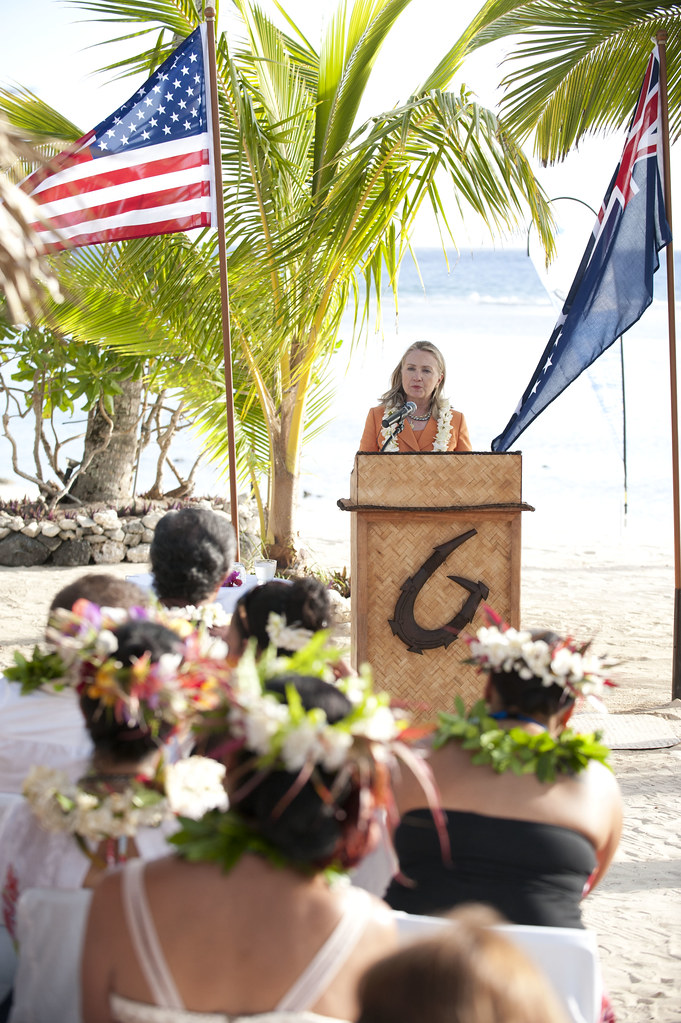
Clinton at event in Cook Islands (Hosted by Flickr)
However, the fact that Clinton attended the Forum meeting highlights Washington’s increased sensitivity to growing Chinese influence in the South Pacific. Consequently, the United States has resumed a more active role in the region.  Senior officials have conducted tours, the United States has bolstered its diplomatic presence and it has opened a USAID office in Papua New Guinea.  It has also increased its military presence, with the relocation of marines from Okinawa to Guam, and via the expansion of its ‘shiprider’ program, under which ships and aircraft from the United States Coast Guard (and now Navy), host law enforcement officers from South Pacific states and patrol their sovereign waters.[12]

Given the United States’ and China’s increasing focus on the South Pacific, the region might become a microcosm of broader emerging strategic rivalry between the two powers. Pessimistic analyses would predict that China and the United States (and its ally Australia) will engage in a zero-sum competition for regional influence, as occurred during the Cold War.  Robert Kaplan has argued that it is ‘not hard to imagine… a replay of the decades-long Cold War, with the center of gravity not in the heart of Europe but, rather, among Pacific atolls’.[13]  If this competition took on a military dimension it could come to a head if there is a clash between China’s island chain strategy and the United States’ presence in Micronesia.  Military bases in the region might also mean that South Pacific states could be dragged into a conflict elsewhere in the Asia-Pacific, such as in the South China Sea.

But there may be room for optimism.  Clinton has argued that, although ‘there are those who see America’s renewed engagements… perhaps as a hedge against particular countries… the United States welcomes cooperation with a number of partners, including… China’.[14]  There is potential for the United States (and its ally Australia) to try to draw China into a more cooperative approach to development and security, particularly by working through regional multilateral institutions. They could also encourage China to carry out joint projects with Western states, to ensure the effectiveness and coordination of aid.  Until recently China has been reluctant to do so, but Tiankai has agreed that China is ‘ready to exchange views, to compare respective practice and where possible and feasible, we’re open to work with them [Western states] for the benefit of the recipient countries’.[15]  Reflecting this new approach, China has taken up observer status on the OECD Development Assistance Committee.  It has also agreed to partner with New Zealand to improve water provision in the Cook Islands.[16]  Clinton welcomed the announcement of the China-New Zealand partnership, declaring that ‘New Zealand sets a good example for working with China’.[17]

Evidence of an emerging willingness by China, the United States and other Western states to cooperate in the South Pacific may suggest that proposals for the United States to engage and cooperate with China, perhaps in a ‘concert of powers’ model,[18] could succeed in the future. These proposals could be developed on a relatively small and low-risk scale in the South Pacific, so that the lessons learnt and the confidence gained may benefit broader Asia-Pacific stability and security.


Dr Joanne Wallis is a lecturer in the Strategic and Defence Studies Centre at the Australian National University, where she convenes the Bachelor of Asia-Pacific program.  She researches politics and security in the South Pacific. 


[1] Henry Puna, ‘Large Ocean Island States – the Pacific Challenge’, letter to Pacific Island Forum leaders from the Prime Minister of Cook Islands, available from: http://www.forumsec.org/resources/uploads/attachments/documents/Forum%20Theme%202012.pdf.
[2] Thomas Lum and Bruce Vaughn, The Southwest Pacific: U.S. Interests and China’s Growing Influence, CRS Report for Congress RL34086, Washington, Congressional Research Service, 6 July 2007.
[3] Fergus Hanson and Mary Fifta, ‘China in the Pacific: The New Banker in Town’, Policy Brief, Sydney, Lowy Institute for International Policy, April 2011.
[4] David Shambaugh, Modernizing China’s Military: Progress, Problems, and Prospects, Berkeley, University of California Press, 2002.
[5] Stratfor, ‘Island Strategy: Why Fiji May Matter’, 12 June 2000, http://www.stratfor.com.
[6] Joel Atkinson, ‘China-Taiwan diplomatic competition and the Pacific Islands’, The Pacific Review, Vol. 23, No. 4, 2010, p. 407-427.
[7] ‘China in Pacific for common development: Chinese vice FM’, People’s Daily Online, 1 September 2012.
[8] Graeme Dobell, ‘China and Taiwan in the South Pacific: Diplomatic Chess versus Pacific Political Rugby’, CSCSD Occasional Paper Number 1, May 2007.
[9] Tamara Renee Shie, ‘Rising Chinese Influence in the South Pacific: Beijing’s Island Fever’, in Anne-Marie Brady (ed.), Looking North, Looking South: China, Taiwan and the South Pacific, Singapore, World Scientific Publishing Company, 2010.
[10] Reuters, ‘Clinton says China seeks to outflank Exxon in Papua New Guinea’, 2 March 2011.
[11] Hillary Rodham Clinton, ‘Commemorating U.S. Peace and Security Partnerships in the Pacific’, speech at Tamarind House, Rarotonga, Cook Islands, 31 August 2012.
[12] Ibid.
[13] Robert D. Kaplan, ‘How We Would Fight China’, Atlantic Magazine, June 2005.
[14] Hillary Rodham Clinton, ‘Commemorating U.S. Peace and Security Partnerships in the Pacific’, speech at Tamarind House, Rarotonga, Cook Islands, 31 August 2012.
[15] ‘China in Pacific for common development: Chinese vice FM’, People’s Daily Online, 1 September 2012.
[16] ‘NZ to build Pacific assistance with China’, China Daily, 30 August 2012.
[17] Hillary Rodham Clinton, ‘Remarks with New Zealand Prime Minster Key’, New Zealand High Commissioner’s Residence, Cook Islands, 31 August 2012.
[18] Hugh White, The China Choice: Why America Should Share Power, Collingwood, Black Inc., 2012.


This Article first appeared on e-IR and is reposted here under a Creative Commons license.

News Story: Annual New Zealand Defense Report Boosts Focus on South Pacific

HMNZS Canterbury

By Nick Lee-Frampton

WELLINGTON, Australia — The 2012 Annual Report of the New Zealand Defence Force (NZDF) reveals enhanced attention on the South Pacific.

“Our Pacific neighbourhood is the primary focus,” Lt. Gen. Rhys Jones, the chief of Defence Force, writes in the report.

At the heart of the strategy, or as the report describes it, a “key enabler,” is the establishment of a Joint Amphibious Task Force (JATF), based on the Navy’s amphibious flagship HMNZS Canterbury, capable of transporting 250 troops.

Supported by Anzac-class frigates, P-3K2 Orion surveillance aircraft and NH90 helicopters, the JATF is scheduled to be “in place” by 2015.

While the JATF will primarily be structured for the deployment of combat forces, says the NZDF, its most likely contingencies will be humanitarian assistance and disaster relief, and “conducting missions in our region to support nation building.”

Read the full story at DefenseNews

03 September 2012

News Story: U.S. Not a Threat to China, Envoy Says


BEIJING — U.S. Ambassador to China Gary Locke on Sept. 1 tried to ease China’s fears that Washington wants to hem it in by emphasizing any U.S. military presence in Asia was not targeted at a single country.

“We strongly believe, and I believe most in the region would agree, that our security presence here is beneficial to the countries of the region and necessary for the continued vitality of the Asia-Pacific,” Locke said.

“Our security presence is not aimed at any one country,” he said in a speech at Peking University, noting that the United States was also boosting its diplomatic and economic engagement in the region.

Read the full story at DefenseNews

29 August 2012

USA: Secretary of State Hillary Rodham Clinton's Travel to the Cook Islands, Indonesia, China, Timor-Leste, Brunei, and Russia


Secretary of State Hillary Rodham Clinton departs for the Cook Islands, Indonesia, China, Timor-Leste, Brunei, and Russia on August 30.

In the Cook Islands, Secretary Clinton will attend the Pacific Islands Forum (PIF) Post Forum Dialogue on August 31 as part of our intensive engagement and ongoing collaboration with the Pacific Islands. Her visit will emphasize the depth and breadth of American engagement across economic, people to people, strategic, environmental, and security interests. The visit also represents a concerted effort to strengthen regional multilateral institutions, develop bilateral partnerships, and build on alliances – three core elements of U.S. strategy toward the Asia-Pacific. She will lead the highest-level U.S. interagency delegation in the 41-year history of the Forum with senior officials from the Departments of State, Defense, and Interior.

In Jakarta on September 3, Secretary Clinton will discuss with senior Indonesian officials the U.S.-Indonesia Comprehensive Partnership and our respective engagements on regional global issues.

In Beijing September 4-5, Secretary Clinton will meet with senior Chinese leaders. Discussions are expected to cover a wide range of issues of importance in the U.S.-China relationship as part of our efforts to build a cooperative partnership, including preparations for Asia-Pacific Economic Cooperation (APEC) and other upcoming multilateral meetings and numerous bilateral, regional, and global issues.

On September 6, Secretary Clinton will be the first Secretary of State to travel to Dili, where she will emphasize U.S. support for the young democracy of Timor-Leste in her meetings with senior officials.

In Brunei, Secretary Clinton will meet with senior officials to emphasize the importance of the increasingly vibrant U.S.-Brunei relationship. She will also highlight the U.S.-Brunei ASEAN English Language initiative and discuss Brunei’s 2013 chairmanship of ASEAN.

The final stop on Secretary Clinton’s trip will be Vladivostok, where she will lead the U.S. delegation to the APEC Economic Leaders’ Meeting September 8-9. The Secretary will discuss trade liberalization, food security, and green growth including initiatives to fight wildlife trafficking, with heads of state and other regional leaders, including business representatives. She will engage on many areas of bilateral cooperation with Russia including with Foreign Minister Lavrov.

17 August 2012

USA: Assistant Secretary Brimmer's Participation in the Pacific Islands Forum


Assistant Secretary for International Organization Affairs Esther Brimmer will travel to Australia, New Zealand, and the Cook Islands, August 19 – September 2, 2012.

On August 19, Assistant Secretary Brimmer will begin her visit to the Pacific region. In advance of her involvement in the Pacific Islands Forum, she will make stops in Sydney, Canberra, Wellington and Auckland. While in these cities she will meet high level officials, civil society groups and students to discuss the role of U.S. multilateral engagement in addressing global challenges.

Assistant Secretary Brimmer will arrive in the Cook Islands on August 29. She will meet with Pacific Islands Forum members, observers, and Post Forum Dialogue partners. While in Rarotonga, Cook Islands, she will discuss issues including sustainable development and combating noncommunicable diseases. The United States is an observer at the Pacific Island Forum.