Showing posts with label Nauru. Show all posts

02 March 2017

USA: USS Michael Murphy completes OMSI mission

By MC3 Danny Kelley

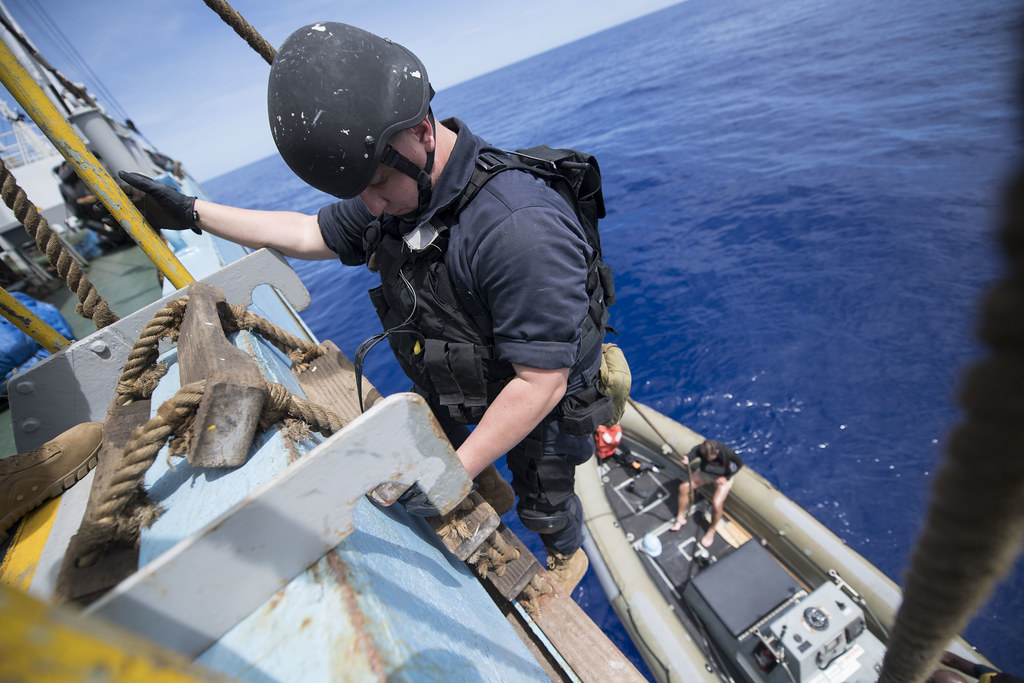
Fire Controlman 2nd Class James Masterson disembarks a fishing vessel Feb. 8 during an Oceania Maritime Security Initiative (OMSI) boarding mission. (U.S. Navy/MC3 Danny Kelley) >>

PACIFIC OCEAN - The U.S. Coast Guard and U.S. Navy completed an 18-day joint mission in the Central and South Pacific under the Oceania Maritime Security Initiative (OMSI) to combat transnational crimes, enforce fisheries laws and enhance regional security, Feb. 18.

A Coast Guard law enforcement detachment from Pacific Tactical Law Enforcement Team (LEDET) 103 embarked USS Michael Murphy (DDG 112) and conducted 16 fisheries enforcement boardings with the assistance of the ship’s visit, board, search and seizure team and law enforcement ship riders from Tuvalu and Nauru.

“While OMSI is an operational mission in nature, its execution has vast strategic implications for the Oceanic region,” said Cmdr. Robert A. Heely Jr., commanding officer of Michael Murphy. “Our patrol reinforced our strong support to the security and economic prosperity of the Pacific Island Nations.”

Five of the boardings were conducted on the high seas under the Western and Central Pacific Fisheries Commission guidelines with zero violations, while the other 11 were conducted in the exclusive economic zones (EEZ) of Tuvalu and Nauru, with no violations in either zone.

04 February 2017

USA: USS Michael Murphy supports Oceania Maritime Security Initiative

By MC3 Danny Kelley, USS Michael Murphy Public Affairs

USS Michael Murphy (DDG 112) transits the Pacific Ocean, Jan. 30. (U.S. Navy/MC3 Danny Kelley) >>

PACIFIC OCEAN - The guided-missile destroyer USS Michael Murphy (DDG 112) with embarked U.S. Coast Guard maritime law enforcement personnel began its support of Oceania Maritime Security Initiative (OMSI) Jan. 31.

OMSI is a Secretary of Defense program aimed to diminish transnational illegal activity on the high seas in the Pacific Island Nations of Oceania’s exclusive economic zones (EEZ) and enhance regional security and interoperability with partner nations.

“OMSI is about expanding our network of cooperation with partners throughout the Asia-Pacific region to secure common interests in the Western-Central-Pacific,” said Lt. Cmdr. Connor Sullivan, the embarked Coast Guard team lead. “Our common interest is ensuring that these countries can protect their resources, which will allow them to become more economically independent.”

25 February 2016

USA: William P. Lawrence Supports Oceania Maritime Security Initiative

By Lt. j.g. Jane M. Baird

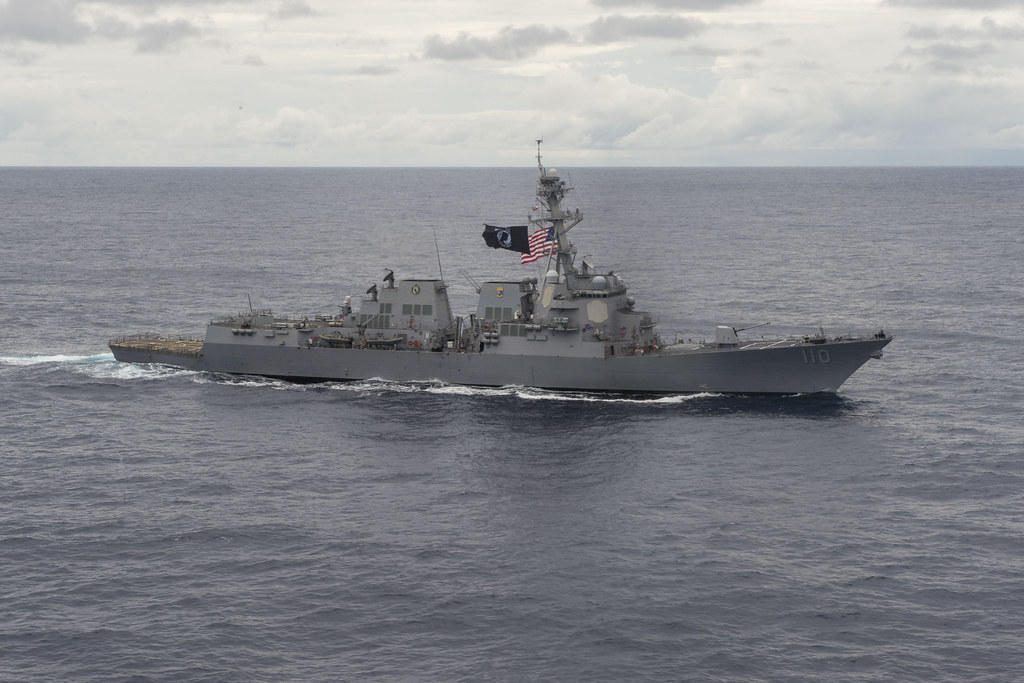
In this file photo, USS Wiiliam P. Lawrence (DDG 110) transits the Pacific Ocean in early February. (U.S. Navy/MC3 Emiline L. M. Senn) >>

PACIFIC OCEAN - The guided-missile destroyer USS William P. Lawrence (DDG 110) supported two commercial fishing vessel boardings off the coast of the Republic of Nauru this week as part of the Oceania Maritime Security Initiative (OMSI).

OMSI is a Secretary of Defense program leveraging Department of Defense assets transiting the region to increase the Coast Guard’s maritime domain awareness, ultimately supporting its maritime law enforcement operations in Oceania.

Embarked aboard Lawrence, a law enforcement detachment from U.S. Coast Guard Tactical Law Enforcement Team South conducted the boardings in support of U.S. and Pacific Island Nations (PIN) fisheries laws.

The boarding teams inspected documentation and fishing holds for illegal activity and conservation management compliance. PIN ship riders provide assistance as the local authority within their respective Exclusive Economic Zones (EEZ), an area defined by international law allowing each nation exclusive rights to the exploration and use or marine resources. Oceania contains 43 percent of the United States’ EEZs.

29 August 2015

USA: USS Chafee Supports Oceania Maritime Security Initiative

From USS Chafee Public Affairs

In this file photo, USS Chafee (DDG 90) operates in the Western Pacific in July. (U.S. Navy/MCSN Clemente A. Lynch) >>

PACIFIC OCEAN - The Arleigh Burke-class guided-missile destroyer USS Chafee (DDG 90) participated in the Oceania Maritime Security Initiative (OMSI) with the U.S. Coast Guard’s 14th District, Aug. 5 - 21, in the western Pacific Ocean.

OMSI is a maritime security operation designed to enhance maritime domain awareness, increase law enforcement presence, and expand at-sea law enforcement capabilities throughout Oceania.

“We were there to provide key presence in the region and build partner nation capacity for a critical oceanic partner,” said Cmdr. Shea Thompson, Chafee’s commanding officer. “Our presence with the Coast Guard and our partner nation set a new tone of deterrence in the region and will prevent future violations.”

07 March 2015

Editorial: New Zealand's Mass Surveillance of Pacific States Exposed


By Ankit Panda

New Zealand’s Government Communications Security Bureau conducts mass surveillance of several Pacific states.

Reports citing classified documents leaked by U.S. National Security Agency whistleblower Edward Snowden state that New Zealand is carrying out mass surveillance over several Pacific island states, including  Fiji, Papua New Guinea, the Solomon Islands, Nauru, Samoa, Vanuatu, Kiribati, New Caledonia, Tonga and French Polynesia. The New Zealand Herald notes that the data gathered was shared with the other members of the “Five Eyes” intelligence-sharing network, a grouping encompassing the United States, Australia, the United Kingdom, and Canada. New Zealand’s Green Party has lodged a complaint with the country’s Inspector General of Intelligence and Security claiming that the Government Communications Security Bureau (New Zealand’s intelligence agency) broke the law by spying on, among other target, New Zealand citizens’ activities in the aforementioned states.
Diplomatically, the revelations will likely cause a problematic backlash for Prime Minister John Key’s government. The nations included in the Snowden documents as targets of New Zealand’s mass surveillance are all friendly with New Zealand. The Intercept, which hosted the leaked documents, notes that the surveillance “is being carried out by GCSB from an intelligence base in New Zealand’s Waihopai Valley.” The report adds:
Intercepted data collected at the Waihopai site is being shared through an NSA surveillance system called XKEYSCORE, which is used to analyze vast amounts of emails, internet browsing sessions and online chats that are intercepted from some 150 different locations worldwide. 
Read the full story at The Diplomat

23 November 2012

AUS: Regional cooperation works to stop transnational crime

Vanuatu Police Vessel RVS Tukoro (Pacific Patrol Boat)

Covering an area approximately 30 million square kilometres in size, the recently concluded Operation KURUKURU was a huge maritime surveillance operation working to stop transnational crime, including illegal, unregulated and unreported fishing, smuggling and people trafficking. 

Parliamentary Secretary for Defence, Senator David Feeney, said the operation was a massive exercise in coordination for all nations involved. 

“OP KURUKURU really does show that as a region we can work together to achieve tangible outcomes for the people of our nations. This operation covered the Cook Islands, the Federated States of Micronesia, Kiribati, Marshall Islands, Nauru, Niue, Palau, Samoa, Solomon Islands, Tokelau, Tonga, Tuvalu and Vanuatu,” Senator Feeney said. 

“Fisheries surveillance and enforcement staff from all these nations, as well as from Australia, New Zealand, France and the United States worked together over a busy two week period toward the same outcomes. 

“This year we have all shown great improvements, with double the number of boardings and infringements being detected, or citations issued, which is really just a tremendous effort,” he said. 

In total, 300 vessels were sighted and 206 vessels inspected in this year’s operation.  

Senator Feeney said that achievements coming out of the operation were in no small part due to the Australian Pacific Patrol Boat Program. 

“Australia’s Pacific Patrol Boat Program is a vital part to the success of the operation. A total of 22 vessels were gifted to 12 Pacific Island Nations under the Program from 1987 to 1997. As the program comes to a close, the cooperation it has begun will continue with the Pacific Maritime Security Program (PMSP),” Senator Feeney said. 

“The Pacific Maritime Security Program will see Australia’s commitment to maritime domain awareness and the peace and security of the ‘global commons’ in the South Pacific remain a priority. The PMSP will be a whole-of-government regional response to intensifying threats posed by illegal, unregulated and unreported fishing and transnational crime.  

“It will promote Pacific integration through better coordinated surveillance, legal frameworks and cooperation to protect national, regional and global resources,” he said. 

Senator Feeney said Australia’s contribution to the operation was a coordinated effort across agencies. 

“As demonstrated by Operation KURUKURU, the Pacific Patrol Boat Program provides Pacific Island Nations with an effective means of surveillance and law enforcement in their Exclusive Economic Zones,” Senator Feeney said. 

“Surveillance was conducted by Pacific Island Nations within their respective Exclusive Economic Zones using ten Pacific Class patrol boats from the Pacific Island Nations, two French patrol boats, a frigate and a US Coast Guard cutter. 

“This was supported by aerial surveillance provided by five maritime patrol aircraft from France, the US Navy and the US Coast Guard. The aircraft surveyed the EEZs of many Pacific Island Nations and adjacent waters.  

“Australian Fisheries Management Authority (AFMA) and Australian Customs and Border Protection Service officers provided operational assistance from the Regional Fisheries Surveillance Centre in Honiara. AFMA also deployed officers onboard two patrol vessel involved in the operation,” he said. 

Operation KURUKURU was planned, hosted and coordinated by the Pacific Island Forum Fisheries Agency (FFA) from the Regional Fisheries Surveillance Centre. Via secure login, all countries had access to an FFA web-based regional surveillance picture. This picture contained fishing vessel contacts, satellite data, surveillance flight plans and vessel patrol plans and indicators highlighting vessels of interest in the region.   

Operation KURUKURU 2012 follows the recent adoption of the Agreement on Strengthening Implementation of the Niue Treaty on Cooperation in Fisheries Surveillance and Law Enforcement in the South Pacific Region by the 17 Pacific Island parties to the Niue Treaty on 2 November 2012.  

This will significantly improve the region’s ability to conduct multilateral activities, such as Operation KURUKURU.