29 April 2014

Editorial: India Looks Far East

Beach in Fiji (Image: Wiki Commons)

By Kailash K. Prasad

A growing presence in the Pacific Islands could have significant benefits for India.

“Five trillion dollars of commerce rides on the sea lanes of the Asia-Pacific each year, and you people sit right in the middle of it.” That was the Commander of the United States Pacific Command, Samuel Locklear speaking of the 8 million people who call 14 islands in the South Pacific home.
As the Pacific Islands, spectators to so many events that have come to define geopolitics since World War II – move out of the periphery of international relations, many powers have been seeking a more comprehensive presence in the region. And as China, through its maritime silk road strategy, and the U.S., through its pivot to Asia, attempt to garner goodwill and influence in the Pacific Islands, India, with its steadily broadening economic and geostrategic interests, seems curiously eager not to be left behind.
Fortunately for New Delhi, a growing development assistance program (PDF) has allowed it to put more meat into what Minister of State for External Affairs E. Ahmed termed an “extended ‘Look East Policy’” – which has largely guided New Delhi’s engagement with its eastern neighbors since the early 1990s.
Between joining the Pacific Islands Forum as an observer in 2002 and last year, India committed over $11 million as grants to the Pacific Islands. In 2009, Delhi announced it would increase the annual grants (PDF) it extends to each of the 14 pacific island nations from $100,000 to $125,000. India also gave a $50.4 million credit line to Fiji to help the island nation revamp some of its sugar mills. 

Read the full story at The Diplomat

Editorial: India - Urgent Defense Reforms Needed


By Nitin A. Gokhale

After years of bungling, India’s next prime minister will need to move quickly on both foreign policy and defense reforms.

On April 2, India’s outgoing Prime Minister Manmohan Singh, told a conference that: “As a responsible nuclear weapon state that remains committed to non-proliferation, India supports the idea of a nuclear-weapon-free world because we believe that it enhances not just India’s security, but also global security.”
Less than a fortnight later, the Bharatiya Janata Party (BJP), largely expected to lead the next government, sprung a surprise by declaring in its election manifesto that it will “study in detail India’s nuclear doctrine, and revise and update it to make it relevant to [the] challenges of current times.”
That was a surprise, because India’s 15-year old nuclear doctrine that decrees “no-first use” of nuclear weapons was put in place by the last BJP-led National Democratic Alliance government. If the BJP indeed comes to power and then delivers on its promise, it would mark a major shift in India’s nuclear policy.
Tweaking or changing the course of India’s nuclear doctrine will surely alter India’s foreign policy too. The challenge for the new government will be to balance India’s own national interest with the current – and fast-changing – geopolitical situation in Eurasia. 

Read the full story at The Diplomat

28 April 2014

USA: Bonhomme Richard Offloads 31st Marine Expeditionary Unit

Landing operations during Exercise Ssang Yong 2014

By Mass Communication Specialist 2nd Class Adam D. Wainwright

WHITE BEACH, Okinawa (NNS) -- The forward-deployed amphibious assault ship USS Bonhomme Richard (LHD 6) offloaded Marines from the 31st Marine Expeditionary Unit (MEU) after conducting joint-force operations in the U.S. 7th Fleet area of responsibility, April 24.

During the patrol, Bonhomme Richard and the 31st MEU participated in Exercise Ssang Yong 2014 with their counterparts from the Republic of Korea (ROK).

The exercise was the first to include a joint, combined command and control headquarters which was led by Rear Adm. Hugh Wetherald, commander, Amphibious Forces 7th Fleet; ROK Rear Adm. Chun, Jung-soo, commander, Flotilla Five; Brig. Gen. Paul Kennedy, commanding general, 3d MEB; and ROK Brig. Gen. Cho, Kang-jae, deputy commander landing force.

News Story: With New Radar, Japan Sends Message to China


By PAUL KALLENDER-UMEZU

TOKYO — With a high-profile groundbreaking ceremony for a small radar station on Yonaguni Island, Japan has drawn a line in the sand about its strategic intent to defend its Nansei Shoto (southwestern island chain) against China, effectively telling Beijing to back off.

The deployment of the “coastal observation unit,” as the Defense Ministry here calls it, will see the deployment of only about 100 troops on a 60-acre site during 2015. But the April 19 groundbreaking ceremony, which included Defense Minister Itsunori Onodera, was the top news in newspapers and for the state broadcaster, quite an event for the 11-square-mile subtropical island, population 1,500, hitherto known for its sugar cane production and scuba diving.

Politics and positioning are behind the fanfare for the event, said Masaaki Gabe, professor of international relations and director of the International Institute for Okinawan Studies at the University of the Ryukyus. Yonaguni is only 67 miles east of Taiwan and 93 miles south of the Senkaku Islands, a major source of friction between Japan and China.

Planting boots on an island at the very extremity of Japanese territory — effectively China’s backyard — makes great public relations domestically for the nationalist administration of Prime Minister Shinzo Abe, serving notice of Japan’s determination to push back against China, he said.

“The radar base [set up] by the Ground Self-Defense Forces [GSDF] is not strategically military important now, but politically, it’s extremely important to the Abe administration,” he said.

Read the full story at DefenseNews

News Story: Indian naval ships visit Thailand


BANGKOK (PTI): Four Indian naval ships visited Thailand's Phuket island as part of a professional exchange cooperation programme, signalling a further boost in defence ties between the two countries which astride one of the strategic international maritime shipping lanes.

Naval exchanges form an important component of the overall bilateral cooperation between India and Thailand.

"The visit of the ships of the 1st Training Squadron of the Indian Navy to Royal Thai Navy has further enhanced the close cooperation and friendship that exists between the two navies," India's Ambassador to Thailand, Harsh Vardhan Shringla, told PTI.

The four-day visit to Phuket, home to Thailand's Third (Andaman) Naval Command, is significant, said Shringla, who hosted a reception onboard INS Sujata on Wednesday.

Read the full story at Brahmand

Editorial: Pacific Partnership - Can an Expensive Exercise Deliver More Value?

Pacific Partnership 2012 (Image: Flickr user Andrea Guthrie)

By Eileen Natuzzi

Eight years in, it is time to reassess the program, its strengths and its weaknesses.

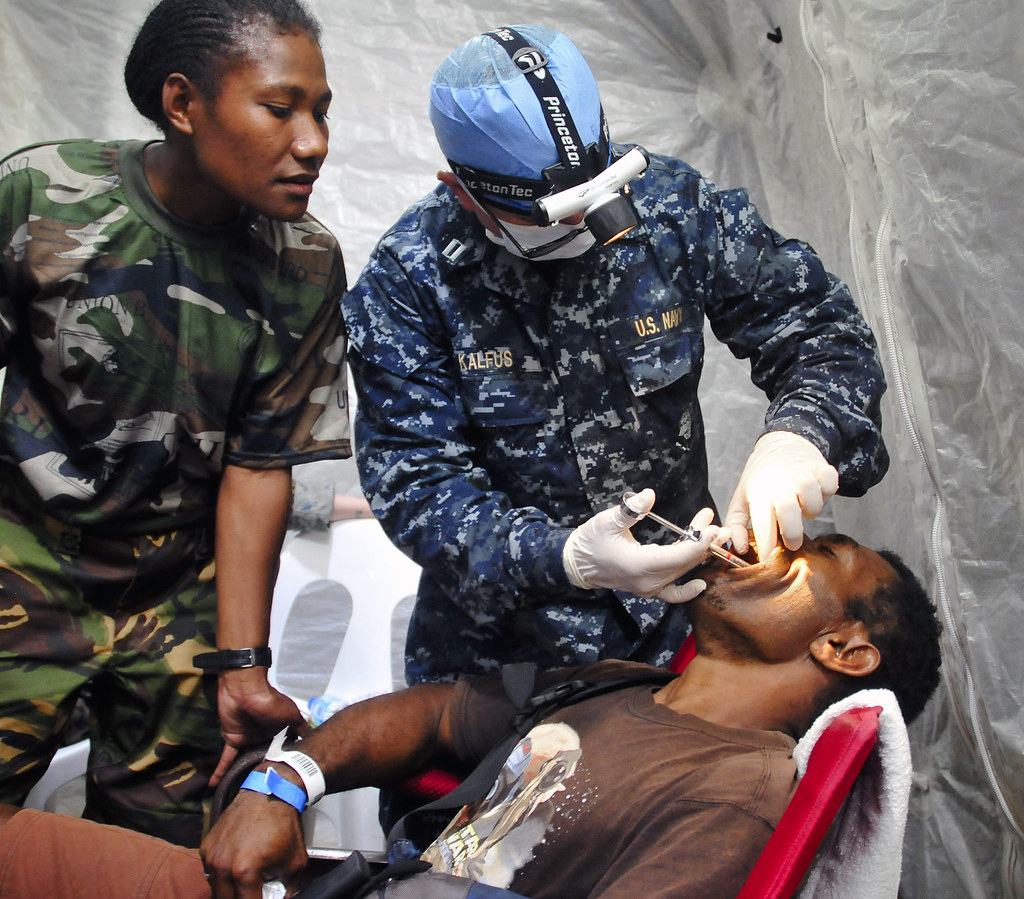
Since 2006, the U.S. Navy has been conducting Pacific Partnership, a U.S. Defense Department forward readiness humanitarian aid program in the Asia Pacific Region. This program costs U.S. taxpayers roughly $20 million per mission. Captain Jesse Wilson, the 2011 mission commander sees responses to natural disasters in the Pacific as part of Pacific Partnership’s mission. They are a constant reminder that the United States must “be ready and trained to operate collectively and effectively with our partner nations throughout the Pacific.”
Image: Flickr user Official U.S. Navy Page
Over the past year there have been a number of significant natural disasters in the Pacific Region. In January, category 5 Tropical Cyclone Ian slammed into Tonga’s Ha’apai islands, destroying homes and taking down vital communications. Just over a year ago, the Solomon Islands suffered an 8.1 earthquake followed by a deadly tsunami that left many homeless and to this day still living in tent cities. This year, on April 4, the entire island of Guadalcanal experienced devastating flooding after days of rain dumped meters of rainfall on the island, causing rivers to swell and forge deadly new paths through villages. More than 20 percent of the Solomon Island population has been adversely impacted by this latest disaster.
The U.S. Navy and Pacific Partnership did not mobilize to assist with any of these disasters, despite significant on-the-ground logistical issues in delivering relief. This raises some questions: What is the commitment of the U.S. Navy’s Pacific Partnership to the Pacific Island region? And is the United States taxpayer getting true value for money? 

Read the full story at The Diplomat

Editorial: Washington’s Flawed Myanmar Policy

Kachin Independence Army (KIA) troops

By David Brenner

Many of Myanmar’s ethnic minorities are growing increasingly disillusioned with America and may turn to China instead.

“The water stays cool inside even if the bottle sits in the sun for the whole day.” Tu Ja proudly explains the virtue of storing water in his 1943 U.S. Army stainless steel flask, one of the few belongings he could save when fleeing his village from the advancing Myanmar army in 2011. The internally displaced person (IDP) holds the bottle against a sun beam entering the dim communal cooking space in one of the countless makeshift camps in Kachin State. The smoke from open fires in the cramped space makes it hard to breath. Yet, Tu Ja goes on telling the story of a water bottle which seems to be as displaced as himself in this remote corner of northern Myanmar. It was given to him by his grandfather who fought with the Kachin Rangers for Detachment 101 of the American Office of Strategic Services against the Japanese on one of the Second World War’s most vicious battlefields. The Kachin, an ethnic minority group, have earned a reputation for being skilled mountaineers without whose courageous and fierce fighting abilities the Allied forces could not have driven the Japanese out of Burma. U.S. soldiers have long left these rugged borderlands in between Myanmar and China. Sadly, war has stayed.
For many decades this area has witnessed various ethnic armed groups struggling for minority rights and political autonomy against central government control. After the breakdown of a 17-year long ceasefire in 2011, conflict escalated again between Naypyidaw and the Kachin Independence Organisation (KIO). Since then, large-scale army offensives against rebel-held positions have displaced more than 100,000 civilians. While this conflict is largely ignored by the international media, international affairs are closely followed in the tea houses of Laiza, a small town nestled on the border of China’s Yunnan province and headquarter of the KIO. “One of our long-term mistakes was to think that we can be allies of the U.S.,” an officer of the 10,000 man-strong Kachin Independence Army (KIA) – the armed wing of the KIO – explains over dinner. “You know, we helped the Americans in the past and we identify with them. After all they brought us Enlightenment: our script and the Bible,” he continues by referring to the Swedish-American missionary Ola Hanson, who spread the gospel in Myanmar’s borderlands and developed an orthography for the Kachin language in the late 19th century. 

Read the full story at The Diplomat

26 April 2014

USA: Boxer ARG, 13th MEU Return from Deployment


From Boxer Amphibious Ready Group Public Affairs

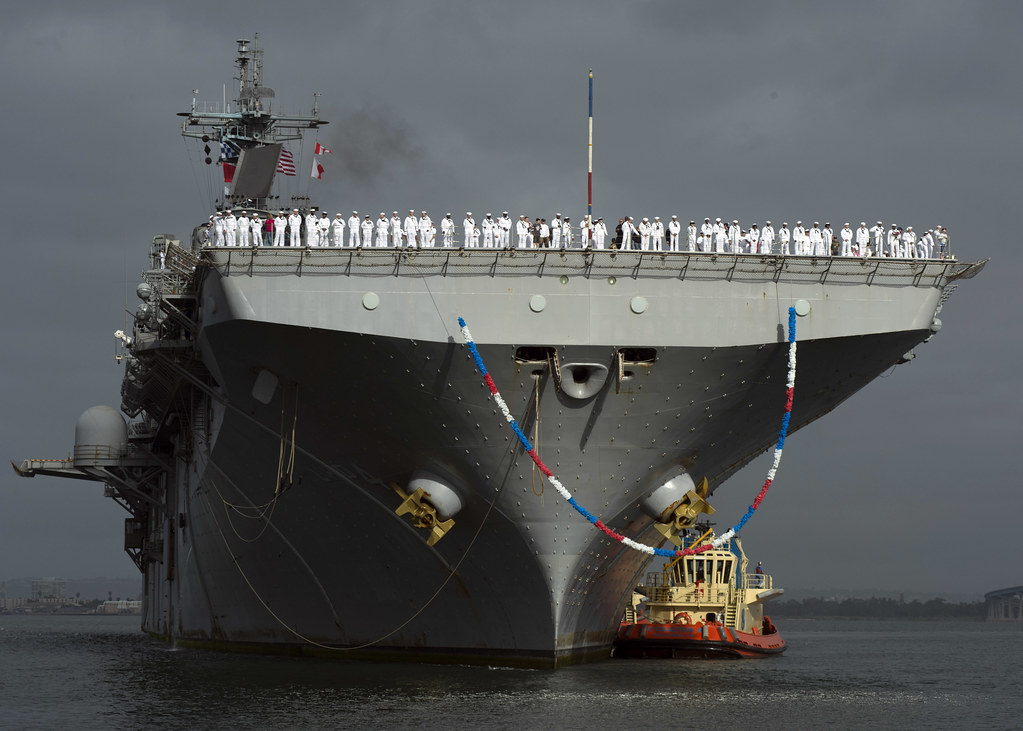
<< USS Boxer (LHD 4) transits San Diego Bay, April 25. (U.S. Navy/MC3 Derek A. Harkins) Image: Flickr user U.S. Pacific Fleet

SAN DIEGO - More than 4,500 Sailors and Marines of the Boxer Amphibious Ready Group (ARG) and 13th Marine Expeditionary Unit (MEU) completed an eight-month deployment April 25 when the ships arrived at Naval Base San Diego.

While deployed, the Boxer ARG/13th MEU served in the U.S. 5th, 6th and 7th Fleet Areas of Responsibility (AOR), providing maritime security operations, crisis response capability, theater security cooperation and forward naval presence.

The Boxer ARG (BOXARG), led by Commander, Amphibious Squadron (PHIBRON) 1, is comprised of PHIBRON 1 staff, multipurpose amphibious assault ship USS Boxer (LHD 4), amphibious dock-landing ship USS Harpers Ferry (LSD 49), amphibious transport dock ship USS New Orleans (LPD 18) and Fleet Surgical Team 3. Additional detachments included Tactical Air Control Squadron 11, Helicopter Sea Combat Squadron 21, as well as Assault Craft Unit (ACU) 1 and 5, and Beachmaster Unit 1.

Sri Lanka: Two Japanese Naval Ships arrive at the Port of Colombo


Two Japanese Maritime Self Defence Force (JMSDF) ships, Samidare DD-106 and Sazanami DD-113 arrived at the Port of Colombo for a goodwill and supply visit on 25th April 2014. The ships are en route for Counter Piracy Operations off the Coast of Somaliya and in the Gulf of Aden. They were welcomed by the Sri Lanka Navy in accordance with naval traditions on arrival. 

Head of the mission, Commander Escort Division iv, Captain Hiroaki Tajiri and Ships’ Commanding Officers, Commander Takashi Saito and Commander Yasihiro Hayashi paid a courtesy call on Commander Western Naval Area, Rear Admiral Sirimevan Ranasinghe of the Sri Lanka Navy at the Western Naval Command Headquarters in Colombo. They held cordial discussions and exchanged mementos as a gesture of goodwill.

“Samidare” and “Sazanami” are both destroyers, which are 151 meters in length. “Samidare” has a displacement of 4,550 tons while “Sazanami” has a displacement of 4,650 tons. Each consists of a complement of 190 naval personnel onboard.

The ships’ complements will participate in a special programme organized by the Sri Lanka Navy during their stay in Sri Lanka. The visiting Japanese ships will stay in Sri Lanka until 27th April.

News Story: China splurging on military as US pulls back

PLA Navy Ships (File Photo)

QINGDAO, CHINA (AP): China's Navy commissioned 17 new warships last year, the most of any nation. In a little more than a decade, it is expected to have three aircraft carriers, giving it more clout than ever in a region of contested seas and festering territorial disputes.

Those numbers testify to huge increases in defence spending that have endowed China with the largest military budget behind the United States and fuelled an increasingly large and sophisticated defence industry. While Beijing still lags far behind the US in both funding and technology, its spending boom is attracting new scrutiny at a time of severe cuts in US defence budgets.

Beijing's newfound military clout is one of many issues confronting President Barack Obama as he visits the region this week. Washington is faced with the daunting task of fulfilling its treaty obligations to allies such as Japan and the Philippines.

China's boosted defence spending this year grew 12.2 per cent to 132 billion USD, continuing more than two decades of nearly unbroken double-digit percentage increases that have afforded Beijing the means to potentially alter the balance of power in the Asia-Pacific.

Read the full story at Brahmand