Showing posts with label Sentient Vision Systems. Show all posts

26 July 2017

Industry: AeroVironment Participates in Contract Signing Ceremony for Australian Defence Force Wasp AE Package

Wasp AE being tested by Australian Army Soldier
AeroVironment Participates in Contract Signing Ceremony for Australian Defence Force Wasp AE Package

  • Three-year contract includes AeroVironment Wasp® AE systems, plus multi-year training and support
  • Australian-based companies XTEK Limited, Sentient Vision Systems and General Dynamics Mediaware to provide added capabilities for Wasp AE and local support
  • AeroVironment now supports more than 40 allied countries with its family of small unmanned aircraft systems
Canberra, Australia, July 25, 2017– AeroVironment, Inc. (NASDAQ: AVAV), a global leader in unmanned aircraft systems (UAS) for both military and commercial applications, today participated in a signing ceremony here for the formal execution of contracts (first announced June 1, 2017) to deliver Wasp® AE unmanned aircraft systems (UAS) to the Australian Defence Force (ADF) over a three-year period commencing July 1, 2018.

02 June 2017

Industry: Australian Defence Force Selects AeroVironment Wasp® AE for AUD $101 Million Small Unmanned Aircraft Systems Program

A Wasp AE being tested by a soldier in the Australian Army
Australian Defence Force Selects AeroVironment Wasp® AE for AUD $101 Million Small Unmanned Aircraft Systems Program

  • AeroVironment to provide Wasp® AE systems over three years with multi-year training and support
  • Total contract value to AeroVironment of up to USD $36.5 million for hardware and services over program lifespan
  • Australian partners XTEK, General Dynamics Mediaware and Sentient to provide added capabilities for WASP AE and local support for the Australian Defence Force

MONROVIA, Calif.,June 1, 2017 – AeroVironment, Inc. (NASDAQ: AVAV), a global leader in unmanned aircraft systems (UAS) for both military and commercial applications, today announced the selection of the company’s Wasp AE small unmanned aircraft system by the Australian Defence Force (ADF). The ADF Indefinite Delivery/Indefinite Quantity (ID/IQ) contract calls for the delivery of Wasp AE systems over a three-year period, as well as training and logistics support for up to ten years, for a total AeroVironment contract value of up to USD $36.5 million.

25 February 2017

Think Tank: Unmanned naval aviation—bigger isn’t always better

Geoff Slocombe

The 14 February piece by James Mugg and Andrew Davies was like the curate’s egg: good in parts. Much of what they wrote about the significance of unmanned aerial vehicles (UAV) and systems (UAS), especially about Navy’s recently announced contract for 110kg CAMCOPTER S-100 rotary wing UAS and three year logistics support, is non-controversial. They could’ve also mentioned Navy’s current trials with the Boeing Insitu 22kg ScanEagle fixed wing UAV, equipped with Melbourne’s Sentient Vision Systems ViDAR sensor, but more on that later.

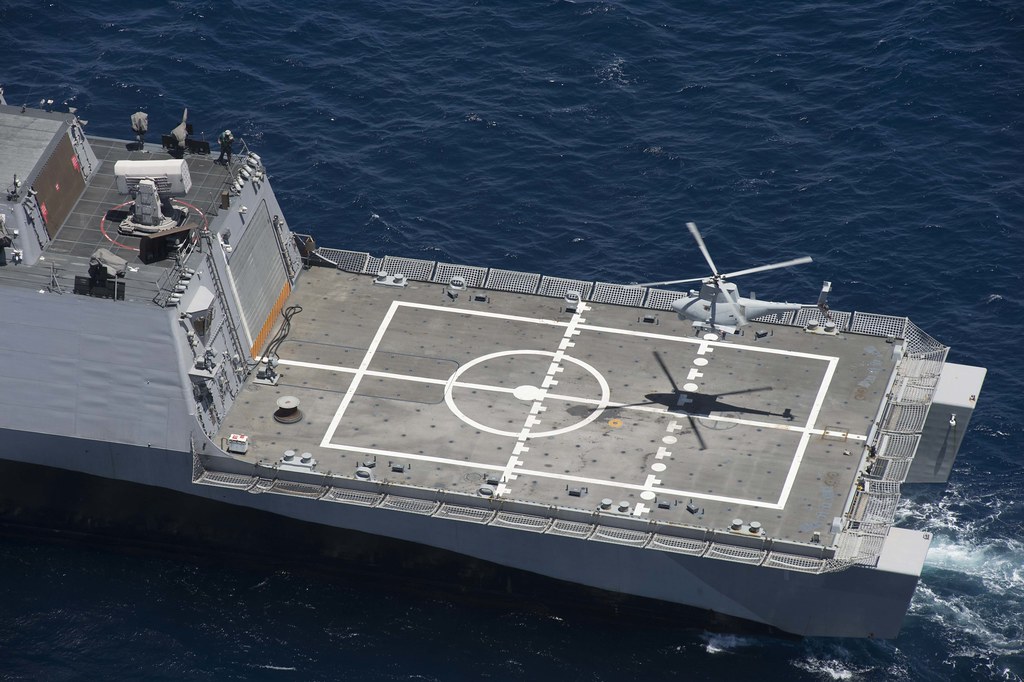
Their consideration of a large unmanned helicopter like Northrop Grumman’s 1,430kg, 7.3 metre long MQ-8B/C Fire Scout for Navy was the problem. Probably the only RAN vessels where Fire Scout would be an excellent UAV choice are the two Canberra Class LHDs plus HMAS Choules, a smaller amphibious vessel. Smaller UAVs make much more sense for the air warfare destroyers, future frigates and offshore patrol vessels.

Fire Scout is an outstandingly good UAV, with excellent endurance, serious sensor capabilities, and it can be equipped with offensive missiles. The US Navy’s large platforms, like their littoral combat ships, have deck space and hangar room to deploy Fire Scout very effectively.

So why is this contrary view on the suitability of large unmanned helicopters for the RAN’s ships, apart from those already mentioned, being put forward?

07 September 2016

AUS: Government congratulates Sentient Vision Systems

The Minister for Defence Industry, the Hon Christopher Pyne MP today congratulated Sentient Vision Systems on achieving 1000 global sales of their innovative vision processing system, Kestrel.

Minister Pyne said the deployment of more than 1000 Kestrel systems is a worldwide export success for Australia.

“It shows Defence and Australian industry can not only collaborate successfully on developing a Defence capability but also market it internationally,” Minister Pyne said.

The Kestrel software identifies and tracks moving targets on land and sea environments from live stream video on military platforms.

“This product significantly improves Defence’s ability to simultaneously identify multiple threats that would normally be missed by the human eye,” Minister Pyne.

Kestrel has been successfully deployed in Middle East Area of Operations in support of Australian and Coalition forces.

Kestrel was developed under the Defence Capability and Technology Demonstrator program and transitioned into service with Australian and Coalition forces.

The Capability and Technology Demonstrator Program is one of the Defence innovation programs that are transitioning into the new Defence Innovation Hub that will open later this year as part of the Turnbull’s government’s $1.6 billion investment in building a strong and vibrant Australian defence industry and innovation sector.

06 September 2016

Industry: AeroVironment Teams with Australia-based XTEK, Sentient Vision and General Dynamics Mediaware to Offer Small UAS to the Australian Army and Special Forces

  • The AeroVironment Australia team provides complete, end-to-end system capabilities to support Australian customers
  • The Wasp AE Micro Air Vehicle is the first of AeroVironment’s Family of Unmanned Aircraft Systems to be adopted by the Australian Armed Forces
  • Wasp AE Micro Air Vehicle systems operate virtually undetected to deliver superior intelligence, surveillance and reconnaissance capabilities in both ground and maritime operations

ADELAIDE, Australia, At Land Forces 2016, Sept. 6, 2016 – AeroVironment, Inc. (NASDAQ: AVAV), a global leader in small unmanned aircraft systems (UAS), today announced it is teaming with Australia-based XTEK, Sentient Vision and General Dynamics (GD) Mediaware to deliver AeroVironment’s Family of Unmanned Aircraft Systems to the Australian market. The team will offer the AeroVironment Wasp AE Micro Air Vehicle, designated as the RQ-12A by the U.S. Department of Defense, to the Australian Armed Forces.

02 December 2015

Industry: Australian Maritime Safety Authority search and rescue aircraft to see further, more clearly, with Sentient ViDAR


The Australian Maritime Safety Authority’s (AMSA) four new Challenger 604 jet search and rescue aircraft which begin to enter service in August 2016 will have an unprecedented ability to visually detect and track objects and people in the water, thanks to prime contractor Cobham Aviation Services’ selection of Sentient Vision’s Kestrel Maritime ViDAR (Visual Detection and Ranging) system as part of the program’s sensor suite.

Kestrel Maritime ViDAR consists of a 9-megapixel optical sensor and on-board software that automatically detects and highlights sea surface objects invisible to the naked eye in real time. In tests with the US Coast Guard in 2014 the ViDAR system detected small boats at ranges in excess of 20nm that were optically invisible to the sensor operators. Each Challenger 604 will mount three fixed ViDAR sensors and an integrated processing system to cue the primary Wescam MX-15 sensor to detected objects.

01 October 2015

Industry: Royal Australian Navy to trial innovative Australian designed ViDAR payload for Naval Unmanned Aircraft Systems (NUAS) operations

A Scan Eagle UAV launched from a Warship
Sentient has confirmed the procurement of its ViDAR (Visual Detection And Ranging) wide area maritime detection software by Insitu Pacific Ltd which is to be utilised and trialled by the Royal Australian Navy (RAN) on their specially configured Scan Eagle unmanned aircraft system (UAS)

MELBOURNE, Australia, Sep. 30, 2015 – Sentient today announced that the RAN has procured a license for its Kestrel Maritime ViDAR wide area maritime detection software to support RAN UAS activities. The software is designed to be incorporated into a purpose built ViDAR payload that can be modularly applied to the existing Block D Scan Eagle currently being flown by the Navy. 

31 March 2015

Think Tank: Flight Path (31-Mar-2015)


Palmo Tenzin

In this week’s flight path, we cover the Germanwings plane crash, Joint Strike Fighter close air support capability, Australia’s next Chief of Air Force, Russia’s bombers and safety deposit boxes in space.

Recent revelations that identified German co-pilot Andrew Lubitz as deliberately locking the cockpit and crashing the Germanwings Airbus into the French Alps has highlighted some of the complex issues in cockpit security. Despite acknowledging Lubitz’s history with depression, the debate has largely focused on the need to enforce a rule that stipulates two pilots must be in the cockpit at all times. In fact, just yesterday, the Deputy Prime Minister Warren Truss announced Australia’s airlines would immediately implement the two-person rule for all services operated by aircraft with over 50 seats. In contrast to this approach, Australian pilot Mark Gilmour argues the debate is ignoring the elephant in the room: mental health. Gilmour suggests the solution lies in destigmatising mental health in the aviation industry and avoiding kneejerk reactions such as implementing impractical cockpit rules.

26 February 2014

Industry: Northrop Grumman Announces Contracting Awards to Australian Companies


CANBERRA, Australia – Feb. 26, 2014 – Northrop Grumman Corporation (NYSE:NOC) has awarded contracts to several Australian suppliers as the company continues to grow its footprint in the country.

"Northrop Grumman's growing business opportunities in Australia are a vital component of our future strategic goals," said Ian Irving, chief executive Australia, Northrop Grumman. "Awards to these outstanding Australian suppliers show the full breadth of our commitment to Australian industry and their development of world class capabilities."

The awards were made in conjunction with the Australian Defence Materiel Organisation's Australian Global Supply Chain Deed program. Companies receiving awards include: Ferra Engineering Pty. Ltd of Tingalpa, Queensland, for work on 58 part types on the F-18 program; Ultra Electronics of Mawson Lakes, South Australia, for a Gap Analysis Study on the Triton program; Sentient Vision Systems of Port Melbourne, Victoria, for a Compatibility Study on the Triton Program; Quintessence Labs of Acton, Australian Capital Territory, for a Capability Verification Activity; iWebgate Technology of Perth, Western Australia, for a Capability Demonstrator Activity; Electro Optic Space System of Weston Creek, Australian Capital Territory, for expanded work to study Space Debris; Royal Melbourne Institute of Technology of Sir Lawrence Wackett Aerospace research Centre, Bundoora, Victoria, for a Triton Airworthiness Study.

Northrop Grumman is a leading global security company providing innovative systems, products and solutions in unmanned systems, cyber, C4ISR, and logistics and modernization to government and commercial customers worldwide. Please visit www.northropgrumman.com for more information.

30 October 2013

News Story: Software Innovations Boost Australian UAV Tracking Capabilities

Australian operated Shadow 200 UAV (File Photo)

By NIGEL PITTAWAY

MELBOURNE, AUSTRALIA — Innovations by Australian software companies have improved the military’s ability to track targets in difficult environment and rapidly disseminate data to analysts and deployed units.

More recently, Sentient Vision Systems and General Dynamics (GD) Mediaware combined forces to develop capabilities for UAVs to spot hard-to-see targets and to provide near real-time data analysis.

Sentient first developed its Kestrel Land MTI software under an Australian Defence Force Capability and Technology Demonstrator program in 2008 for use with the Boeing/Insitu ScanEagle UAVs, then being used in Afghanistan. Today, it is used on the Australian Army’s AAI RQ-7B Shadow 200 unmanned systems in theater, as well as the fixed-wing Lockheed Martin AP-3C Orions flown by the Air Force.

Read the full story at DefenseNews