30 October 2015

Editorial: Road to Nowhere? Peace Efforts in the Southern Philippines

By Peter M. Sales

The derailing of the work of peace makers is raising the odds of renewed conflict in Mindanao.

The plight of the southern Philippines is a lesson in how not to undertake a peace process. It especially illuminates the pitfalls of negotiating without the wholehearted commitment of the stakeholders, especially the central government. Successive regimes in Manila have made feints at achieving a settlement in Mindanao, but the national leadership has been in turns half-hearted, dilatory and insincere. So the south remains in turmoil despite the best intentions and unflagging efforts of peace advocates. Whatever else, the so-called Mindanao problem has much to teach the international community about intractable warfare. Hard-won lessons in this southernmost and second largest island of the Philippines can undoubtedly contribute to understanding civil unrest and the challenges of peace-building in general.

Often dismissed as a religious war, the conflict in Mindanao is far too complicated for simplistic labels. Centuries ago, when Spanish (and then American) invaders established control across the archipelago, the southern region was already part of a tide of Malay Islam which resisted Manila-based incursions vigorously. But mainly the Moros – the indigenous Muslims – thrived in an atmosphere of benign neglect. After independence, however, the central power became more assertive and Mindanao fell subject to a form of internal imperialism. The centrifugal impulse towards separatism grew ever stronger among increasingly alienated clans and tribes. It remains difficult for a largely Islamic and fiercely independent bangsamoro homeland to identify with a Catholicized, neo-colonial Philippine nationalism. Economic exploitation and rapacious development have compounded feelings of exclusion and powerlessness among Moros, lumads (indigenous peoples), and the landless poor.

This Mindanao imbroglio permits the enemies of peace to manipulate complex issues for their own purposes. In such cases, academe, the media, and other opinion makers have a special responsibility to speak truth to power and provide some much-needed analysis. This sort of rigor has been absent in Philippine public life, allowing the worst rogues to reinvent themselves at will and even to interfere with peace initiatives ostensibly to protect the constitution and the sovereignty of the state, thus revealing the difficulties of a weak polity in achieving a political settlement with a disgruntled, rebellious, and distant territory.

During decades of vicious fighting between the Armed Forces of the Philippines (AFP) and a series of secessionist groups, Mindanao has occasionally appeared to be poised on the brink of peace as various political settlements moved towards fruition. The fate of these initiatives explains the nature of the turmoil in the south. Peace efforts since the 1976 Tripoli Agreement reveal a process which insiders appear unable to put into perspective and outsiders simply do not comprehend.

The Moro National Liberation Front (MNLF) under its charismatic leader Nur Misuari led the modern struggle for Muslim independence until surrendering to the administration of Fidel Ramos in 1996 (the so-called Davao Consensus). Such arrangements invariably work in favor of the central government, itself too corrupt and cash-strapped to honor its commitments. Development funds go astray and in the 1996 case Ramos even appears to have introduced the dreaded Abu Sayyaf Group (ASG) into the volatile equation as a means of compromising the Moro cause and linking it to Islamic extremism. And by 2001, Washington had branded Mindanao the Second Front in the new War on Terror. The southern Philippines was dragged into a global predicament and its problems became ever more complicated.

Read the full story at The Diplomat

29 October 2015

AUS: RAAF KC-30A refuels USMC Hornet with engine trouble over Iraq

The Air Task Groups KC-30A Multi Role Tanker Transport (MRTT) aircraft carries out air to air refuelling of a United States Marine Corps (USMC) F/A-18 Hornet fighter/attack aircraft in the skies over Iraq. (Image: Aus DoD>>

In an Australian first, a RAAF KC-30A Multi-Role Tanker Transport has refuelled a United States Marine Corps (USMC) F/A-18C Hornet with engine trouble over Iraq.

The USMC Hornet was flying a combat mission against Daesh over Northern Iraq when it was forced to shut down one of its two engines due to a mechanical issue.

Short on fuel, the Hornet requested air-to-air refuelling support from the RAAF KC-30A.

A challenging feat at the best of times, air-to-air refuelling with an engine-out Hornet had only ever been conducted in flight testing scenarios and never before from the RAAF aircraft over a war-zone.

AUS: General Manager Submarines announced

Rear Admiral Stephen Johnson (US Navy, Retired) has been appointed the new General Manager Submarines within the Capability Acquisition and Sustainment Group.

From 1978 to 1992, Rear Admiral Johnson held various positions in the US Navy. He was the Commanding Officer of the USS Chicago from November 1992 until May 1995. He worked on the Virginia Program from 1995 to 1998 and was Manager of the Seawolf Program from 1998 to 2003.

Rear Admiral Johnson was the Director for Undersea Technology in the Naval Sea Systems Command from 2003 to 2006 and was the Director of Strategic Systems Programs from 2006 to 2010. Since 2010 he has worked as an Adviser to the US Department of Energy and NASA and as Vice President and General Manager of Power and Control Technologies in DRS Technologies.

Rear Admiral Johnson will take up duty with Defence on Wednesday 4 November.

CASG (Formerly DMO)

USA: Two carrier strike groups operating in 7th Fleet promoting security, stability

USS Ronald Reagan
Commander, Task Force 70 / Carrier Strike Group 5

SINGAPORE - Nimitz Class aircraft carrier USS Theodore Roosevelt (CVN 71) and Ticonderoga class guided missile cruiser USS Normandy (CG 60) departed Singapore after a four-day port visit to the island nation, Oct. 28, and continues on its routine journey to its new homeport of San Diego.

Concurrently, the Ronald Reagan Carrier Strike Group (CSG) is operating off the east coast of the Korean peninsula conducting routine bilateral training with the Republic of Korea navy. Their carrier strike group consists of Nimitz-class aircraft carrier USS Ronald Reagan with its embarked air wing, Carrier Air Wing (CVW) 5, Ticonderoga-class guided-missile cruiser USS Chancellorsville (CG 62) and Arleigh Burke-class guided-missile destroyers USS Curtis Wilbur (DDG 54), USS Fitzgerald (DDG 62) and USS Mustin (DDG 89). 

"Having two carrier strike groups in the region working simultaneously with our allies and partners is just another example of our commitment to building capacity, keeping the sea lanes open and maintaining peace in the region," said Vice Adm. Joseph Aucoin, commander, Seventh Fleet. "We are pleased with the opportunity for the crew of the Theodore Roosevelt to have been able to work alongside our Indian and JMSDF partners on its way through 7th Fleet."

News Story: US warships may force Beijing to change S. China Sea strategy - Duowei

Image: Flickr User - Greg Bishop
The decision by the United States to routinely venture into disputed waters claimed by China to be its sovereign territory could force Beijing to alter its strategy in the South China Sea, says Duowei News, a US-based Chinese news outlet.

On Oct. 20, US President Barack Obama authorized the US Pacific Command to send warships into the South China Sea, most of which is claimed by China. On Tuesday, the USS Lassen "conducted a transit" within 12 nautical miles of Subi Reef in the Spratly archipelago. The USS Theodore Roosevelt was also sent to monitor the mission.

US officials noted that the US vessel would have been in an area considered Chinese sovereign territory if the US recognized the islands as belonging to China.

Read the full story at Want China Times

News Story: Beijing gets Cambodia to condemn US move in S China Sea

A Cambodian government official and scholars on Tuesday criticized the United States for sending a warship near artificial islands held by China in the South China Sea, saying the move would stir regional tensions.

Phay Siphan, spokesperson for Cambodia's Council of Ministers, said the US is flexing its muscles and creating more tension in the area. "The US is not an involved party in this issue, so it should distance itself from this matter," he told Xinhua. "We urge all parties concerned to exercise the utmost constraint to avoid any confrontation."

Chheang Vannarith, chair of the Cambodian Institute for Strategic Studies, said the US is testing China's behavior and reaction to the move. "The US aims to challenge and delegitimize China's claims in the South China Sea, particularly China's artificial island construction," he told Xinhua.

Read the full story at Want China Times

News Story: Stealing their Thunder - India to offer Tejas fighter to Sri Lanka

India plans to export its LCA Tejas multirole fighter to Sri Lanka to compete with the JF-17 Thunder or FC-1 Xiaolong multirole fighter developed jointly by China and Pakistan, according to a senior officials from Colombo, the Sunday Observer, an English-language weekly based in Colombo, reported on Oct. 25.

Air Marshal Gagan Bulathsinghala, commander of Sri Lanka Air Force, will visit Pakistan next month to learn more about the Thunder, as Sri Lanka wants new supersonic fighter jets to strengthen its air defense. However, air force officials said Bulathsinghala's visit to Pakistan is only a routine official visit. The nation has not made a final decision about purchasing the fighter from Pakistan.

Read the full story at Want China Times

News Story: US, Chinese Naval Chiefs To Talk

By Christopher P. Cavas

WASHINGTON — Adm. John Richardson, the US Navy’s chief of naval operations (CNO), and Chinese Navy chief Adm. Wu Shengli will speak tomorrow via video teleconference (VTC) — a conversation likely to be concentrated on issues in the wake of the transit Monday of a US destroyer through disputed territorial waters in the South China Sea.

A US official confirmed the discussion will take place.

“This call was not scheduled, but agreed upon between the two naval staffs in light of current events,” the official said Wednesday.

Tensions have risen between the two countries after the passage Monday of the US destroyer Lassen through waters in the South China Sea claimed by China.

The Lassen passed within 12 nautical miles of an artificial island newly built by China on Mischief Reef near the Spratly Islands. The region is known to the Chinese as the Nansha Islands.

Read the full story at DefenseNews

News Story: KF-X project gets boost from Park

A model of one of several possible KFX designs
By Jun Ji-hye

President Park Geun-hye asked the Defense Acquisition Program Administration (DAPA), Tuesday, to make efforts to push forward the country's KF-X project to develop indigenous fighter jets by 2025 as scheduled.

The comments from the President came amid growing concerns that a delay in the project could be unavoidable because the National Assembly may cut the relevant budget following the U.S. refusal to allow Lockheed Martin to transfer core technologies related to its F-35 stealth fighters to Korea.

She made the remarks when DAPA head Chang Myoung-jin visited Cheong Wa Dae to brief her about the procurement agency's measures to handle the crisis facing the project.

Chang was quoted as saying by lawmakers of the National Assembly Defense Committee, "After listening to my report, President Park asked me to do the best to push the KF-X as planned, because it is the nation's most important project."

According to officials, Chang told Park about DAPA's plans to push for domestic development of related technologies along with cooperation with foreign companies.

Read the full story at Korea Times

Editorial: Thailand - Poking the Tiger

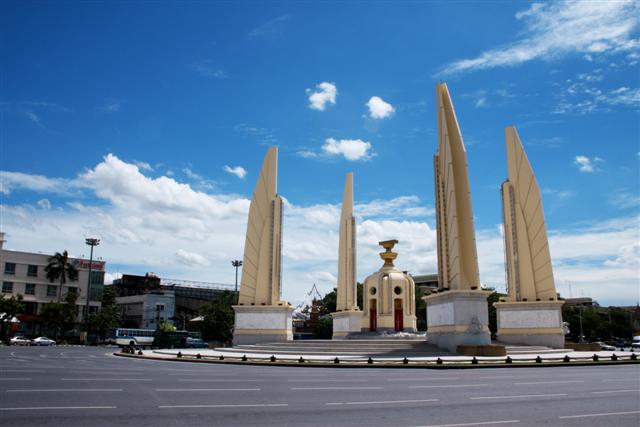
Thailand Democracy Monument (Image: Wiki Commons)
By James Buchanan

Young student activists are unlikely to bring down the junta — but they can make its life more difficult.

Activists in Thailand have a busy calendar. Throughout the year they solemnly mark anniversaries of key dates in the struggle to establish a meaningful democracy in the kingdom. The surfeit of such events highlights just how turbulent the country’s modern history has been, with no less than twelve military coups since the abolition of absolute monarchy in 1932. On May 22 this year, a group of students calling themselves New Democracy Movement (NDM) held a spirited protest to mark the anniversary of the most recent coup, which overthrew the democratically elected government of Yingluck Shinawatra in 2014. Fourteen of the students were arrested – literally dragged away – and held for twelve days by a junta intent on stamping out any signs of dissent. They were released with charges still hanging over them, including one of sedition, punishable by up to seven years in prison.

The students were unbowed and last month used the anniversary of another of Thailand’s coups to denounce military rule once again. On September 19, they gathered to remember the 2006 putsch that ousted Yingluck’s elder brother Thaksin and sent the country careening into chaos. Proceedings started at the traditionally liberal Thammasat University, an important site in Thai history due to the massacre of student protesters that occurred there in 1976. The NDM then led a crowd of up to two hundred on a march to the nearby Democracy Monument, where Red Shirt protestors rallying to call for elections were shot dead by the military in April 2010. Tragically, Thai history is as littered with killings as it is coups.

Against the impressive backdrop of the monument, the students delivered speeches and handed out slick-looking pamphlets criticizing the military and calling on people to rise up to defend their freedom. The unflagging Sirawit Serithiwat, who has been arrested countless times since the coup, and Rangsiman Rome, who shot to fame after his robust scuffle with police in May, presided over events. They are the new face of the struggle for democracy in Thailand.

However, amongst the new faces were some familiar older faces too. Red Shirt activists have been laying advisedly low since the military seized power, but a look around suggested they may have been buttressing the crowd that day. For every youngster in tight jeans and converse sneakers there was also an older protestor who, outwardly at least, seemed to fit the demographic of the now dormant movement. They are newly emergent middle-class from the provinces, dressed tidily but simply and without the trappings of conspicuous consumption so beloved by well-heeled Bangkokians. Middle-aged women in particular – so called “aunties” – formed the backbone of the Red Shirts and were also prominent at the gathering that day.

Nearby was another fixture of the Red Shirt movement; the city’s ubiquitous motorbike taxi drivers. Sitting on their bikes, they watched the protest with interest and eagerly read the NDM pamphlets. On those pages they would find many claims which echoed the Red Shirts’ own, especially denunciations of privy councilor Prem Tinsulanonda, who is alleged to have played a pivotal role in the assault on Thai democracy. Given the similarities in aims and beliefs, it seems natural that there be some crossover between the two movements.

Read the full story at The Diplomat