Showing posts with label US Army Pacific Pathways. Show all posts

25 July 2017

USA: Soldiers Prove Mettle, Readiness in Talisman Saber

By Army Sgt. Frank Strumila, 3rd Battalion, 21st Infantry Regiment

QUEENSLAND, Australia, July 24, 2017 — Australia is not for the faint of heart. Scorpions, snakes, and spiders lurk in the Outback; treacherous terrain crisscrosses the northeastern countryside; extreme temperature shifts can leave you sweltering during the day and chilled to the bone at night.

These challenges did not deter the soldiers of the U.S. Army's 25th Infantry Division as they trained alongside their Australian counterparts during Talisman Saber 17.

Talisman Saber is a multinational, multiechelon exercise held in Australia every other year. This year, 33,000 troops from Australia, New Zealand, Canada and Japan trained alongside Americans from all military branches.

As part of Talisman Saber, the Australian Defense Force's 3rd Brigade conducted a certification field training exercise called Operation Hamel. The soldiers associated with the 1st Stryker Brigade Combat Team, 25th Infantry Division, from Alaska, Hawaii, and around the Pacific, supported 3rd Brigade's certification as a subordinate maneuver force.

For the soldiers from Alaska, Talisman Saber 17 was the first of three exercises supported by Pacific Pathways, a U.S. Army Pacific initiative of exercises that take place annually around the Asian Pacific region. After completing Talisman Saber 17, the Task Force will travel next to the Hanuman Guardian exercise in Thailand and then to Orient Shield in Japan to build both readiness and interoperability with multinational partners.

26 January 2017

News Story: Mattis Heads To Japan, Korea: Why Asian Alliances Will Survive TPP’s Death

Image: Flickr User - Morning Calm Weekly Newspaper, U.S. Army
By SYDNEY J. FREEDBERG JR.

A member of the 1st Battalion, 32nd Infantry, participates in the joint South Korea/US Exercise Team Spirit '84 >>

WASHINGTON: President Donald Trump killed the Trans-Pacific Partnership just two days ago, but this morning, multiple experts and one four-star general agreed that America’s Pacific alliances — except perhaps the Philippines — would survive and even thrive. A few hours later, aptly enough, the Pentagon announced that Defense Secretary James Mattis, the new administration’s most outspoken proponent of strong alliances, will visit Seoul and Tokyo next week in his first foreign trip.

But it’s not just longstanding allies like Japan, South Korea, and Australia that want the US to reach out. Across the Pacific, more nations than ever before are asking to hold joint exercises with the US military. Why? Because as unsettled as Asian leaders are by Trump’s “America First” rhetoric and his demands that allies spend more on their own defense, they’re even more unsettled by a rising, militarizing China and a consistently erratic North Korea. In brief: Threats trump Trump.

Yes, “we’re going to see some surface noise and chop” as the political leadership changes, said Andrew Shearer, a former Australian national security official now at the Center for International and Security Studies, which hosted this morning’s event. Some Asian leaders may clash with the new administration, like the Philippines’ erratic and fiery Rodrigo Duterte. But others may be quite simpatico with Trump, like Australian Prime Minister Malcolm Turnbull, himself a brash businessman turned politician, or Japanese PM Shinzo Abe, who wants to boost his country’s defense spending and has already met with Trump in New York.

But in a way that transcends personalities, Shearer said, the alliances have been and will remain strong because “they’re driven by threats and, guess what, the threat’s not going away. The North Korean threat in particular is going to be a real driver.”

Read the full story at Breaking Defense

10 December 2016

News Story: US Official - North Korea's Nuclear Capabilities Growing

Carla Babb

PENTAGON — North Korea now has the capability to launch a nuclear weapon, but it may not be able to hit its intended target, according to a senior U.S. military official.

The Pentagon believes Pyongyang can mount a warhead on a missile, but North Korea has not developed the capabilities needed for the warhead to re-enter Earth's atmosphere and strike a specific area, the official told reporters Thursday, speaking on condition of anonymity.

“It is the threat that keeps me awake at night,” the senior military official said. “And that's why they continue to test their systems out there.”

06 April 2016

USA: MSC Ships Deliver Marines, Cargo to Philippines for Balikatan

By Grady Fontana, Military Sealift Command Far East

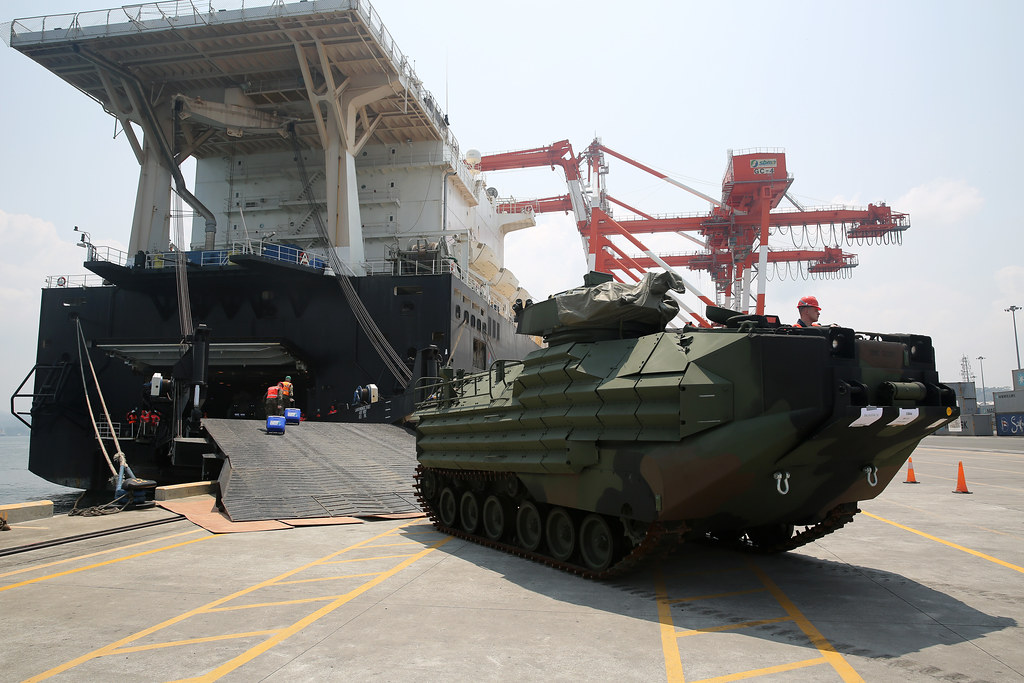
An AAV-7 Amphibious Assault Vehicle rolls off the ramp of maritime prepositioning force ship USNS 1ST LT Jack Lummus (T-AK 3011) in preparation for exercise Balikatan 16. (U.S. Navy/Grady T. Fontana) >>

OLONGAPO, Philippines - Military Sealift Command’s (MSC) maritime prepositioning force (MPF) ship USNS 1ST LT Jack Lummus (T-AK 3011) arrived at Subic Bay here, March 26-29, and offloaded her cargo to 3rd Marine Expeditionary Force Marines in preparation for exercise Balikatan 16 (BK16).

BK16, in its 32nd iteration, is scheduled to take place on the Philippine islands of Luzon, Palawan, and Panay and is an annual bilateral exercise that involves U.S. military and Armed Forces of the Philippines personnel and subject matter experts from Philippine Civil Defense agencies.

At the end of the two-day offload, the Lummus discharged more than 100 personnel, 157 vehicles and 12 shipping containers of equipment.

29 March 2016

Think Tank: An underappreciated strategic option in North Asia

Tom Hanson

Continued Chinese maritime ‘gray zone aggression in the South China Sea (as well as further afield) requires that Australia make strategic choices now to avoid being militarily dominated or economically marginalised by Beijing in the future.

China is Australia’s largest trading partner, accounting for more than 25% of Australia’s total export market. The recently-concluded China–Australia Free Trade Agreement means that Australia has unprecedented access to Chinese markets for its agricultural produce, natural resource extraction industries and a range of service offerings. If Australia’s only concern was maintaining or expanding current levels of economic activity between the two countries, the question of whether or not to conduct a freedom of navigation operation in the South China Sea would be self-evident.

But Australia has much more at stake than balance sheets, and therefore a more problematic set of choices to confront. The greatest challenge for the Turnbull Government and its successors is how to create manoeuvre space between the two superpowers and thus avoid the fate of either tributary state or ‘expendable ally’.

USA: U.S., Cambodian Forces Close Angkor Sentinel 2016

By Army Master Sgt. Mary E. Ferguson, 8th Theater Sustainment Command 
DoD News, Defense Media Activity

KAMPONG SPEU PROVINCE, Cambodia, March 28, 2016 — As Angkor Sentinel 2016 drew to a close March 25, U.S. and Cambodian forces wrapped up two weeks of bilateral training and relationship-building with a ceremony and a Royal Cambodian Army capability demonstration at the Training School for Multinational Peacekeeping Forces here.

This year marked the seventh iteration of the annual bilateral military exercise hosted by the Royal Cambodian Armed Forces and sponsored by U.S. Army Pacific. The exercise is designed to collectively strengthen the two countries’ humanitarian assistance and disaster relief capabilities and improve military-to-military cooperation.

“The men and women of the Royal Cambodian Armed Forces have again and again demonstrated their commitment to serve,” said U.S. Ambassador to Cambodia William Headt. “When storms or floods have affected Cambodia, service members have responded. The Cambodian military is a critical government asset in providing humanitarian assistance and disaster relief, and I’m proud that the United States has been able to support Cambodia in this important task.”

04 February 2016

News Story: Reshape US Army, Asian Alliances To Deter China - CSBA

THAAD Missile Defense System
By SYDNEY J. FREEDBERG JR.

WASHINGTON: The US Army must play a larger role in the Pacific to deter China, one of DC’s leading defense experts is telling Congress today. That larger role requires politically and fiscally difficult decisions to build new kinds of units and base them in new places, Andrew Krepinevich told me in advance of his Capitol Hill briefing.

The core of Krepinevich’s vision: Army missile batteries — for anti-air, anti-ship, missile defense, and long-range strike — regularly deploying to, or even permanently based in, West Pacific nations. Those allies could contribute crucial ground forces themselves, each according to their capabilities. Japan has its nascent coastal anti-ship batteries. The Philippines could build a state-sponsored irregular defense force, one that takes tactical and technological lessons (but not ethical ones) from Lebanon’s Hezbollah.

Together, US and local ground forces along the First Island Chain — running from Japan to Indonesia — would provide the strong backbone of a Western Pacific defense. Dug in on islands, they would be the immovable anvil to the mobile hammer of the Air Force, Navy and Marines.

Read the full story at Breaking Defense

30 January 2016

USA: MSC Delivers Essentials, Rolls-out Exercise Cobra Gold

By Grady Fontana

The ramp is lowered from USNS MAJ Stephen W. Pless (T-AK 3007), one of two ship Military Sealift Command ships delivering equipment for exercise Cobra Gold in Thailand. (U.S. Navy/Grady T. Fontana) >>

LAEM CHABANG, Thailand - Military Sealift Command’s (MSC) Surge Sealift, Roll-on/Roll-off ship USNS MAJ Stephen W. Pless (T-AK 3007) arrived at the port here to offload essential military equipment in support of exercise Cobra Gold 2016 (CG-16), Jan. 27.

Thailand and the United States are scheduled to co-host the annual, multilateral Exercise CG-16 in various areas throughout the Kingdom of Thailand Feb. 9-19. This year’s CG-16 will consist of three primary events: a command post exercise, which includes a senior leader seminar; humanitarian civic assistance projects in Thai communities; and a field training exercise that will build regional relationships.

The Pless was carrying more than 470 items that totaled approximately 2,500 long tons (5.38 million lbs.). The cargo included such items as military vehicles, aircraft and ammunition. A second MSC vessel, USNS 1ST LT Jack Lummus (T-AK 3011), is scheduled to arrive in the coming days to offload additional CG-16 gear.

09 December 2015

News Story: Brooks - Pacific Pathways Generating Savings, Highlighting Challenges

By Jen Judson

WASHINGTON — The commander of US Army Pacific is working to preserve funding — while finding savings — for a series of yearly exercises that are designed to build partnerships and to project ready forces in the Asia Pacific region.

Pacific Pathways is a series of three annual exercises typically involving three other countries west of the international dateline as part of the operations and which defines Army presence as "more faces in more places with less bases," Gen. Vincent Brooks told reporters today at a breakfast in Washington.

The exercises, which began in 2014, are a way of reconciling how to project forces  amid shrinking resources as part of the Obama administration's mandate to pivot focus to the Pacific Rim.

Brooks said he is trying "to do this in a cost-informed way, where we actually leverage existing funds for exercises."

The effort is funded in the Army's five-year budget plan between fiscal 2018 and 2022, Brooks said, adding, "we are asking to have that preserved."

Brooks said he believes he can conduct Pacific Pathways using about $38 million a year to cover three exercises at about $13 million each.

Pacific Pathways funding in fiscals 2014 and 2015 came from moving money within the command, Brooks explained.

"That was by cost avoidance and cost savings," he said, adding the cost savings are, in a way, inherent to how Pacific Pathways is organized and conducted.

Read the full story at The Diplomat