Showing posts with label IDSA. Show all posts

18 October 2013

Think Tank: India-Australia Maritime Cooperation: Raising the Pitch


Abhijit Singh

With INS Sahyadri – India’s modern stealth frigate – participation in the just concluded International Fleet Review (IFR) in Sydney, there has been some enthusiastic discussion in India’s strategy circles on the state of the India-Australia maritime relationship, recently witnessing a major revival.

The Royal Australian Navy’s fleet review (04 – 10 October) is a useful start point to look at the growing maritime convergence between India and Australia. For a start, the IFR is a high profile affair and the centrepiece of the Royal Australian Navy’s centenary celebrations this year. With a participation of more than 40 naval ships, 16 tall ships, 60 aircraft and 8000 sailors from 19 countries, it can justifiably be called as the ‘defining’ maritime event in Australia’s 2013 maritime calendar.

The Sahyadri’s presence in the IFR is significant, as it came about following a special invitation extended by the Australian Defence Minister, Stephen Smith, during the visit of his Indian counterpart, A K Antony, to Australia in June this year. For the Indian navy, the Australian invitation is a particular privilege as not many Indian Ocean navies have been invited for the IFR.

20 September 2013

Think Tank: India's approach to Asia Pacific


Arvind Gupta

Several political, security, economic and socio-cultural factors are at play making Asia Pacific a highly dynamic region. India needs to have a long term strategy to make use of the opportunities arising in the Asia-Pacific while keeping in view the security challenges. The Asia-Pacific is marked by the following key trends: rise of China; the rebalancing strategy of the US; a regional architecture underpinned by centrality of ASEAN; the growing importance of the Indian Ocean region and maritime issues; the growing salience of non-traditional security threats.

This policy brief discusses some of the key trends in the Asia Pacific and sets out a long-term approach for India so as to maximise its security and developmental opportunities. The focus is on Indo-ASEAN relations while other countries are discussed in brief.
 
Rise of China

China's rise has created a flux. An economic giant, with a GDP of USD 7.3 trillion (2011-World Bank) & an annual military expenditure of Yuan 650 billion (approx USD 103 billion) in 2012, China has overtaken Japan in economic and military terms and may overtake the US’ economy in the next 10-20 years depending upon the growth rate differential between the two countries.

China’s rise is altering the balance of power globally & regionally. The confidence in China's peaceful rise and peaceful development has been seriously dented due to rising tensions in South China Sea and in East China Sea. The new leadership is nationalistic & sharply focused on China’s ‘core’ interests.

05 September 2013

Think Tank: Indian Airpower Afloat

INS Vikrant Under-Construction (File Photo)

Vivek Kapur

The first indigenously designed and built aircraft carrier, INS Vikrant, was launched on August 12, 2013. While still several years from being operational, the launch of the carrier, which has been designed to carry 36 fixed wing fighter aircrafts, comprising a mix of MiG-29K and the indigenous LCA (naval variants) in addition to Ka-31 AEW and ALH helicopters, will provide air cover to Indian Navy (IN) vessels. The launching of the hull of INS Vikrant with the power plant and generators integrated is the first step in the further development of the ship, particularly the weapon systems. This work is likely to consume the better part of two years before the ship can join the operational fleet. Only the UK, the US, France, and Russia have demonstrated the ability to design and build such ships. Reportedly, the second Indigenous Aircraft Carrier (IAC-2) is under design already.

One particular feature of the aircraft carrier is that it does not plan to utilise steam catapults, like the US super carriers, for the launch of the fixed wing aircraft. Instead, the bow of the ship sports a ski-jump configuration, in which the aircraft rolling down the very short available runway on take off is lofted into the air like a skier.1 This will impose limitations on the type of aircraft operable. The IAC-2 is likely to have catapults for aircraft launch.

The importance of air power at sea can not be overstated especially since the Battle of Coral Sea (May 4–8, 1942), in which two opposing fleets fought a major sea battle through the use of aircrafts launched from their carriers. Replacement of the battleship of yore with aircraft carriers, as the new capital ship, has been a strategic choice for the navies of the world since then.

18 April 2013

Think Tank: China consolidates claim in South China Sea


Mandip Singh

It has barely been a month since the 12th National People’s Congress ended, with new appointees to various ministries and committees in the State Council. While one would have expected the new dispensation to settle down, one area that has seen plenty of activity, albeit unobtrusive, is the South China Sea. In 2012, China upped the ante on all fronts on issue. Diplomatically, it stalled the “Code of Conduct” at the 20th ASEAN Summit in Phnom Penh; politically, it declared the South China Sea as a “core national interest” and “non-negotiable”; and militarily, it raised a new military garrison on Yongking island with a mandate to administer and control over 200 islets, sand banks and reefs in the Xisha, Nansha and Zhongsha islands, and over 2 million square kilometers of waters within the “nine dash line” of the South China Sea.

Having buttressed its claims with legitimacy of its sovereign rights, China is now moving towards slowly consolidating its claims.

Significantly, in early April China hosted the 12th annual Boao Forum for Asia (BFA)—a congregation of 2,500 industrialists and business community from over 30 countries—at Sanya, in Hainan Province. It must be noted here that Hainan also administers the Xisha (Paracel), Zhongsha (Pratas), and Nansha (Spratlys) islands in the South China Sea. The significance of the venue would not have escaped the attention of the international community. While the conference was in progress, China announced that the Xisha islands, disputed between China, Taiwan and Vietnam, would be open to tourism from May this year.1 It also announced that as a part of the security drill during the Boao Forum, a “fleet of five marine surveillance ships will monitor maritime traffic safety, investigate maritime accidents, detect pollution, and carry out other missions around the clock during the Boao Forum.”2 Further, it also banned low flying aircraft during the conference.3 While no mention was made of the area in latitude and longitude over which these marine surveillance and flight restrictions would apply, the fact that the writ of the administration applies over the disputed South China Sea would be axiomatic.

21 March 2013

Think Tank: America’s Asia Strategy in Obama’s Second Term


Arvind Gupta

In a major speech delivered at the Asia Society on 11 March 2013, US National Security Adviser Thomas Donilon clarified Obama’s rebalancing strategy. The clarification is important as there has been a lot of confusion since 2011 as to what US rebalancing to the Asia Pacific actually meant. The Chinese were particularly concerned that rebalancing was aimed at containing their rise.

The rebalancing strategy, Donilon noted, is characterized by ‘five pillars”. These are: “strengthening alliances; deepening partnerships with emerging powers; building a stable, productive, and constructive relationship with China; empowering regional institutions; and helping to build a regional economic architecture that can sustain shared prosperity.”

He explained at length each of these pillars. First, the US remains fully committed to its alliance relationships with Japan, South Korea, Thailand, Philippines and Australia. Second, the US will develop closer ties with emerging powers like India and Indonesia. Noting that US and Indian interests powerfully converge in the Asia-Pacific, he described the bilateral relationship as the ‘defining relationship’ of the 21st century. And with respect to Indonesia, he characterised that country as a “global partner” of the US.

14 February 2013

India: Antony Pleads for a Proactive Role by India in West Asia Region


In the backdrop of tumultuous changes sweeping the Middle East, the Defence Minister Shri A K Antony today expressed concern about the safety and security of Indians working in the region. 

Addressing the 15th Asian Security Conference organized by IDSA here he said, “the strong urge for change is clearly visible across the region.” Dwelling at length on the changes taking place in the Middle EastShri Antony said, the voice of youth is a universal message that is strongly echoing across to governments in all regions of the world. Defence Minister said, the recent developments in all these countries give us lesson that no government, or regime, can afford to ignore the popular aspirations anymore. Shri Antony emphasised that social media has emerged as a potent and vibrant force. The social media has served as a 'force multiplier' in the hands of the protesters, he said. 

12 January 2013

Think Tank: China to Survey Disputed Marine Territories for Natural Resources


By Bijoy Das

After establishing Sansha, passing a new maritime regulation from Hainan, and, printing maps on passports, the Chinese authorities have now unveiled a plan to survey all marine and island territories for marine resources. This was reported by the Xinhua website at 09:42:31 hrs (Beijing time) on 10 January 2013.1

Although the report indicates that the survey will be carried out throughout the country, it also specifically mentions Sansha (i.e. South China Sea) and baseline points (which would include all disputed marine territories). The terse report, when translated, reads as follows:

“The 2nd Chinese Comprehensive Survey of Marine and Island Resources will be started sometime in the first half of this year. The survey is expected to be completed by December 2016. By this survey, the Chinese hope to fill earlier gaps regarding the distribution, quality and quantity of resources in important marine and island territories like Sansha and other baseline points.”

After establishing Sansha, passing a new maritime regulation from Hainan, and, printing maps on passports, the Chinese authorities have now unveiled a plan to survey all marine and island territories for marine resources. This was reported by the Xinhua website at 09:42:31 hrs (Beijing time) on 10 January 2013.1

Although the report indicates that the survey will be carried out throughout the country, it also specifically mentions Sansha (i.e. South China Sea) and baseline points (which would include all disputed marine territories). The terse report, when translated, reads as follows:

“The 2nd Chinese Comprehensive Survey of Marine and Island Resources will be started sometime in the first half of this year. The survey is expected to be completed by December 2016. By this survey, the Chinese hope to fill earlier gaps regarding the distribution, quality and quantity of resources in important marine and island territories like Sansha and other baseline points.”

Undoubtedly, the unveiling of this new plan would draw criticism from other countries having disputes with China on marine territories (including islands), with the probable exclusion of Taiwan. But of greater concern is the escalation of disputes mainly in the East China Sea and South China Sea.

It remains to be seen what measures countries such as Japan and Vietnam resort to when Chinese survey vessels actually begin conducting surveys in marine territories and islands which they claim to be their own. One has also to watch what security measures these Chinese survey vessels employ to thwart actions from vessels of the other claimant countries.

Earlier, countries in this part of the world involved in such disputes have been known to have resorted to building structures, cutting sea cables, using water cannons, permitting civilian demonstrations, allowing military or para-military vessels and aircraft to pass and patrol, and the like, to strengthen their claims on such territories. Although there has been talk of joint exploitation of resources, nothing has really happened on the ground to show that these disputes can be amicably resolved by the parties without sensationalising them from the angle of national territory and sovereignty.2

Of late, the trend is to strengthen their respective claims through administrative and legislative measures. The aim is to showcase the supremacy of the respective parliaments and governments. This approach also tends to make all “national territory” non-negotiable. Japan, China and Vietnam have all attempted this in the recent past.

The current move by China also seems to have been made with the objective of strengthening its claim to disputed marine territories by conducting “surveys” which a country normally does in its own territory. It also has the potential of keeping the other disputants on the edge. Besides, the sheer frequency with which China has recently been able to come up with such claims has also given it a definite psychological advantage over others as a first mover.

However, the flip side of this Chinese approach is that it would most certainly end up with an outcome most disliked by China – the involvement and long term presence of the United States. That actually would mean a failure of China’s vision, diplomacy and regional influence. By the same coin, it would also mean that it is a collective failure of not only the disputing countries, but also of multilateral regional forums such as ASEAN, ARF, ADMM Plus, etc., which are striving for acceptable peaceful solutions to the disputes. The stalemate is mostly about whether China has its way in negotiating the disputes bilaterally or whether the others get it done multilaterally.

Given such a deadlock and possibilities of escalation, it goes without saying that apart from fielding their own military and para-military forces, the only way open to the other claimants in the short term is continue to involve bigger powers from elsewhere such as the United States, Russia and India. However, the big bet which China has placed is that none of these powers would be able to throw in their actual military weight behind any of the regional claimants to fight China despite policies such as the US Pivot to Asia or India’s Look East. Ultimately, China feels confident that its sheer power can both shield the region from outside influence and drive a hard bargain in these disputes.

The United States may have some traction in the form of old allies and new willing partners in the region to enable it to play a role to resolve the disputes. While Japan, South Korea, the Philippines and Australia may be counted as old allies, Vietnam and Indonesia may be considered as countries now willing to partner the United States in regional territorial disputes. However, since China is unwilling to grant any such space to the United States or any such "outsider", the prospects of an active and direct US role in the matter is ruled out.

Russia is keen to tap into the natural resources under these seas, but is aware that it cannot get directly involved in the territorial disputes. Besides, it has other pressing security concerns elsewhere to attend to.3 India too is expected by certain regional countries to mark its presence in the area possibly to hedge against China. However, the prospects of any decisive Indian role appear dim for the moment although it does seem that the limited Indian presence in the region has reduced the possibility of unilateral military action there.

As is known, India is exploring for hydrocarbons in a part of the South China Sea under Vietnamese possession but claimed by China. It is a challenge for India to hold on to the contract between ONGC Videsh Limited and Petro Vietnam and yet prevail upon the disputing parties to bring about a peaceful solution. Needless to say, India’s leverage in the region would receive a quantum boost if it can present a formula for peaceful resolution acceptable to all the parties concerned.

What shape events assume in the coming months is a good case for the soothsayers. But what seems to be highly probable amidst this trend of irredentism is that East and South-east Asia may gradually descend into conflict zones, and take down with them the potential, prosperity, peace and dreams of an Asian century.

-- 

1.Xinhua News Agency, 10 Jan 2013, available at http://news.xinhuanet.com/2013-01/10/c_114317329.htm, last accessed on 10 January 2013.
2.Inquirer Global Nation, 07 January 2013, available at http://globalnation.inquirer.net/61033/philippines-cautious-on-chinas-offer-to-jointly-explore-for-oil-in-spratlys-area, last accessed on 10 January 2013.
3. Vladimir N. Kolotov, “Russia’s Views of the Security Situation in East Asia,” September 2012, available at http://www.brookings.edu/research/opinions/2012/09/17-russia-east-asia-kolotov, last accessed on 11 January 2013.

Originally published by Institute for Defence Studies and Analyses (www.idsa.in) and can be found HERE.

27 December 2012

Think Tank: LDP “Take(s) Back Japan” - The creation of a national military is on Abe’s agenda


Shamshad A. Khan

Introduction

The Liberal Democratic Party (LDP) is back in the saddle with a land slide victory and has ousted the Democratic Party of Japan (DPJ) in the general election held on December 16. This was a snap election that took place almost three years after the DPJ dethroned the LDP in August 2009 and was necessitated by circumstances created by the opposition parties. The opposition parties, which hold a combine majority in the Upper House of the Diet, had blocked various measures taken by Prime Minister Noda including the consumption tax. In a bargain with the LDP to help pass the consumption tax hike bill, Noda has agreed to call a fresh poll.1

Apart from political gridlock, the DPJ had been facing various challenges on the domestic front including the situation arising from the March 11 earthquake and tsunami, which crippled the Fukushima nuclear power plants. The party has failed to come up to the public expectation as the reconstruction work in the devastated area was slow and more than 100,000 people evacuated from Fukushima could not be rehabilitated and have been living in temporary shelters.

On the foreign policy front, Japan has been facing territorial assertions from China and South Korea over Senkaku and Takeshima, respectively, which surfaced in quick succession and soured ties with Beijing and Seoul. The Japanese people viewed the DPJ’s response to Chinese and South Korean territorial assertions as “weak-kneed” as a result of which the Noda cabinet’s public approval plummeted. North Korea’s rocket launch on December 12 (which also meant a demonstration of its ability to launch a long range missile) and Chinese air intrusion into Japanese airspace on December 13, which came a few days before the December 16 election, also provided an opportunity for the opposition parties to criticize the weak DPJ government. The public also perceived that their country is under increasing threat from belligerent neighbours.

Sensing the public mood, the main opposition LDP announced a number of pledges including revival of the Japanese economy, revision of the Constitution and dealing with China strongly. The “swing voters” and nationalists found these pronouncements appealing. Thus the public dissatisfaction with the DPJ and manifestations of external threat helped the LDP wrest power.

Under the leadership of Shinzo Abe, the LDP presented a distinct set of foreign and security policies during the election campaign. It is expected that the new government under Abe’s primeministership would aggressively push to realize these policy goals following the formation of the new cabinet on December 26. This Issue Brief attempts to analyse national security issues in the LDP’s agenda especially the creation of ‘national defense force’ through constitutional revision and lifting the ban on exercising the right of collective self-defence. The Brief also looks at the hurdles the Abe cabinet will likely face in implementing its agenda.

--

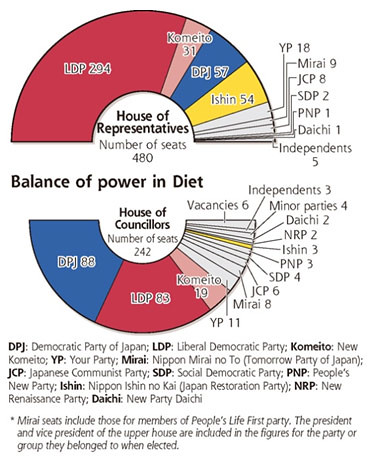
Figure 1: Strength of Political parties in the Lower and Upper house of the Diet


--

A new political push for the creation of a national defence force

Constitutional revision, particularly amending Article 9 of the Constitution which bars Japan from possessing a full-fledged army, has been one of the pet agenda of Shinzo Abe. During his previous stint as Prime Ministers in 2006-07, he had enacted a bill to hold a referendum2 on Constitutional revision and upgraded Japan’s Defense Agency as Ministry of Defense. During the December 2012 election campaign, the LDP pledged to upgrade the status of the Self Defense Force to a “National Defense Force”.3 The LDP and other nationalist parties want to end the Constitutional prohibition for Japan’s possession of “land, sea, and air forces”, which they see as an insult to a sovereign nation. In fact, even the Self Defense Force had been created in 1954 by citing the external security situation and arguing that an independent nation has a right to “self-defense”. The LDP also promises to revise the interpretation of the Constitution which prohibits Japan from exercising the right of “Collective Self Defense”. The debate to lift this self-imposed prohibition by the Cabinet Legislation Bureau is gaining momentum; the aim is to come to the aid of Japan’s ally the United States. The LDP is considering various contingencies in which the SDF should come to the help of the United States including in case the US Navy comes under fire near the Senkaku Islands. Opponents of this move, however, argue that exercising the right of collective self defence would “open way for Japan’s involvement in military conflict not directly affecting it.”4

During the recently concluded election campaign, Shinzo Abe aggressively canvassed for revising the Constitution and upgrading the SDF into a military. His argument was:

“To outside world we call it a military force and to domestic audience, we call it the SDF. The LDP is calling for a halt to such sophistry.”5

LDP officials are using the ongoing stand-off with China over the sovereignty of Senkaku and North Korea’s rocket launch to propel a debate on constitutional revision. Linking these issues with the inadequacy of the Constitution, Shigeru Ishiba, LDP’s Secretary General and former Defence Minister, has argued the need for providing constitutional legitimacy to the SDF.6

The Key partners who can help achieve the goal

Similar pledges to revise the Constitution has also been made by Shintaro Ishihara, whose newly formed Nippon Ishin no Kai (Japan Restoration Party)7 has won 54 seats and emerged as the third largest party in the new Diet. It is expected that the Japan Restoration Party will vote for the revision of the Constitution, if the Abe cabinet were to put the agenda before the Diet. Following the election, Abe has hinted that he would seriously pursue his “unfinished agenda” of revising the Constitution for which he will seek support from the Japan Restoration Party and Your Party. Your Party, yet another nationalist party, won 18 seats this time around. Days after winning the election, Abe was quoted by Asahi Shimbun as saying that “we built a bridge to change the Constitution. The first thing we will do after crossing the bridge is to revise Article 96.”8

The LDP wants to change Article 96 first which it sees as the biggest bottleneck in amending the Constitution. Article 96 stipulates strict conditions to amend the Constitution including a “two thirds majority” approval in both the houses as well as a “concurring vote” in both houses. Thereupon, it should be submitted to the people for “ratification” in a referendum. Because of this strict condition, no amendment to the Japanese Constitution promulgated in 1947 has taken place so far. Therefore, the LDP wants to change the procedure of Constitutional amendment through a “simple majority9 instead of two-thirds majority as spelt out in Article 96.

Be that as it may, the post poll mood of the lawmakers suggests that even the two-thirds majority could be achieved for revising the Constitution. A Kyodo news opinion poll found that a total 343 lawmakers in the newly elected Lower House want an amendment to Article 9 of the Constitution.10 Another survey conducted by the Mainichi Shimbun found that around 72 per cent of lawmakers elected to the Lower House would support amending the peace clause.11 A similar survey conducted by Mainichi in 2009 had found quite the opposite result: only 34 per cent of the parliamentarians then had wanted to revise Article 9, while 51 per cent were opposed to the revision.12 It can be said that the ongoing territorial assertions by Japan’s neighbours and the volatile security situation in the region have led to a change in thinking among the people’s representatives.

Nevertheless, given the present strength of the upper house of the Japanese Diet and the Constitutional requirement of a “concurring vote” in both the houses, Abe would find it difficult to place the issue in the Diet in the near future. It is likely that he will go slow in realizing his campaign pledge to revise the Constitution. The LDP would have to wait for next summer when election for some 80 seats of the upper house is due.

The Opponents

The LDP faces a number of impediments in realizing its goal of creating a National Defense Force. The New Komeito, supported by lay Buddhist Sokagakkai, has been the LDP’s coalition partner for the last decade and is opposed to amending the Constitution. This time again, the LDP is forming a coalition with New Komeito despite having a majority (294 seats) in the Lower House. This is because a combined strength of 325 (two thirds majority) in the Lower House will give the ruling coalition an upper hand to overrule the upper house. As per the Japanese constitution, in case the Upper House votes down a bill passed by the lower House, the Lower House can overrule the house of peers by passing the bill again with a two third majority.

Given this requirement, the LDP would be in a fix. All the decision has to be passed through the cabinet first and it has to be vetted by the New Komeito representative in the cabinet. New Komeito President Natsou Yamaguchi has already made his stance clear on the issue of Constitutional amendment. In an interview to the Japan Times he said:

“The people are most concerned about the economy and social welfare, and they are not asking us to immediately amend the Constitution. It is an important issue that needs to be discussed thoroughly.”13

On the issue of revising the ban on exercising the right of collective self-defence also, Yamaguchi is at odds with Shinzo Abe. He enunciated his views as follows:

“If the exercise of the right of collective self-defense is recognized and the Constitution revised to create a national military, there would be no constitutional restraints on the use of force. The nature of the SDF’s duties would also change. We cannot agree to that.”14

During the post poll coalition talks as well, New Komeito has opposed Shinzo Abe’s efforts to boost Japan’s military status.15 The Left parties, including the Japanese Communist Party (JCP) and the Social Democratic Party (SDP) have also voiced their concern over the nationalist parties’ push to amend the Constitution. SDP President Mizuho Fukushima had also voiced her opposition to the move during her election speeches. She said that “I am afraid that we will be rapidly moving toward changing the Constitution for the worse.”16 The JCP has also opposed the Constitutional revision terming it a “dangerous trend toward a major chorus calling for a tilt to the right.”17

However, the SDP and JCP would find it difficult to turn the tide to revise the Constitution in the Diet since their strength has been reduced to 10 in the lower house. But it is expected that they will join the pacifist groups in mounting pressure on the government through public rallies to preserve the Constitution. The role of the centre-left DPJ would also be critical. Some of the DPJ leaders including Seiji Maehara have been in favour of lifting the ban on exercising the right of Collective Self Defence. During his term in office, Yoshihiko Noda had shown willingness to review the right of collective self-defence. He has been quoted by the Japanese media as saying that “one opinion holds that the minimum right of self-defense includes elements of the right of collective self-defense”, adding that he would like to “deepen discussion” (on the issue) within the Government.”18 In its election manifesto for the 2010 election, however, the party called for “adhering to pacifism”.19 DPJ President Yoshihiko Noda has criticized Abe’s move to make Constitutional revision a “poll plank.” It is therefore uncertain whether the DPJ will take a clear position when the issue is tabled in the Diets.

Opposition from the Media

A group of liberal media has also opposed the LDP’s stance to give greater power to the Japanese SDF by upgrading it to a “National Defence Force.” Questioning the LDP’s efforts to change the status of the SDF to a national defence force, The Asahi Shimbun stated that “the LDP wants to make the SDF closer to an ordinary force” by amending the Constitution. It noted that the SDF is recognized as an organization with a “restricted use of force” to defend the Japanese territories and added that “if this restriction is removed, Japan could cause the international community, in particular neighbouring countries, to harbor the suspicion that it is reviving its military forces.”20

The Japan Times has also written a series of editorials criticizing Abe’s pledge to revise the Constitution. One of its editorials stated that “[a]ttempting to change the no-war principle of the Constitution without holding thorough public discussion is highly dangerous.”21 In yet another editorial, it opined that changes to Article 9 and the government’s interpretation of the right to collective self-defence would “shatter the trust Japan has gained from the international community through its adherence to its constitutional no-war principles.” It added that such changes would contribute to the “destabilization of East Asia.”22 In an editorial analysing the post poll situation, the daily opined that while the LDP wants the proposed NDF to participate in international activities to help maintain peace and security in the international community, but also pointed out that this concept can be used to “justify Japan’s participation in virtually any type of military mission abroad”. It concluded that people must therefore keep a strict watch on the new administration’s behavior.”23

In a similar tone, the Mainichi Shimbun has cautioned that “political demand is not sufficient to override the established interpretation of the Constitution”, adding that any change in the interpretation of the Constitution, “needs careful consideration.”24

The move to change the SDF into a normal military force, however, received backing from the Yomiuri Shimbun, which has been advocating such a change through its proposals on national security since 2004. In a recent editorial, the Daily urged the need to “step up Constitutional debate” and reiterated the need for the creation of a “military force for self defence.”25 Much before the LDP could propose the amendment of Article 96, the Yomiuri had suggested to all the parties that the two-third majority requirement for Constitutional revision be relaxed. It argued that “relaxing this requirement by revising it to a majority would be the first step to reviewing the Constitution based on the changes of time.”26

Conclusion

The mood in Japanese political circles over transformation of the SDF to a military force and easing the restriction on allowing the exercise of collective self defence suggests that the push to change the Constitution has gained momentum and cannot be rolled back. It is the external security situation marked by China’s territorial assertions and aggressive behaviour as well as North Korea’s rocket launch that has propelled the case forward for a stronger military. However, Abe can realize his dream of amending the Constitution only if he is able to convince his pacifist ally, the New Komeito. Had he aligned with the Japan Restoration Party, instead of sticking to the LDP’s traditional coalition partner, this goal could have been achieved swiftly.

Another problem that Abe faces is whether to give priority to economic and fiscal issues or national security issues. The general public sentiment is to give priority to fiscal health and help the country come out of the slump.

Abe is also likely to confront another problem: criticism from neighbours, if he pushes too aggressively to revise the Constitution and give more power to the military. In the past he has been blamed by neighbours for pushing Japan towards the right, which reminded them about Japan’s militarist past. Much would depend how he balances his priorities in the near future to realize his goal of a “normal” Japan.

Shamshad A. Khan is a Research Assistant at IDSA and presently a Visiting Research Fellow at the Institute for Developing Economies in Chiba, Japan.


1. “Noda dissolves Lower House for election”, Japan Times, November 17, 2012.
2. The Constitutional Referendum Bill adopted in April 2007 by the Lower House of the Japanese Diet came into effect in 2010. But by then a new government had taken office and held no deliberation on how to hold a referendum over the issue.
3. “Nippon O Torimodosu” (Take Back Japan), Election pledge of the LDP for 2012 election, p. 26. Author’s copy received from an activist canvassing for the Party in Tokyo.
4. “Dangerous move on supreme law”, The Japan Times, December 5, 2012.
5. “Why Change the Self Defense Force to a national defense force?” The Asahi Shimbun, November 29, 2012 available online at http://ajw.asahi.com/article/views/editorial/AJ201211300036, accessed on December 17, 2012.
6. “LDP, Japan Restoration Party leading momentum for Constitutional revision”, The Asahi Shimbun, December 6, 2012, available online at http://ajw.asahi.com/article/behind_news/AJ201212060050, accessed on December 7, 2012.
7. Ibid.
8. “Abe Seeks partner to pave way for Constitutional revision”, The Asahi Shimbun, December 18, 2012, available online at http://ajw.asahi.com/article/behind_news/politics/AJ201212180064, accessed on December 19, 2012.
9. “Nippon O Torimodosu”, note 3, p. 26.
10. “76% election winner support revising in Article 9”, Kyodo news/ Japan Times, December 9, 2012.
11. “72% of the newly elected lawmakers want to revise war-renouncing Article 9 of the Constitution”, The Mainichi Shimbun, December 18, 2012 available online at http://mainichi.jp/english/english/newsselect/news/20121218p2a00m0na011000c.html, accessed on December 19, 2012.
12. Ibid.
13. “New Komeito not necessarily on same policy page as old, hawkish ally”, Japan Times, November 30, 2012.
14. “LDP, Japan Restoration Party leading momentum for Constitutional revision”, Note 6.
15. “LDP’s nuclear, Constitutional stances not ally’s”, The Japan Times, December 20, 2012.
16. “Two liberal Parties face uphill fight on December 16”, The Asahi Shimbun, December 13, 2012, available online at http://ajw.asahi.com/article/behind_news/politics/AJ201212100087, accessed on December 14, 2012.
17. “LDP, Japan Restoration Party leading momentum for Constitutional revision”, Note 6.
18. “Review top law to exercise right of collective self defense” (editorial), The Yomiuri Shimbun, July 17, 2012.
19.Our Responsibility for Now and the Future, (Democratic Party of Japan’s manifesto), Issued on November 26, 2012, Nagata-cho, Tokyo, p. 3.
20. “Why change the Self Defense Forces to a national defense force?” Note 5.
21. “Dangerous moves on supreme law”, The Japan Times, December 5, 2012.
22. “An election that really matters”, The Japan Times, December 15, 2012.
23. “LDP back in the saddle again”, The Japan Times, December17, 2012.
24. “Constitution should put brakes on collective self-defense”, The Mainichi Shimbun, December 10, 2012, available online at http://mainichi.jp/english/english/perspectives/news/20121210p2a00m0na005000c.html, accessed on December 11, 2012.
25. “Step up Constitutional debate on ‘national defense force”, The Yomiuri Shimbun, November 29, 2012.
26. “Relax two-thirds rule for Constitutional revision”, The Yomiuri Shimbun, December 16, 2012.


Originally published by Institute for Defence Studies and Analyses (www.idsa.in) and can be found HERE.

19 December 2012

Think Tank: The Return of Shinzo Abe as Japan’s new PM - What does it mean for India?

Shinzo Abe (Wiki Info - Image: Wiki)

R. S. Kalha

Shinzo Abe belongs to a distinguished family of political leaders in Japan. His father Shintaro Abe was a former Foreign Minister, and his maternal grandfather Nobusuke Kishi a former Prime Minister. Shinzo Abe himself was briefly Prime Minister from 2006 to 2007 and returns after the recent general elections with a huge majority as a leader of the Liberal Democratic Party [LDP]. He is known for his hawkish views, particularly on the Senkaku/Diaoyu islands dispute with China. Press reports quote him as saying that ‘Japan owns and controls the islands under international law. There is no room for negotiations on this point.’

There is no doubt that after the recent events over the disputed islands the relationship between China and Japan is at the cross-roads. Fresh evidence, if any was needed, came in the figures published by the Chinese Ministry of Commerce that the volume of direct investment from Japan to China had dropped to US$ 460 million, down by nearly a third from one year ago. The currency swap arrangement between the two countries is also in limbo. The recent wave of anti-Japanese feelings in China, leading to large scale boycott of Japanese products in China, has further embittered relations. There are nearly one million Chinese employed in Japanese firms operating in China and should Japanese firms decide to scale down their operations, the livelihood of these workers would be at risk. If Shinzo Abe lives up to his campaign rhetoric, the Sino-Japanese relationship is indeed headed for troubled waters.

Chinese strategic analysts have always believed that the main security threat to China would come from the Pacific Ocean. The US decision to ‘pivot’ its strategy to Asia has only tended to confirm their apprehensions. Even at the height of the troubles between India and China over Tibet in 1959 and subsequently over the boundary issue, the Chinese never lost sight of this fundamental fact and it remained ingrained in their strategic thought. The Chinese have never shied away from expressing their thoughts on the subject. On 16 May 1959, at the height of the troubles in Tibet, the then Chinese Ambassador visited South Block and handed over a Diplomatic Note, said to be personally drafted by Mao himself, to the then Foreign Secretary. It makes a most interesting reading. Among other things, it stated the following:

The enemy of the Chinese people lies in the east—the US imperialists have many military bases in Taiwan, South Korea and Japan and in the Philippines which are all directed against China. China’s main attention and policy of struggle are directed to the east, to the west Pacific region, to the vicious and aggressive US imperialism and not to India….India is not an opponent but a friend of our country. China will not be so foolish to antagonize the US in the east and again to antagonize India in the west. The putting down of the rebellion….in Tibet will not in the least endanger India. You can wait and see.…This is our state policy…Our Indian friends! What is in your mind? Will not you be agreeing to our thinking regarding the view that China can only concentrate its main attention eastwards of China but not south-westward of China, nor is it necessary for it to do so….Friends! It seems to us that you too cannot have two fronts….Is it not so? If it is, here lies the meeting point of our two sides. Will you please think it over?

Nehru did not respond in the manner that the Chinese had hoped he might have. Why he chose not to do so is also moot? Had he done so, or at the very least explored further what the Chinese had in mind, it is quite possible that the troubles over the boundary issue could have been avoided. All this is, of course, a matter of history now. Yet the fundamental fact remains that the Chinese threat perceptions even today have not changed very substantially from what was stated to Nehru in 1959. And herein lies India’s opportunity now.

Both the United States and Japan wish for India to play a much more robust role not only in the Indian Ocean area but also in the South China Sea and beyond in the Pacific Ocean. With Japan, India’s relationship is not only moving at a brisk pace but the two Prime Ministers have decided to meet on an annual basis. India considers Japan as a strategic partner, a source of economic funding and a country that can provide significant technological and scientific up-gradation for its industrial development. Between the years 2000 to 2012, Japanese FDI into India totalled US$12.86 billion, which is about 9 per cent of the total, with Japan just behind the United Kingdom. Japanese firms operating in India provide 152,280 jobs to Indians. And above all there are no issues that bedevil the relationship. Similarly, the countries of South East Asia, such as Vietnam, the Philippines and to a lesser extent Malaysia and Indonesia, hard pressed as they are by China’s belligerent posturing, all wish India to play a much more robust role in the region. While the United States promises to provide the necessary military security in South East Asia and have also promised Japan support over the Senkaku islands in its stand-off with China, most countries in the region watch with apprehension the continuing US entanglements in the Middle East. The latest imbroglio over Syria has raised doubts whether the United States would ever be free from such entanglements. The promised pivot to Asia still seems to be largely rhetorical and so far away. Meanwhile, the shadow of a resurgent China looms ever larger. China’s economic muscle is also on full display. There are only three countries ranging from the east coast of Africa to the west coast of the United States that do not have China as their largest trading partner!

As the opportunity presents itself, it is now time for Indian diplomacy to show what stuff it is made off. With China increasingly wary of the developments taking place on its Pacific seaboard, it would perhaps be in a much better frame of mind to listen to Indian concerns. India should not be shy of stating them, in a forthright manner, at the highest levels of the Chinese leadership. These should include the boundary issue, Chinese meddling in our neighbourhood and above all China’s destructive nuclear and military supply relationship with Pakistan that is so detrimental to Indian security. Let the Chinese also begin to re-assess the stakes involved.

China is also clearly worried at the US ‘containment’ policy and ‘rebalancing’ to Asia. Any indication of joint naval exercises by India, Japan, the United States and Australia usually brings forth vociferous protests. Although Prime Minister Manmohan Singh has conveyed to the Chinese leadership that India will not be a part of any ‘containment’ policy, yet it does no harm to let the perception grow among the Chinese leadership that there are other options available. Similarly, it would do no harm for Japan to exponentially increase its FDI coverage into India. Should Japanese manufacturing companies presently operating in China downsize their presence there and simultaneously enlarge their presence in India, the message would have been sent loud and clear. It is for the Indian authorities now to take the decisive lead to encourage Japan and other South East Asian countries, instead of wasting valuable time in fruitless ideological debates.

The Author is a former Secretary, Ministry of External Affairs of India.

Originally published by Institute for Defence Studies and Analyses (www.idsa.in) and can be found HERE.

15 November 2012

Think Tank: Japan-China spat over the Senkakus shows no sign of abating


Pranamita Baruah

The recent spat between Japan and China which erupted after the nationalization of the Senkaku islands shows no signs of abating. In September 2012, the Noda Administration in Japan purchased three of the five Senkaku islands—Uotsurijima, Kita-kojima and Minami-kojima—and then nationalised them. Beijing opposed the nationalisation and claimed its ‘indisputable sovereignty’ over the Senkakus (Diaoyu in Chinese). It also termed Japan’s unilateral move in nationalising the islands as illegal and invalid. Tokyo, however, asserted that the islands have been historically part of Japanese territory. It also alleged that China started claiming sovereignty over the Senkakus only after a 1968 UN Commission reported possible undersea deposits nearby. In the meantime, Taiwan, another claimant to the islands, took an equally strong stance against Japan’s nationalisation and alleged that it was an infringement upon its own sovereignty over these islands.

Because nationalisation appeared as intended to demonstrate Japan’s uncompromising stance on sovereignty over the Senkakus, it evoked large-scale anti-Japan protests within China. Chinese protestors attacked the Japanese embassy and vandalised Japanese-affiliated business establishments. The tension between the two countries seemed to heighten further as during this period, the Japanese Coast Guard vessels and Chinese surveillance ships continued to square off against each other in the waters near the Senkakus. The Chinese government’s recent support for Taiwanese fishing boats and patrol vessels to enter the waters off the Senkakus has worried many Japanese. The emphatic statement made by Jia Qinglin, one of the key figures of China’s communist party, about the urgency of forming a China-Taiwan united font vis-à-vis Japan has made Tokyo wonder if both China and Taiwan are actually working in tandem.

In the meantime, Beijing’s persistent attempt to internationalise the Senkaku issue has evoked a strong response from Tokyo. While during the China-EU Summit in Brussels, Chinese Premier Wen Jiabao was emphatic about the necessity of taking ‘strong measures’ on the issue, Vice President Xi Jinping accused Japan of staging ‘the farce’ of purchasing the islands. Then, at the recent UN General Assembly meeting, Chinese Foreign Minister Yang Jiechi alleged that Japan “stole” the islands from China after the 1895 Sino-Japanese War. China even abstained from sending its representative to the plenary session of the annual meetings of the IMF and the World Bank Group scheduled in Tokyo from October 14. In a nautical chart submitted to the United Nations by the Chinese government recently, Beijing even identified the areas around the islands as its own ‘territorial waters’.

In the face of increasing demand from the Japanese public to assert Japan’s own stance on the issue, the Noda Administration also has taken certain measures to appeal to the international community. The Japanese Foreign Ministry has, in its home page, developed a new banner labelled as “Japan-China Relations: Current Situation on the Senkaku Islands”. For the next fiscal year, it has already requested 600 million yen for public relations, investigation and research over Japan’s territorial integrity, including the Senkakus. Tokyo is also considering lobbying for international support by dispatching the Foreign Ministry’s top key parliamentary ministers, including Foreign Minister Koichiro Gemba, to relevant countries to explain Japan’s stance on the Senkakus.

The spat between Japan and China has trampled on the cooperative relations that they have nurtured over many years. This has, in particular, adversely affected their strong economic ties. The delay in the resumption of operations in several Japanese factories in China and the Chinese government’s lack of initiative to compensate them for the damage caused during the demonstrations have made Japanese business houses wary about their investments in China. There is no doubt that Japan’s investment in China, which reached a total of US $6.3 billion in 2011, might drop significantly in the coming months if the current tension drags on. From January to September 2012, China’s trade with Japan reportedly fell 1.8 per cent compared with a year earlier. If the spat pushes some of the Japanese-affiliated companies in China to close down their factories and shift them to other Asian countries like Vietnam and Thailand, the employment of several million Chinese workers in those companies would pose a major challenge to the Chinese government. As China is Japan’s biggest trading partner, economic turmoil in China is bound to have a negative impact on the Japanese economy. China has also been the biggest export market for Japanese businesses. Thus, in September 2012, as China’s imports from Japan plunged 9.6 per cent, it had a strong impact on the Japanese economy.

To avoid further deterioration in the bilateral relationship, both Japan and China need to now abandon their hard-line stance and stop escalating nationalistic sentiments among their people. However, a resolution of the issue through peaceful means has become complicated due to strong political pressure within the two countries. Due to the upcoming general election in Japan and the leadership transition in China, both the DPJ in Japan and the CCP in China are apprehensive about hurting popular sentiments by adopting a compromising stance on the Senkaku issue. The CCP leadership is particularly concerned about taking any step during the ongoing 18th party congress (November 8-14), since it might trigger a nation-wide revolt against its rule. As far as Japan is concerned, any relaxation in the ruling DPJ-led government’s stance vis-à-vis China might prove disastrous for the party’s prospect in the upcoming general election expected to be held in 2013.

Under these circumstances, China and Japan have not been able to hold any meaningful dialogue to resolve the current impasse. Since any further delay in resolving the issue might aggravate bilateral tensions further, the two governments need to focus on softening their attitudes towards each other, promote people-to-people contact, encourage cultural activities and revive and strengthen their economic ties. At the same time, the United States along with other regional powers in East Asia need to take an initiative to create a conducive environment for China and Japan to hold a meaningful dialogue to heal their fraught relationship.

Originally published by Institute for Defence Studies and Analyses (www.idsa.in) and can be found HERE.

14 November 2012

Think Tank: DF-41 - China’s answer to the US BMD efforts


DF-41 ICBM (Wiki Info)
Arjun Subramaniam

China had recently test fired the mobile, MIRV capable DF-41 missile which is reported to have a range of 14000 km. This missile adds to the existing ICBM inventory of the Second Artillery, which already operates the older DF-5A and the more mobile DF-31, DF-31A. Among the existing three variants the DF-31 with a range of 7200 to 8000 km can reach only till Alaska with a single warhead. The other two have the range to deliver a single warhead on any part of the US mainland. The DF-31A is reported to be MIRV capable and can be armed with three warheads, but this will compromise the range of the missile, making it incapable of reaching the US mainland. To date, China has the capability of delivering a single warhead per missile on the US mainland. However, it is concerned about a new threat that degrades its deterrence capability—the US missile defence initiatives which continue to improve technologically and expand spatially. And the recent testing of the DF-41 which is capable of delivering 10 warheads over a distance of 14000 km is an effort towards improving the Chinese deterrence capability. China is actively working to balance the equation with the United States to maintain deterrence.

China is estimated to possess 30 to 40 ICBMs1 that have the range to reach the US mainland. In the event of a US first strike, the surviving missiles when launched could be intercepted by the US missile defence systems thus degrading China’s retaliatory capability. Nevertheless, the US Ballistic Missile Defence (BMD) technology has not fully matured and various technical analyses of the US BMD systems tell us that it will be ineffective against saturation attacks and those that come with countermeasures and Multiple Independently targetable Re-entry Vehicles (MIRVs). It is well known that China has the technology to develop and deploy MIRVs and countermeasures to penetrate defences. In light of this, many analysts believe that China will continue to maintain a minimum deterrence policy and a smaller force structure while improving only the survivability and effectiveness of its delivery mechanisms. On the other hand, considering the improving US missiles defences, it is possible that, in future, China will be forced to go for a vertical increase in its nuclear force (warheads and missiles). The recent testing of the DF-41 is an indication of the Chinese efforts towards this end. But to further explore this possibility it is essential to study the present US missile defence efforts and the future progress in US missile defence technology and the possible options for China to counter these efforts.

US Missile Defence Efforts

The United States has begun to forward deploy its missile defence component to protect the US mainland from missile attacks. Recent reports state that it will deploy an X-band radar in southern Japan as part of its missile defence plans. Japan already has one X-band radar deployed at Shariki base in Tsugaru City, in the far north of the main island of Honshu.2 The United States would also deploy floating Sea Based X-band (SBX) radar in the Pacific (may be in the North Pacific) for mid-course defence against InterContinental Ballistic Missiles (ICBM). A GBR-Prototype (GBR-P) X-band radar is located at Kwajalein Atoll in the Southern Pacific.3 An upgraded AN/FPS-115 radar (UHF) is deployed at Beale Air Force Base, California which is supported by an upgraded radar at Flyingdales, UK and Thule, Greenland.4 Added to this, the United States along with Japan has also deployed some Aegis SM-3 equipped ships near Chinese waters. These Aegis systems have S-band primary radar and X-band engagement radars and are capable of intercepting ballistic missiles of all range with unitary and separating warheads in its terminal phase, except ICBMs. Apart from providing terminal defence against Short Range Ballistic Missiles (SRBM) and mid-course defence against MRBMs and IRBMs, these systems can detect and track ICBMs and transmit necessary target details and trajectory information to other systems in the BMD architecture for mid-course interception of ICBMs. In addition to these sensors the United States has deployed space based tracking and surveillance systems which consist of two satellites (technology demonstrators) that scan for targets in the infra-red and visible regions of the spectrum. These space based sensors can detect missiles in their boost phase when they emit high intensity short-wave IR radiations and can transmit information to other sensors and fire control systems.

These multiple arrays of sensors, which are netted together with the Fire Control System (FCS), and at places overlap in coverage, indicate that the detection, tracking and to some extent Decoy-Warhead (DW) discrimination capability of the United States is highly advanced, particularly for the crucial mid-course phase. All US radar sensors, except early warning radars AN/FPS-132 (UHF), Cobra Dane radars (L band) and the SPY-1 radar (S-band), operate in the X-band region, which helps in obtaining high resolution target details, thus enabling the discrimination of decoys and other missile debris from actual warheads. However, an attacker could employ both Infrared (IR) and radar signature countermeasures. Hence, for better Decoy-Warhead (DW) discrimination, the early warning and tracking systems should include optical sensors as well. The space tracking and surveillance system, which is in the demonstration phase, would be improved and expanded in future enabling it to perform better tracking as well as DW discrimination in the optical region thereby enhancing the effectiveness of the BMD systems. The forward positioning of the ground based sensors along with the space based systems would provide more reaction time for the fire control system. The improvement in the DW discrimination and the early initiation of the interception process will enable the employment of Shoot-Look-Shoot method, which would reduce the number of interceptors required and also lessen the burden for the terminal defence systems.

The other vital area which needs refinement is interception technology. The kinetic kill vehicle of the mid-course interceptor uses a dual band (visual and IR) optical terminal seeker5 to home in on to the warhead. To increase the accuracy as well as terminal target discrimination efficiency, which would improve the Single Shot Kill Probability (SSKP) of the interceptor, a dual seeker (optical and high frequency Imaging Radar) might be used in the future. A higher SSKP would further reduce the number of interceptors required. Improvement to the burn-rate performance of the rocket motor, which would increase the average speed, and upgrading of control systems with better onboard software and attitude controls could be expected in future. All these improvements and fine tuning will complicate the Chinese efforts to maintain credible deterrence.

US BMD vs. Chinese Nuclear Force

A Chinese ICBM attack on the US mainland could be launched from two directions; either, over the North Pole (Circumpolar trajectory) or, over the extreme fringes of the Northern Pacific.6 Along both these directions, the missiles have to pass through the engagement envelope of the interceptors based in Alaska and, depending on the target area, over California too. The US BMD sensors (ground based X-band radars and Aegis ships) in and around Japan would detect and track any Chinese ICBM launch during the boost phase. It has been reported that AN/SPY-1 radars have tracked ballistic missiles at ranges in excess of 1000 km7 and the THAAD GBR (AN/TPY-2) X-band radar may be used as forward based sensors to alert the SM-3 systems when a threat missile launch has been detected.8 However, the altitude (boost phase) at which the missile would be detected depends on the distance of the launch point from the radar (due to Earth’s curvature and line of sight issues). If the missile is launched from areas closer to the shore, within the engagement envelope of the SM-3 missile, it is possible that the ICBM will be intercepted in the boost phase itself (To perform boost phase interception, interceptor speed might require improvement, minor changes in the guidance software might also be required, and the target missile with the presence of booster stages will also present a large target for the X-band radar.)

Over the next 10 to 15 years, the US military wants to equip Aegis ships with a much larger, faster interceptor that the United States is developing cooperatively with Japan. Estimates suggest that the interceptor's speed will be high enough—in principle—to allow it to intercept missiles with intercontinental range.9 Therefore, there is a high probability that the missiles would be launched from deep inland China and in the circum polar trajectory to avoid the Aegis system. Operating from deep inland would also increase the survivability of the missile units from US air strikes. To penetrate an effective BMD system, the Chinese missile should employ appropriate counter measures (decoy with IR and radar countermeasures, Manoeuvrable Re-entry Vehicle (MARV) and MIRV). However, with the gradually increasing capability of the US Decoy-Warhead discrimination capability, the countermeasures would gradually continue to become less effective. China does not enjoy the option of launching its land based ICBM in depressed or lofted trajectories to overwhelm the defences, as it would reduce the range of the missile, thus preventing them from reaching the US mainland.

Currently, China has deployed two ICBMs: the silo based older DF-5A and the solid fuelled and more mobile DF-31A. China had earlier tested the longer range, road mobile DF-41 with a range of 14000 km. While the DF- 5A and the DF-31A are reportedly single warhead10 missiles, the DF-41 will be a MIRVed (10 warheads)11 missile. At present, there are an estimated 30 to 40 ICBMs that have the range to reach the United States and, each being a unitary warhead missile, the total number of warheads would be 30 to 40. Assuming a SSKP of 0.30 per cent for the interceptors based in Alaska and California, it would require four interceptors for a single warhead. Hence the total requirement would be of 120 to 160 interceptors. But once the MIRV (10 warhead) capable DF-41 becomes operational, the number of warheads for this missile force would be a multiple of 10, thus quadrupling the number of interceptors required. This will get more complicated if the Chinese deploy decoys and countermeasures which would further increase required interceptor numbers. However, as discussed earlier, the improving sensor capability for Decoy-Warhead discrimination and the interceptor efficiency might reduce the number of interceptors required, negating the Chinese efforts to some extent.

The other measure the Chinese could undertake to counter US efforts would be to strengthen their undersea deterrence. Submarine Launched Ballistic Missiles (SLBM) are a little difficult for missile defence systems to counter compared to land based missiles. A submarine could fire its SLBM in a depressed trajectory confusing the tracking systems and reducing the reaction time for the BMD system to respond. China’s SSBN fleet is in a nascent stage with all nuclear ballistic missile submarines (SSBN) (Xia and Jin) tied up at ports with zero patrols so far due to various technological problems. Once these problems are overcome and the boomers (Jin class) are operationalised, it will ensure better deterrence. Considering that four Jin class SSBNs will be deployed, with each housing 16 JL-2 missiles, it makes a total of 64 missiles and warheads (if armed with a single warhead). The JL-2 can also be MIRVed (three warheads (60, 90 or 120 kt)12 ), multiplying the total number of warheads to 192. However, an effective Chinese under sea deterrence, given the various problems (technology, crew training and experience), does not appear possible at least in the near future.

Conclusion

The US efforts to improve and expand its BMD system would degrade Chinese nuclear retaliatory capability thus making China’s nuclear deterrence less effective. This would force Beijing to initiate efforts to go for a qualitative and quantitative improvement of its nuclear force by increasing and improving its nuclear force structure by deploying more ballistic missiles with MIRV and MARV capability and penetration aids. China’s emphasis on the land based deterrent component is evident from the recent testing of the MIRV capable DF-41. This missile offers sufficient range to target any part of the US mainland and is also MIRV capable, which will be more effective in penetrating the missile defence shield being deployed by the United States. The deployment of the DF-41 will result in a vertical increase in the nuclear force operated by China. Nevertheless, the minimum deterrence doctrine might not change, with the aim remaining the same, i.e. to operate a necessary force capable of delivering at least a few warheads on the US mainland.

---

1. Hans M. Kristensen and Robert S. Norris, “Chinese nuclear forces, 2011,” Bulletin of the Atomic Scientists, November/December 2011 vol. 67 no. 6, pp. 81-87, available at http://bos.sagepub.com/content/67/6/81.full.
3. Edited by Duncan Lennox, Ground based mid-course defence (GMD) segment, Jane’s Strategic Weapon Systems, Issue 55, 2011.
4. Ibid
5. Ibid
6. This is due to geography i.e. the location of the two countries.
7. See Note 3
8. Ibid
9. David Wright and Lisbeth Gronlund, “Technical flaws in the Obama missile defense plan” Bulletin of the Atomic Scientists, 23 September 2012, available at http://www.thebulletin.org/web-edition/op-eds/technical-flaws-the-obama-missile-defense-plan.
10. Though there were some reports of the DF-31A being MIRVed, there is no confirmation yet. Jane’s Strategic System Issue 55 reports that, if DF-31A is MIRVed (3 warheads), its range will reduce to 10,000 km from 14000 km. The DF-5A reportedly still remains operational as a single warhead missile.
11. “PLA test-fired multiple warhead ICBM in July: Jane's Defence Weekly,” WantChinaTimes.com, 22 August 2012, available at http://www.wantchinatimes.com/news-subclass-cnt.aspx?id=20120822000138&cid=1101.
12. See Note 3

Originally published by Institute for Defence Studies and Analyses (www.idsa.in) and can be found HERE.