Showing posts with label Galle Dialogue. Show all posts

31 January 2017

India: Visit of Commander of the Sri Lankan Navy

Vice Admiral RC Wijegunaratne, Commander of the Sri Lanka Navy is on an official visit to India from 29 January to 02 February 2017. The visit is aimed at consolidating bilateral naval relations between India and Sri Lanka and to explore new avenues for naval cooperation.

Commander, Sri Lankan Navy will hold bilateral discussions with Admiral Sunil Lanba, Chief of the Naval Staff and other senior officials of the Indian Navy on 30 January 2017.  The Admiral is also scheduled to meet the Chief of the Air Staff, Chief of the Army Staff as well as the Director General, Indian Coast Guard. Calls on of the Hon’ble Minister of State for Defence and Defence Secretary have also been scheduled as part of his official meetings in New Delhi.

Naval cooperation between India and Sri Lanka has been traditionally strong, encompassing a wide span which includes operational interactions through bilateral exercises, Training, Port Calls, Hydrographic co-operation, Special Forces interactions, Capability Building and Capacity Augmentation initiatives. Two Advanced Offshore Patrol Vessels (AOPVs) are also being constructed for the Sri Lankan Navy at M/s Goa Shipyard Limited.

In addition to New Delhi, the Admiral is also scheduled to proceed to Goa where he will be visiting Naval War College and Goa Shipyard Limited besides interacting with Flag Officer Commanding Goa Area. The Admiral would further visit the Training Command of the Indian Navy based at Kochi, where he would be briefed on training aspects and would also visit various training facilities/ professional schools. During his visit to Kochi, the Admiral would also interact with Sri Lankan Naval personnel undergoing training in India. The Commander, Sri Lankan Navy’s visit follows closely on the visit of the Chief of Naval Staff, Admiral Sunil Lanba’s visit to Sri Lanka wherein he also participated in the 7th International Maritime Conference, Galle Dialogue 2016.
30 November 2016

USA: Pacom Chief Praises Stronger Indo-Asia-Pacific Maritime Partnerships

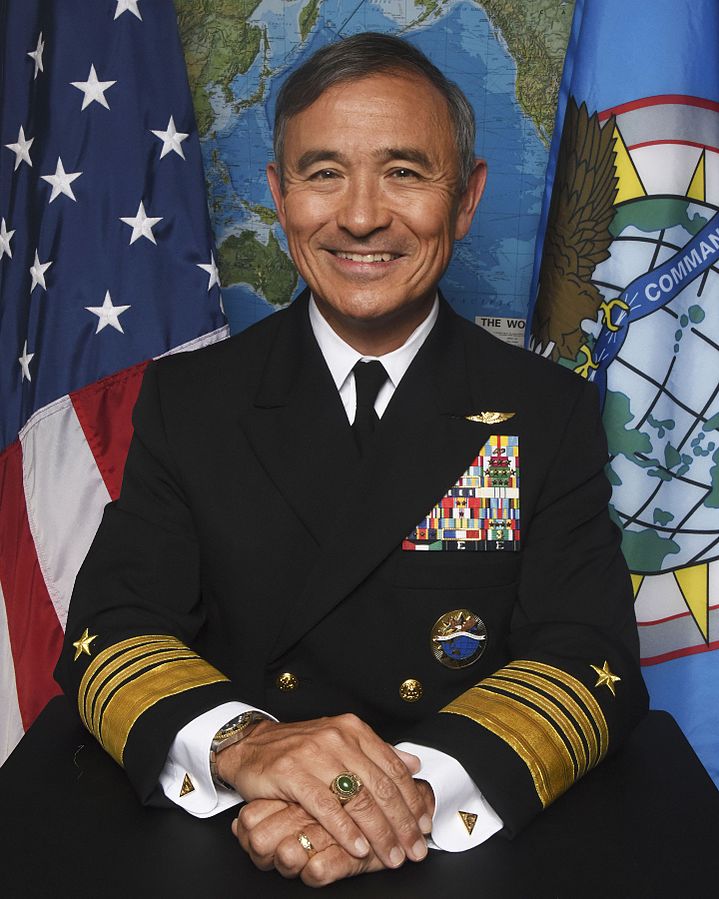
Navy Adm. Harry B. Harris Jr (Image: Wiki Commons)
By Amaani Lyle DoD News,
Defense Media Activity

WASHINGTON, Nov. 29, 2016 — As U.S. forces strengthen ties in the Indo-Asia-Pacific region, the island nation of Sri Lanka has emerged as a significant contributor to regional stability and security, U.S. Pacific Command’s commander said yesterday at the Galle Dialogue 2016 conference in Sri Lanka’s capital city of Colombo.

The first American four-star officer to visit Sri Lanka in almost a decade, Navy Adm. Harry B. Harris Jr. said at the two-day international maritime conference that he was pleased to see a deepened military-to-military relationship between Sri Lanka and the United States.

“To continue along a prosperous path, we must expand partnerships among like-minded nations to uphold the rules-based global operating system,” Harris said. “This helps build what [Defense Secretary Ash] Carter calls a ‘principled security network.’”

29 November 2016

News Story: China calls for concerted efforts to strengthen maritime security

COLOMBO, Nov. 28 (Xinhua) -- China on Monday called on countries to join hands in strengthening maritime security and overcoming the challenges and threats faced at sea.

Rear Admiral Wang Dazhong, assistant to chief of staff of the People's Liberation Army Navy, said with maritime security issues becoming more diversified, complicated and comprehensive, navies should aim at shared responsibility, development and prosperity, and establish an effective and efficient emergency response mechanism to solve maritime security issues, control maritime security risks and avert conflict through fusion of interests.

Wang was speaking at the "Galle Dialogue 2016," the 7th International Maritime Conference held in Colombo, the capital of Sri Lanka.

Read the full story at Xinhua

28 November 2016

India: Admiral Sunil Lanba, Chief of the Naval Staff visits Sri Lanka

Admiral Sunil Lanba, PVSM,AVSM,ADC, Chief of the Naval Staff, is visiting Sri Lanka on a bilateral visit from 27 November to 01 December 2016. The visit is intended to consolidate and enhance the bilateral maritime relations between India and Sri Lanka. During his visit, the CNS will hold bilateral discussions with His Excellency Maithripala Sirisena, President of Sri Lanka, Mr Ranil Wickremesinghe, Hon'ble Prime Minister of Sri Lanka and various senior dignitaries including the Chief of Defence Staff and the three Service Chiefs. The Admiral will also attend the 'Galle Dialogue' which is being held at Colombo. The Galle Dialogue is an annual conference hosted by Sri Lanka on the issues of Maritime Security and Cooperation between international navies. Representatives from 39 countries and 13 international organisations are likely to participate in the event. The CNS would be delivering Key-Note address on 'India's perspective on the benefits of Strategic Maritime Partnerships', during the event.

There exists a robust Naval cooperation between India and Sri Lanka encompassing a wide span which includes operational interactions through bilateral exercises, coordinated patrolling along the common maritime border, Training, Port Calls, Capacity Building and Capacity Augmentation initiatives.

The Admiral will also lay a wreath at the IPKF memorial, which has been built by Sri Lanka to honour Indian Martyrs, during his visit.

08 January 2015

Editorial: The Indian Ocean Zone of Peace - Reality vs Illusion


By Abhijit Singh

A recent proposal for the Indian Ocean leaves much to be desired.

Yogi Berra, the legendary American baseball player known for his pithy quotes, once remarked: “In theory there is no difference between theory and practice; but in practice there is.” India’s recent pitch for an Indian Ocean Zone of Peace (IOZOP) at the Galle dialogue in Sri Lanka is a classic example of theoretical propositions not always meeting the test of practical utility. In principle, the proposal to declare the Indian Ocean Region (IOR) as a zone of peace is strikingly apposite. Increasing Chinese presence and the threat of PLA-N bases in the IOR, the growing interests of other major powers (U.S., U.K., Russia, France and Japan) in the region, and the many Chinese infrastructure projects in the region, create an imperative for India to actively limit the military maritime activity of external powers in the region. But attempting to do so through the IOZOP route will ensure that while no military activity is ever practically curtailed, Indian influence and credibility in the region will be severely eroded.
The trouble with the IOZOP proposal is its flawed premise: that by simply declaring the region a “Zone of Peace,” foreign military presence and activity can be effectively halted. Conceivably, the proposal has been triggered by the recent docking of a Chinese submarine in Colombo – an event India took grave exception to, even remonstrating with Sri Lanka for its insensitivity to Indian security interests. New Delhi also may have taken note of a recent media report that quoted a Namibian Ministry of Defence official suggesting that discussions were underway “at the highest levels” for Chinese naval bases in the Indian Ocean Region. Though it was subsequently denied, the report had sufficient sting to give Indian policymakers the strategic heebie-jeebies. Proponents of the proposal now believe that in the absence of military strength and influence to counter the growing Chinese presence in the region, India should use the multilateral route to create a consensus for preventing the military activity of external powers in the region. A study of the past would, however, enlighten ardent Indian Ocean peaceniks of the efficacy of such a proposal. 

Read the full story at The Diplomat

03 December 2014

Sri Lanka: “Galle Dialogue 2014” concludes pledging support for Cooperation & Collaboration to achieve Maritime Prosperity


The international maritime conference, “Galle Dialogue 2014”, organized by the Sri Lanka Navy under the aegis of the Ministry of Defence and Urban Development, concluded on 02nd December 2014 pledging support for cooperation and collaboration to achieve maritime prosperity. One hundred and seven foreign delegates from 36 countries and 160 local counterparts participated in the two days of discussions which paved the way for exchange of ideas, better understanding and fostering of friendship. The "Galle Dialogue" has made its own unique contribution to the international discourse and gathered momentum as a venture with the potential to deliver substantial outcomes and strengthen co-operation among participating nations in the area of maritime security.

The following papers were presented at the conference:

Editorial: The Modi Doctrine for the Indo-Pacific Maritime Region


By Patrick M. Cronin and Darshana M. Baruah

India’s PM has wasted no time pursuing a new maritime doctrine in the Indian Ocean and beyond.

Only six months into his tenure, Indian Prime Minister Narendra Modi is breathing new life into the concept of Indo-Pacific security. Indeed, it is not too early to describe the key elements of an emerging “Modi Doctrine” focused on the vigorous pursuit of political influence through greater maritime power. Acutely aware that India’s development is best advanced across the sea lanes of the Indian and Pacific Oceans, the prime minister is embarking on a course of intensified engagement with other regional maritime powers.
If the Modi Doctrine persists, then about a quarter century of “looking East” is truly set to be followed by a long-term period of “acting East.” Heightened security cooperation with Japan, Australia, and the United States are three prime indicators of the new doctrine. Strengthening existing security ties with Association of South East Asian Nations (ASEAN) and deepening cooperation with islands in the Pacific and the Indian Ocean are other factors underpinning this doctrine.
Eighty-eight months ago, in August 2007, Prime Minister Shinzo Abe underscored the rising significance and linkages between the Indian and Pacific Oceans. Abe told the Indian Parliament that the rising “confluence of the two seas” would draw together Asia’s two wealthiest democracies. Three months ago, while visiting Abe in Tokyo, Prime Minister Modi took steps to operationalize a “special strategic global partnership.” He talked of “vikas vaad” (peaceful development) and “vistar vaad” (expansionism) characteristics of nations in the 21st century, noting that nations engaging in vikas vaadlead to development.  In perhaps a thinly veiled reference to China’s maritime coercion he pointed out that some countries are still stuck in the “18th century” mindset, engaging in “encroachments” of other’s territory.
Burgeoning Indian-Japanese security cooperation is one reason to believe that the Look East policy is genuinely now the Act East policy. The two countries are now fully committed to the joint production of a large, four-engine amphibious aircraft, the ShinMaywa US-2. This is critical departure for both countries. For Japan, the US-2 would mark the first major sale of military hardware overseas since the end of the Second World War. In fact, Japan is reportedly mulling over a new government-financing agency to ensure that money does not hold back the implementation of its recently relaxed export guidelines. 

Read the full story at The Diplomat

02 December 2014

Sri Lanka: Galle Dialogue 2014 commences in the port city of Galle


The international maritime conference, “Galle Dialogue - 2014”, organized by the Sri Lanka Navy under the aegis of the Ministry of Defence and Urban Development, got underway in the southern port city of Galle today, 01st December 2014. Thirteen (13) papers are scheduled to be presented at the two-day dialogue held under the theme, “Cooperation & Collaboration for Maritime Prosperity”.

The National Security Advisor of India Dr. Ajit Kumar Doval, who arrived in the island to attend the high profile event, delivered the keynote address and the Commander of the Sri Lanka Navy, Vice Admiral Jayantha Perera made the welcome speech. The Minister of External Affairs of Sri Lanka Hon. Prof. G.L. Peiris gracing the occasion as the Chief Guest addressed the august gathering on the theme "Towards Blue Economy" during the first session.

The Member of Parliament and Monitoring MP for the Ministry of External Affairs of Sri Lanka Hon. Sajin De Vass Gunawardena, the Secretary to the Ministry of Defence and Urban Development Mr. Gotabaya Rajapaksa, Ambassadors and High Commissioners to Sri Lanka, senior Government and military officials were also among the VIPs attending the inaugural session.

Sri Lanka: Two Japanese Naval Ships arrives in Sri Lanka to attend Galle Dialogue 2014


Accepting the invitation extended by the Sri Lanka Navy two Japanese Maritime Self Defence Force (JMSDF) ships, Harusame DD-102 and Amagiri DD-154 arrived in the island on 01st December 2014 to attend the Galle Dialogue International Maritime Security Conference. They were welcomed by the Sri Lanka Navy in accordance with naval traditions on arrival at the Port of Colombo.  

The mission, Commander Escort Division II, Captain Masatoshi Kashihara and Ships’ Commanding Officers, Commander Masanobu Takasuga and Commander Kunio Aoki are due to attend the Galle Dialogue 2014 been held in port city of Galle from 01st to 02nd December 2014. 

Prior to proceeding to the conference venue at the Lighthouse Hotel in Galle the mission Commander accompanied by the ships Commanding Officers call on Deputy Area Commander of the Western Naval Command, Commodore, KG Paul of the Sri Lanka Navy at the Western Naval Command Headquarters in Colombo. They held cordial discussions and exchanged mementos as a gesture of goodwill.

“Harusame” and “Amagiri” are both destroyers, which are 151 meters and 137 meters in length respectively. “Harusame” has a displacement of 4,550 tons while “Amagiri” has a displacement of 3,550 tons. Harusame consists of a complement of 170 naval personnel and Amagiri consists of a complement of 220 naval personnel onboard.