02 November 2015

USA: Carter - South Korean Alliance 'Ironclad' in Face of Constant Danger

US SecDef: Ash Carter
By Lisa Ferdinando 
DoD News, Defense Media Activity

WASHINGTON, November 1, 2015 — The United States remains committed to a denuclearized Korean Peninsula and continues to call on North Korea to maintain peace and stability in the region, Defense Secretary Ash Carter said today.

Carter spoke to reporters during a visit to the South Korean side of the heavily fortified Demilitarized Zone between the Koreas.

"You can see right behind me is North Korea and the DMZ, and being here shows you up close just how dangerous this part of the world is," he said, with the North Korean side of the zone just yards away.

The strong U.S.-South Korea alliance is a deterrent to the constant danger posed by North Korea, he said.

USA: Dunford Discusses Progress With South Korean Counterpart

By Jim Garamone 
DoD News, Defense Media Activity

SEOUL, November 1, 2015 — North Korea is just 35 miles away from Seoul, a world capital with more than 20 million inhabitants.

That fact colors all the discussions between American and South Korean leaders, and the 40th Military Committee Meeting was no exception.

Marine Corps Gen. Joseph F. Dunford, the chairman of the Joint Chiefs of Staff, and his South Korean counterpart, Army Gen. Lee Sun-jin, met here today to discuss security issues that face the Korean peninsula and the way forward for the alliance.

News Story: Taiwan plans to purchase 10 MH-60R Seahawk ASW helicopters

MH-60R Seahawk (Image: Wiki Commons)
Taiwan's military yesterday confirmed that it is seeking to buy 10 MH-60R Seahawk anti-submarine warfare helicopters from the U.S. to replace its existing aging chopper fleet. Fielding questions during an interpellation session at the Legislative Yuan, Deputy Defense Minister Adm. Chen Yung-kang confirmed to lawmakers that the R.O.C. Navy is scheduled to purchase MH-60R Seahawk anti-submarine choppers.

"We plan to purchase 10 MH-60R Seahawk helicopters," said Vice Adm. Hsiao Wei-ming, the Navy's chief of staff, in response to questions by a lawmaker during a hearing before the Legislature's Foreign Affairs and National Defense Committee.
The purchase is meant to replace the Navy's aging MD500 helicopters that have been in service for decades, he noted.

As Taiwan's military will soon acquire Perry-class frigates from the U.S. to meet its defensive needs, Chen said the Navy needs more cutting edge weapons systems to boost its anti-submarine warfare capabilities.

Elaborating on the upcoming project, the Navy Chief of Staff, Rear Adm. Hsiao Wei-min, said the Navy is aiming to buy 10 MH-60R Seahawks from the U.S. because the helicopter has much greater anti-submarine warfare capabilities than the Navy's current choppers.

Read the full story at Navy Recognition

News Story: (China's View) Not caving to Beijing shows Manila's lack of vision - Xinhua

The latest ruling by an international tribunal in The Hague regarding the South China Sea seemed to be a positive result for Manila but in a sense it also reflects the Philippines' role as a fickle player on the world stage and its lack of vision in handling such disputes.

Despite its agreement with Beijing to resolve their disputes in South China Sea via bilateral talks, which could be testified by several joint statements and declarations, Manila readily reneges on its promises and takes every chance to make waves in the South China Sea.

Earlier this year, the Philippines staged a string of stunts to generate publicity and rake up support for its South China Sea claim, at the cost of Manila-Beijing ties and regional stability.

Read the full story at Want China Times

News Story: PLA holds South China Sea drill after USS Lassen patrol

Chinese Navy Warships on patrol (File Photo)
A naval exercise was launched by the People's Liberation Army Navy after a US Navy destroyer carried out a patrol within 12 nautical mile of China's artificial islands in the South China Sea, according to the PLA Daily on Oct. 30.

The exercise was held on Oct. 28, a day after the USS Lassen made its passage to challenge China's territorial claims in the disputed Spratly archipelago. Another joint naval exercise was carried out by the USS Theodore Roosevelt, a Nimitz-class aircraft carrier, and the JDS Fuyutsuki, a Japanese Akizuki-class destroyer, in the South China Sea in the same day.

While the PLA Daily did not reveal how many Chinese warships were dispatched to the South China Sea, it pointed out that they were vessels of the South Sea Fleet and were accompanied by aircraft from the Guangzhou Military Region.

Read the full story at Want China Times

News Story: US Defense Chief Calls On North Korea To Avoid Provocations

US SecDef: Ash Carter
DEMILITARIZED ZONE, South Korea — US Defense Secretary Ash Carter on Sunday visited the Demilitarised Zone (DMZ) dividing the Korean Peninsula and renewed calls for North Korea to avoid provocations and step away from its nuclear program.

On a brief trip to the heavily mined area that for 60 years has been a buffer between the Koreas, Carter and South Korean Defense Minister Han Min-Koo stood atop a hill known as Observation Post Ouellette — the closest post to the demarcation line between the two nations.

Carter later said the United States remains committed to the six-party talks process that seeks the denuclearization of the peninsula.

"That remains our policy," he told reporters. "We remain committed to achieving that negotiated outcome with North Korea, and believe that they should be on the path of doing less — and ultimately zero — in the nuclear field, not to be doing more."

North Korea has carried out three nuclear tests and has explicitly indicated its intention to carry out a fourth.

It abandoned the six-party talks, which also grouped South Korea, China, Russia, the US and Japan, in April 2009.

Read the full story at DefenseNews

News Story: Russia Seeks To Energize Asian Presence

S-400 system (Image: Wiki Commons)
By Matthew Bodner

MOSCOW — With Russia's defense industry cut off from Western markets following a series of sanctions imposed by the United States and European Union last summer, Moscow has been hyping up efforts to bolster its presence in Asia.

Russian arms exports already have a firm presence in the region. According to a report released earlier this year by the Stockholm International Peace Research Institute (SIPRI), more than 60 percent of Russian arms exports go to Asia and Oceania.

India and China in particular command a large percentage of these orders. As a share of total Russian arms transfers from 2010 to 2014, India and China represented 39 and 11 percent of Russian arms transfers, respectively.

As Russia's political and economic relations with the West collapsed last year over Moscow's actions in the Ukraine crisis, the Kremlin and senior Russian government officials have been pushing the development of a new Sino-Russian alliance to counter Western influence.

This has resulted in a number of joint-project announcements — from the co-design and production of new military transport aircraft, heavy-lift helicopters and even the sale of advanced Russian rocket engines to the Chinese space program.

Read the full story at DefenseNews

Editorial: Australia’s Submarines - The US Option

US Navy Virginia-class Nuclear Attack Submarine
By David Hamon and Christine M. Leah

Why leasing U.S. boats might be Canberra’s best option.

Lost in the debate surrounding the Collins-class replacement was serious consideration on leasing Virginia-class boats from the U.S. According to a former Bush administration official, conversations were held but failed to progress due in part because Canberra was not entirely confident the U.S. government would agree. No less a strategist than Hugh White, in a recent op-ed, urged Australia’s new defense minister to “…ask very searching questions about what submarines we are trying to buy… (and she should) satisfy herself that the submarines’ operational roles have been properly thought through, and fit with Australia’s strategic needs over coming decades.”

Leasing is a simple solution to the seemingly endless debates and acquisition negotiations with the Japanese and European governments, and it offers Washington and Canberra a number of strategic benefits. The operational procedures would be fairly straightforward. It would also strengthen the overall alliance in a context of increasing friction between the U.S. and China, and more closely integrate the two countries’ naval forces in a fundamental way.

The Japanese government has proposed the Soryu design, built by Mitsubishi Heavy Industries and Kawasaki Heavy Industries. It is considered among the most advanced and largest non-nuclear attack submarine in the world. Displacing about 4,200 tons submerged, the submarine is powered by a series of four Swedish Sterling V4-275R air independent propulsion (AIP) units that allow the ship to operate its diesels without the need to surface or snorkel. The Soryu also have a range of more than 11,000 km (6,800 miles) and come armed with Harpoon missiles, the export or transfer of which would be a first in Japan and might face political opposition. It would also be a lethal new technology for Australia.

Read the full story at The Diplomat

Editorial: A First - Japanese and US Navies Hold Exercise in South China Sea

By Ankit Panda

Following Malabar 2015, a Japanese destroyer and a U.S. carrier are exercising together in the South China Sea.

The Japanese Maritime Self-Defense Force (MSDF) and the U.S. Navy are holding a joint naval exercise in the South China Sea, the Yomiuri Shimbun reports. The exercise marks the first bilateral U.S.-Japan exercise in the area. The drill comes days after the United States staged its first freedom of navigation operation within 12 nautical miles of a Chinese artificial island in the Spratly Islands. The Japanese Defense Ministry has told the Yomiuri that the ongoing South China Sea drill between the two allied navies is “an ordinary drill and unrelated to the U.S. Navy’s patrolling activities there.” The exercise is reportedly not taking place near the Spratly Islands.

Per the Yomiuri, the JS Fuyuzuki, an Akizuki-class destroyer, is currently conducting drills of an unspecified nature in the South China Sea with the USS Theodore Roosevelt, a Nimitz-class super-carrier. Both the Fuyuzuki and the Theodore Roosevelt participated in the recently concluded Malabar 2015 exercise – a trilateral naval exercise with India. Malabar 2015 concluded on October 19, 2015.

The Theodore Roosevelt docked in Singapore on October 24, three days before the scheduled U.S. freedom of navigation operation. The drills in the South China Sea between the U.S. Navy and the MSDF began on Wednesday and will “continue for several days” according to the Yomiuri. The report adds that the exercise will focus on the transportation of crew members and communication training exercises.

Read the full story at The Diplomat

Editorial: In China, Germany's Merkel Talks Trade, Syria, and South China Sea

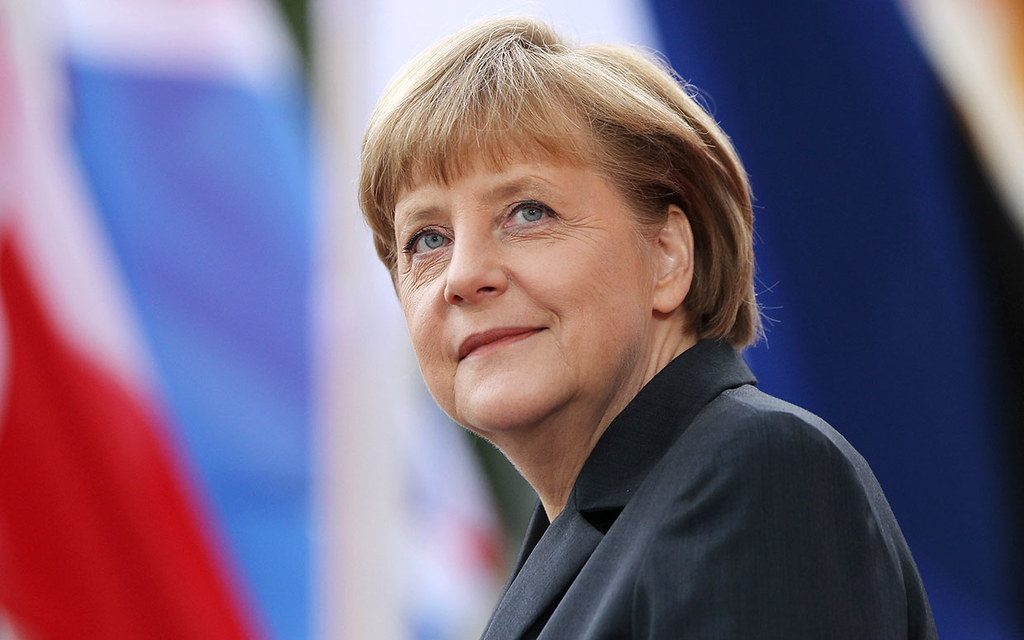
Angela Merkel (Image: Flickr User - Haluk Beyazab)
By Shannon Tiezzi

Germany wants China to play a larger role in resolving international issues such as the Syria crisis.

German Chancellor Angela Merkel visited China on October 29 and 30, marking her eighth visit to the country since she assumed office in 2005. Ostensibly, her trip was aimed at deepening the economic ties between China and Germany, but security and strategic issues – from the Syria crisis to the South China Sea – also featured on the agenda.

Germany has been concerned about China’s economic slowdown, and for good reason – last year, China was Germany’s fourth biggest export market, representing nine percent of total German exports, according to Reuters. Ironically, Germany’s robust exports to China (something other countries have envied as they eye their trade deficits with Beijing) are now a headache for Berlin, as total trade between China and Germany plummeted nearly 12 percent in the first six months of 2015. Meanwhile, there’s some nervousness in Berlin that the United Kingdom, with its avowed wish to be China’s “best partner in the West” could siphon off some of China’s economic largess.

Accordingly, trade was the major purpose of Merkel’s visit. While she was there, primarily meeting with Premier Li Keqiang (though she also met with Chinese President Xi Jinping), the two sides signed 15 business deals worth a total of roughly 20 billion euros ($22 billion). That included deals for China to purchase helicopters and passenger planes worth over $16 billion from Airbus. Merkel also voiced support for a China-EU bilateral investment treaty, which would serve as a precursor to a China-EU free trade agreement.

However, Merkel made it clear that China still has work to do in opening its economy. She lent her support for China’s bid to be granted market economy status in the World Trade Organization – which would help alleviate penalties on imports from China – but noted that first “China has to do some homework, for example in the area of public procurement.”

Read the full story at The Diplomat