Showing posts with label MI-25. Show all posts

01 February 2017

News Story: Russia conducts Mi-24 helicopters exercise in western Siberia

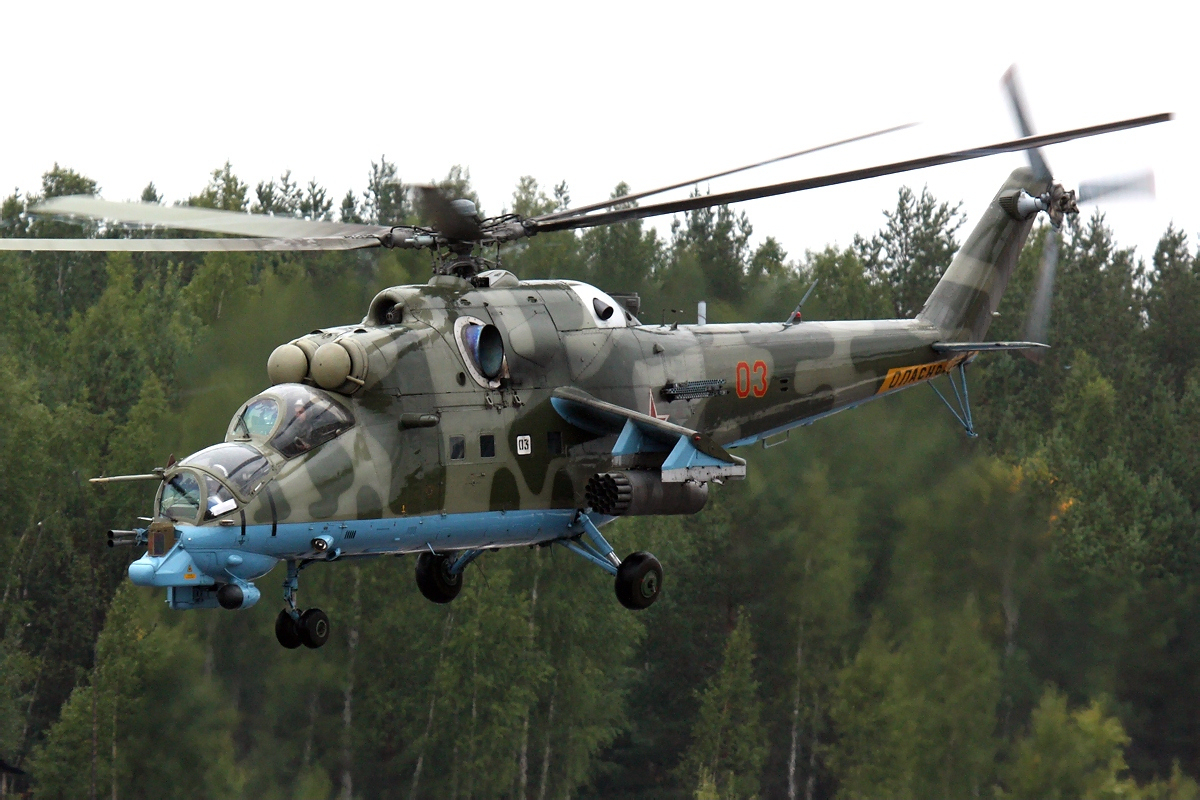
Mi-24/Mi-25 (Image: Wiki Commons)
MOSCOW, Jan.31 (Xinhua) -- Crews of attack helicopters Mi-24 from the "Tolmachevo" airbase carried out mock an air combat on the training ground in the Novosibirsk region, the Russian news agency TASS Thursday cited the Russia's Central Military District (CVO) representative as saying.

"Pilots performed complex aerobatics maneuvers to be in advantageous angles of attack and hit the air targets. In the second stage crews conducted aerial reconnaissance and stroked on simulated tactical landing, and also supported motorized divisions from air," the CVO spokesman said.

Read the full story at Xinhua

30 November 2016

News Story: India Moves To Scale Up Military Aid To Afghanistan

An-32 of the Afghan Air Force (Image: Wiki Commons)
After supplying four attack helicopters to Afghanistan, India is quietly moving to qualitatively scale up military assistance in terms of long-term spares and support, The Hindu reported on Monday.

According to officials, this involves a trilateral framework with Russia, who said it is likely to be discussed by Afghanistan President Ashraf Ghani and Prime Minister Narendra Modi when they meet on the sidelines of the sixth Heart of Asia (HoA) ministerial conference in Amritsar later this week.

The Hindu quoted defense and diplomatic sources as saying that two Indian Air Force technical teams visited Afghanistan last month to assess the requirements for spares and maintenance to restore the Soviet-era helicopters and transport aircraft lying there.

"There are at least 40-50 helicopters of various types and some An-32 medium transport aircraft which have been grounded from a long time for need of spares. We have asked Indian help in refurbishing them," diplomatic sources stated.

The teams were tasked to assess the requirements and submit a report on what can be provided by India from its existing inventory and what needs to be procured from Russia which is the original manufacturer of the hardware, a Defencs Ministry source said.

Read the full story at TOLOnews

15 September 2016

News Story: India, Afghanistan ink 3 pacts as President Ghani meets Modi in Delhi

NEW DELHI, Sept. 14 (Xinhua) -- India and Afghanistan Wednesday inked three pacts, including an extradition treaty, after visiting Afghan President Ashraf Ghani held discussions with Indian Prime Minister Narendra Modi in the national capital on a wide range of issues of mutual interest.

"One more step in closer ties. Exchange of agreements on MLAT (Mutual Legal Assistance Treaty), Extradition & peaceful uses of outer space follows talks," External Affairs Ministry spokesperson Vikas Swarup tweeted.

A joint statement said that Modi and President Ghani expressed concern at the continued use of terrorism and violence in region for achieving political objectives. "The PM reiterated India's support for unified, sovereign, democratic, peaceful,stable and prosperous Afghanistan," it said.

Read the full story at Xinhua

06 September 2016

News Report: Taliban Warns India Over Military Aid to Kabul

Afghan Mi-35 variant of the MI-25 (Image: Wiki Commons)
Ayaz Gul

ISLAMABAD — The Taliban is urging India to stop giving lethal military equipment to the Afghan government, condemning it as a “clear hostility” towards the war-torn nation.

In its first public reaction to New Delhi’s growing military cooperation with Kabul, the Islamist insurgency alleged Indian aircraft and equipment are being used to kill Afghans and destroy their homes as well as other civilian infrastructure.

“The Islamic Emirate [the Taliban] condemns this action with the strongest of terms,” said Zabihullah Mujahid, the main spokesman for the Taliban, in a statement issued Sunday.

12 August 2016

News Story: US General Asks India for Military Assistance in Afghanistan

Vivek Raghuvanshi

NEW DELHI — The commander in charge of US forces in Afghanistan has asked India to step up military aid in the Middle Eastern country. Gen. John Nicholson's call to action comes as Western sanctions against Russia is leading to a paucity of spares for Russian-made weaponry used by Afghan forces.

Speaking to journalists Wednesday after meeting with India's National Security Adviser Ajit Doval, Foreign Secretary Subrahmanyam Jaishankar and Defence Secretary G.Mohan Kumar, the US Army officer said: "Due to sanctions on Russia, it's difficult to acquire supplies of spare parts for Russian military platforms, because much of the money is given to Afghanistan by donors who have sanctions against Russia in place."

Nitin Mehta, a defense analyst in India, commented on the US approach: "The call for stepping up military aid to Afghanistan is not a changed response of Washington in diplomatic terms, but only in military terms, arising from the sanctions by the Western world on Russia, thereby [pulling] the plug on supply of military spares."

Read the full story at DefenseNews

16 February 2016

Editorial: Afghanistan - Lessons Learned for the 2016 Fighting Season

Image: Flickr User - U.S. Department of Defense Current Photos
By Shawn Snow

The situation is not all bad, but Afghan forces need to learn the lessons of 2015.

Looking through the headlines emanating from Afghanistan it would be difficult to find any message of hope or progress. The situation looks bleak, with reports stipulating that the Taliban controls more territory than at any point since it lost power in 2001. Afghan forces saw record casualties, and a recent NATO report has concluded that a majority of Afghan infantry units are combat ineffective, with only 1 out of 101 units operationally ready and 38 suffering from major issues. But not all is lost in the war-torn country. For one thing, the 2015 fighting season has provided Afghan forces with much needed lessons learned from the battlefield, lessons that are not impossible for Afghan forces to implement

Much of Afghanistan’s record casualty numbers can be attributed to the withdrawal of U.S. and NATO forces from a combat role last year, and the ushering in of the “train, advise, and assist” mission, aka Resolute Support. During this pivotal 2015 fighting season Afghan forces took the lead role in providing security for its country. Though Afghan forces have struggled to combat a reinvigorated Taliban, they still control all key urban population centers, including wrestling back control of Kunduz last October.

Headline grabbing advances by Taliban forces have usually been overturned by security forces, as Afghan forces have been able to regain much of the territory lost to the Taliban either immediately or within a few days, and although coalition partners have assisted, that assistance has been minimal. To put this in perspective, NATO airstrikes to assist Afghan forces in retaining the vitally important Sangin province or retaking Kunduz city could be counted on one hand, while coalition airstrikes to retake Ramadi in Iraq numbered over 600.

Read the full story at The Diplomat

02 February 2016

Editorial: Why India Transferred Attack Helicopters to Afghanistan

Afghan Mi-35 (Wiki Info - Image: Wiki Commons)
By Ankit Panda

India’s attack helicopter transfer to Afghanistan suggests a new era in ties between New Delhi and Kabul.

Earlier this month, the Afghan Ministry of Defense inducted three Mi-25 attack helicopters into the Afghan Air Force (AAF). The helicopters were supplied by India and mark the first time that New Delhi has transferred lethal military equipment to Afghanistan. The AAF inducted three of four scheduled Mi-25 helicopters. The Mi-25s will replace Afghanistan’s aging Mi-35 attack helicopters and provide a much-needed boost to Afghanistan’s air support capabilities in the ongoing struggle against the Taliban across the country.

On January 20, Afghanistan confirmed that three multirole Mi-25 had been assembled and were ready for operational use. The Mi-25s will likely see their first use in the ongoing struggle against Taliban fighters in Helmand province. “We have always been helped by India. The helicopters donated by India to Afghanistan have been assembled and will help us fight terrorists,” Ghulam Sakhi Ahmadzai, deputy chief of procurement at the Afghan defense ministry, told Tolo News.

The Mi-25 agreement between the two countries was announced in November 2015, when Afghan National Security Adviser Hanif Atmar and Afghan Deputy Foreign Minister Hekmat Khalil Karzai visited New Delhi. India had previously supplied three Hindustan Aeronautic Limited (HAL) Cheetal trainer helicopters to the AAF.

Read the full story at The Diplomat

25 November 2015

Editorial: A Turning Point in Afghanistan-India Relations?

By Ankit Panda

Recent developments in the India-Afghanistan bilateral relationship suggest a major shift may be afoot.

Ever since a U.S.-brokered agreement resolved Afghanistan’s electoral dispute last year, forming an experimental National Unity Government, strategic relations between Afghanistan and India have effectively been stuck in limbo. The primary cause for this was Afghan President Ashraf Ghani’s pollyannaish attempt to forge a modus vivendi with Pakistan – a break from his predecessor Hamid Karzai who, despite his mistrust of the United States in his final years at the helm, approached India with ease.

Afghanistan’s rapprochement with Pakistan was short-lived, confirming the expectations of many who suspected that Ghani would be unable to keep at bay the interests in Pakistan that have historically sought to sow instability and violence in Afghanistan. The first troubling signs were that Pakistani Prime Minister Nawaz Sharif and Ghani managed to agree to a formal counter-terrorism cooperation mechanism that would see Afghanistan’s National Directorate of Security liaise with Pakistan’s Inter-Services Intelligence.

Ghani’s first mistake was trusting Pakistan’s civilian leadership to speak on behalf of the country’s military-intelligence apparatus. As has been the case throughout most of Pakistan’s history, foreign and security assurances delivered by civilian leaders are subject to the fickle whims of the country’s military establishment.

To credit Ghani, the arrangement with Pakistan was never entirely comfortable. Critical voices in Afghanistan cried foul when the arrangement for counter-terrorism cooperation was announced, but it was an attempt by the new government in Afghanistan to seek peace. After all, peace talks with the Taliban would be dead-on-arrival without Pakistan’s support.

Tragically, three months after announcing that the ISI and NDS would cooperate, in August 2015, Ghani found himself mourning the victims of devastating attacks in Kabul which claimed nearly 60 lives. The president, who had months earlier reached out to Islamabad, minced few words in response, accusing Pakistan of sending “messages of war.” He continued that the events in Kabul showed “that suicide bomber training camps and bomb-producing factories which are killing our people are as active as before in Pakistan.”

Read the full story at The Diplomat