Showing posts with label Harpoon. Show all posts

14 February 2017

USA: Coronado focuses on flight ops, crew training at sea

By MC2 Amy M. Ressler, USS Coronado Public Affairs

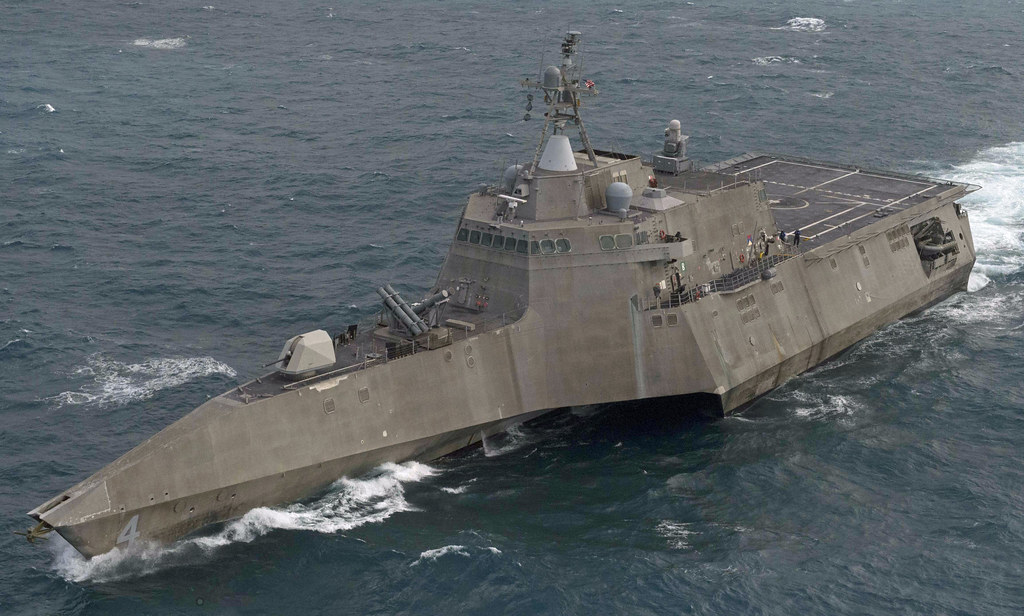
USS Coronado (LCS 4) transits the South China Sea, Feb. 12. (U.S. Navy/MC2 Amy M. Ressler) >>

SOUTH CHINA SEA - Sailors aboard littoral combat ship USS Coronado (LCS 4) are training and conducting operations at sea following the ship’s departure from Singapore, Feb. 10.

After a short, but productive in-port period conducting engineering maintenance, the Coronado crew is executing a busy training schedule focused on unit level training, crew served weapons firing, small boat operations, flight operations and engineering operations testing.

“While underway, we are conducting training across multiple mission areas, including weapons training, manned and unmanned flight operations, ship-handling and damage control drills,” said Cmdr. Scott Larson, commanding officer, USS Coronado. “Training at sea in these warfare areas maintains crew proficiency and ensures we are ready to operate successfully in a variety of missions.”

The first few days of the underway have primarily focused on flight operations, to include functional check flights, familiarization flights and training and a photo exercise.

USA: Boeing Co, is being awarded a contract for the procurement of spares in support of Harpoon and SLAM-ER for the US Navy & Foreign Military Sales

The Boeing Co., St. Louis, Missouri, is being awarded a $12,399,305 firm-fixed-price contract for the procurement of spares in support of Harpoon and Stand-Off Land Attack Missile-Expanded Response (SLAM-ER) for the Navy (83); and the governments of Saudi Arabia (143), Australia (5,734), Canada (50), Japan (96), Malaysia (17), Turkey (11), India (24), Taiwan (3), and Thailand (1).

Work will be performed in McKinney, Texas (29.56 percent); St. Charles, Missouri (21.51 percent); Black Mountain, North Carolina (15.04 percent); Joplin, Missouri (14.72 percent); Beverly, Massachusetts (4.24 percent); Burnely, United Kingdom (3.30 percent); Galena, Kansas (3.26 percent); Hayward, California (2.83 percent); Lititz, Pennsylvania (1.40 percent); Landsdale, Pennsylvania (1.01 percent); St. Louis, Missouri (0.94 percent); Middletown, Connecticut (0.70 percent); Chandler, Arizona (0.41 percent); Toledo, Ohio (0.29 percent); Skokie, Illinois (0.25 percent); Staten Island, New York (0.16 percent); Roswell, Georgia (0.10 percent); Huntington Beach, California (0.09 percent); Chatsworth, California (0.08 percent); St. Petersburg, Florida (0.07 percent); Irvine, California (0.03 percent); and Carson, New York (0.01 percent), and is expected to be completed in December 2018.  

10 January 2017

News Report: New Strategy Emphasizes High-end Surface Warfare

By: Sam LaGrone

A new strategy for the surface force – released today – creates an outline for a navy that anticipates a return to high-end warfare it hasn’t known since the Cold War.

The document will fill in gaps for several pushes the surface establishment has announced over the last two years to create a cohesive path forward for the force.

“There was a picture that we were building, we just had to get that picture into focus. You want to be impatient, you want it into focus as rapidly as you can, but you may focus on the wrong picture,” Vice Adm. Tom Rowden told USNI News last week.

“This is our North Star, if you will. All the conversations we’ve had over the last three, four years, and starts to focus them in a single direction that will drive resources.”

For Rowden, that direction is sea control.

02 July 2016

News Story: Missiles to be tested at RIMPAC exercise

Penguin anti-ship missile firing from a Sea Hawk
helicopter (Image: Wiki Commons)
by Geoff Ziezulewicz

The U.S. and New Zealand are planning to show off missile systems during the massive Rim of the Pacific war game event that starts Thursday.

New Zealand's sea service plans to test launch a Penguin anti-ship missile from the Defense Force's new Seasprite helicopter, the New Zealand news site Newshub reports.

That helicopter deploys from the frigate Te Kaha. The Te Kaha is one of 45 ships and five submarines involved in the biennial RIMPAC exercise.

The Penguin is a helicopter-launched anti-ship missile originally developed by Norway, and further developed for use on LAMPS II helicopters and NATO allies.

Read the full story at SpaceDaily

24 February 2016

Think Tank: Filling the gap - Anti-ship missiles and the Royal Australian Navy

Christopher Cowan

On 4 February, US Secretary of Defense Ash Carter announced that the US Navy had developed a new anti-ship missile (ASM)—the Standard Missile 6 (SM-6). But that ‘new’ missile isn’t as new as it might seem. The SM-6 has been in limited service with the US Navy as its most capable long range anti-air and anti-missile weapons system since 2013. The SM-6 is estimated to have a range of over 200 nautical miles (370km) and flies at Mach 3.5, giving it the ability to hit an adversary at a long range with little to no warning from defensive radars.

That news comes at a welcome time for many around the world lamenting the US Navy’s lack of a long-range ASM capability. Since retiring the anti-ship variant of the venerable AGM-65 Tomahawk in 1994, the US Navy has been in want of a long range supersonic ASM and has relied upon the slower and shorter ranged RGM-84 Harpoon and SM-2 (the SM-6’s predecessor which had a limited anti-ship capability) missiles to satisfy its surface-to-surface requirements. However, the US Navy isn’t the only state with this capability gap. Years of disinterest in surface warfare, caused by a lack of credible adversaries, have left many western navies (including Australia) far behind the likes of China and Russia in the development of those types of missiles.

09 January 2016

Editorial: US Navy Wants New Missile for Littoral Combat Ship by End of 2016

Kongsberg NSM (Image: Flickr User - U.S. Pacific Fleet)
By Franz-Stefan Gady

However, no decision on what new missile system to purchase has been made yet, according to a U.S. Navy admiral.

The United States Navy wants to equip its burgeoning fleet of Littoral Combat Ships (LCS) with a new over-the-horizon missile by the end of 2016, the Navy’s surface warfare director, Rear Admiral Peter Fanta, told USNI News in a recent interview.

According to Fanta, equipping the LCSs with a new missile is “an absolute requirement” for the U.S. Navy. By the end of 2016 the admiral wants to have a new missile on the ships at least as a demonstration.

The U.S. Navy has rebranded the LCS as a frigate due to recent advances in effective counter-swarm defenses and is looking to increase the ships’ firepower. Naval engineers are currently studying what missile system would fit best on the LCS.

“It takes a little while for the guys with the slide rules to figure out… what the deck strength needs to be and what angle the launcher needs to sit at. That’s my biggest hold right now is guys doing math,” Fanta said.

Read the full story at The Diplomat