26 April 2014

Editorial: The Crisis of Confidence in US Hegemony


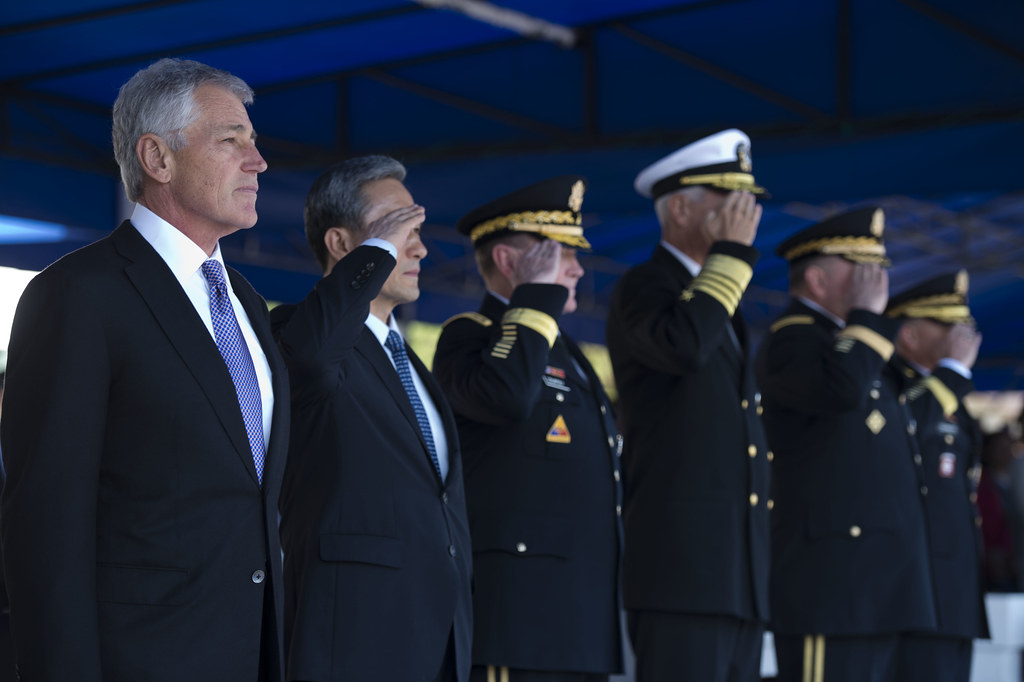
<< Secretary of Defense Chuck Hagel stands with Republic of Korea Minister of Defense Kim Kwan-jin, Chairman of the Joint Chiefs of Staff General Martin Dempsey, Pacific Command commander Admiral Samuel Locklear, outgoing commander of United States Forces Korea commanding general General Robert Thurman, and incoming commanding general General Curtis M. Scaparrotti at a change of command ceremony in Seoul, Republic of Korea October 2, 2013. Hagel and Dempsey attended the ceremony where Thurman handed over command of the U.S. Forces Korea to Scaparrotti. Photo by Erin A. Kirk-Cuomo (Released) Image: Flickr user Chuck Hagel

By Chen Jimin

New constraints on US power create their own risks for the international community.

The 21st century is still young, but it has already presented the United States with a series of internal and external challenges. In the very first year, the U.S. faced a major security threat from non-state actors manifest in the 9/11 terrorist attacks, which completely changed Americans’ traditional view of their homeland as a safe haven.
Following the attacks, the Bush administration launched its global war on terrorism. Rather than achieve its stated objective, however, the war placed the U.S. under fiscal pressure and damaged its international standing. Meanwhile, America now faces a new challenge: the rise of non-Western countries, a development likely to have a much more far-reaching impact on U.S. hegemony.
When U.S. President Barack Obama took office, he found that global power had subtly but irreversibly shifted in a way that reflected the new features of the international system. Thus, in the U.S. National Security Strategy(2010) (PDF), the administration acknowledged that the international system needed to adjust to accommodate the interests of new centers of power.
Even as the United States was trapped in two wars, the U.S. domestic economy was  facing its own crisis: the meltdown that followed the collapse of Lehman Brothers. Out of the recession that followed, new political and social movements emerged. The rise of Tea Party in 2010 produced a rupture in domestic politics. Late in September 2011, Occupy Wall Street targeted injustices in American society. Political squabbles on domestic issues such as health care, immigration reform, and the debt ceiling have had repercussions for U.S. diplomacy. For instance, Obama was absent from the APEC summit last year largely because of the government shut-down.
In the name of fiscal austerity, the U.S. Department of Defense was required to cut military spending by $487 billion over the next decade. U.S. Defense Secretary Chuck Hagel was prompted to complain: “these cuts are too fast, too much, too abrupt, and too irresponsible,” asserting that they would seriously restrict America’s readiness and ability to respond to challenges. 

Read the full story at The Diplomat

Editorial: Guns, Courts and Dirty Politics Puts Thailand Back on Edge


<< A Type-85 AFV reconoiters the Red Shirt barricade at Chulalongkorn Hospital, accompanied by a Signal Corps soldier with a portable radio unit. Image: Flickr user null0

By Luke Hunt

The killing of an activist adds to tensions in a country that some believe is sliding towards civil war.

The killing of a well known poet and Red Shirt activist in Thailand has outraged human rights activists and prompted speculation that the country is again on the verge of civil war, with supporters of Prime Minister Yingluck Shinawatra warning the government is facing a “judicial coup.”
Kamol Duangphasuk, 45, died in hospital after being shot twice in the chest by unidentified gunmen in broad daylight while sitting in his parked car outside a restaurant in Bangkok.
Brad Adams, Asia director of Human Rights Watch (HRW) described the killing as brutal and outrageous, which “can only worsen the already tense political situation in Thailand.”
Known by his penname “Mai Nueng Kor Kunthee,” Komal was prominent at rallies organized by the United Front for Democracy Against Dictatorship (UDD), more commonly known as Red Shirts. Hereferred to himself as their poet. 

Read the full story at The Diplomat

Editorial: CSTO Looks Away From NATO and Toward SCO

NATO Logo (left)   --|--   CSTO Logo (right)

By Ankit Panda

The Russia-led military alliance has given up all pretenses of cooperation with NATO and will look toward the SCO.

According to a report in RIA Novosti, the Russian-led Collective Security Treaty Organization (CSTO) has suspended all contacts with NATO due to the crisis in Ukraine. Russia’s preeminent status as a leader in CSTO effectively guaranteed that the organization would have to sever ties with NATO, given the impasse over Russia’s annexation of Crimea and its current coercive position on the eastern Ukrainian frontier. CSTO Secretary-General Nikolai Bordyuzha told a press conference, “For now we will not be making any efforts to establish contact with NATO, due to their stance during the Ukrainian crisis.”
According to the Secretary-General, NATO is “blackmailing” Russia and its CSTO allies. ”Today, NATO is blackmailing all of the CSTO member states … showing that they are extremely dissatisfied with Russia’s actions in recent months,” he told reporters. NATO and its member states are heavily involved in the management of the Ukrainian crisis and are striving to prevent separatism and instability in eastern Ukraine following Russia’s successful annexation of Crimea. Last week, NATO Secretary-General Anders Fogh Rasmussen indicated that NATO will ready additional troops and equipment to prepare for any combat operations that might be necessary in connection with the Ukrainian crisis.
One report in the Belarussian Telegraph Agency further cites Bordyuzha as stating that, after several failed attempts at cooperating with NATO, the CSTO will look towards the Shanghai Cooperation Organization and China. “We are also about to start cooperating with other organizations that take care of security matters in the Asian region,” he said. Bordyuzha also referred to Iran as a burgeoning partner for the CSTO. 

Read the full story at The Diplomat

25 April 2014

USA: Obama - U.S. Treaty Commitment to Japan is 'Absolute'

Japanese Prime Minister Shinzo Abe (left)
and US President Barack Obama (right)

By Nick Simeone
American Forces Press Service

WASHINGTON, April 24, 2014 – President Barack Obama, making the first state visit by an American president to Japan in nearly two decades, made clear today the United States would be obligated to come to Japan’s defense in any confrontation with China over islands both nations claim in the East China Sea.

During a joint press conference in Tokyo with Japanese Prime Minister Shinzo Abe, Obama said treaty obligations to defend Japan would apply if hostilities broke out between Japan and China over the disputed islands known in Japan as the Senkaku and as the Diaoyu in China.

“Let me reiterate that our treaty commitment to Japan’s security is absolute, and Article 5 covers all territories under Japan’s administration, including the Senkaku islands,” said Obama, while making clear that the United States does not take sides in the dispute.

Sri Lanka: SLN welcomes First Patrol Boat gifted by Australia


The first patrol boat gifted to the Sri Lanka Navy by Australia arrived at the Port of Colombo on 24th April 2014. It was ceremonially welcomed in accordance with naval traditions on arrival. Australian High Commissioner to Sri Lanka, Her Excellency Robyn Mudie and Commander of the Sri Lanka Navy, Vice Admiral Jayanath Colombage were among the distinguished persons who were present at the ceremonial reception.

The Bay Class boat served the Australian Customs and Border Protection Service under the name “Corio Bay” before being gifted to Sri Lanka. It is 38.2 meters long and has a 2.3 meter draft. With a maximum speed of 24 knots, the boat can cover a range of 3,000 nautical miles.

News Report: Analyst - North Korea May Already Have Militarized Warhead


Baik Sungwon

As concern grows that North Korea may be preparing for another underground nuclear weapons test, a leading nuclear scientist says Pyongyang already may have acquired a device small enough to fit atop a missile.

David Albright, president of the Institute for Science and International Security, explained that the North does not need another nuclear test to acquire a militarized warhead.

“I think it is a mistake to think that they require this testing in order to design a militarized warhead. I think they may have gotten one from Pakistan or China," said Albright.

But Albright, who also worked as an inspector for the International Atomic Energy Agency, the U.N.’s nuclear watchdog, said that doesn't rule out another North Korea test.

"But what they can't get without testing is reliability. So the testing is invaluable to make sure everything works," he said.

Editorial: ASEAN and UN Peacekeeping


By Carl Thayer

ASEAN will slowly develop and evolve regional peacekeeping coordination capacity.

The Association of Southeast Asian Nations (ASEAN) has set the objective of creating an ASEAN Community by the end of 2015. The ASEAN Community will be based on three pillars or communities: the ASEAN Political-Security Community, the ASEAN Economic Community and the ASEAN Socio-Cultural Community.
After the ASEAN Political-Security Community is created, what role could ASEAN and the United Nations undertake in peace operations in Southeast Asia and globally? How would ASEAN’s existing capacity and structure have to change in order to deploy on peace operations?
These questions and other questions were posed at an international conference on “The New Landscape of Peace Operations: A Dialogue with South East Asia and Vietnam.” The conference was convened in Hanoi from April 15-16 under the co-sponsorship of the Swedish International Peace Research Institute (SIPRI), the Frederick Ebert Stiftung (FES) based in Germany, and the University of Social Sciences and Humanities, Vietnam National University. 

Read the full story at The Diplomat

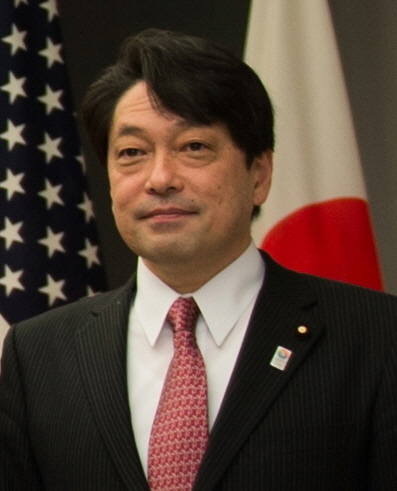
Editorial: Japan’s Defense Minister Kept Busy as Obama Visits Asia

Japan's Defense Minister Itsunori Onodera
(Wiki Info - Image: Wiki Commons)

By Victor Robert Lee

Itsunori Onodera has spent the week bolstering Japan’s defenses, but was not helped by his colleagues.

Japanese Defense Minister Itsunori Onodera has been an exceptionally busy man this week, which coincides with U.S. President Barack Obama’s state visit to Tokyo. On April 19, Onodera oversaw the groundbreaking ceremony for a new military base and radar installation on Yonaguni Island, Japan’s westernmost territory, only 110 kilometers from Taiwan and the closest inhabited spot to the Senkaku/Diaoyu islands, hotly disputed by China and Japan.
Onodera’s attendance at the groundbreaking was delayed by thirty minutes as 70 protestors jostled with security personnel to block the minister’s vehicle. The Yonaguni base will be the first expansion of Japan’s military footprint in more than forty years. In his speech at Yonaguni, Onodera also suggested the possibility of Japan creating additional bases on its southwest islands, which lie closest to China.
The next day at Naha Air Base on the island of Okinawa, Onodera launched a new squadron of four E-2C Hawkeye airborne early warning aircraft to increase surveillance of the skies between China and Japan’s southern islands, which include the disputed Senkakus/Diaoyus. Underscoring the need for the new squadron, the Ministry of Defense reported earlier this month that in the twelve-month period ending March 2014, it had scrambled fighter jets in response to Chinese aircraft approaching Japan’s airspace a record 415 times, up from 306 in the prior twelve months. The ministry said “many” of the Chinese aircraft were fighter jets. 

Read the full story at The Diplomat

Editorial: Taiwan to Simulate Chinese Aircraft Carrier Assault


By Zachary Keck

Taiwan’s annual computer-aided war games will simulate a PLA assault led by its carrier, the Liaoning.

Taiwan will simulate an attack against China’s sole aircraft carrier during annual war games scheduled for next month.
According to a report in the China Post, Taiwan’s Ministry of National Defense (MND) announced on Tuesday that annual computer war games will simulate Taiwan’s response to an all-out invasion of the island by the People’s Liberation Army (PLA) in 2015. The report said that this will include simulating attacks against China’s only aircraft carrier, the Liaoning, which Taipei apparently expects would be utilized by the PLA were it to invade Taiwan next year.
China Post went on to say that Taiwan’s military would also be simulating various responses to some of the other most recent additions to the PLA’s arsenal, without specifically naming any weapon systems besides the aircraft carrier. Other reports have suggested that Taiwan’s simulated response will include the use of weapon systems that Taiwan recently acquired from the United States, including the AH-64E Apache attack helicopter and the P-3C anti-submarine aircraft. In addition, the drill will include the use of Taiwan’s recent, domestically produced Thunderbolt-2000 artillery multiple-launch rocket system.
No reports suggested that Taiwan’s military would simulate using any of its new so-called “carrier killers,” although the lead ship of the class is expected to be deployed early next year. 

Read the full story at The Diplomat

Editorial: China’s Military Urges Increased Secrecy


By Shannon Tiezzi

A new official report cited by state media urges the PLA to more closely guard its military secrets.

From U.S. Defense Secretary Chuck Hagel’s tour of the Liaoning aircraft carrier earlier this month to the recent release of two music videos featuring footage ofLiaoning’s crew in training, we’ve been seeing a lot of what might be termed “military transparency with Chinese characteristics.” Lest anyone get too optimistic, however, those initiatives were followed up this week by an article in the People’s Liberation Army Daily extolling the virtues of secrecy.  Xinhua also carried excerpts of the article in English translation, with the headline “China’s military requires tightened secrecy.”
The article quoted from a document entitled “Suggestions Regarding the Work of Protecting Secrets Under New Trends,” which PLA Daily said had been issued by China’s Central Military Commission at the order of Xi Jinping. The report named military secrecy as a key requirement to fulfilling Xi Jinping’s exhortation that China’s military should be capable of winning a war. Chinese military personnel must “clearly recognize the severe and complicated situation facing the protection of secrets, always remain sober-minded, persist in strengthening knowledge of enemies and awareness of duty, and spare no effort to fight the battle of maintaining secrecy,” the report urged. 

Read the full story at The Diplomat