31 October 2015

Editorial: Japan Launches New Warship

By Franz-Stefan Gady

A Japanese shipyard has launched a new minesweeper for the Japan Maritime Self-Defense Force.

This Tuesday, the Japan Maritime United Corporation (JMUC), a shipyard located in Tsurumi, Yokohama, launched a new mine countermeasures vessel built for the Japan Maritime Self-Defense Force (JMSDF), The Japan Times reports.

The 690-ton Awaji is the lead vessel of a new class of mine countermeasure vessels slated to replace three wooden-hulled 1,000-ton Yaeyama-class minesweepers that have been in service since March 1993.

The Awaji, named after an island in Hyogo Prefecture, boasts a new special hull made out of composite fiber-reinforced plastic in order not to set off mines with its built-in metal detecting sensors during minesweeping operations.

Read the full story at The Diplomat
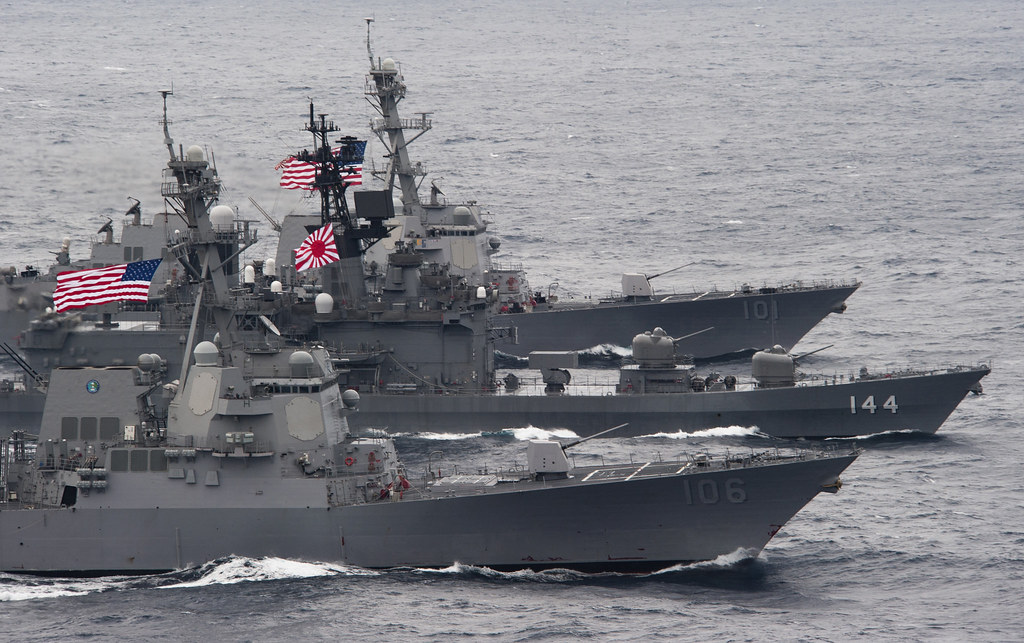
Editorial: The South China Sea - A Test for Japan’s 'Proactive Contribution to Peace'

Image: Flickr User - Official U.S. Navy Page
By Yuki Tatsumi

What will Tokyo do to demonstrate its commitment?

It’s turned out to be an eventful week for the South China Sea. On October 26, the USS Lassen conducted a freedom of navigation operation (FONOP) within 12 nautical miles of an artificial land feature that China has reclaimed and been building on since the beginning of this year. China strongly condemned the U.S. action as having “threatened China’s sovereignty and security interests, jeopardized the safety of personnel and facilities on the reefs, and damaged regional peace and stability.” But the United States firmly maintains that what its Navy ships did was a routine freedom of navigation operation, which it is entitled to conduct in accordance with the international law.

At China’s request, U.S. Chief of Naval Operations John Richardson and his Chinese counterpart Wu Shengli had a one-on-one video conference on October 29 regarding the U.S. action. Although no details of their discussion have been released, it is clear that their conversation was triggered by USS Lassen’s sailing near China’s artificial land feature.

In addition, on October 29, the Permanent Court of Arbitration ruled that it accepts the arbitration case that Philippines submitted vis-à-vis China. In the months ahead, the Court will deliberate on four primary questions: (1) status of China’s so-called nine-dash line, (2) the legality of Chinese occupation of various land features in the Spratly Islands, (3) the legality of China’s exploitation of natural resources within areas that would be considered as the Philippines’ exclusive economic zone (EEZ) under the United Nations Law of the Sea Convention (UNCLOS), and (4) whether China has interfered with the Philippines’ freedom of navigation in its own EEZ. Washington welcomes this decision, as it has long held the position that the sovereignty claims in South China Sea need to be solved through diplomatic means, including arbitration.

Now that the tide in the international community seems to be converging in the direction of questioning China’s recent assertiveness in its maritime claims in South China Sea, Japan may be tested for its commitment to making a “proactive contribution to peace.”

Read the full story at The Diplomat

Editorial: South China Sea - No Win-Win for China and US

Image: Flickr User - Greg Bishop
By Bernard Fook Weng Loo and Koh Swee Lean Collin

Neither China nor the U.S. can back down now without losing credibility and face.

In October 2015, the U.S. Navy announced that it was preparing to send a surface combatant to sail within 12 nautical miles – what the United Nations Convention on the Law of the Sea (UNCLOS) recognizes as the territorial waters of littoral states – of the artificial islands that China has been constructing in the South China Sea. On October 27, the USS Lassen, an Arleigh Burke-class guided missile destroyer, patrolled within 12 nautical miles of Subi Reef, in the Spratly Islands.

As Ashton Carter, the U.S. Secretary of Defense, said, “Make no mistake, the United States will fly, sail and operate wherever international law allows, as we do around the world, and the South China Sea will not be an exception.”

The move has potentially serious consequences for the security and stability of the South China Sea and Southeast Asia, especially when one considers the more intrusive nature of prospective U.S. Navy intelligence-gathering activities so close to the artificial islands. The U.S. Navy risks creating a situation where there is no win-win solution for either the United States or China.

At least two possible scenarios eventuate from this policy position: One, China is forced to back down and lose any credibility as a great power that has overcome its Century of Humiliation; or two, the U.S. ultimately gives way on future freedom of navigation patrols, undermining at best the credibility of its security guarantees to its allies and security partners in the Asia-Pacific.

Read the full story at The Diplomat

30 October 2015

USA: Possible Foreign Military Sale to Thailand of Evolved Seasparrow Missiles (ESSM)

WASHINGTON, Oct. 29, 2015 - The State Department has made a determination approving a possible Foreign Military Sale to Thailand of Evolved Seasparrow Missiles (ESSM) and associated equipment, parts and logistical support for an estimated cost of $26.9 million. The Defense Security Cooperation Agency delivered the required certification notifying Congress of this possible sale on October 28, 2015.

The Government of Thailand requested a possible sale of Major Defense Equipment for its Evolved Seasparrow Missile (ESSM) program. The total estimated value of MDE is $18,570,385. The total overall estimated value is $26,943,445.

Major Defense Equipment (MDE) includes: 
Sixteen (16) Evolved Seasparrow Missiles (ESSM) (Fourteen (14) tactical missiles and two (2) telemetry missiles)
Three (3) MK25 Quad Pack canisters
Ten (10) MK783 shipping containers

Also included with this request is additional equipment; training; and technical services.

Industry: ASC on a roll with (Australian) submarine maintenance

Adelaide-based submarine builder and maintainer ASC has taken another step towards achieving international benchmark performance with Collins Class submarine HMAS Farncomb rolling out of the shed, on its way back to the water.

HMAS Farncomb arrived for maintenance in late May 2014 and is the first Collins Class submarine to undergo the new and revised maintenance regime since the Coles Review into submarine sustainment. 

Previously, a full cycle docking of a Collins Class submarine could take in excess of three years; but HMAS Farncomb is on track to be completed in less than two years.

ASC Interim Chief Executive Officer Stuart Whiley says HMAS Farncomb rolling out of the shed represents another step in ASC’s journey to overhaul the way it undertakes submarine maintenance and ultimately improve submarine availability for the Royal Australian Navy.

News Report: Vietnam Gives Noncommittal Response to US Patrol in S. China Sea

Tra Mi

Two days after the United States sailed a warship within the 12-nautical-mile zone of man-made islands in the hotly disputed waters of the South China Sea, Vietnam has given a noncommittal response to the incident.

While most nations in the region responded quickly to the event, Vietnam stayed silent until Thursday, when a foreign ministry spokesman in Hanoi was asked a question about the incident.

Without directly criticizing China or the U.S., spokesman Le Hai Binh told reporters that Vietnam respects the freedom of navigation and overflight in the East Sea consistent with relevant provisions of the U.N. Convention  on the Law of the Sea as well as its national laws.

However, others in Vietnam have called for their government to be supportive of the U.S. action.

News Story: Xinhua harrumphs over US Navy passage in South China Sea

Though the United States insists that it won't take positions on South China Sea disputes, all of its actions seem to be targeting China — a naval destroyer sailing within 12 nautical miles off China's artificial islands in the Nansha (Spratly) islands is the latest example.

An Associated Press report quoted a Pentagon official as saying that "we will fly, sail, and operate anywhere in the world that international law allows."

We should give "credit" to Uncle Sam. As an unrelated party in the dispute, the country has spared no effort to create a fanfare in the South China Sea, accusing China of harming navigational freedom, though evidence has seldom been presented on how harm was done or how shipping lanes have been threatened by China's island construction, which is primarily used for the creation of two lighthouses.

China's sovereignty over the Nansha Islands and adjacent waters is "irrefutable," said Lu Kang, a spokesman of the foreign ministry when commenting on the incident, adding China will respond to any deliberate provocation by any country.

It is understandable for the US to be posturing as a defender of world order, as it always claimed to do so, for itself or for its allies, but sending warships and planes to the islands may have stepped out of the line. Worse still, it is counterproductive to the solution of the disputes.

Read the full story at Want China Times

News Story: Australia Plans Chinese Naval Exercises Despite US Warship Sail-by

HMAS Stuart - Pearl Harbor 2006 (Image: Wiki Commons)
SYDNEY — Australia said Thursday it would continue scheduled live-fire naval exercises with China, even after close ally the United States sent a warship into disputed South China Sea waters this week.

On Tuesday, Washington sent its USS Lassen destroyer within 12 nautical miles of small artificial islands in the South China Sea claimed by Beijing and vowed to send more, sparking fury in China.

The disputed waters — claimed in part by Vietnam, Malaysia, the Philippines and others — have become the stage for a burgeoning tussle between the world's two largest economic and military powers as they struggle for regional dominance.

Australia's Defence Minister Marise Payne said after the incident she supported the Americans' right to freedom of navigation under international law, but added that Canberra was not involved in the US action.

Read the full story at DefenseNews

News Story: Secretary Carter Heads to Asia Amid South China Sea Tensions

US SecDef Ash Carter
By Aaron Mehta

WASHINGTON — US Secretary of Defense Ash Carter is set to embark on a swing through Asia, days after the newest wave of tensions between US and Chinese naval forces began to rise.

Carter's trip, which has been planned for some time, will take him through South Korea and Malaysia before returning to the US. The visits coincide with a number of major conferences, including the 47th Security Consultative Meeting between the US and Republic of Korea held in Seoul and the ASEAN Conference in Kuala Lampur.

His trip will loop back through California in time for the Reagan National Defense Forum on Nov. 7 near Los Angeles, where he will be the keynote speaker.

The trip also comes amid another round of exchanges by the US and China in the South China Sea.

On Monday, the US sent the destroyer Lassen within 12 nautical miles of an artificial island built by China on a reef in the South China Sea's Spratly Islands. The artificial island is one of at least seven construction projects intended to cement Chinese sovereignty claims in waters where several nations have territorial disputes. The US contends that its ships merely continue to navigate international waters.

Read the full story at DefenseNews

News Story: Protesters Dragged Away at US Military Base Demonstration in Japan

TOKYO — Japanese police on Thursday dragged away a group of elderly protesters trying to block construction of a US military base in Okinawa, the latest flare-up in tensions over the bitterly opposed project.

Hundreds of local Okinawans, most of them elderly, were staging a sit-in protest with their arms linked in a bid to block trucks and other construction vehicles.

In response, police dragged away some demonstrators including physically picking up frail activists, television images showed.

"Okinawa doesn't belong to the United States or the central government," a visibly angry Hiroshi Ashitomi, 69, told the Jiji Press news agency.

The clash comes days after the Japanese government overturned a move by Okinawa's governor to stop work on the US base relocation site.

The proposal to move the Futenma air base, first mooted in 1996, has become the focus of anger among locals, who insist it should be shut and a replacement built elsewhere in Japan or overseas.

Read the full story at DefenseNews