27 November 2014

Editorial: For SAARC to Work, India and Pakistan Must Resolve Differences


By Akhilesh Pillalamarri

Despite Modi highlighting South Asia’s problems at the SAARC summit, SAARC fails to progress.

This year’s long-awaited South Asian Association for Regional Cooperation (SAARC) meeting kicked off in Kathmandu, Nepal on Wednesday. This year’s summit is Indian Prime Minister Narendra Modi’s first SAARC meeting and it has been eagerly anticipated. This is because Modi and other South Asian regional leaders have been pushing to make SAARC actually relevant by advocating for regional cooperation and trade.
In fact, Modi highlighted both the problems and promise of South Asia during his speech on Wednesday. Speaking about his region, Modi said:
Today, less than 5 percent of the region’s global trade takes place between us. Even at this modest level, less than 10 percent of the region’s internal trade takes place under SAARC Free Trade Area. Indian companies are investing billions abroad, but less than 1 percent flows into our region. It is still harder to travel within our region than to Bangkok or Singapore; and, more expensive to speak to each other. 
Read the full story at The Diplomat

Editorial: China Makes Inroads Into India's Backyard


By Shannon Tiezzi

At the SAARC summit in Nepal, China seeks deeper relationship with South Asian countries.

The 18th summit of the South Asian Association for Regional Cooperation (SAARC) is underway in Kathmandu, Nepal. SAARC consists of Afghanistan, Bangladesh, Bhutan, India, Maldives, Nepal, Pakistan and Sri Lanka. The prime ministers and presidents of each of those countries gathered in Nepal for the summit, along with diplomatic representatives from SAARC observers – including China.
China has been an observer at SAARC since 2006, but is interested in pursuing full membership. China’s “all weather friend” Pakistan helped push for China’s full inclusion during the SAARC summit but, as has happened in the past, reluctance from India kept the proposal from moving forward. For now, China remains a SAARC observer, a status also claimed by the U.S., Australia, South Korea, Iran, and the European Union.
China’s delegation to the SAARC summit was headed up by Vice Foreign Minister Liu Zhenmin. While in Nepal, Liu pledged that China will seek deeper ties with South Asia, especially on the economic front. “China has put forward a series of initiatives, (including) increasing trade between South Asia and China to 150 billion U.S. dollars and investment to 30 billion U.S. dollars in the next five years,” Liu said. The $30 billion will go to road construction, Liu said. 
Read the full story at The Diplomat
Editorial: China-US Relations - The Return of Mao’s Noose


By Zach Przystup

‘The U.S. and China are locked in a great power competition, and their primary goals are incompatible.’

The uneasy U.S.-China relationship as strategic partners and competitors was on full display at the recent APEC summit. Although encouraging, agreements on climate, trade, and maritime security cannot mask a fundamental geopolitical reality: The U.S. and China are locked in a great power competition, and their primary goals are incompatible. The U.S. wants to keep its seat at the head of the table in East Asia, and China wants to reclaim it. To achieve this goal, Chinese President Xi Jinping has taken a page out of the playbook of Mao Zedong:  tightening the noose to test the U.S. commitment to its allies.
During the 1950s, Mao engineered two international crises in the Taiwan Strait by bombarding the nearby Jinmen islands. In both instances, he sought to dial up pressure on the U.S., or “tighten the noose,” by drawing attention to what he deemed its overextension and over-commitment to an island halfway around the world. In a speech at the Supreme State Council, Mao boasted, “At present, America has committed itself to an ‘all-round responsibility’ policy along our coast. Someday we will kick America, and it cannot run away, because it is tied up by our noose.” Ultimately, Mao’s noose strategy failed. He earned bragging rights for standing up to the U.S., but the Strait crises led to a security treaty between the U.S. and Taiwan, accelerated the Sino-Soviet split, and deepened China’s isolation.
Times have changed; China’s noose strategy has not. Now Xi has his hands on the rope. Since 2012, China has repeatedly challenged Japan’s control over the Senkaku/Diaoyu Islands by sending ships into its surrounding waters and declaring an ADIZ over the East China Sea. In the South China Sea, Xi has used a nine-dash noose to lasso the Scarborough Shoal and park an oil rig in Vietnamese waters. Beijing is once again probing the bottom line on the U.S. commitment to its allies. America proved it was not overcommitted against Mao’s weak China. But what about against Xi’s rising China? 

Read the full story at The Diplomat

Editorial: China’s Friendship Treaty - A Distraction from South China Sea Diplomacy


By David Gitter

Why ASEAN states should think twice before signing on to China’s treaty of friendship and cooperation.

As China once again offers ASEAN states billions of dollars and promotes another treaty for “Good Neighborly and Friendly Cooperation” (which sounds an awful lot like the Treaty of Amity and Cooperation), Southeast Asian nations should consider how China perceives ASEAN and what goals it hopes to gain from its interactions with the bloc. By and large, China has maintained a favorable view of ASEAN since opening relations with it in 1991. Two factors contributing to Beijing’s positive perception of the Association include its flexible and non-binding “ASEAN Way,” and its openness to Chinese win-win overtures that help Beijing secure its territorial ambitions in the South China Sea (SCS). Given China’s exploitation of these characteristics in pursuit of its expansionist goals, ASEAN should seriously consider whether it wants to sign on to another vague deal when diplomatic capital might be better spent on alternative frameworks.
Perhaps unexpectedly, China finds ASEAN a favorable diplomatic partner in part because its diplomatic style is compatible with China’s. American criticisms that are directed at both ASEAN forums (PDF) and the US-China Strategic and Economic Dialogue are remarkably similar, describing both bodies as talk shops that lack substance and are at times largely symbolic. However, these very characteristics of the “ASEAN Way” offer Beijing a non-confrontational, consensus-based mechanism for addressing regional issues that is in stark contrast to the expectations levied on Beijing in Western diplomatic forums. Like ASEAN, China’s own diplomatic style has traditionally tended to focus more on form than on substance. Although the ASEAN Way may frustrate Western governments that seek to achieve concrete decisions after attending the Association’s many meetings, Chinese diplomats likely find ASEAN diplomacy preferable for its comparatively ambiguous, hard to enforce agreements. This inclination mirrors the Chinese Communist Party’s (CCP) domestic preference for guidelines and regulations versus detailed, enforceable laws that could threaten to control Party actions. In the SCS, this preference is reflected through Beijing’s vocal support for vague and easily circumvented agreements such as the Treaty of Amity and Cooperation (TAC) and the Declaration of Conduct on the South China Sea (DOC), and its relative lack of enthusiasm for a Code of Conduct on the South China Sea (COC). Beijing has even less regard for the SCS plan of the only other non-ASEAN claimant, Taiwan’s East China Sea Peace Initiative, which Taipei asserts is applicable to the SCS and has successfully guided the island’s diplomacy towards maritime dispute resolution with Japan and the Philippines (PDF). 

Read the full story at The Diplomat

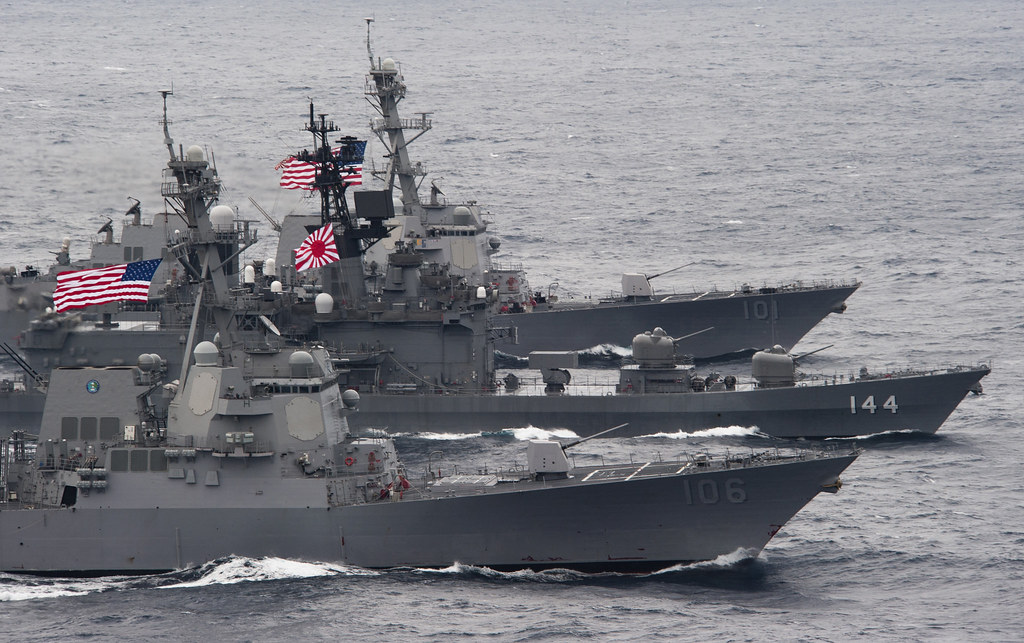
Editorial: US-Japan Defense Guidelines Likely to Be Delayed

Image: Flickr User Official U.S. Navy Page

By Ricky Hough

For now, Japan’s domestic political turmoil and economic woes are trumping its regional security challenges.

With all the political turmoil taking place in Tokyo this week, Japan’s central government has announced plans to delay talks with Washington on revising and finalizing the U.S.-Japan Defense Guidelines. The announcement comes as no surprise given the political vacuum caused by the dissolution of the Lower House of Representatives and the upcoming snap elections to be held on December 14. Indeed, delaying the revision process has been discussed publicly for some time. According to the Jiji Press, Tokyo hopes to have the guidelines completed by spring of 2015, several months after the year-end deadline. Top officials from Japan’s Defense Ministry Policy Bureau, led by director-general Tetsuo Kuroe, are set to travel to Washington this weekend to hold talk with U.S. defense officials. 

Read the full story at The Diplomat

Editorial: Vietnam, the US, and Japan in the South China Sea


By Alexander L. Vuving

Prospects for regional security hinges heavily on how these actors relate to the South China Sea issue.

Between May and July 2014, China unilaterally deployed a giant drilling rig in waters claimed by Vietnam as its exclusive economic zone (EEZ). The move led to a fierce confrontation between Chinese and Vietnamese government vessels and saw relations between the two countries deteriorate to their lowest point since 1988. The standoff also served as a litmus test to identify who will side with whom in this conflict. While most of the world remained neutral, several states came out in support of Vietnam in one form or another. Among these supporters, the United States and Japan stood out as the most powerful and staunchest.
The fault line between Vietnam, the U.S., and Japan on one side and China on the other can be seen as one between status quo and revisionist powers. The former share the same objective of maintaining the balance of power that has kept the region in peace for the last two decades. China, with its long period of rapid economic growth in the last three decades, appears to be determined to use its newfound power to assert its sovereignty claims, which in end effect would amount to its dominance of the region. The prospects for regional security hinges heavily on how these actors relate to the South China Sea (SCS) issue. 

Read the full story at The Diplomat

26 November 2014

Think Tank: Sri Lanka tilts to Beijing


Author: David Brewster, ANU

A sea change is occurring in Sri Lanka’s strategic orientation. Recent developments suggest that Sri Lanka is becoming China’s new best friend and security partner in the eastern Indian Ocean. This would represent a major change in Sri Lanka’s foreign policy and could have significant consequences for regional security.

The immediate cause célèbre is the visit of a Chinese submarine and announcement of a new Chinese-built port in Colombo in September, followed by another visit in early November. A third is rumoured for later this month. These are no ordinary naval visits: their nature, frequency and timing are extraordinary. The first occurred during state visits by Japanese Prime Minister Abe and Chinese President Xi Jinping. Claims by Beijing that its nuclear-powered attack submarine is on deployment against Somali pirates are risible. Despite Colombo’s initial attempts at secrecy, the visits seem to be a deliberate signal by China that it intends to maintain a submarine presence in the Indian Ocean and that Sri Lanka will play an important role that strategy.

Sri Lanka has a longstanding policy of showing accommodation and reassurance towards India. In particular, Sri Lanka will not allow itself to be used by other powers to threaten India’s security interests. This policy has been followed more or less since independence. It was reflected in a 1987 agreement under which Sri Lanka committed not to allow any of its ports to be used by any country for military purposes in a manner prejudicial to India’s interests. Overall the strategy has served Sri Lanka well in dealing with its huge and sometimes difficult neighbour.

Brunei: RBN COMMANDER VISIT TO MALAYSIA ENHANCES NAVAL COOPERATION


KUALA LUMPUR, Monday 24 November 2014 - The Commander of the Royal Brunei Navy (RBN), First Admiral Dato Seri Pahlawan Abdul Aziz bin Haji Mohd Tamit made a courtesy call to Admiral Tan Sri Abdul Aziz bin Haji Jaafar, Chief of Navy, Royal Malaysian Navy (RMN) at the Naval Headquarters in Wisma Pertahanan, Kuala Lumpur today to strengthen and enhance bilateral relations and regional cooperation in maritime security aspect for both countries.

First Admiral Dato Seri Pahlawan Abdul Aziz and his delegation is on a three day introductory visit to Malaysia from 23 November to 26 November 2014. He is also accompanied by his spouse, Datin Sakdiah binti Haji Mohammad Noor. Upon arrival at the Royal Malaysian Navy Headquarters, the RBN Commander was accorded with the Guard of Honour at the Dataran Wisma Pertahanan.

During the courtesy call, apart from exchanging views and opinions, the discussion also touched on technical cooperation and training involving both navies. This cooperation will be reinforced with joint training activities and an enhanced cooperation to improve security in our respective waters by the exchange of timely intelligence information and discussions.

The Royal Brunei Navy and The Royal Malaysian Navy enjoy the strong defence cooperation through a wide range of interactions and activities such as bilateral exercises, regular visits and professional exchanges.

Brunei: REGIONAL STRATEGIC ENVIRONMENT SERIES


BOLKIAH GARRISON, Tuesday 25 November 2014 – SHHBIDSS held the Regional Strategic Environment Series this morning at Sultan Haji Hassanal Bolkiah Institute of Defence and Strategic Studies (SHHBIDSS) Lecture Hall which showcased a panel of renowned experts in Asia-Pacific namely Dr Carlyle Thayer, Emeritus Professor at the University of New South Wales, Australia Defence Force Academy, Australia, Dr Tim Huxley, the Executive Director of the International Institute of Strategic Studies (IISS), Singapore, Dr Jim Rolfe, Director of the Center of Strategic Studies at Victoria University of Wellington, New Zealand, Dr Mark Rolls,  Senior Lecturer and Director of the International Relations and Security Studies Programme at University of Waikato, New Zealand, and Dr Li Mingjiang, Associate Professor from Rajaratnam School of International Studies, Nanyang Technological University, Singapore.

The talks focused on power dynamics in the Asia-Pacific region which contributes to the patterns of today’s military modernisation, the prospects of escalating tensions stemming from misperceptions, and the importance of defence diplomacy both at the bilateral and multilateral to ensure regional stability. The Series sought to provide a scanning exercise for strategic planning, in turn allowing participants to get a clearer understanding of the growing and complex defence and security challenges as well as appreciate the implications to Brunei’s interests.

Present at the seminar were the Deputy Minister of Defence, Dato Paduka Haji Mustappa bin Haji Sirat, the Commander of the Royal Brunei Armed Forces, Yang Dimuliakan Pehin Datu Pekerma Jaya Major General Dato Paduka Seri Mohammad Tawih bin Abdullah as well as members of the Defence Executive Committee, service commanders, directors and officers from the Ministry of Defence and officers of the Royal Brunei Armed Forces.

India: Joint Military Exercise Hand-In-Hand 2014 Culminates


The fourth India China Joint Training Exercise Hand-in-Hand 2014 culminated on   25 November 2014 after a Joint Tactical Exercise and a closing ceremony held at Aundh Military Camp, Pune. Twelve days of joint training included understanding of transnational terrorism, developing interoperability and conduct of a joint tactical operation controlled by a Joint Command Post.

Lt General Ashok Singh, Army Commander, Southern Command of the Indian Army and Lt General Zhou Xiaozhou, Chief of Staff, Chengdu Military Command, People’s Liberation Army of China witnessed a Joint Tactical Exercise conducted at College of Military Engineering, Pune, on 25 Nov. The exercise involved insertion of troops by slithering from helicopters and destroying a terrorist hide out. It demonstrated the commitment of both Armies in working closely with each other to eradicate the menace of terrorism in all its forms.

Later, Lt General K Surendranath, Chief of Staff of Southern Command of Indian Army & Lt General Zhou Xiaozhou, Chief of Staff, Chengdu Military Command, People’s Liberation Army of China jointly reviewed the parade commanded by Colonel MS Khan,  Commanding Officer of the 9 Rajputana Rifles. Fly past by Sukhoi-30 aircrafts added colour to the impressive parade displayed by the joint contingent.

Lt General K Surendranath of the Indian Army after addressing the parade declared the joint training closed. Observers of both the nations which included senior military officials complimented the participants on the professional conduct of training.