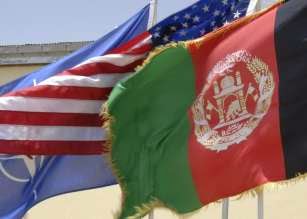
Showing posts with label US-Afghan Relations. Show all posts

18 September 2017

News Story: McMaster And Atmar Discuss US Strategy In Video Conference

By Rajab Taieb

The Afghan National Security Advisor Mohammad Haneef Atmar on Thursday spoke with his US counterpart H.R. McMaster in a video conference and discussed the US's new strategy for Afghanistan, the National Security Council said in a statement issued on Saturday.

According to the statement, they went through the new strategy and discussed the issue in detail.

“The two sides had a detailed discussion of the new US strategy for Afghanistan and South Asia,” read the statement.

The statement said the US and Afghan security advisers also exchanged views on the implications of the new policy and bilateral cooperation between the United States and Afghanistan. 

Read the full story at TOLOnews

02 September 2017

News Report: Mattis Signs Orders for More US Troops in Afghanistan

U.S. Secretary of Defense Jim Mattis
Carla Babb

PENTAGON — U.S. Secretary of Defense Jim Mattis says he has signed orders to deploy additional American troops to Afghanistan beyond the 11,000 currently serving in the war-torn country.

Speaking to reporters Thursday at the Pentagon, Mattis said the additional troops would mostly advise and "enable the Afghan forces to fight more effectively" against the Taliban and more than a dozen terror groups in Afghanistan.

The secretary said he would provide the public with more information once he had completed the orders and notified Congress next week of the military's next steps.

"I've signed orders, but it's not complete. In other words, I've signed some of the troops that will go and we're identifying the specific ones," Mattis said.

30 August 2017

News Story: Allies Will Be in Afghanistan for Decades - Ex-CIA Chief

David Petraeus (Image: Wiki Commons)
General David Petraeus, a former CIA director and former commander of US and NATO troops in Afghanistan said American forces are likely to stay in the country for decades after an increase in troop numbers, The Times in Britain reported.

 “The analogy with Afghanistan isn’t perfect, given that is a true shooting war, but when we have had significant national interests at stake, we have sustained efforts, and I think that is why a sustained commitment is important here but also why that has to be sustainable,” he told The Times.

He “wouldn’t hazard a prediction” on how long NATO forces would be in Afghanistan, but indicated that the 16-year war, America’s longest, was set to last.

“This is not the fight of a decade, much less a few years,” he said. “We are engaged in a generational struggle. That is why we need sustained commitments that are sustainable. I believe that this is a sustainable sustained commitment,” he said.

Read the full story at TOLOnews

29 August 2017

News Report: US Military Plan for Afghanistan 'Not There Yet'

Jeff Seldin

PENTAGON — The Pentagon is not ready to move forward with President Donald Trump's new strategy for the war in Afghanistan, since military officials say key decisions have yet to be made.

Defense officials said Monday that critical planning was still under way, and that there was no timeline for when it might be finished, despite the fact that the Afghanistan strategy remains a "top priority."

"We're just not there yet," a Pentagon spokesman, Colonel Robert Manning, told reporters. "There is work to be done here within the department and answers that need to be provided."

Following months of deliberations, the president unveiled his new, "condition-based approach" for Afghanistan at a military base outside Washington last week.

"Conditions on the ground, not arbitrary timetables, will guide our strategy from now on," Trump told about 2,000 troops at Joint Base Myer.

06 July 2017

News Story: U.S Senators Call For Elimination Of Taliban Safe Havens

By Samim Faramarz

A U.S. congressional delegation on Tuesday warned that Washington will change its approach towards Pakistan if Islamabad fails to tackle militants effectively.

The five-member bipartisan delegation which comprises senator John McCain and  fellow senators Lindsey Graham, Elizabeth Warren, David Perdue and Sheldon Whitehouse arrived in Kabul on Tuesday after holding discussions with Pakistani officials in Islamabad.

The congressional delegation stressed the need for the elimination of the Taliban and its brutal offshoot Haqqani Network and their safe havens in Pakistan.

They said that the deployment of additional troops to Afghanistan was needed and that more authorities should be given to these forces to win the war in the country.

“We told them (Pakistan) that in our view, the Haqqani having a safe zone in their country was not acceptable. They (Pakistan) responded that they have taken some measures which is true, such as clearing Waziristan and doing some other work that I think has been important. We told them that we would be discussing the entire situation with the president, with general Mattis and General McMaster. We made it very clear that we expect them to help us in cooperating in our struggle particularly against Haqqani as well as other terror organizations,” said McCain.

Read the full story at TOLOnews

03 July 2017

News Story: The Military Can't Fix This Mess Alone - Former U.S Envoy

In an article published recently in National Interest magazine, the former U.S ambassador to Afghanistan James Cunningham said there is no guarantee that America can "win" in Afghanistan, but it is quite clear that it can lose. 

He stated that U.S President Donald Trump’s decision last month to delegate troop level and operations decisions to his secretary of defense, James Mattis, set the correct conditions to improve security in Afghanistan. 

But Cunningham asked the question that many have done - if the U.S could not win with 100,000 troops, what difference would a few thousand more now make? 

He said the key here was that despite mistakes having been made in the past and present, there have been significant achievements gained. He also said that any new strategy must aim all its instruments of power at countering Daesh and the Taliban. 

He said if the U.S gets this right, “America and its allies will be on much sounder footing in Afghanistan and in the global confrontation with Islamist terror.”

He went on to say, “There is no guarantee that the United States can ‘win’ in Afghanistan, but it is quite clear that it can lose, with grave consequences for American security.”

Read the full story at TOLOnews

30 June 2017

News Story: Afghan president meets top U.S. military officer, discusses security

KABUL, June 28 (Xinhua) -- Afghan President Ashraf Ghani met here Wednesday with Chairman of the Joint Chiefs of Staff of U.S. army General Joseph Dunford and discussed various topics including Afghan security situation, said Afghan Presidential Palace.

The two sides discussed U.S.-Afghan bilateral ties and the U.S. support for the Afghan security forces, the palace said in a statement.

The top U.S. military officer's trip to Afghanistan is a clear indication of the U.S. long-term commitment to Afghanistan, it added.

Read the full story at Xinhua

21 June 2017

News Story: US-Afghan Officials Claim Insider Attacks Will Not Damage Ties

Afghan National Army (ANA) Commandos
By Sharif Amiri

General John Nicholson, the commander of U.S and NATO forces in Afghanistan has said that insider attacks against foreign forces will not damage relations between Afghan security forces and foreign troops in the country. 

He said that efforts are ongoing to identify infiltrators within the ranks of the Commandos within the Afghan National Army (ANA). 

“We will not allow the actions of a few confused individuals to break the strong bounds and relationship we have with you,” said Nicholson. 

Meanwhile, general Tariq Shah Bahrami, the acting minister of defense said that recent attacks by two Afghan Commandos against their foreign counterparts in Nangarhar and Balkh provinces had been plotted by some neighboring countries and intelligence services. 

“The attack was plotted by the neighboring countries and the terrorist organizations; they wanted to harm our strategic partnership; but we want to say that this partnership is strong and it will remain sustainable,” added Bahrami.

However, it appears the existence of infiltrators within the ranks of the Afghan Commandos - the most trusted soldiers within the army - has become a major headache for the Afghan government and the foreign forces.

Read the full story at TOLOnews

08 May 2017

News Story: Pakistan’s Envoy To U.S Meets McMaster, Discusses Afghan Issues

Pakistan's Ambassador to the United States Aizaz Ahmad Chaudhry met with the U.S National Security Adviser Lt Gen H.R. McMaster on Thursday and discussed peace in Afghanistan and recent border clashes.

Chaudhry stressed during the meeting that the benefits of war on terror could only surface after peace returned to Afghanistan, adding that peace in Afghanistan is one of Pakistan’s priorities.

According to a statement issued by the Pakistani government, Chaudhry met with McMaster on Thursday afternoon at the White House and bilateral relations were discussed in the wake of McMaster’s recent visit to Pakistan.

"Peace in Afghanistan and broader regional stability also came under discussion,” read the statement.

Chaudhry reportedly told McMaster: "Peace in Afghanistan was a high priority for Pakistan especially to consolidate the gains made in our enduring fight against terrorism."

His meeting came just a day before four Afghan border force members were killed and 14 others were wounded in a Spin Boldak clash on Friday.

Read the full story at TOLOnews

06 May 2017

News Story: NATO Chief Tells EU Alliance Needs To Stay In Afghanistan

By Massoud Ansar

NATO Secretary General Jens Stoltenberg said in an address to the European Parliament that the alliance needs to stay in Afghanistan and help conventional Afghan forces in their campaign against terrorism. 

“We have played a key role in Afghanistan for many many years. Our military presence in Afghanistan, is our biggest mission ever. And all NATO allies have participated, but also many non-NATO allies have participated, because they are partners they have participated in the recent support mission, and before that ISAF mission in Afghanistan. And many of the countries that are not members of NATO, but members of EU have been in Afghanistan,” said Stoltenberg. 

Addressing the European Parliament in Brussels on Wednesday, Stoltenberg said the organization needs to make decisions on its in presence in Afghanistan in the coming years. 

“We have ended our combat operations in Afghanistan, but we continue to train and assist and advise the Afghan forces to enable them to stabilize their own country, enable them to fight terrorism themselves. And I think that if there's one lesson we've learned, both from Afghanistan, but also in a different way, but at least the same lesson, we have learned from Bosnia-Herzegovena and from Kosovo, is that in the long-run it's much better if we are able to train the local forces to stabilize their own country, to fight terrorism themselves, instead of NATO deploying a big number of combat troops, and big combat operations. 

“So building local capacity, training local forces is the key when it comes to NATO's contribution to fighting terrorism. We have to make decisions on our presence in Afghanistan in the coming years,” he said. 

This comes just days after Stoltenberg told a German daily Die Welt that NATO is considering sending additional military personnel to Afghanistan and increasing the timeframe of the deployment in view of the “challenging security situation.” 

Read the full story at TOLOnews

25 April 2017

News Report: Top US Military Officials 'Not Refuting' Russia Arming Afghan Taliban

Carla Babb

KABUL — Days after the brazen Taliban attack on an Afghan military base, top U.S. military officials are "not refuting" reports Russia has been arming the insurgent group.

"We continue to get reports of this assistance and, of course, we had the overt legitimacy lent to the Taliban recently by the Russians that really occurred late last year," said U.S. General John Nicholson, the ground commander for international forces in Afghanistan.

Nicholson made the comments Monday in Kabul alongside U.S. Defense Secretary Jim Mattis, who made a previously unannounced visit to Afghanistan, after stops in Qatar and Djibouti.

Mattis noted Russia is choosing to be a strategic competitor in a number of areas, including in the war-torn South Asian country.

"We will engage with Russia diplomatically, we will do so where we can, but we will have to confront Russia when what they are doing is contrary to international law or denying the sovereignty of other countries," Mattis told reporters in the Afghan capital, where he also met with Afghan President Ashraf Ghani and Chief Executive Abdullah Abdullah.

21 April 2017

News Story: Moscow Not About To Challenge U.S In Afghanistan - Envoy

By Samim Faramarz

The Russian Ambassador to Kabul Alexander Mantytskiy said on Wednesday at a press conference in Kabul that Moscow is not interested in challenging the United States and NATO in Afghanistan nor is it following a hidden agenda regarding the country. 

“We do not have any hidden agenda in Afghanistan; similarly, we do not have the will to compete with the United States in Afghanistan,” Mantytskiy told the press conference.

The Russian envoy defended his country’s stance regarding Moscow’s contact with the Taliban and said their aim is to help ensure peace and stability in Afghanistan.

Mantytskiy did however raise the issue of the U.S bombing Achin in Nangarhar last week. 

Read the full story at TOLOnews

18 April 2017

News Report: McMaster Talks to Civilian, Military Leaders in Pakistan

H.R. McMaster (Image: Wiki Commons)
Ayaz Gul

ISLAMABAD — U.S. National Security Advisor H.R. McMaster is in Pakistan where he is holding meetings with both civilian and military officials on bilateral security matters and efforts to stabilize neighboring Afghanistan.

McMaster arrived in Islamabad Monday, a day after holding talks with Afghan leaders in Kabul to review and assess the situation with regard to the U.S. military’s counterinsurgency and counterterrorism missions in the country.

After McMaster’s meeting with Pakistan's foreign policy advisor, Sartaj Aziz, an official statement said Islamabad conveyed its concerns about the deteriorating security situation in Afghanistan.

It added that Aziz "reaffirmed” Pakistan’s commitment to work with the international community to support efforts for Afghan peace and reconciliation. The statement noted McMaster acknowledged Pakistan’s sacrifices in combating extremism and terrorism.

“He renewed the commitment of the new administration to work closely with Pakistan in strengthening mutually beneficial relations and towards the shared objectives of peace and stability in Afghanistan and the region,” it said.

This is McMaster's first trip to the region since becoming U.S. President Donald Trump's national security advisor, and it comes in the wake of calls by military commanders for adding “several thousand” troops to 8,400 U.S. forces already in Afghanistan to help break the "stalemate" in the battle with the Taliban.

News Story: President Ghani Meets Trump’s National Security Advisor

Afghan President Ashraf Ghani and CEO Abdullah Abdullah held discussions with U.S President Donald Trump’s national security adviser H.R McMaster at the Presidential Palace on Sunday over the security situation in Afghanistan, ARG said in a statement.

McMaster, who arrived in Kabul early Sunday, met with National Unity Government (NUG) leaders and high-ranking officials, and discussed other issues including Afghan-America relations, the fight against terrorism, regional issues, and the economic and development situation in the country.

According to the statement, Ghani said at the meeting that terrorism is a serious threat to regional and world security and if measures are not put in place to fight the scourge it will have a lasting impact for generations to come.  

Ghani also said apart from terrorism, drugs and corruption were a serious challenge in the country and affecting security, stability and development.

He also said that these issues needed to be fought jointly and that there should be a clear vision on terrorism with no distinction being made between good and bad.

At the meeting, Ghani said that the Afghan government has taken practical steps to fight corruption and that it will increase efforts to combat the scourge.

McMaster reiterated Ghani remarks on terrorism and said terrorism and drugs were a joint threat for the region and the world and to eliminate these threats countries must fight them together.  

Read the full story at TOLOnews

30 March 2017

News Report: Afghanistan to Get Helicopters, Aircraft as Part of Security Plan

Afghanistan's US-Built MD-530 Light Attack Helicopters
Ayesha Tanzeem

ISLAMABAD — Afghanistan is expected to get up to 200 helicopters and other aircraft as part of a four-year plan to improve the nation's security forces to help beat the Taliban insurgency, according to Dawlat Waziri, the spokesman for the Afghan Defense Ministry.

Waziri said discussion of the plan is part of the agenda of a top level U.S. delegation expected to visit Kabul over the next couple of weeks. U.S. officials have not publicly confirmed the reported trip, but their Afghan counterparts have been discussing the expected agenda.

Ahead of the visit, Afghanistan’s National Security Adviser Haneef Atmar held a one-hour video conference Wednesday with his American counterpart H. R. McMaster to discuss bilateral security cooperation between the two nations.

08 February 2017

USA: Mattis Confers With Afghan President During Phone Call

DoD News, Defense Media Activity

WASHINGTON, Feb. 7, 2017 — Defense Secretary Jim Mattis spoke today by telephone with President Ashraf Ghani of Afghanistan to discuss the enduring U.S.-Afghan security relationship, according to a statement issued by Pentagon spokesman Navy Capt. Jeff Davis.

Mattis thanked Ghani for his leadership and emphasized the importance of the government of national unity to the stability of Afghanistan, Davis said in the statement.

Importance of U.S. Afghan Relationship

Ghani affirmed his commitment to reforms, especially eliminating corruption, and highlighted the importance of a sustained U.S.-Afghan relationship for the security of Afghanistan and the region, the spokesman said.

In light of the recent terrorist attacks in Afghanistan, including today's attack against the Afghan Supreme Court, Mattis offered his condolences for the sacrifices of the Afghan people and commended Ghani's unwavering commitment in the face of the enemy, Davis said.

Both leaders expressed their desire to maintain a strong relationship and look forward to engaging again in the near future, the spokesman said.