Showing posts with label South East Asia. Show all posts

23 August 2017

AUS: (MinDef) Visit to South East Asia

Minister for Defence, Senator the Hon Marise Payne, will travel to Thailand, Laos and Vietnam from 21 to 25 August 2017 as part of a South East Asia visit focussed on strengthening defence relationships and promoting regional cooperation.

Minister Payne will travel from Singapore where she attended the tenth Singapore Australia Joint Ministerial Committee (SAJMC) with Minister for Foreign Affairs, the Hon Julie Bishop MP, and Minister for Trade, the Hon Steven Ciobo MP to Thailand, Laos and Vietnam, meeting with both the Thai and Vietnamese Prime Ministers and her counterpart Defence Ministers from all three countries. 

“Australia enjoys strong and dynamic defence relationships with Singapore, Thailand, Laos and Vietnam, reinforced by the 65th anniversary of diplomatic relations with Thailand and Laos, and the 50th anniversary of ASEAN,” Minister Payne said.

“We will explore opportunities for increased defence engagement activities between our nations, including in maritime security and counter terrorism, share views on the region’s changing dynamics and discuss issues that affect our collective security and prosperity.

“This regional visit comes at a time when the focus of economic and strategic gravity in the world is shifting towards the Indo-Pacific and demonstrates Australia’s commitment to be an enduring, engaged and constructive partner in our region.”

17 July 2017

News Story: App blocks terror content as Southeast Asia boosts efforts vs radicalism

By Stephen Wright

JAKARTA, Indonesia — The encrypted messaging app Telegram is forming a team of moderators who are familiar with Indonesian culture and language so it can remove "terrorist-related content" faster, its co-founder said Sunday, after Indonesia limited access to the app and threatened a total ban.

Pavel Durov, who with his brother Nikolai founded the app in 2013, said in a message to his 40,000 followers on Telegram that he'd been unaware of a failure to quickly respond to an Indonesian government request to block a number of offending channels — chat groups on the app — but was now rectifying the situation.

The Ministry of Communications and Information Technology on Friday said it was preparing for the total closure of Telegram in Indonesia, where it has several million users, if it didn't develop procedures to block unlawful content. As a partial measure, it asked internet companies in the world's most populous Muslim nation to block access to 11 addresses offering the web version of Telegram.

Samuel Pangerapan, the director general of informatics applications at the ministry, said the app is used to recruit Indonesians into militant groups and to spread hate and methods for carrying out attacks including bomb making.

Read the full story at PhilStar

01 July 2017

News Story: Southeast Asia should be vigilant over terrorism

Jakarta (VNA) – Terrorism has become a regional issue, which requires members of the Association of Southeast Asian Nations (ASEAN) to tighten coordination to prevent terrorist attacks.

Arisman, Executive Director of Centre for Southeast Asian Studies, made the remark in a recent interview granted to Vietnam News Agency correspondents in Indonesia.

The cooperation is not only the collaboration among anti-terrorism agencies such as sharing information and experience and coordination of actions, but it should be comprehensive in order to ensure people in the region live in a peaceful and stable environment. 

The developments in the southern Philippine city of Marawi could be consider a warning for the regional stability, he said, adding that it could be followed by similar incidents in Indonesia, Malaysia and other regional countries.

Read the full story at VietnamPlus

07 June 2017

News Report: Officials Warn of Daesh Fighters Returning to Asia After Middle East Defeat

As a fierce standoff between Philippines security forces and militants fighting under the Daesh flag continues in the city of Marawi, US and Australian officials warn that fighters may return to Southeast Asia from the Middle East, to take up arms in their own countries.

The Indonesian defense minister said Sunday at an international security forum in Singapore that around 40 out of 1,200 Daesh militants fighting in the Philippines are from Indonesia, referring to the fighters as "killing machines."

The issue of the impending return of hundreds of Southeast Asian fighters who also fought with Daesh in Syria and Iraq has been part of the agenda at an Australia-US ministerial summit, attended by top US and Australian officials, including Pentagon chief Jim Mattis and Canberra's Defense Minister Marise Payne.

"[Deash fighters will] come back with battlefield skills, they'll come back with hardened ideology, they'll come back angry, frustrated, and we need to be very aware of that," Payne said.

10 May 2017

News Report: New Survey Paints Bleak Picture of Southeast Asian Views on Trump Administration

US President Donald Trump
Joe Freeman

YANGON — Despite a fresh push by President Donald Trump's administration to reach out to Southeast Asia, a new poll suggests that confidence in the relationship is at a low point.

Titled “How do Southeast Asians view the Trump administration?” the online survey was compiled by the Singapore-based ASEAN Studies Centre at ISEAS-Yusof Ishak Institute. The center received more than 300 responses last month from a variety of government officials, civil society members, business leaders, academics and journalists in ASEAN.

Roughly 43 percent of respondents said the Trump administration was “not interested” in Southeast Asia, compared to 37 percent who said it was interested. Similar numbers (around 43 percent) said they expected U.S. engagement with the region to decrease and that the U.S. was “undependable” as an ally compared to four months ago.

06 February 2017

News Story: US lawmakers set up congressional caucus on ASEAN

Washington D.C (VNA) – US congressman Joaquin Castro from Texas and congresswoman Ann Wagner from Missouri have jointly formed a congressional caucus devoted to issues related to Southeast Asia, aiming to strengthen relations between the US and ASEAN.

According to the website “Insidertrade.com”, the caucus will focus on important matters to the security and economic interest of the US in the relationship with Southeast Asian countries.

In their speeches, the two congresspersons highlighted that the 10 ASEAN member countries represent the world’s seventh largest economy and the third biggest labour force.

“The Congress must recognise the need for enhanced dialogue with our Southeast Asian peers,” they said, expressing hope that the congressional caucus on Southeast Asia will help increase the US administration and congress’ attention toward ASEAN.

Read the full story at VietnamPlus

21 January 2017

News Story: (Japan) Gov't to submit bill allowing free giveaway of used defense equipment to other countries

Japans TC-90 trainer aircraft (Image: Wiki Commons)
With the rise of China's naval presence in mind, the Japanese government is poised to submit a bill in the upcoming ordinary session of the Diet that will allow it to give Japan's second-hand defense equipment to other countries -- primarily in Southeast Asia -- for free.

In 2014, the administration of Prime Minister Shinzo Abe dropped the Three Principles on Arms Exports and replaced it with the Three Principles on Transfer of Defense Equipment and Technology, but the new principles limit the transfer of equipment and technology to sales or leases, and prohibit the government from giving away such items for free.

The aim of the move is to help beef up the defense capabilities of Southeast Asian countries that face territorial disputes with China in the South China Sea and raise Japan's presence in the region to keep China in check. The bill, however, is expected to face criticism that such a move could lead to a limitless expansion of Japan's transfer and lease of weapons.

Read the full story at The Mainichi

08 December 2016

News Report: Center of Global Power Shifts to Asia - Turkish Deputy Parliament Speaker

The center of the global power was moving to the Asian region, Turkish Deputy Parliament Speaker Ahmet Aydin told Sputnik.

MOSCOW (Sputnik) — Aydin said that the Energy corridor and the Silk Road passed through the region will facilitate turning of the Asian region into "the world center of power and attraction."

The parliament speaker noted that the region would continue developing, since Turkey would soon complete the construction of the railway linking Europe and Asia. Agricultural sector, livestock, industrialization are also promptly developing in the region, Aydin said. 

Aydin stressed that among the Asian countries, India remained number one in the sphere of information technology, while China continued to generate sustainable economic growth with the rest of the Asian countries trying to follow the trend of development.

This story first appeared on Sputnik & is reposted here with permission.

26 November 2016

News Report: Experts Urge Southeast Asian Leaders to Gauge Threat from Regional, Returning IS Supporters

Ron Corben

BANGKOK — Hundreds of fighters from Southeast Asia have traveled to Syria and Iraq to join the Islamic State (IS) militant group, and security analysts say they are tracking growing links between the terrorist organization and regional militant groups.

Researchers say they do not want to overstate the threat posed by these links, but that it warrants increased attention.

“Yes, the governments of Southeast Asia are concerned about returning foreign fighters and they’ve been concerned for several years now," said Sidney Jones, director of the Institute for Policy Analysis of Conflict in Jakarta. "The level of concern may be rising even though there isn’t evidence at the moment that there’s any huge exodus from the Middle East.”

IS-inspired attackers have attempted several strikes in Southeast Asia in recent years — far fewer than the number of attacks in South Asia, the Middle East, Europe and the United States.

In 2016, IS-aligned fighters launched attacks in Indonesia's capital and a police station in Central Java, as well as several in the southern Philippines, parts of which are considered safe havens for militants fleeing the Middle East.

However, the number of IS sympathizers traveling to Iraq and Syria from Southeast Asia is relatively small. Analysts estimate 800 fighters from Indonesia and Malaysia, roughly 100 Australians, as well as a “few" supporters from Singapore and the Philippines, have traveled to fight in the Middle East.

But there is increased worry that IS radicals could unify and empower disparate militant factions in Southeast Asia, some of which already enjoy relative autonomy.

29 October 2016

News Report: Facing Pressure at Home, Islamic State Focuses on SE Asia

Ron Corben

BANGKOK — As the Islamic State terror group faces territorial losses in the Middle East, there are signs that the group is increasing its cooperation with local militant groups in Southeast Asia.

A new report from researchers at the Institute for Policy Analysis of Conflict (IPAC), warns that supporters of the terrorist group are networking in Southeast Asia and law enforcement agencies appear unprepared for the new threat.

“Over the last two years, ISIS has provided a new basis for cooperation among extremists in the region,” said IPAC director Sidney Jones, using an acronym to describe the Islamic State, which is also known as IS, ISIL, and Daesh.

11 October 2016

News Story: China calls for Asian community of shared future

BANGKOK, Oct. 11 (Xinhua) -- Delegates from 34 member countries of Asia Cooperation Dialogue(ACD) gathered in Bangkok to talk about Asian cooperation, development and integration during the 2nd ACD summit held here on Monday.

China called for an Asian community of shared future for the continent.

"It is time for us to vigorously build an Asian community of shared future driven by the two wheels of cooperation and dialogue," said Chinese Vice President Li Yuanchao at the summit, under the theme "one Asia, Diverse Strength."

Li said the Asian community of shared future is about facilitating common development, promoting common interests, enhancing common security and taking on common responsibilities.

According to him, to build the Asian community of shared future, Asian countries need to enhance unity and coordination to maintain stability in the continent, strengthen connectivity to deepen integration and promote beneficial cooperation to boost development.

"China supports a multi-tiered Pan-Asian connectivity network to facilitate comprehensive integration of infrastructure in Asia," Li said.

Read the full story at Xinhua

04 October 2016

USA: USS Coronado enters 7th Fleet, prepared to operate with allied and partner navies

From Task Force 73 Public Affairs

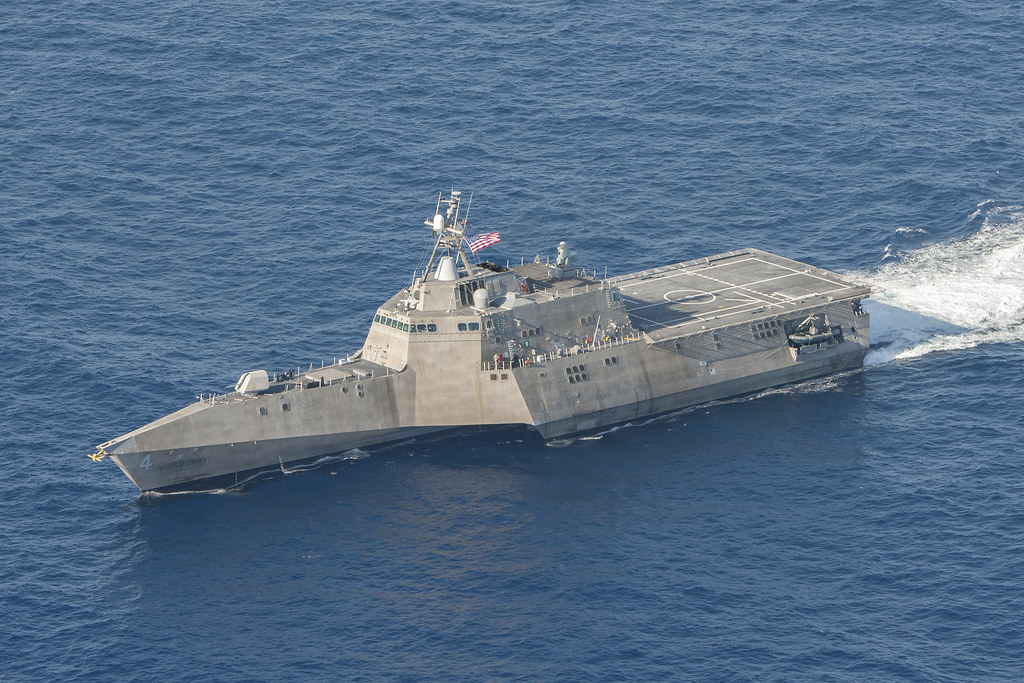
USS Coronado (LCS 4) file photo. (U.S. Navy/CPO Keith DeVinney) >>

SINGAPORE - The littoral combat ship (LCS) USS Coronado (LCS 4) arrived in the 7th Fleet area of responsibility (AOR) Oct. 3 while on its maiden deployment to Southeast Asia.

Coronado is the first Independence-variant LCS to deploy to the U.S. 7th Fleet as part of an initiative to deploy multiple LCS to the Indo-Asia-Pacific region in just a few years. The Freedom-class LCS variants USS Freedom (LCS 1) and USS Fort Worth (LCS 3) have previously deployed to the region. Coronado, like Freedom and Fort Worth, will operate from Singapore as a maintenance hub and rotationally deploy crews during the deployment.

“Similar to the Freedom and Fort Worth deployments, Coronado will participate in exercises and engagements throughout South and Southeast Asia and beyond,” said Capt. H. B. Le, commodore, Destroyer Squadron 7. “The LCS platform is well suited for this region and provides a unique opportunity for our partner and allied nations to operate alongside one of our navy’s newest and most advanced platforms.”

USA: USS Fort Worth departs Pearl Harbor, continues journey home to San Diego

By Ensign Emily Judstra, USS Fort Worth Public Affairs

Members of the Coast Guard Maritime Safety and Security Team San Diego demonstrate visit, board, search and seizure (VBSS) techniques aboard USS Fort Worth (LCS 3), Sept. 30 (USAF/TSgt Brigitte N. Brantley) >>

PACIFIC OCEAN - USS Fort Worth (LCS 3) departed Joint Base Pearl Harbor-Hickam Sept. 30, following a port call which included participation in the Association of Southeast Asian Nations (ASEAN) Defense Informal, hosted by Secretary of Defense Ash Carter.

While moored in Pearl Harbor, Fort Worth participated in a live helicopter visit, board, search, and seizure (VBSS) demonstration with Helicopter Maritime Strike Squadron (HSM) 37, Helicopter Sea Combat Squadron (HSC) 21, and a U.S. Coast Guard Maritime Safety and Security Team. The demonstration included two VBSS teams fast roping onto Fort Worth’s flight deck as a presentation to allies from Southeast Asia in efforts to enhance multilateral partnerships throughout the region.

“Being afforded the opportunity to participate in the Secretary of Defense’s ASEAN conference has been a very positive experience for us,” said Cmdr. Michael Brasseur, Fort Worth’s commanding officer. “The teams we worked with were very impressive. I’m glad our Sailors were able to be a part of this demonstration of some our Navy’s and USCG’s top end capabilities.”

25 July 2016

News Story: SE Asia deadlocked as S. China Sea split deepens

By Martin ABBUGAO, Annabel SYMINGTON

Southeast Asian nations were deadlocked Sunday about how to confront China's territorial claims in the South China Sea as pressure from Beijing again drove a wedge between countries on the region's toughest security challenge.

Their gathering in the Laos capital is the first time regional players -- including China and the United States -- have met en masse since a UN-backed tribunal delivered a hammer blow to Beijing's claim to vast stretches of the sea.

The 10-member Association of Southeast Asian Nations (ASEAN) boasts four countries who have competing claims with Beijing to parts of the sea, and is fiercely divided on the issue.

Rival claimants have accused China of deftly forging alliances with smaller member countries like Laos, this year's host, and Cambodia through aid and loans to divide the once consensus-driven bloc.

Chinese pressure was blamed last month for a startling show of ASEAN discord when countries swiftly disavowed a joint statement released by Malaysia after an ASEAN-China meeting.

That statement had expressed alarm over Beijing's activities in the South China Sea. Cambodia and Laos were later fingered as being behind moves to block it.

Those divisions were on stark display once more in Vientiane on Sunday as regional foreign ministers met for talks.

Read the full story at SpaceDaily

24 June 2016

News Report: India Wants More Frequent Military Drills in Southeast Asia

Indian Navy Kolkata class Destroyer
India's steadily growing engagement with South East Asian nations is not indicative of India's confrontational mood with China.

India's Defense Minister, Manohar Parrikar, today urged the country's armed forces to establish stronger military partnerships with friendly foreign countries, especially, in South East Asia by conducting more joint military exercises involving more than one wing of the armed forces.

Parrikar said, "by virtue of our dominant, geographical location, India is poised for a predominant role in the volatile region around us. Hence, there is a requirement to exploit this advantage by developing joint capabilities."

03 June 2016

USA: Carter to Speak at Singapore Conference, Says U.S. Presence in Region is Significant

US SecDef: Ash Carter
By Terri Moon Cronk
DoD News, Defense Media Activity

WASHINGTON, June 02, 2016 — Making his fifth trip to the Asia-Pacific region since becoming defense secretary in 2015 shows the significance of the U.S. military’s longstanding presence there, Defense Secretary Ash Carter told reporters traveling with him to Singapore today.

Aboard a military aircraft, Carter talked about his two-day trip to the world’s only island city-state, where he will give a keynote address at the Shangri-La Dialogue June 4 and engage in bilateral talks with Singaporean Prime Minister Lee Hsien Loong and Defense Minister Ng Eng Hen.

The secretary said the U.S. military’s rebalance in the Asia-Pacific region is the single-most consequential element of America's future, because half of the world's population and half the economic activity exist there.

08 April 2016

News Story: China, Southeast Asian countries to improve anti-terror cooperation

BEIJING, April 7 (Xinhua) -- China and Southeast Asian countries decided to improve their cooperation in security and anti-terrorism during a meeting in Beijing on Thursday.

The two sides will take action to improve multilateral and bilateral cooperation against terrorism, said senior Chinese official Meng Jianzhu.

Meng, head of the Commission for Political and Legal Affairs of the Communist Party of China (CPC) Central Committee, made the remarks while addressing the opening ceremony of the China-Southeast Asian security services counter-terrorism dialogue.

He said China and Southeast Asian nations share close geographical and cultural links as well as common interests and future. The two sides have witnessed increasing mutual trust and cooperation in security.

He thanked Southeast Asian nations for their support to China in the fight against terrorism.

Read the full story at Xinhua

16 March 2016

Think Tank: Southeast Asia’s muted reaction to the 2016 Defence White Paper

Tim Huxley

Like its predecessors, Australia’s new Defence White Paper pays considerable attention to Southeast Asia. Its ‘Strategic Outlook’ chapter reiterates the long-held and axiomatic conventional wisdom that the geography of the archipelago to Australia’s north ‘will always have particular significance’, because any conventional military threat—and indeed some low-intensity challenges such as people- and drug-smuggling—are ‘likely to approach through the archipelago’.

The DWP also notes Australia’s ‘deep economic security interests’ in Southeast Asia, including the fact that nearly two-thirds of the country’s exports ‘pass through the South China Sea’. It holds that Southeast Asian instability—whether within or between countries—could affect Australia’s security, and highlights a specific current concern over the ‘return of foreign terrorist fighters from conflicts in the Middle East’. Significantly, there’s a particularly strong emphasis on the dangers of the escalating tension in the South China Sea.

While its focus on the South China Sea is striking, the White Paper’s confirmation of the importance of Southeast Asia for Australia’s security hardly represents a radical shift in the thinking of Canberra’s defence establishment. The country’s wide-ranging security interests in the sub-region are reflected in the breadth and depth of its defence relations across Southeast Asia. Those with Malaysia and Singapore are particularly strong, both bilaterally and through the Five Power Defence Arrangements, set up 45 years ago with New Zealand the UK as the other two partners.

16 January 2016

Editorial: Indonesian Strikes Confirm Spread of ISIS

Image: Flickr User - Karl-Ludwig Poggemann
By Luke Hunt

Fears of the terror group spreading its tentacles further into Southeast Asia are proving to be tragically real.

Fears that the troubles in the Middle East – where Islamic militants are fighting for a caliphate and centralized Muslim leadership – will spread to Southeast Asia are proving tragically real with a series of bombs and gun battles in Jakarta.

Two civilians and five terrorists were killed. Another 26 were wounded and authorities were lucky the toll was not substantially higher after militants opened fire around a Starbucks coffee shop and Western-styled supermarkets in the first such strike in-country since 2009.

Experts say the self-declared Islamic State of Iraq and Syria (ISIS) is looking to build at least one base in Southeast Asia in 2016. The Philippines and Indonesia are most likely the preferred locations given their historical links to jihadists in the Middle East.

It is a similar objective that was once pushed by the now defunct Jemaah Islamiyah during the 2000s, through a bombing campaign backed by al-Qaeda and their infamous leader Osama bin Laden. Their claim straddled most of Southeast Asia and even included parts of northern Australia.

Southeast Asia is already a key recruitment center for ISIS, attracting more than 500 Indonesians and dozens of Malaysians. They have formed their own unit, the Katibah Nusantara (Malay Archipelago Combat Unit).

Maj. Gen. Tito Karnavian, Jakarta police chief, said the militants responsible for Thursday’s attacks belonged to a group led by Bahrum Naim, an Indonesian militant who currently resides in Syria.

“We have identified all attackers… We can say that the attackers were affiliated with the ISIS group,” he said.

Read the full story at The Diplomat

Editorial: Beyond Bombings - The Islamic State in Southeast Asia

By Zachary Abuza

To understand the group, look at its other tactics.

On 14 January, nine militants staged a barricade style attack at a Starbucks in central Jakarta. Small IEDs were detonated, and the militants engaged security forces for almost two hours. Two civilians, a Canadian and an Indonesian were killed. Five of the attackers were killed and four were arrested. Fortunately Indonesian security forces responded quickly and professionally, mitigating what could have been a much more costly attack that appears to have been perpetrated by the Islamic State or Iraq and the Levant (ISIL).

The attack in Jakarta should not have surprised anyone; this type of barricade style attack has been seen from Mumbai to Paris. With low technical requisites and a high probability of spreading fear and garnering media attention, it has been the weapon of choice, including in Southeast Asia.

On 30 June 2015, a Malaysian court convicted a man and his son for fighting with ISIL and planning terrorist incidents at home. But it was not a wave of bombings they were plotting, but rather the kidnapping of politicians. While hostage taking, executions and barricade style attacks garner less concern from security services than bombings, this is potentially an important development at both the tactical and strategic levels for Southeast Asian militants. If we are to understand the real impact of ISIL on Southeast Asian militancy, it is this.

Hostage taking has become the face of ISIL terror in the Middle East. The grisly executions of orange-jumpsuited victims, mimicking Guantanamo Bay uniforms, have become more and more macabre. Dr. John Horgan called the recent execution videos “sadism at a clinical level.” These videos are instantly disseminated across a host of social media platforms, and rather than repulse people tend to broaden the group’s appeal as they try to outbid their rivals, equating sadistic violence with religious zeal.

Likewise, there have been a number of “barricade” style hostage taking events perpetrated by ISIL-inspired militants in Europe and beyond, most spectacularly on 13 November 2015 in Paris in coordinated attacks that left 129 dead. And it is these barricade-style attacks that pose a serious threat in Southeast Asia. As J.M. Berger explained, “Al Qaeda’s love of elegance was a distraction… But in reality, AQAP carried out only a handful of attacks, and at a languid pace, over the course of many years.” But these low-tech, low-cost, and high probability of success attacks are tailor made for those who have fought with ISIL, but have little other experience than as front line troops.

The threat posed by ISIL in Southeast Asia is small but present. There are an estimated 800-1,000 Southeast Asians supporters of ISIS, including those who have traveled to Iraq and Syria, their family members, those killed in battle and arrested, as well as those returned by Turkish security forces. It also includes the first wave that has already returned home to Malaysia and Indonesia. The Soufan Group estimates the number of Southeast Asian combatants to be 600, lower than official regional estimates of 900. Several have returned and plotted or executed attacks, including the first bombing plots in Malaysia and the first attempted chlorine bomb at an Indonesian mall. Already, more Southeast Asians have joined ISIL and the Al Qaeda-linked Al Nusra Front than ever joined the anti-Soviet mujahideen. ISIL has revitalized terror networks in Southeast Asia.

Yet, despite this concern as well as the previous wave of terrorism by the Al Qaeda-linked Jemaah Islamiyah, there has been very little use of hostage taking, beheading, or barricade-style attacks as a tactic by Southeast Asian militant groups. That should be expected to change, with the success of ISIL, the proliferation of their ideology, and return of veterans from Syria over the coming few years.

Read the full story at The Diplomat