Showing posts with label Aerostat. Show all posts

24 August 2017

News Story: Philippine Navy receives radar blimp from US

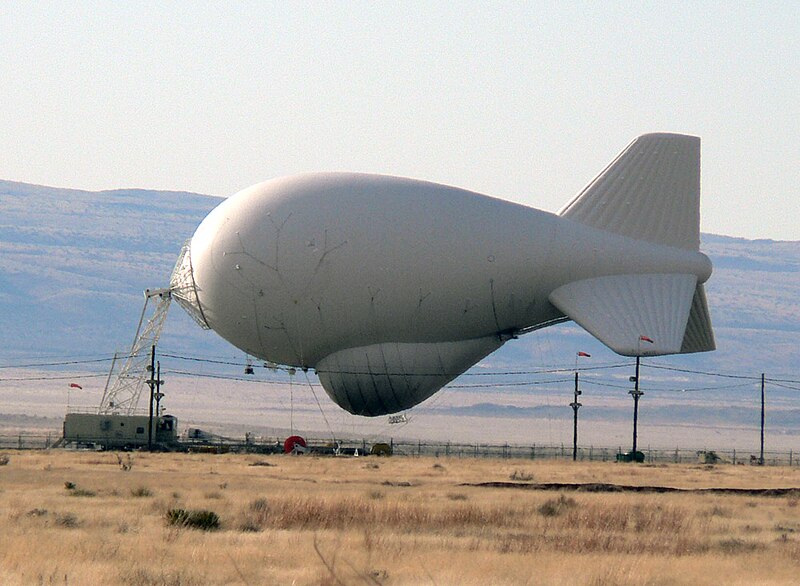
Tethered Aerostat Radar System (Image: Wikipedia)
MANILA, Philippines — The United States (US) has turned over a new Tethered Aerostat Radar System (TARS) to the Philippine Navy which will enhance its maritime surveillance capabilities.

The rapidly-deployable 28M Class TARS can rise to an altitude of 5,000 feet while tethered by a single cable. It is a self-sustained, unmanned lighter-than-air platform, according to the US Embassy.

This donation would enhance the Navy's capability in maritime intelligence surveillance and reconnaissance by detecting maritime and air traffic within the country's coastal waters.

The TARS will also be used for humanitarian assistance and disaster response operations.

The donation of the radar system is part of the US Maritime Security Initiative, a program for Southeast Asian countries that seek to improve their abilities to address maritime challenges.

Read the full story at PhilStar

19 August 2017

News Story: AFP urges gov’t - Raise Chinese incursions in WPS

MANILA, Philippines - The military wants to bring Chinese incursions at sandbars in the West Philippine Sea before the China-Philippines Bilateral Consultative Mechanism (BCM).

Armed Forces of the Philippines (AFP) spokesman Gen. Restituto Padilla broached the idea after the military affirmed reports of the presence of Chinese vessels near Pag-asa Island in the West Philippine Sea (WPS).

“We will work to clarify all of these things and there is a mechanism that is built-in in our current relationship, which is called the Bilateral Consultative Mechanism, that has already been initiated before,” Padilla said.

The BCM was formed by the Philippines and China to address concerns in the disputed seas.

The first BCM was held last May in Guiyang, China – the venue chosen by President Duterte and Chinese President Xi Jinping. Through the BCM, both parties can raise issues surrounding the maritime claims in a bid to avoid violent confrontation between the two countries.

“It would be best to ask the Department of Foreign Affairs (DFA) what happened to this mechanism because this is the proper forum to address those issues,” Padilla said.

Earlier, the DFA reported that a second meeting is forthcoming within the year where the Philippines can further bring its concerns. 

Read the full story at PhilStar


Related Links:

08 July 2017

News Report: India, Israel Ink Deal for Air Defense System, Radars, UAVs Worth $4.3 Bln

Indian companies have signed 12 strategic agreements ranging from air defense systems, radars, anti-ship missiles to medium altitude long endurance UAVs in India under technology transfer worth $4.3 billion during the first formal meeting of India-Israel CEOs forum in Tel Aviv.

New Delhi (Sputnik) – The meeting took place at the end of Prime Minister Narendra Modi's visit.

Pune-based Kalyani Strategic Systems Ltd has signed a joint venture agreement with Israel Aerospace Industries (IAI) for addressing a range of opportunities across air defense systems, radars, anti-ship missiles and command & control systems for the Indian armed forces. Both the companies will produce weapons worth $1.54 billion over a period of 7-10 years.


30 November 2016

News Report: Eyes in the Sky - Singapore Launches Enormous Military Spy Aerostat

Singapore has begun test-launching a 55 m tethered aerostat radar system, a move the nation thinks will strengthen its maritime and aerial surveillance capacities.

At the Choa Chu Kang Camp on the western part of the island, the Republic of Singapore Air Force (RSAF) will deploy a ground crew of eight officers to operate the airborne vehicle. The radar system provided by the aerostat allows the RSAF to detect naval and airborne threats within a 200 km range around the clock, IHS Jane’s 360 reports. 

"The very fact that we have [the aerostat system] adds another layer of defence, and confidence in terms of what we are able to detect with regards to aerial and maritime threats," Ng Eng Hen, Singapore Defence Minister, said. “I call it…the RSAF biggie,” he added, TodayOnline reports.

Ng Eng Hen pointed to New York City’s 9/11 aerial attacks and more recent Mumbai attacks—where terrorists arrived by boat—as precedents for bolstering the nation’s surveillance techniques.

Ng Eng Hen added that deployment of the aerostat isn’t urgent, and that authorities want to double check that it will be safe before it becomes operational. 

The deployment of the recently acquired aircraft is intended to give Singapore additional resources to detect threats from high altitudes. The island-nation has already established a slew of unmanned aerial vehicles and surveillance plans in addition to air- and ground-based radar sensors to help detect foreign invaders.

This story first appeared on Sputnik & is reposted here with permission.

30 September 2016

News Report: India Invites Global Tender for High Tech Aerial Surveillance Equipment

Northrop Grumman AN/TPS-78 Radar (Example Photo)
India is interested in buying surveillance equipment that would enable its forces to keep watch over the close-range aerial activities of rivals.

New Delhi (Sputnik) – In order to beef up its network-centric operations and air defense system along the northern frontier, India has listed a series of high value systems for procurement through global tender. Defense Ministry documents show that India would acquire high power radars for high frequency voice and data communication sets for high-altitude areas.

The Indian Air Force intends to procure 12 High Power Radars (HPRs) for air defense surveillance. The radars would be based on active aperture phased array technology, based on Solid State Trans / Receive Modules. 

28 June 2016

Think Tank: Sea, air and land updates (28-Jun-2016)

Indian Navy's first Kolkata class Destroyer
Dione Hodgson, Ashleigh Sharp and Lachlan Wilson

Sea State

The National Interest has jumped into a time machine to take a look at the world’s most powerful navies in 2030. It suggests that the ‘eastward shift’ in naval power will continue due to decreasing defence budgets in Europe and growing naval interests in Asia, with China and India the big winners. According to the piece, aircraft carriers and ballistic missile submarines will be the defining factors in naval power in the early-to-mid 21st century. US naval superiority is expected to continue—it should reach its 300-ship goal—but may face challenges from competing budgetary demands. The PLA-N will continue to expand its naval forces and may have the world’s largest navy in terms of number of ships by 2030. Russia, suffering a shortfall in funding, may only retain its position due to its ballistic missile submarine fleet.

Future weapons update now: the USN is continuing the development of its new electromagnetic railgun, despite Pentagon officials’ concerns over its cost and viability. The weapon—a long-term project for the Office of Naval Research—utilises electromagnetic energy to shoot a bullet at speeds up to Mach 7.5 (9,100kph) at moving targets up to 160km away. Pentagon officials have voiced their concern at the cost of the project (it currently stands at more than US$500 million), as well as the railgun’s requirement of 25 megawatts of power, making most vessels unsuitable hosts. Despite that, railgun program manager Tom Boucher said he’s optimistic the weapon would be operationally deployable within a decade—possibly on the USS Zumwalt.

29 April 2016

News Story: India Seeks New Radar-Carrying Aerostats

Singapore's future Aerostat
by Neelam Mathews and Chris Pocock

The Indian Air Force is considering a new purchase of radar-carrying aerostats for air and sea surveillance, especially of low-flying targets. The Indian Ministry of Defense issued a request for information (RFI) late last year for a batch of four, six or eight static, mobile or portable aerostat systems, and may soon make a request for proposal, which will include a 30 percent offset clause. The aerostats are likely to be employed in the western and or northern sectors of the Indian sub-continent, an Indian defense official told AIN. Apart from the U.S., only a handful of countries operate such systems, mostly in the Middle East, although Singapore is joining their number.

The two major suppliers in the class, Lockheed Martin (LM) and Rafael, are both expected to bid. LM was the integrator and radar supplier for the Tethered Aerostat Radar System (TARS) that is deployed at eight sites along the U.S. southern border, and subsequently provided 65 smaller Persistent Threat Detection Systems (PTDS) for deployment by U.S. forces over Afghanistan and Iraq. Rafael supplied two large aerostats carrying IAI radars to India in 2002. In 2011, one of these “was damaged due to a sudden strong gust of wind and became non-operational,” the Indian defense minster reported.AIN understands that it broke loose and drifted toward another country. The troubled Raytheon JLENS program suffered a similar accident in the U.S. last October and is likely to be denied further funding.

Read the full story at AINonline

30 October 2014

News Story: Singapore To Deploy Massive Surveillance Balloon

Tethered Aerostat Radar System (Wiki Info - Image - Wiki)

SINGAPORE — Singapore will deploy a huge tethered surveillance balloon to boost its maritime and air security, the defence ministry announced.

The helium-filled “aerostat” will be equipped with radar equipment that can spot threats from as far as 200 kilometers (125 miles) away, the ministry said in a post on its website late Tuesday.

“It will be deployed sufficiently high enough so as to have a clear line of sight over Singapore’s air and sea space,” the ministry said.

“Existing systems are facing increasing constraints, mainly due to the construction of taller buildings which prevent the systems (from) establishing a clear line of sight,” it added.

The Straits Times reported that the balloon will be able to scan up to Malacca in Malaysia for stray aircraft as well as detect small boats coming from Indonesia’s Pekanbaru.

Read the full story at DefenseNews