Showing posts with label Power Projection. Show all posts

28 September 2017

News Report: Top US General Says China Will Displace Russia as ‘Greatest Threat’ By 2025

General Joseph Dunford (Image: Wiki Commons)
The highest ranking military officer in the United States armed forces told Congress that he expected China to become “the greatest threat to our nation” by the year 2025, and pushed for an expansion in military spending to “maintain a competitive advantage” over Beijing.

General Joseph Dunford, chairman of the Joint Chiefs of Staff, appeared before the Senate Armed Services Committee (SASC) on Tuesday to testify on a variety of subjects related to US national security and the military as part of the confirmation process for his second term.

Among comments on areas of interest the world over, such as Afghanistan and North Korea, Dunford told the SASC that he expected China to "probably" become the US' primary adversary by 2025.

Dunford, a decorated soldier who previously served as commandant of the Marine Corps and the leader of US forces in Afghanistan, said this in response to Sen. Mazie Hirono (D-HI) asking him if he still believed the three biggest military threats to the US were Russia, China and North Korea in that order. "If I look out to 2025, and I look at the demographics and the economic situation, I think China probably poses the greatest threat to our nation by about 2025," he said.
31 August 2017

USA: USS Wasp departs to join 7th Fleet forces in Japan

From USS Wasp Public Affairs

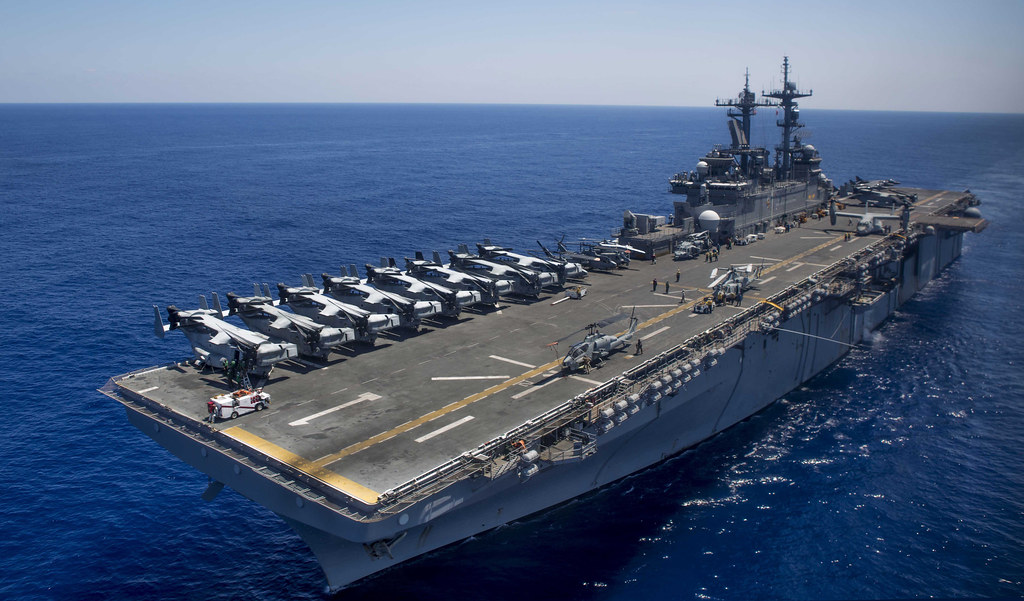
USS Wasp (LHD 1) file photo. (U.S. Marine Corps/Cpl. Ryan G. Coleman) >>

NORFOLK, Va. - Amphibious assault ship USS Wasp (LHD 1) departed for Sasebo, Japan, Aug. 30, where it will assume duties as the forward-deployed flagship of the amphibious force of the U.S. 7th Fleet.

The shift will introduce an F-35B Joint Strike Fighter-capable amphibious assault ship to the Indo-Asia-Pacific region, pairing it with the F-35Bs of Marine Fighter Attack Squadron (VMFA) 121.

"This move ensures that our most technologically-advanced air warfare platforms are forward deployed," said Wasp Commanding Officer Capt. Andrew Smith. "Our capabilities, paired with the F-35B Joint Strike Fighter, increases our Navy's precision strike capabilities within the 7th Fleet region. Wasp will help America's commitment to the maritime security and stability in the Indo-Asia-Pacific."

04 August 2017

News Report: Best Birthday Gift - Why China Marks Army Anniversary With Djibouti Base Opening

On Tuesday, China formally opened its first overseas naval logistics center with a flag raising ceremony in Djibouti, the same day as the People's Liberation Army (PLA) marked its 90th anniversary. In an interview with Sputnik some experts said this is a clear sign of China’s determination to uphold its national interests outside the country.

The base in Djibouti is China's first overseas naval base, though Beijing officially describes it as a logistics facility.

According to media reports more than 300 people attended the ceremony, including Chinese deputy naval commander Tian Zhong and Djibouti's defense minister.

The ceremony was held with the participation of Chinese PLA soldiers and the guard of honor of the army of Djibouti. The culmination of the ceremony was the mooring of the ships of the PLA Navy, which headed for Djibouti on July 11.

03 August 2017

News Report: Strange Bonhomie - India, Bhutan Attend PLA Event in Spite of China Standoff

Despite the Doklam standoff and reports of new incursions by Chinese troops, representatives of India and Bhutan attended an event organized by the Chinese Embassy in New Delhi to mark the 90th anniversary of the founding of the People's Liberation Army.

New Delhi (Sputnik) — With the face-off between Indian and Chinese troops in Doklam now threatening to extend into the third month, the representatives from India, Bhutan and other members of the South Asian Association for Regional Cooperation (SAARC) attended an event in New Delhi on Monday to mark the PLA’s 90th anniversary.

Oddly, the Indian participation at the event came amid reports of a fresh Chinese incursion in Uttarakhand state. India was represented by a high-ranking army official, while Bhutan's ambassador to India Vetsop Namgyel was also present along with the likes of Pakistani High Commissioner Abdul Basit. Envoys and military attaches of around 20 countries including Russia and the US also joined in.

India's home ministry confirmed on Tuesday that some 50 Chinese soldiers entered Uttarakhand's Barahoti on July 25. The PLA soldiers entered some one kilometer inside India and threatened some cattle herders to leave the area with their animals.

15 July 2017

News Report: China to Trim Its Army - What Does It Mean for India and the Region?

China is planning to cut down its 2.3 million-strong military, the world's largest, to below one million in the biggest troop reduction as part of a restructuring process. Indian experts said the People's Liberation Army (PLA) downsizing has implications for India and the wider region.

New Delhi (Sputnik) — The PLA will increase the numbers of other services, including navy and missile forces, the PLA Daily, the official newspaper of the Chinese military, reported.

"The old military structure, where the army accounts for the vast majority, will be replaced after the reform. The reform is based on China's strategic goals and security requirements. In the past, the PLA focused on ground battle and homeland defence, which will undergo fundamental changes," the report said.

"This is the first time that active PLA army personnel would be reduced to below one million," it added.

12 July 2017

News Story: Analyst - China diverting int'l pressure while completing facilities in disputed sea

By Patricia Lourdes Viray

MANILA, Philippines — Beijing appears to be engaging with Manila and other Southeast Asian governments to divert international pressure from the disputed South China Sea, a foreign policy analyst said.

A few weeks ago, Washington-based CSIS Asia Maritime Transparency Initiative (AMTI) released new satellite imagery that China has been continuing the construction of facilities in three Manila-claimed reefs in the Spratly Islands.

China appears to have installed new missile shelters, radar and communication facilities on Fire Cross Reef, Mischief Reef and Subi Reef despite starting direct negotiations with the Philippines last May.

Gregory Poling, director of the AMTI, said that the approach of the Duterte administration hasn't resulted in any slowdown in the construction of military facilities on the artificial islands.

"This suggests that Beijing wants to keep Manila and the other Southeast Asian governments talking, diverting international pressure, while it finishes its power projection capabilities without interference," Poling said in an exclusive interview with Philstar.com

Poling added that Beijing is determined to establish de facto control over all features within its so-called nine-dash line in the South China Sea.

Read the full story at PhilStar

11 July 2017

News Report: 'Strategic Message' for Beijing - US Leads Massive Navy Drills With India, Japan

The US Nimitz Carrier Strike Group arrived in India for war games with the Japanese and Indian navies known as Malabar 2017, the US Navy announced Monday.

"I would like to say this is a strategic message to China," US Navy Cmdr. Rear Adm. William Byrne told reporters.

"Malabar 2017 is a trilateral, two-phase exercise hosted by the Indian navy and held in Chennai and the waters of the Bay of Bengal," a Navy release stated.

The drill "consists of shore and sea phases that emphasize high-end warfighting skills, maritime superiority and power projection."

The US Navy explained Malabar 2017 is part of ongoing joint exercises involving the US that started in 1992 to address shared threats to maritime security in the Indo-Asia Pacific. 

10 July 2017

USA: Nimitz Carrier Strike Group begins Malabar 2017

From Carrier Strike Group 11 Public Affairs

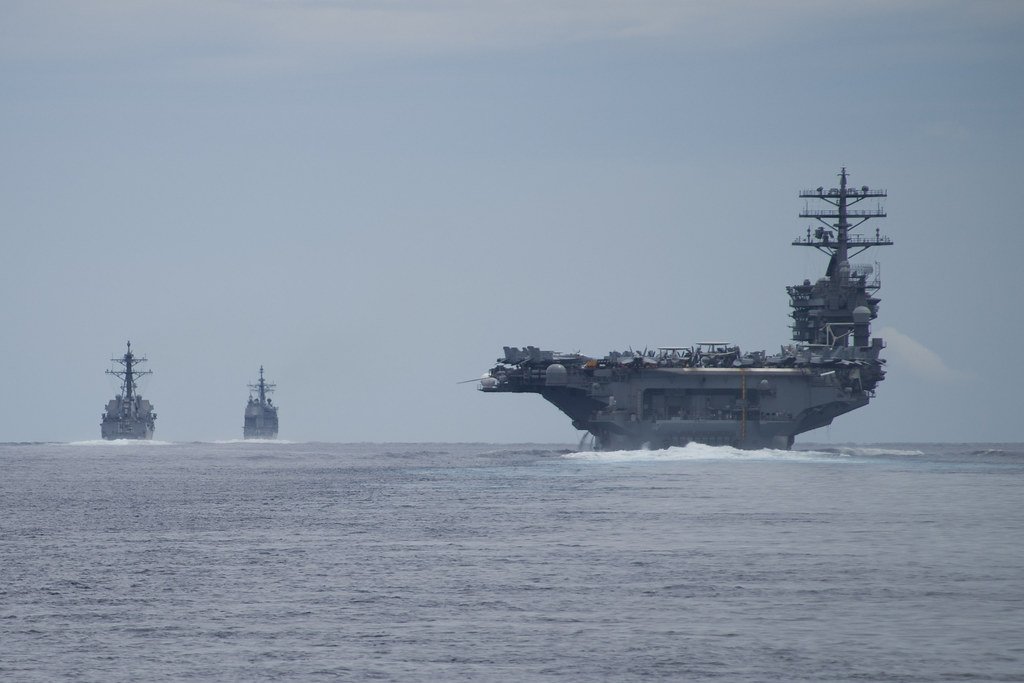
Ships assigned to the Nimitz Carrier Strike Group transit the Surigao Strait earlier this month. (U.S. Navy/MC3 Maria I. Alvarez) >>

BAY OF BENGAL - Sailors and Marines assigned to the Nimitz Carrier Strike Group, the Indian Navy and the Japan Maritime Self-Defense Force (JMSDF) commenced the Malabar in-port portions in Chennai, India, July 9.

The maritime exercise Malabar, which was first held in 1992, occurs annually to improve interoperability between U.S., Indian, and Japanese maritime forces. The exercise enhances maritime relationships and demonstrates credible naval power in the Indo-Asia-Pacific region.

“The exercise continues to grow because we are bringing in more ships and we are bringing together three countries,” said Cmdr. Vernon H. Stanfield, the Nimitz Strike Group operations officer. “We make sure that we strengthen our partnerships, and we learn from the experience so that we continue to become more proficient in the future.”

14 June 2017

News Story: Mattis - Trump military buildup begins in 2019

US SecDef Jim Mattis
By: Joe Gould

WASHINGTON — As lawmakers grilled Defense Secretary Jim Mattis on the gap between President Trump’s defense buildup promises and his 2018 budget, Mattis reassured them the “real growth” begins in 2019. 

Mattis told members of the House Armed Services Committee he did not yet have funding projections for the troops, ships and jets Trump has talked about and offered assurances the budget released in May was the first step towards that goal. The military buildup will happen in 2019 to 2023.

“We didn’t get into this situation in one year, and we aren’t going to get out of it in one year,” Mattis said in response to questions about a 355-ship Navy. “We’re going to have to have sustained growth in ’19 to ’23, and this is where you’ll see the biggest growth: Army, Air Force and Navy as we’re digging us out of a readiness and maintenance hole.”

The outing, with Joint Chiefs Chairman Gen. Joseph Dunford and DoD Comptroller David Norquist, was the first in a marathon week of congressional testimony on the president's budget released in May. Lawmakers critical of Trump’s $639 billion budget proposal as insufficient used the hearing to set up the fight to increase military spending as the House crafts its version of the budget in the coming weeks. 

At the hearing, Dunford and Mattis, said that to stay competitive, the military needs  3 percent to 5 percent growth above inflation — a tall order for Congress at roughly $19 billion per year. To achieve the military buildup “is going to take sustained growth over time,” Dunford said.

Read the full story at DefenseNews

News Story: US ‘Will Lose Ability To Project Power’ In 5 Years If Hill Doesn’t Act - CJCS

By COLIN CLARK

WASHINGTON: The United States, guarantor of the current world order, will lose the ability to maintain that role in five years unless something fundamental changes on Capitol Hill, Gen. Joe Dunford, chairman of the Joint Chiefs of Staff, told Congress at an extraordinary Monday evening hearing.

Dunford made it personal, saying “…without sustained, sufficient, and predictable funding I assess that within 5 years we will lose our ability to project power; the basis of how we defend the homeland, advance U.S. interests, and meet our alliance commitments.”

Why? It’s simple, really. “The Budget Control Act (BCA) has forced the Department of Defense (DoD) to operate with about $450 billion less than planned and required. These reductions have been aggravated by repeated Continuing Resolutions (CR) which hamper long-term investment and often result in increased costs,” Dunford testified before the House Armed Services Committee at the first of the annual budget posture hearings for the 2018 request. “For nine of the last ten years, the Department of Defense has operated under some type of CR, delaying critical new starts, deferring installation and infrastructure modernization, and canceling major training events. A year-long FY18 CR would cut $33 billion from the Department’s request, further exacerbating these problems.”

If you want to be nasty and boil that down, he’s telling Congress that it’s their fault the United States will no longer be the world’s global power because they can’t do their jobs and pass annual appropriations bills or break the agonizingly long impasse over the too honestly-named Budget Control Act, fondly known in shorthand as sequestration. There’s time to fix things, but not much.

Read the full story at Breaking Defense

27 April 2017

News Report: China Launches Second Aircraft Carrier

William Ide

BEIJING — China has launched its first domestically built aircraft carrier, marking an important military milestone. The vessel will become the second carrier in the country’s expanding naval fleet.

Analysts say the launch highlights the strides China has made in advancing its carrier program, as well as its ambitions to project power further into the Pacific and Indian Ocean.

Fan Changlong, vice chairman of China’s Central Military Commission, presided over a ceremony for the launch of the Shandong on Wednesday in the northeastern port of Dalian. A champagne bottle was cracked over the bow during the event and state television showed tugboats, pushing the vessel away from its berth.

26 April 2017

News Report: Indonesia Steps Against 'Any Power Projection' in South China Sea

China's moving lines in he South China Sea
The Indonesian maritime minister said Tuesday Jakarta opposes "any power projection" in the South China Sea, saying Indonesia doesn't recognize China's so-called "Nine-Dash Line," a demarcation line Beijing uses for their territorial claims in the region.

WASHINGTON (Sputnik) – Indonesia opposes power projection by any major nation in the South China Sea but also wants to maintain good relations with Beijing, Maritime Affairs Minister Luhut Binsar Pandjaitan said in remarks at the Center for Strategic and International Studies (CSIS).

“We don’t want to see any power projection over there,” Pandjaitan, a retired senior general and former chief of staff to President Joko Widodo said on Tuesday. “We like to see stability in that area.”

Pandjaitan noted that more than $5 trillion worth of world trade passed through the South China Sea every year and that Jakarta refused to recognize China’s claim to sovereignty over 90 percent of the area of the sea.

“We don't recognize [Beijing’s] nine dotted line,” he told the forum.

The Nine-Dash Line — at various times also referred to as the “10-dash line” and the “11-dash line” — refers to the demarcation line used initially by the government of the People’s Republic of China for their claims of the major part of the South China Sea.

Pandjaitan said Indonesia continued to negotiate with Beijing to solve problems of illegal fishing, but sought to maintain a friendly tone with China throughout the negotiations.

This story first appeared on Sputnik & is reposted here with permission.

11 February 2017

News Report: Manila Predicts Beijing Will Build Base On Scarborough Shoal

By: Sam LaGrone

This week the Philippine defense secretary predicted China would start building an artificial island on the bones of Scarborough Shoal.

If unopposed, China would likely attempt to build an installation like the several bases Beijing has constructed in the Spratly Island chain to the south of Scarborough, Delfin Lorenzana said in a Tuesday interview with AFP.

“If we allow them, they will build,” he told the wire.
“That’s very, very disturbing. Very much (more) disturbing than Fiery Cross because this is so close to us.”

Unlike the other installations in the Spratlys, Scarborough is less than 200 miles from the main Philippine island of Luzon and within striking distance of several facilities that hosts rotational American forces. The Chinese have been in de facto control of the feature since 2012 and have intermittently patrolled the shoal with Chinese Coast Guard cutters and boats.

10 February 2017

News Story: China upgrades military infrastructure on South China Sea islands, report claims

By: Mike Yeo

MELBOURNE, Australia — China is continuing to expand its construction activities in a second group of disputed South China Sea islands, according to a Washington-based think tank on Wednesday.

The report, released Wednesday by the Center for Strategic and International Studies’ Asia Maritime Transparency Initiative, says Beijing has undertaken substantial upgrades to its military infrastructure in the Paracel Islands, with the construction of harbors, helipads and a full-fledged helicopter base on several islands in the chain. 

Also claimed by Vietnam, the Paracels already play a key role in China’s goal of establishing surveillance and power projection capabilities throughout the South China Sea. Their location, less than 200 miles from the southern Chinese island of Hainan, means that bases and facilities on the Paracels can serve to bridge the distance between Hainan and outposts farther south.

China occupies 20 outposts in the Paracels, of which it gained total control after a series of skirmishes with the former South Vietnam in 1974. The islands lie farther north of the more well-known Spratly Islands, and are referred to as the Xisha Islands by the Chinese.  

Read the full story at DefenseNews

17 January 2017

News Report: Military Reforms Indicate China's Readiness for Geopolitical Standoff With US

Beijing is preparing for a shake-up in the command ranks of the People’s Liberation Army (PLA). In recent years, Beijing has been implementing a large-scale military reform aimed at adjusting China’s military capabilities to the emerging geopolitical challenges.

The Chinese military is undergoing a massive reshuffle in the command ranks. Nearly 50 high-profile officers, including 18 generals, will soon step down, the South China Morning Post reported, citing military sources.

In particular, among the 18 generals to be relieved of their command is Admiral Sun Jianguo, deputy chief of the PLA Joint Staff Department. 

"The coming changes are aimed at promoting a new generation of officers, with veterans giving way to younger talent to take over the leadership," according to the sources. Chinese President Xi Jinping wants to optimize the effective forces of the Chinese military and increase its firepower by introducing new technologies in the defense sector. The Chinese leader expects a breakthrough in China’s defense capabilities in the 13th five-year period (2016-2020).

27 October 2016

News Story: Joint Strike Fighter an instrument of Power Projection, not just another fighter

by Scott N. Romaniuk and Tobias J. Burgers

America's F-35 has earned the unfair sobriquet as the nation's "worst fighter jet ever." However, this singular vision of Lockheed Martin's Joint Strike "Fighter" (JSF) as a fighter jet has failed to give credit to its capabilities when coupled with other forms of advanced technology finding their way into every nook and cranny of military arsenals and operational platforms.

It is precisely this jointness, which sets it apart from 4th generation fighters (still evolving, still relevant today), and which gave the jets its appropriate name of joint strike fighter. In this, the F-35 has advanced beyond the "F" designation and should be judged as a multirole platform - one in a larger framework of multitude of advanced platforms.

F-35 technology combined with the capabilities of highly trained pilots, and the many platforms it works with, opens the way for an advantageous awareness of what's out there and well beyond the immediate periphery of the aircraft. In this, the JSF moves beyond the long-hold dominance and concept that "first sight wins the fight."

Instead it seeks through the use/relationship of other systems to gain this first sight - and can mobilize a range of distant systems to win the fight. The drone component of this relationship, for example, help fighter pilots with reconnaissance, sensing tracking, and targeting, enabling this much desired first sight. They build on the existing technology to create a unique situational awareness (SA) or a combination of technological functions to build contingent knowledge and responsiveness.

Read the full story at SpaceDaily

07 September 2016

USA: U.S. Pacific Command forces to come together for exercise Valiant Shield

From U.S. Pacific Fleet Public Affairs

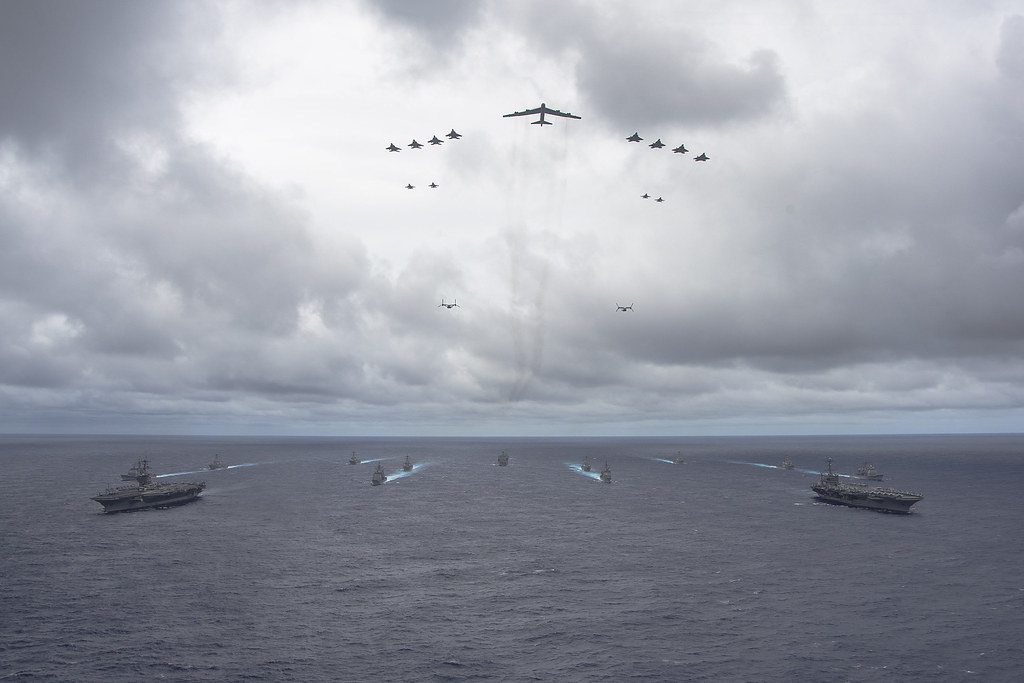
In this file photo, ships and aircraft operate in formation over the Pacific Ocean during exercise Valiant Shield 2014. (U.S. Navy/MC1 Trevor Welsh) >>

PEARL HARBOR - Forces from the U.S. Pacific Command are scheduled to participate in exercise Valiant Shield (VS) 2016, Sept. 12-23 on Guam and around the Marianas Island Range Complex.

Participants include USS Ronald Reagan (CVN 76), nine surface ships, the Bonhomme Richard Amphibious Ready Group - to include three amphibious vessels - an estimated 18,000 personnel and more than 180 aircraft from the U.S. Navy, Air Force and Marine Corps.

Valiant Shield is a U.S.-only, biennial field training exercise (FTX) with a focus on integration of joint training in a blue-water environment among U.S. forces. This training enables real-world proficiency in sustaining joint forces through detecting, locating, tracking and engaging units at sea, in the air, on land, and in cyberspace in response to a range of mission areas.

14 May 2016

USA: DoD Report - China’s Military Investments Continue

By Terri Moon Cronk
DoD News, Defense Media Activity

WASHINGTON, May 13, 2016 — China’s investments in military and weaponry operations continue on a path to increase its power projection, anti-access and area denial and operations in cyberspace, space and electromagnetic emerging domains, the deputy assistant secretary of defense for East Asia told Pentagon reporters today.

Abraham M. Denmark described the Defense Department’s annual report on military and security developments involving China, released to Congress today.

Highlighting China’s defense strategy and military developments, Denmark said the report provides factual, descriptive and analytical information to Capitol Hill. “It lets the facts speak for themselves,” he said.

“China continues to focus on preparing for potential conflict in the Taiwan Strait,” Denmark added, “but additional missions such as contingencies in the East and South China seas and on the Korea Peninsula are increasingly important to the [People’s Liberation Army].”

22 March 2016

Think Tank: Seeing the dragon on our doorstep (part 1)

Click Image to enlarge
Malcolm Davis

A key challenge in the coming years for Australia will be the PLA’s growing ability to project military power beyond what Chinese military thinkers deem to be the first and second island chains (see map right).

‘Near Seas’ vs. ‘Far Seas’

When considering the canvas upon which future geopolitical competition in Asia is to be played out, it seems doubtful that China will be content to seek control of the South China Sea alone. Beijing has every incentive to steadily increase its naval power projection capabilities to protect vital strategic interests—notably trade and energy—along the Maritime Silk Road that traverses the Indian Ocean. The MSR, along with the Silk Road Economic Belt that runs overland through Eurasia, are the foundations for ‘The China Dream’ of national rejuvenation. Without access to energy resources, China’s economy will slow, the country will become more vulnerable to internal social and political disorder and the CCP’s grip on power will weaken.

Current projections suggest that by 2020, imported oil will make up 66% of China’s total oil demand, and by 2040, it will make up 72%. Up to 80% of China’s energy and trade will move along the MSR and through the Malacca Strait from Africa and the Persian Gulf. The nearby Lombok­–Makassar straits are also strategically significant as most super tankers too large for Malacca traverse this deep water route. It also allows PLA Navy submarines to access the Indian Ocean submerged, and the entrance to the Lombok Strait is also very close to Darwin. The MSR starts and ends in the South China Sea, meaning that the the China Dream is unattainable if Beijing’s claim of ‘indisputable sovereignty’ over the South China Sea remains unfulfilled.

19 October 2015

Editorial: China - Projecting Power Through Peacekeeping

By Ryan Pickrell

World peace is an admirable goal, but states are rarely interested in pursuing it over their own interests.

President Xi Jinping’s recent visit to the United States came with a lot of the usual and the expected, but it also delivered a few surprises. One was Xi’s announcement at the United Nations (UN) headquarters in New York that China is preparing to set up a permanent peacekeeping force of 8,000 soldiers, donate $100 million over the next five years to the African Union for the creation of an emergency response force, and contribute $1 billion over the next ten years for the establishment of a China-UN “peace and development fund.” This kind of contribution to global peacekeeping operations suggests that China may be ready to answer America’s call and become a “responsible stakeholder.” While contributions of this nature are sure to produce positive effects in many struggling states, Chinese actions signal a distinct shift in Chinese foreign policy, a shift that is being driven by motives other than a desire to promote peace.

Peacekeeping, emergency response, and disaster relief activities are excellent opportunities for power projection. While humanitarian assistance benefits struggling states, assisting states often offer assistance only when their assets and interests are on the line. As a general rule, in an anarchic international system, what are perceived as altruistic humanitarian endeavors are often self-serving actions. In most cases, China likes to pull plays out of the American playbook, but this time, it appears to be tossing in a few plays from Japan as well. Since the 1990s, Japan has been actively engaging in international disaster relief cooperation in an effort to create a more positive image of itself in the international community, protect economic assets abroad, and steadily create a place for Japanese military operations abroad. This process set the stage for the amending of the Japanese constitution and the re-militarization of Japan. For Japan, disaster relief has been an excellent outlet for increased power projection. While China and Japan have different long-term aspirations, there is reason to believe that China is interested in using peacekeeping for similar purposes.

Read the full story at The Diplomat